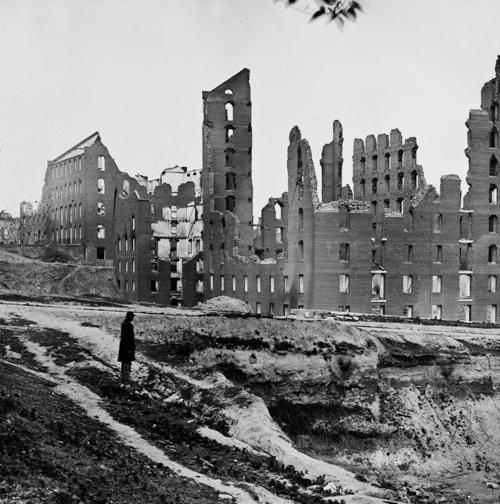
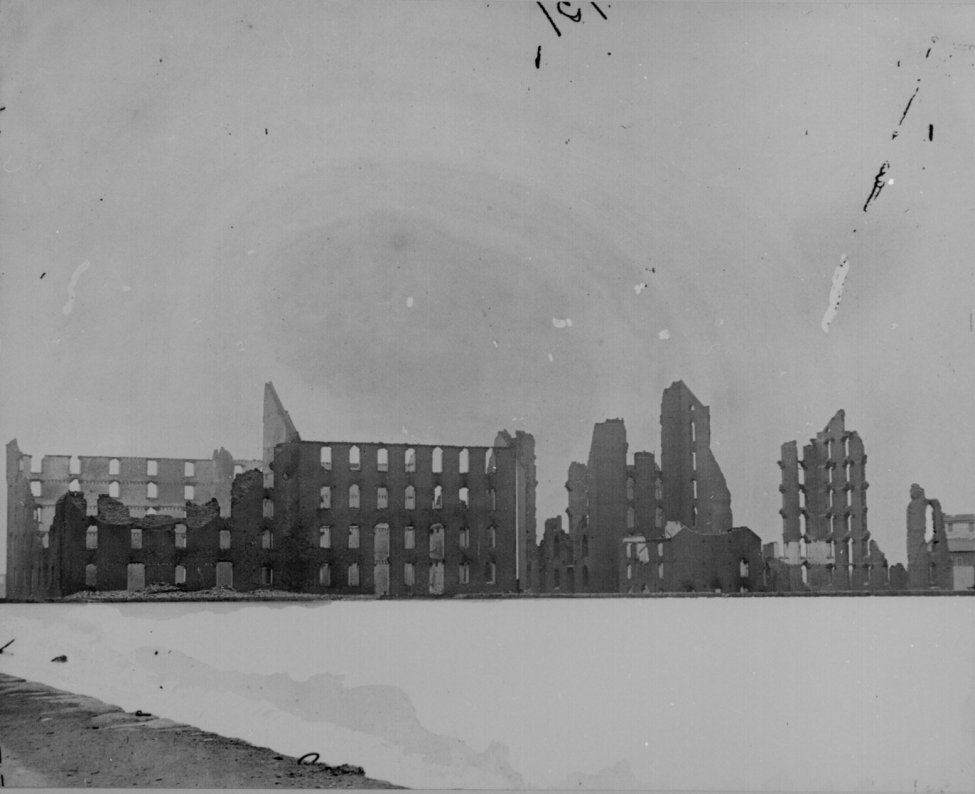
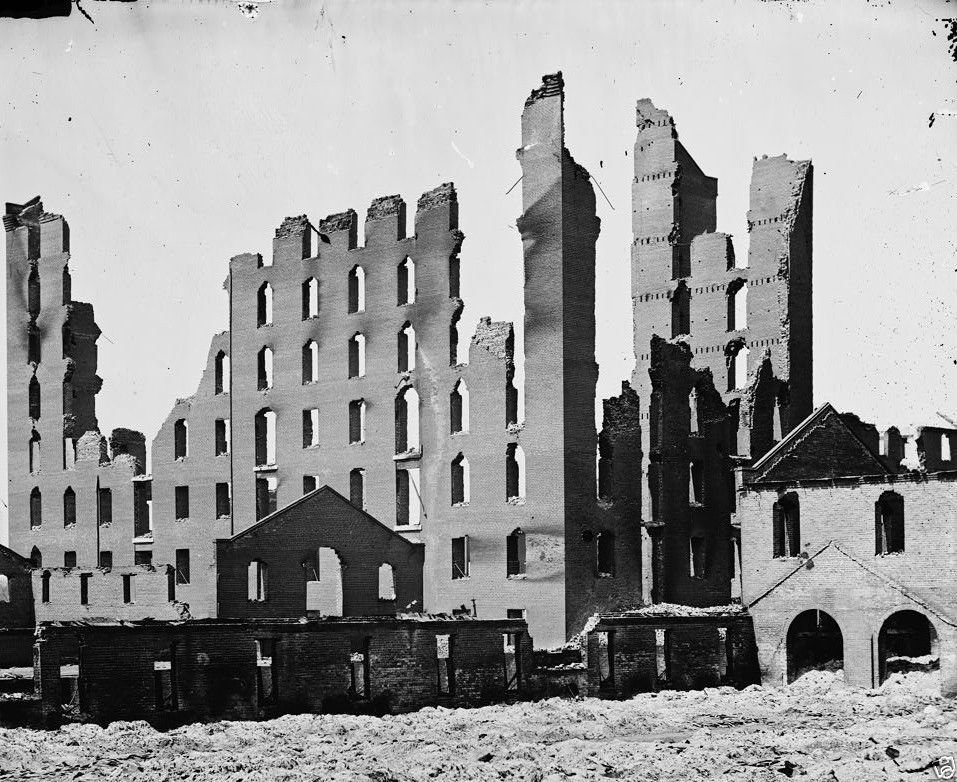
SH Archive Single Photo: 1865 - Nine Story Building in Charleston

SH.org OP Username
KorbenDallas
SH.org OP Date
2019-05-23 00:47:46
SH.org Reaction Score
14
SH.org Reply Count
12

KD Archive

Not actually KorbenDallas
Active Member
Joined
Sep 22, 2020
Messages
4,691
Reaction score
1,500
Below is an image claimed to be pertaining to 1865. This would suggest that the 9=story structure had to be built some time prior to 1865. My question is fairly simple:
  • Does this look like any warehouse you know? To me it looks like an office, or apartment building.
  • What is your opinion about having building this tall that far back?
  • Do you think it had elevators?
  • How much water pressure was needed to get water supplied to the very top?
  • What about the sewer system? Do you think there had to be one in a building like this? I can not imagine handling those natural needs any other way.
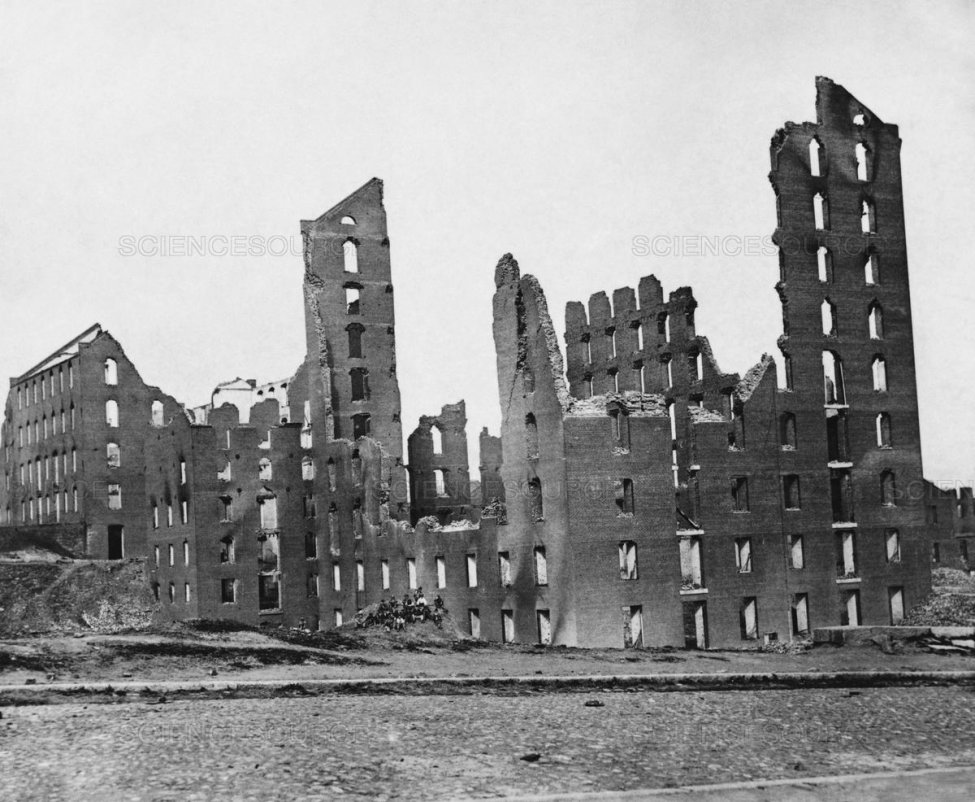
The ruins of a warehouse in Charleston, South Carolina, as it appeared in February, 1865, when General Beauregard withdrew his troops from the city.

Note: This OP was recovered from the Wayback Archive.
Note: Archived Sh.org replies to this OP are included in this thread.
 
Note: This post was recovered from the Sh.org archive.
Username: RecycledSoul
Date: 2019-05-23 02:39:42
Reaction Score: 1
I found a reasonable explanation on the water pressure here, provided there was electricity to pump the water up to the upper floors. It’s a pretty good explanation of head loss in regard to pressure.

https://www.hunker.com/12318081/how-to-calculate-head-loss

I can’t think of any reason to have a multi-story warehouse without elevators, unless the product was trash bags full of weed, that might be light enough to carry up the stairs.

The windows look too gothic for anything commercial from what I can tell. Looks more like the residence of a robber baron to me.
 
Note: This post was recovered from the Sh.org archive.
Username: BrokenAgate
Date: 2019-05-23 04:54:49
Reaction Score: 1
Why isn't there more rubble all around the building? It looks like a bomb went off inside, yet the surrounding area is pretty clean. I can't believe that little cluster of men on that dirt mound cleared it all away by themselves.
 
Note: This post was recovered from the Sh.org archive.
Username: jd755
Date: 2019-05-23 06:43:36
Reaction Score: 1
Looks to me like it was a cotton mill.
 
Note: This post was recovered from the Sh.org archive.
Username: hajni
Date: 2019-05-24 20:53:53
Reaction Score: 1
Don't you think that those men are far too small compared to the buildings?
 
Note: This post was recovered from the Sh.org archive.
Username: KorbenDallas
Date: 2019-05-25 05:25:58
Reaction Score: 1
Funny that the image attributed to Charleston, South Carolina above is being attributed to Richmond, Va on a different website.
  • In this photo provided by the Library of Congress, ruined buildings in the burnt district of Richmond, Va., are visible during the Civil War, April 1865.
Richmond, Va.jpg
This one here is called:
Haxall's Mills.jpg
The below one had at least 8 stories, but who knows for sure now?
civ_1.jpg

Would not be surprised if it's one and the same.
 
Note: This post was recovered from the Sh.org archive.
Username: Jim Duyer
Date: 2019-05-25 21:05:46
Reaction Score: 1
Sure, a warehouse without any large doors on the bottom floors - just toss crap in through the windows, please. And no roads leading up to any part of it. Looks like a hospital of some kind. But to be honest, when I first saw this image I thought it was a WWII German building damaged.
 
Note: This post was recovered from the Sh.org archive.
Username: anotherlayer
Date: 2019-05-26 01:13:42
Reaction Score: 11
I feel like I post this every 3 months but... can someone again please tell me how we got a bunch of white people who spoke english and served a christian god to kill fellow white people who also spoke english and who also served the same christian god? It's the pictures of bombed out churches that really stump me the most.

Why were Civil War soldiers bombing churches? How shameful and pitiful. We should all be disgusted by the Civil War but instead, we glorify the nobility of it all. I know, surely a group of rogue soldiers would huddle up at the church for safety but... would soldiers do that? Because, that is not what 'Little House on the Prairie' taught me. The church was a place to send the women and children during times of war. And well, blizzards, they had a lot of blizzards on the prairie.

America was the new frontier, there was space for every body and beyond every green mountain there was fertile and prosperous land as far as the eye can see. And we just decided to shoot at people who lived across the street? We would set out to cannonball a church to prevent a safe haven for those who could not take up the fight?

Anyway, what got me ranting was the OP photo. That picture is identical to any modern photo of "ancient rome ruins" or "ancient greek ruins". Look at the mound of goofballs just sitting there like they just found the craziest abandoned warehouse complex. That's not a picture of a wartime bombed out building. That is a picture of a building who the owners left 100 years prior and mother nature slowly let the roof cave in. Once the roof falls in (takes what... 50 years or neglect), the rest will slowly follow. This is the same damage and what I believe is also the time frame of the Angkor Wat region. The trees that are now employed to keep the stones together in Angkor are no more than 100-200 years old... tops. It's modern decay. And Rome ain't much older.

451.jpg
Cathedral of St. John and St. Finbar (View2) - Charleston, SC, 1865
 
Note: This post was recovered from the Sh.org archive.
Username: SeVen
Date: 2019-06-08 16:36:20
Reaction Score: 3
Greetings. I love the SH website and decided to quit lurking and officially register. Thanks for the add!

The building is from the Gallego flour mills and was located in Richmond, VA.

Here is a snippet which quotes an 1865 Richmond newspaper article regarding the size of the building -
"Richmond can boast of having within its limits the largest flouring mill in the world. The erection of the mill was regularly commenced some time in 1854. The superstructure rests upon a solid foundation of granite, the base of which is seventeen and a half feet thick. The width tapers to a thickness of six feet at the top of the granite. The average thickness of the brick walls, forming the first four stories above Canal Street, is three feet two inches. The great mill is twelve stories in height, fronts ninety-six feet on Canal Street, and is one hundred and sixty-five feet deep. The height of the front wall is one hundred and twenty-one feet to the top course of bricks. Including the observatory the total height is one hundred and thirty-five feet. The rear wall, embracing a partof the granite foundation, is one hundred and fort-seven feet high. Each floor contains 155,000 square feet. ----We have no positive information on the cost of this immense structure, but presume that the sum will not fall short of $130,000.”

Pages 6 & 7 from this pdf - Link
 
Note: This post was recovered from the Sh.org archive.
Username: KorbenDallas
Date: 2019-06-08 17:11:18
Reaction Score: 0
Welcome to our little forum.

Granite can wait. For right now, I would like to know the meaning of this:
  • ...regularly commenced some time in 1854
 
Note: This post was recovered from the Sh.org archive.
Username: jd755
Date: 2019-06-08 17:49:52
Reaction Score: 1
That pdf is an odd cove containing contradictions, such as poor quality building skills, insufficient numbers of craftsmen yet exponential increase in the numbers of mills and the amount they were producing during the same time periods quoted.

One Quaker was running a globalist type operation in the 1700's;
"The proprietor of one of the Brandywine mills examined by Rouchefoucauld was a Quaker by the name of Tatnall.Tatnall purchased the needed grain in Virginia, Maryland, and New York and brought it to his mill in his own ships. After being converted to flour, it was carried back to Philadelphia,in the same ships,where it was sold for exportation. This single mill produced about 20,000 barrels of flour yearly. "

And this bit jumped out at me;

"In the 1850’s, San Francisco reported receiving some 743,000 barrels of flour, virtually all ground in the Gallego or Haxall mills."

Those two mills were in Richmond.
Yet this bit appears to contradict it, though 1850's could cover a decade I suppose.
"By the time of the Civil War,the joint annual production of the Richmond mills was over 400,000 barrels."

So the 'new' big mill recommenced construction (I'm with KD what does it mean) in 1854, San Francisco was just 5 years old and the 'old gallego' mill must have knocked out as much as the new one if the 400,000 barrels is accurate as the massive new mill only began production a year after the construction recommenced so why spend so much time/effort/presumably money moving the thing for no increase in production?
Doesn't make sense or my brain is addled, probably the latter.
 
Note: This post was recovered from the Sh.org archive.
Username: Onijunbei
Date: 2019-06-08 19:04:11
Reaction Score: 1
I just delivered to a very old 9 story brick building in Cleveland so no biggie about the height. The building could have been erected prior to 1854 with irregular use.. So only used seasonally, presumably right after the harvest. It wouldn't require water. The picture could have been taken from the back side so we wouldn't see doors. Inside could have been filled with chutes and ladders, and mechanical lifts. The 49ers probably needed flour and that area is not known for wheat cropping. In 1854 it milled flour regularly to assist growing demand.
 
Note: This post was recovered from the Sh.org archive.
Username: DanfromMN
Date: 2020-06-08 12:58:31
Reaction Score: 1
Before the damned civil war. More evidence that the civil war was essentially to destroy stuff like this.
No. Probably not.
 
Note: This post was recovered from the Sh.org archive.
Username: Starmonkey
Date: 2020-06-08 13:06:37
Reaction Score: 2
And mud flooded to boot. They weren't attacking any PEOPLE there.
Now, was it made from Portland cement? Or Rosendale?
 
Tips
Tips
Please respect our Posting Rules.
Back
Top