- Joined
- Mar 19, 2021
- Messages
- 131
- Reaction score
- 310
Templar Downfall: Chronology and Symbolic Alignments
Abstract
This paper reinterprets the downfall of the Knights Templar (1307–1314) through symbolic chronology, revealing alignments between key events and sacred festivals such as Nowruz, Eid al-Adha, and the equinoxes. By comparing Julian, Gregorian, Hijri Qamari, and Hijri Shamsi calendars, it uncovers patterns suggesting deliberate or retroactive timing. The study draws parallels with Abraham’s trial by fire and evaluates three hypotheses: coincidence, calendrical manipulation by Philip IV, or later historiographical revision. It proposes that the Templars’ suppression was not only political but also ritually staged or re-written across cultural time cycles.
Keywords
Knights Templar; Jacques de Molay; symbolic chronology; calendar conversions; spring equinox; Nowruz; Eid al-Adha; medieval history; alternative chronology
Introduction
The downfall of the Knights Templar has long captivated historians, theologians, and revisionists. From the mass arrests in October 1307 to the execution of Grand Master Jacques de Molay in March 1314, the timeline of the Templars’ destruction has traditionally been viewed through legal, political, and ecclesiastical lenses. However, this study presents—for the first time—a focused analysis of the symbolic timing of these events, revealing their alignment with sacred festivals, astronomical transitions, and calendrical cycles across Islamic, Persian, and Christian traditions.
Rather than dismissing these alignments as mere coincidence, this research explores the possibility that key dates were either deliberately chosen or retroactively edited to reflect deeper symbolic meaning.
This study begins with a concise summary of the historical background of the Order of the Temple and the circumstances that led to its downfall. Attention then turns to three pivotal dates: the execution of the Grand Master, the mass execution of the knights, and the planning and implementation of the arrests. The discussion proceeds with an exploration of several festivals and significant events that intersect with these moments, emphasizing their symbolic and calendrical significance. Finally, I will analyze the subject in detail, considering the symbolic alignments, and I will evaluate the various hypotheses.
For calendar conversions, this study relies on calendarhome.com a scientifically grounded and widely respected resource for cross-referencing Julian, Gregorian, Hijri Qamari, and Hijri Shamsi systems. Its precision and transparency make it suitable for historical analysis. Dates were also cross-checked against astronomical data to confirm seasonal alignment.
This paper employs a proximity-based threshold to determine significant symbolic alignment. For lunar Islamic (Hijri Qamari) dates, an event occurring within one or two days of a major festival is considered significant, acknowledging the variability in moon sightings that defined the medieval calendar. For solar dates and equinoxes, a one-day window is applied. This method allows for the practical realities of historical timing while highlighting the most meaningful calendrical correlations.
Brief Overview of the Knights Templar
The Knights Templar, officially known as the Poor Knights of Christ and of the Temple of Solomon, were founded around 1119 to protect Christian pilgrims in the Holy Land. Over time, they evolved into a formidable military and financial institution, gaining vast landholdings and influence across Europe. Their members lived under strict monastic rules, swearing vows of poverty, chastity, and obedience, and were recognized for their discipline and combat prowess
Despite their prominence, the Templars faced growing resentment and suspicion. On October 13, 1307, King Philip IV of France ordered their arrest, accusing them of heresy and other fabricated crimes—likely driven by his desire to seize their wealth. Under torture, many confessed falsely. Although Pope Clement V initially resisted, he dissolved the order in 1312 under pressure. The last Grand Master, Jacques de Molay, was executed in 1314, marking the end of the Templars and the beginning of their mythologized legacy (Encyclopedia Britannica, 2025)
Calendar Conversions of key dates
To begin, I will focus on the execution of Grand Master Jacques de Molay, as it represents the most widely recognized event in the downfall of the Knights Templar. Once this pivotal moment is examined in detail—across multiple calendar systems and ritual frameworks—I will then trace backward through earlier dates, uncovering additional patterns and alignments that shaped the broader chronology of the Order’s suppression.
Burning of Jacques de Molay
The exact date of the burning of Jacques de Molay, the 23rd and last Grand Master of the Knights Templar, is a point of contention among historical accounts, with March 11 and March 18, 1314, being the most frequently cited dates. Another source also mentions March 15, 1314.
(Demurger, 2019, p. 232)
(Dumas, 1841, pp. 313–315)
This is the interpretation of Alexandre Dumas’s calculation;
“The core of the argument is that the Templar's own internal calendar, a lunar system based on the Hebrew month of Adar, can be used to verify the event's date on the Julian calendar. The author uses a recorded Templar date, "29th Cédar, year of the order 196," and converts it. The "year of the order 196" is converted to 1314 AD by adding it to the founding year of the Templars, 1118 AD. The "29th Cédar (Adar)" is the final day of the lunar month. To verify this lunar date, the author uses medieval astronomical calculations, specifically the Golden Number (4) and Epact (3), which precisely anchor the lunar calendar to the solar calendar. The author concludes that the Templar date, "29th Adar," mathematically corresponds to March 15, 1314, a date that aligns with the widely accepted historical record of de Molay’s execution.”
Execution of Jacques de Molay — Calendar Conversions
|
The execution of Jacques de Molay occurred around the time of the spring equinox and Nowruz, with proposed dates ranging from 28 Esfand 692 to 6 Farvardin 693 in the Persian Hijri Shamsi calendar. If the date is considered to be March 13th (Julian), it would also align exactly with Chaharshanbe Suri. The dates for the Burning of Judas and Eid al-Adha (festival of sacrifice) occur several days later.
Burning of 54 Templars
In May 1310, fifty-four Knights Templar were executed by burning near the Abbey of St. Anthony, outside the walls of Paris. These men had been condemned based on confessions extracted under three years of imprisonment and torture. Notably, each one retracted his confession before death, citing the unbearable conditions they had endured.
While the commonly accepted date for this mass execution is May 12, 1310 (Julian), Alexandre Dumas, referencing the event in his historical account, records it as May 10. This timing is symbolically significant: May 10 and May 12 correspond to Dhu al-Hijjah 9 and 12 in the Islamic Hijri Qamari calendar, placing the execution either on the eve or just after Eid al-Adha, the Festival of Sacrifice.
Execution of 54 Templars — Calendar Conversions
| Calendar System | Date |
| Julian | May 12, 1310 |
| Gregorian | May 20, 1310 |
| Hijri Qamari (Islamic Lunar) | Dhu al-Hijjah 11, 710 |
| Hijri Shamsi (Persian Solar) | Ordibehesht 30, 689 |
Figure 2 : Detail of a miniature of Templars being burned at the stake.
The Fall of the Templars, the Plan
In September and October of 1307, King Philip IV of France orchestrated a secret and sweeping crackdown on the Order of the Temple, beginning with confidential royal orders on September 14 that accused the Templars of heresy, blasphemy, and immoral conduct. On October 13, hundreds of Templars were seized across France, including Grand Master Jacques de Molay, triggering a coordinated propaganda campaign and brutal interrogations. Under torture, many confessed to the charges, and Molay himself admitted to denying Christ and spitting near a crucifix on October 24–25, later urging others to confess. The pope, furious at the king’s unilateral action, responded on October 27 by condemning the arrests and dispatching cardinals to take control of the investigation, while Philip IV pushed other monarchs, including James II of Aragon, to follow suit.
On November 22, 1307, Pope Clement V issued the papal bull Pastoralis praeeminentiae, commanding all Christian monarchs to arrest the Knights Templar and confiscate their properties, citing widespread rumors, King Philip IV’s aggressive actions in France, and the Grand Master’s public confession as grounds for investigation. This marked a turning point in the Order’s downfall. Later, on March 22, 1312, the pope formally suppressed the Order of the Temple through the bull Vox in excelso, which was publicly proclaimed during the Council of Vienne on April 3, 1312. In the presence of King Philip IV, the pope silenced the assembly under threat of excommunication and declared that the suppression was not a judicial condemnation but an apostolic ordinance, justified by the irreparable damage to the Order’s reputation and the potential threat it posed to the faith. [Barber, 2006]
(Barber, 2006, pp. 291–292)
The plan — Calendar Conversions
| Event | Julian Date | Gregorian Date | Hijri Shamsi (Persian) Date | Hijri Qamari (Islamic) Date |
| Secret orders for arrest | 14 Sep 1307 | 22 Sep 1307 | 30 Shahrivar 686 SH | 15 Rabi` Avval 707 AH |
| Arrest of the Templars in France | 13 Oct 1307 | 21 Oct 1307 | 28 Mehr 686 SH | 14 Rabi` Thani 707 AH |
| Nogaret describes accusations | 14 Oct 1307 | 22 Oct 1307 | 29 Mehr 686 SH | 15 Rabi` Thani 707 AH |
| First confession of Jacques de Molay | 24 Oct 1307 | 1 Nov 1307 | 9 Aban 686 SH | 25 Rabi` Thani 707 AH |
| Molay repeats confession | 25 Oct 1307 | 2 Nov 1307 | 10 Aban 686 SH | 26 Rabi` Thani 707 AH |
| Papal Bull: Pastoralis praeeminentiae | 22 Nov 1307 | 30 Nov 1307 | 9 Azar 686 SH | 25 Jamadi Avval 707 AH |
| Papal Bull: Vox in excelso (ISSUED) | 22 Mar 1312 | 30 March 1312 | 10 Farvardin 691 SH | 13 Dhu al-Qi'dah 711 AH |
| Papal Bull: Vox in excelso (PROCLAIMED) | 3 Apr 1312 | 11 Apr 1312 | 22 Farvardin 691 SH | 25 Dhu al-Qi'dah 711 AH |
The conspiracy against the Templars was initiated with secret orders issued at the Autumn Equinox of 1307, aligning with the beginning of the Persian month of Mehr. The plot continued through the remainder of Mehr, concluding around the time of the Mehregan festival. The arrest of the Templars took place at the end of Mehr.
Jacques de Moley’s confession on 9 or 10 Aban in the Persian calendar corresponds with the traditional observance of Abangan. Later, the Pope's issuance of the bull to disband the Order on 9 Azar coincides with the date of Azargan. Finally, in 1312, the Pope's suppression of the Order—through both the issuance and public proclamation of the bull—occurred in the spring, with the two key dates separated by a period of 13 days.
Cultural Calendars: From the Equinox to Eid
To properly engage with the calendrical findings presented in this study, it is essential for the reader to be familiar with the symbolic meaning of the referenced dates and festivals. The following is a brief overview of each term, accompanied by its corresponding Wikipedia link for further reading:
Persian and Zoroastrian Festivals
Nowruz
Nowruz (Persian: نوروز) is the Iranian New Year, celebrated on the first day of spring and aligned with the vernal equinox. Rooted in Zoroastrian tradition, it symbolizes renewal and is observed across Iran, Central Asia, the Balkans, and the Middle East.
Read more on Wikipedia
Chaharshanbe Suri
Chaharshanbe Suri (Persian: چهارشنبهسوری) is a fire festival held on the eve of the last Wednesday before Nowruz. Participants leap over bonfires while chanting purification verses, a ritual rooted in ancient Zoroastrian fire veneration.
Read more on Wikipedia
Sizdah Be-dar
Sizdah Be-dar (Persian: سیزدهبهدر), also known as Nature Day, marks the 13th and final day of Nowruz celebrations. Families spend the day outdoors, symbolically casting away misfortune and embracing nature.
Read more on Wikipedia
Mehregan
Mehregan is an ancient autumn festival honoring Mithra, the Zoroastrian deity of light, love, and friendship. Celebrated around the autumn equinox, it marks the harvest season and includes offerings, feasting, and—in some traditions—ritual animal sacrifice.
Read more on Wikipedia
Abangan
Abangan (Persian: آبانگان) is a water-centered Iranian festival held in honor of Anahita, the goddess of flowing waters. Traditionally celebrated on the 10th of Aban in the Yazdgerdi calendar (equivalent to the 4th of Aban in the modern calendar), it involves prayers and rituals dedicated to purity and the life-giving force of water.
Read more on Wikipedia
Azargan
Azargan (Persian: آذرگان) is celebrated on the 9th day of the month of Azar, when the name of the day and month coincide. According to al-Biruni’s Chronology of Ancient Nations, this day is dedicated to fire and its divine guardian. Rituals include lighting sacred flames, visiting fire temples, and engaging in communal reflection. Zoroaster is said to have commanded pilgrimage to fire altars and consultation on worldly matters during this festival.
Read more on Wikipedia
Astronomical Event
Equinox
An equinox is an astronomical event that occurs twice a year—around March 20 and September 23—when the Sun crosses the celestial equator, resulting in nearly equal lengths of day and night. The March equinox marks the beginning of spring in the Northern Hemisphere and plays a central role in calendars and seasonal festivals such as Nowruz.
Read more on Wikipedia
Islamic and Christian Rituals
Eid al-Adha (Eid Ghorban)
The "Festival of Sacrifice," commemorates Prophet Abraham’s willingness to sacrifice his son. Observed on the 10th of Dhu al-Hijjah, it includes ritual animal sacrifice, communal prayers, and charitable meat distribution. It coincides with the Hajj pilgrimage.
Read more on Wikipedia
Eid al-Ghadir
Eid al-Ghadir is a major Shi’a and Alawite holiday marking Prophet Muhammad’s declaration of Ali ibn Abi Talib as his successor at Ghadir Khumm. Celebrated on the 18th of Dhu al-Hijjah, it features prayers, feasts, and gift-giving.
Read more on Wikipedia
Burning of Judas
The Burning of Judas is a Christian folk ritual performed during Easter in various cultures. Effigies of Judas Iscariot are burned, hanged, or exploded to symbolize the rejection of betrayal and evil. It is practiced in regions such as Latin America, Europe, and the Philippines.
Read more on Wikipedia
Figure 3 : Muhammad and the Muslims celebrate Eid al-Adha (Eid Ghorban)
Figure 4 : Burning of Judas in Mexico.
Discussion
The potential alignment of Jacques de Molay’s execution with the spring equinox may reflect either symbolic timing or coincidence. However, a deeper layer of historical parallelism emerges when considering revised chronologies proposed by researchers such as Dr. Fomenko and N.A. Morozov.
Fomenko places the crucifixion of Jesus on March 20, 1185 (Nosovskiy & Fomenko), while Morozov situates what he terms the Gospel Christ’s “pillaring”—conceived not as a conventional crucifixion but as impalement or binding to a pillar—on March 21, 368 CE (Christ, vol. 4). Although separated by more than eight centuries, both reconstructions converge strikingly on the spring equinox.
In addition, the execution of Jacques de Molay carries structural echoes of the Crucifixion of Christ. Molay was burned at the stake alongside Geoffroi de Charney, while two other leaders—Hugues de Pairaud and Godefroi de Gonneville—accepted life imprisonment. This division mirrors, in a transformed way, the Gospel account of Christ crucified between two thieves: one defiant and redeemed (the “good thief”), the other compliant and forgotten (the “bad thief”). In the Templar case, Molay and de Charney retracted their forced confessions and died defiantly, proclaiming the Order’s innocence, while the others submitted and faded into obscurity
It is proposed that the execution of Jacques de Molay was symbolically evocative of the Crucifixion of Christ—both in its calendrical timing and in its ritual structure. As previously noted, the Iranian festival of Chaharshanbe Suri and the Burning of Judas ritual appear to share a common origin, both symbolically linked to the Last Supper and the death of the composite figure Jesus-Judas-Yeshu. link
De Molay was burned at the stake alongside one companion, a configuration that mirrors the biblical account of Jesus crucified between two thieves. In contrast, the mass execution of 54 Templar knights in May 1310 occurred on Dhu al-Hijjah 11, placing it exactly within the ritual window of Eid al-Adha, the Islamic Festival of Sacrifice. This sacred period is marked by the slaughter of animals in remembrance of Abraham’s willingness to sacrifice his son. The calendrical overlap between the mass execution and the Islamic sacrificial rite suggests a symbolic alignment: just as animals are ritually sacrificed in large numbers during Eid al-Adha, so too were the Templars condemned and burned en masse.
October 13, 1307,the day King Philip IV of France ordered the mass arrest of the Knights Templar, has long been remembered as an ominous date, later giving rise to the superstition surrounding “Friday the 13th.” However, In the Persian solar calendar, this day corresponds to the 28th of Mehr placing it at the very end of the month of Mehr. What is especially significant, however, is that the secret royal orders for the arrests were issued earlier, on September 14, 1307, which corresponds to 30 Shahrivar—precisely aligned with the autumnal equinox. Thus, the conspiracy against the Templars was set in motion at the equinox, a moment of cosmic balance, and unfolded through the month of Mehr, culminating in the arrests at its close. In the Persian tradition, the equinox marks the transition into autumn and is closely associated with Mehregan. This festival is fundamentally linked to the mythical victory of the hero Fereydun over the tyrannical Zahhak. This story, symbolizes the triumph of justice and light over oppression and darkness. The festival, commemorates this event as the establishment of a new, righteous order, aligning with the autumn harvest to mark an end to barrenness and the beginning of renewal, making it a profound celebration of courage and the defeat of tyranny.
This period of conspiracy coincided with the middle months of the Islamic lunar calendar—specifically the 14th of Rabiʿ al-Awwal (the third month) and the 15th of Rabiʿ al-Thani (the fourth month). In the traditional reckoning of the Hijri lunar cycle, these months are associated with the onset of the spring season, underscoring the symbolic alignment between the Templar arrests and a time of renewal and transition across both calendrical systems.
The confessions of Jacques de Molay are recorded as having taken place on dates that coincide with the festival of Abangan (10th of Aban in the Persian calendar), a Zoroastrian celebration dedicated to the goddess Anahita and the sanctity of water. The alignment of Malay’s confession with Abangan, a festival of pure water and truth, is deeply ironic. It contrasts the festival's theme of purity with the corrupted, forced nature of the confession.
Equally significant is the timing of papal decrees against the Templars. For example, the papal bull Pastoralis praeeminentiae (November 22, 1307, Julian) corresponds to 9 Azar, the day of Azargan, a Zoroastrian fire festival dedicated to the divine guardian of fire. The symbolism is unmistakable: the Church’s formal condemnation of the Order was issued on a day consecrated to fire, foreshadowing the fiery executions that would later consume the Templars.
Furthermore, other papal actions fell in alignment with the thirteen-day cycle of Nowruz, the Persian New Year festival beginning at the spring equinox. This cycle, associated with renewal, judgment, and the casting away of misfortune, provides a symbolic backdrop for the dismantling of the Templar Order.
Hypotheses
Hypothesis 1: The Alignment of Dates is Coincidental
Hypothesis 1: The Alignment of Dates is Coincidental
The first and most straightforward hypothesis proposes that the way the dates line up seems coincidental. This view suggests that the recurring alignment of Templar downfall events (such as arrests, executions, and suppression) with symbolic days like the spring equinox, Nowruz, or Islamic holidays is merely by chance.
Hypothesis 2: King Philip IV Used the Calendar as Psychological Warfare
King Philip IV's motives for destroying the Knights Templar were simple—greed and power—but his methods were not. He used the calendar as a weapon for psychological warfare, making his brutal plot seem like an act of divine will. Philip and his advisors strategically timed key events to align with symbolic dates. The arrests were linked to harvest festivals, mass executions to times of ritual sacrifice, and the Order's final dissolution to the spring rebirth. A particularly striking symbolic parallel has been the execution of Grand Master Jacques de Molay, possibly staged as a perverse mockery of the Crucifixion. The Templars weren't just defeated in battle or court; they were condemned on a grand, symbolic stage built from time itself.
Hypothesis 3: The Historical Narrative Was Retroactively Edited
This is based on alternative view expressed in the book “The Medieval Empire of the Israelites”. The book proposes that the accepted chronological history is flawed, asserting that the first truly global empire was established during the Middle Ages (c. 13th–14th centuries) following a decisive world war. This colossal state, which stretched across Europe, Asia, and civilized regions of Africa and Japan, was known as “Israel,” with its capital located in Istanbul (then called Jerusalem). Its political necessity was maintained through a single, compulsory religion known as monotheism or Proto-Judaism (the faith described in the Old Testament, called "catholic" or universal by its adherents). The empire's governance relied on a caste of educated monotheists (Judais) who developed the sophisticated trade, accounting, and financial practices that became the basis for modern socioeconomic structures. The Knights Templar were an imperial monastic order serving this monotheistic authority, acting as highly influential diplomatic and military stewards who generated immense wealth through "active usurious activity," effectively creating Europe’s banking system until their mass arrest and destruction during the empire's eventual collapse in the late Middle Ages. Because Philip could not openly admit he needed the order's money, the Templars were accused of heresy and sacrileges. The primary accusation was that the order practiced a mix of Islam and idolatry instead of the Christian religion. One specific charge was that the Templars would spit on the cross and trample it under their feet. The authors suggest this was not anti-Christian but rather a monotheistic rejection of paganism, as the cross existed as a symbol of the Sun God Ra many centuries before Christianity. The authors argue that the Templars' destruction occurred much later, as it was tied to the collapse of the "colossal empire" (Israel) in the later Middle Ages, which they date primarily to the 13th to 16th centuries.
The authors argue that labeling the Templars as Islamic is anachronistic, as Mohammedanism did not become a state religion until 1603, and the word "Moslem" was generally unknown in England before the 17th century. The later writers considered being a Muslim meant being a criminal, which suggests the overthrow happened much later. (Grishin & Melamed, 2004)
The historical account of the Templars' destruction appears to have been retroactively edited, incorporating real events with later modifications. It is therefore plausible that forgers deliberately altered the dates to imbue them with symbolic significance. One significant date is the crucifixion of Jesus, which is believed to have occurred around the spring equinox. This timing has been recalculated and brought to light through astrological and mathematical methods. As was mentioned, Alexandre Dumas, a known Freemason, calculated the date of Grand Master Jacques de Molay’s execution using multiple calendar systems. This supports the hypothesis that the event was deliberately aligned with the spring equinox, reinforcing the notion of calendrical manipulation for symbolic effect.
This third hypothesis, while speculative and based on a non-mainstream historical model, is presented to explore the possibility of later narrative fabrication. It serves as a thought experiment on how symbolic patterns can be woven into history retroactively.
Conclusion
While acknowledging that a definitive conclusion is not possible, I propose that the dates associated with the downfall of the Templar Order appear to be aligned with astrological and cosmological events. Some of these alignments are echoed in Eastern traditions and even resonate with certain Islamic historical occurrences. Setting aside the possibility of mere coincidence or deliberate orchestration—whether through conspiracy, symbolic timing of trials, or executions—there remains a more compelling alternative: that the historical narrative itself was rewritten and edited, and in the process, the dates were intentionally arranged to reflect favored symbolic patterns.
Further study
While studying the downfall of the Templar Order and the execution of its Grand Master, I noticed striking parallels with the Qur'anic account of Abraham and the "Cooling of the Fire" episode. Recent findings further highlight these similarities. Abraham, as a monotheist, rejected paganism—a stance central to Islamic tradition. According to Quran, neither a Jew nor a Christian. Rather, he was a Hanif, a Muslim, and he was not one of the polytheists. Similarly, the Templars, were accused of rejecting the doctrine of the Trinity, a position that some associate with Islamic monotheism. The most provocative charges linked the Knights Templar to Islam, suggesting they had incorporated Islamic (or perceived Islamic) practices into their secret rites. One of the charges levelled against the Templars was they kept “secret liaisons with Muslims,” and were accused of “being closer to the Islamic faith than to the Christian.
Abraham famously shattered the idols of his people, leaving only the largest intact and placing an axe in its hand to provoke reflection. The Templars, in turn, were accused of desecrating Christian symbols, including spitting on the cross—charges that may have been symbolic.
According to Tabari, Abraham was imprisoned by King Nimrod for seven years. Likewise, Jacques de Molay, the Grand Master of the Templars, was held captive by King Philip IV of France for six years and five months. In both cases, the rulers bypassed religious authorities and ordered execution by fire: Nimrod's people declared, “Burn him and stand by your gods,” while Philip IV ignored ecclesiastical procedures and had Molay and de Charney burned at the stake.
Yet in both stories, fire did not consume all. Abraham was miraculously rescued from the flames, a divine intervention celebrated in Islamic tradition. Interestingly, two Templars reportedly escaped the fire at the last moment, suggesting a symbolic echo of Abraham’s deliverance.
Abraham later built a sacred structure referred to in the Qur’an as Al-Bayt (“The House”), which is traditionally interpreted as the Kaaba in Mecca. The Templars, as their name implies, were deeply associated with the Temple of Solomon, which they believed to be the spiritual and historical foundation of their order.
Even more intriguingly, Islamic tradition holds that Abraham was thrown into the fire on Eid al-Ghadir, a date that some sources align with Nowruz, the Persian New Year—falling on or near the spring equinox. This timing resonates with the execution of the Grand Master of Templars, which also occurred around the spring equinox, suggesting a deeper symbolic pattern in calendrical alignment.
Additionally, both narratives intersect with Eid al-Adha, the Islamic festival commemorating Abraham’s willingness to sacrifice his son. According to recent findings, the followers of the Grand Master—other Templars—were executed on Eid al-Adha, reinforcing the symbolic parallel between Abraham’s trial of faith and the Templars’ martyrdom. (Al-Ṭabarī, Vol. 2, ) (Al-Majlisī, Vol. 95, p. 325)
Comparative Table: Abraham (Islamic Tradition) vs. Jacques de Molay (Templars)| Aspect | Abraham (Islamic Tradition) | Jacques de Molay (Templars) | Symbolic Interpretation |
|---|---|---|---|
| Monotheism | Rejected paganism; upheld pure monotheism (Hanif, not Jew or Christian) | Accused of rejecting the Trinity; aligned with strict monotheism; some claims link this to Islamic theology | Both figures represent uncompromising monotheism in defiance of dominant religious structures |
| Symbolic Defiance | Smashed idols; left the largest with an axe to provoke thought | Allegedly spat on the cross; accused of blasphemy and desecration of Christian symbols | Provocative acts challenge religious orthodoxy and provoke reflection on true faith |
| Imprisonment | Imprisoned by King Nimrod for 7 years | Imprisoned by King Philip IV for 6 years and 5 months | Long-term imprisonment by tyrannical rulers prior to execution |
| Execution Method | Ordered to be burned alive by Nimrod’s decree | Burned at the stake by Philip IV without church trial | Both condemned by secular authority, bypassing religious institutions |
| Rescue from Fire | Miraculously saved from the flames | Two Templars reportedly escaped the fire at the last moment | Echoes divine intervention or symbolic deliverance from unjust punishment |
| Faithfulness to Belief | Remained firm in monotheism throughout persecution | Maintained loyalty to the Templar cause and refused confession | Steadfastness under duress; refusal to recant beliefs |
| Sacred Architecture | Built Al-Bayt (interpreted as the Kaaba) | Associated with the Temple of Solomon | Both linked to foundational sacred structures in Abrahamic tradition |
| Execution Date Symbolism | Thrown into fire on Eid al-Ghadir, linked to Nowruz (spring equinox) | Executed near spring equinox; calendrical symbolism noted | Alignment with cosmological and ritual cycles suggests symbolic staging or editing |
| Eid al-Adha Connection | Intended to sacrifice his son as an act of faith | Templar followers executed on Eid al-Adha, echoing sacrificial themes | Martyrdom framed within sacrificial paradigms of faith and loyalty |
| Accusation of Islamic Affiliation | Described in Qur’an as a Muslim, not a polytheist | Accused of “secret liaisons with Muslims” and “being closer to the Islamic faith than to the Christian” | Both figures associated with Islamic monotheism, challenging dominant Christian narratives |
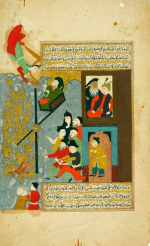
Figure 5 : Abraham sent to the pyre by King Nimrud Iran Qajar period early 19th century. Compare it with Figure 1 and 4
Figure 6 : Abraham cast into the fire , using a catapult. The catapult looks like a cross.
References
Al-Majlisī, M. B. Bihār al-Anwār (Vol. 95, p. 325). Shia Online Library. Retrieved September 25, 2025, from مكتبة الشيعة...
Al-Ṭabarī, M. J. Tārīkh al-Ṭabarī (Vol. 2). Archive.org. . Retrieved September 25, 2025, from Tareekh Tabari - Volume 2 : Umair Mirza : Free Download, Borrow, and Streaming : Internet Archive
Barber, M. (2006). The trial of the Templars (2nd ed., pp. 291–292). Cambridge University Press.
CalendarHome.com. (n.d.). Calendar conversions. Retrieved September 20, 2025, from CalendarHome.com
Demurger, A. (2019). The persecution of the Knights Templar: Scandal, torture, trial (T. L. Fagan, Trans.). Pegasus Books. (Original work published 2018)
Dumas, A. (1841). The progress of democracy illustrated in the history of Gaul and France (Vol. 20, pp. 313–315). J. & H. G. Langley.
Encyclopaedia Britannica. (2025, July 29). Templar | History, battles, symbols, & legacy. Templar | History, Battles, Symbols, & Legacy | Britannica
Nosovskiy, G. V., & Fomenko, A. T. (n.d.). Tsar of the Slavs: Chapter 1. Dating the Nativity of Christ as the middle of the XII century. Chronologia.org.. Retrieved September 6, 2025, from TSAR OF THE SLAVS
Picknett, L., & Prince, C. (2004, January 1). The Templars and the Assassins: Angels and demons. New Dawn Magazine.
WikiShia. (n.d.). Cooling of the fire for Abraham. WikiShia. Retrieved September 25, 2025, from Cooling of the Fire for Abraham - wikishia