

- Joined
- Aug 22, 2022
- Messages
- 116
- Reaction score
- 250
[Note: due to the character limit, this will be posted in two sections:
Part One Alfred and the First Earlies
And what else can TPTB do? They can only repeat what they know: their deeds, their history. They delight in relating their vainglorious bloodthirsty successes; they are proud of what they have achieved. They lack the imagination to create a truly new history, and so they weave their threads around what little they bothered to learn of the natives, and then trash the loom.
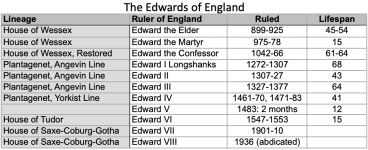
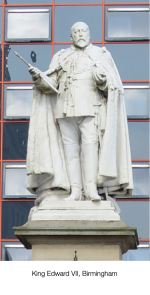
According to the professed narrative, England has had a whopping total of eleven kings called Edward: just two King Edwards in the last 125 years, and the other nine in the 1500’s or earlier.

The King Edward is also a very fine potato variety. While I am sure readers do not require a photo of a potato to be able to visualise one, they are particularly attractive.

King Alfred and the First Earlies
The first three Edwards, all from the royal House of Wessex, have been given descriptive titles, perhaps to divert attention from the astonishing durability of the name Edward among all royal households for over a millennium.
The first was Edward the Elder, the eldest son of King Alfred the Great (848-899), ruler of the Kingdom of Wessex - which was, generally speaking, the southern half of the area now called England. The Danes invaded the neighbouring Kingdom of Mercia , which became divided between those in the east, suffering under imposed Danelaw, and those in western English Mercia, who were still protected by common, or divine law.

Alfred the Great had “a reputation as a learned and merciful man of a gracious and level-headed nature who encouraged education, proposing that primary education be conducted in English rather than Latin, and improving the legal system and military structure and his people's quality of life”. It is interesting to note that Alfred had to protect his subjects from the Papists’ interference in the education of young children, that they were trying to undermine the English language.
The most heinous crime committed by King Alfred was to burn some cakes, when he was pre-occupied with how to handle the invaders, and it certainly wasn’t held against him.
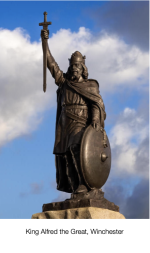
I have been able to find five statues of Alfred the Great in England today, although the one in Manchester is not widely listed. Given its majestic but neglected location, I’m not surprised it’s ignored, for purposes of preserving the narrative… lovely bit of fencing round it.

Three are said to be erected 115-125 years ago for commemorative purposes, while two are attributed to the same sculptor in the 1820s, James George Bubb. The base of the statue in south London is recycled from an earlier “Roman” statue, with the top half is made from Coade Stone, which had apparently ceased production in the 1840’s.

The statues at Southwark and Manchester are identical. Both gentlemen were also holding something(s) in their hands, possibly a sword and shield as at Winchester and Pewsey, which have since been removed.
Edward the Elder inherited rule over the Kingdom of Wessex, rather than England, as England did not yet exist. He was successful in repelling the Viking invaders and was admired by medieval chroniclers. In the view of William of Malmesbury, he was "much inferior to his father in the cultivation of letters" but "incomparably more glorious in the power of his rule". Wikipedia continues that ‘he was largely ignored by modern historians…, but is now seen as destroying the power of the Vikings in southern England…’
Edward the Elder died of his injuries in Cheshire, shortly after a battle in Chester, and was succeeded by his son Aethelstan. Then came Edmund, Eadred, Eadwig, and Edgar, before Edward the Martyr ascended the throne (975-78), aged just thirteen . Three years later, he was murdered, slain by unknown soldiers while visiting his brother Aelfthryth, aged just sixteen.
Then came Aethelred, and finally another Edmund, bringing an end to the Eds, Eads, Aeths and Aelf, all thrown in to bamboozle. Following this is a run of invaders with fun names: Svein Forkbeard, Canute or Cnut, Harald Harefoot and Hardicanute/Harthacanute. Which set do you think the kids are going to enjoy learning about more?
Finally, in 1042, the House of Wessex is restored, with Edward the Confessor, who, by narrative contortion, is both the nephew of Wessex’s young, slain Edward the Martyr and half-brother of the Viking Hardicanute - seriously? It is suggested that the name Confessor reflects his reputation as a saint who did not suffer martyrdom as opposed to his murdered teenage uncle, King Edward the Martyr. But maybe he would not fall in line with the pro-fessors, and was seen by the invaders as a con-fessor?
These First Earlies are recorded as being pious and well-respected, with the Martyr and Confessor also being saints. The reverent names and fond respect, even today, of the House of Wessex are indicators that the Aristotelian state classification of Monarchy - that is, the “Ideal” state when ruled by one individual - is appropriate.

The Second Earlies
The next time that Edward emerges again is nearly four hundred years later, with King Edward I finally making an appearance on the stage in 1272. One of his first acts is to make war against the neighbouring country of Wales, extorting 1 million marks of silver from Prince Llewellyn for peace. When Llewellyn was slain ten years later, King Edward I sent his head to London to be put on display at the Tower.
King Edward also appears as the king of Engelond in the Chronicle of London. The (suspiciously) high volume of detail available about this particular King Edward’s reveals that his ‘reign’ was more ‘campaign’, with high taxes. Aristotle would likely view this as an example of a perverted state of rule, namely Tyranny, and I suspect the deeds attributed to this Edward are those of the heathen invaders.
When Edward I died of dysentery, on the way to fighting the neighbouring Scots, he was succeeded by one of his sons, Edward. The story of Edward II is complicated - rumours of homosexuality, a bitter feud with his wife, and plenty of battles on the Welsh border. Eventually, he was captured and forced to abdicate in favour of his son, you guessed it, Edward.
Edward III was another young king, being crowned at just fourteen years old. Ten years later, he started the Hundred Years’ War (1337-1453) between England and France, with his successes leading to the early years being known as the Edwardian War (1337-1360). He also campaigned against the Scots.
It was during this time that the Black Death arrived in Europe - a notoriously fatal disease blamed on invisible bacteria, with the source under dispute, but widely blamed on rats, rather than bats or pangolins. The Papist London project swooped in, and tried to maintain wages at pre-pandemic rates, and stopped folk from leaving (Statute of Labourers 1351, dusted off recently and revised as the Coronavirus Act 2020). The natives were not impressed, and the result was The Peasants’ Revolt.
Edward III’s eldest son, was, rather predictably, another Edward. Also known as the Black Prince, young Edward fought alongside his father in the Hundred Years’ War, and was created Prince of Wales. Unfortunately, he died before his father, otherwise we would have had a dozen King Edwards.
Edward III’s other sons, William of Hatfield, Lionel of Antwerp, John of Gaunt, Edmund of Langley, William of Windsor and Thomas of Woodstock, were all passed over, without quarrel apparently (probably because they are all fictional characters!), and the crown jumped a generation to land on the head of Richard, so of Edward, Prince of Wales.
[Part Two to follow]
Part One Alfred and the First Earlies
The Second Earlies
Part Two Maincrop King Edwards, plus oneThe Cleaving of Good Queen Bess ]
Following my train of thought in Postcard from the English Civil War, I looked into the many and various King Edwards offered to us. It is my belief that there are nearly always some crumbs of the truth in the narrative repeated in schools, and elaborated upon by academics; there has to be a framework on which to hang the remnants of a once flourishing kingdom; a story into which relics and new archaeological finds can be fitted, as best suits the preservation of the status quo.And what else can TPTB do? They can only repeat what they know: their deeds, their history. They delight in relating their vainglorious bloodthirsty successes; they are proud of what they have achieved. They lack the imagination to create a truly new history, and so they weave their threads around what little they bothered to learn of the natives, and then trash the loom.
According to the professed narrative, England has had a whopping total of eleven kings called Edward: just two King Edwards in the last 125 years, and the other nine in the 1500’s or earlier.
The King Edward is also a very fine potato variety. While I am sure readers do not require a photo of a potato to be able to visualise one, they are particularly attractive.
King Alfred and the First Earlies
The first three Edwards, all from the royal House of Wessex, have been given descriptive titles, perhaps to divert attention from the astonishing durability of the name Edward among all royal households for over a millennium.
The first was Edward the Elder, the eldest son of King Alfred the Great (848-899), ruler of the Kingdom of Wessex - which was, generally speaking, the southern half of the area now called England. The Danes invaded the neighbouring Kingdom of Mercia , which became divided between those in the east, suffering under imposed Danelaw, and those in western English Mercia, who were still protected by common, or divine law.
Alfred the Great had “a reputation as a learned and merciful man of a gracious and level-headed nature who encouraged education, proposing that primary education be conducted in English rather than Latin, and improving the legal system and military structure and his people's quality of life”. It is interesting to note that Alfred had to protect his subjects from the Papists’ interference in the education of young children, that they were trying to undermine the English language.
The most heinous crime committed by King Alfred was to burn some cakes, when he was pre-occupied with how to handle the invaders, and it certainly wasn’t held against him.
I have been able to find five statues of Alfred the Great in England today, although the one in Manchester is not widely listed. Given its majestic but neglected location, I’m not surprised it’s ignored, for purposes of preserving the narrative… lovely bit of fencing round it.
Three are said to be erected 115-125 years ago for commemorative purposes, while two are attributed to the same sculptor in the 1820s, James George Bubb. The base of the statue in south London is recycled from an earlier “Roman” statue, with the top half is made from Coade Stone, which had apparently ceased production in the 1840’s.
The statues at Southwark and Manchester are identical. Both gentlemen were also holding something(s) in their hands, possibly a sword and shield as at Winchester and Pewsey, which have since been removed.
Edward the Elder inherited rule over the Kingdom of Wessex, rather than England, as England did not yet exist. He was successful in repelling the Viking invaders and was admired by medieval chroniclers. In the view of William of Malmesbury, he was "much inferior to his father in the cultivation of letters" but "incomparably more glorious in the power of his rule". Wikipedia continues that ‘he was largely ignored by modern historians…, but is now seen as destroying the power of the Vikings in southern England…’
Edward the Elder died of his injuries in Cheshire, shortly after a battle in Chester, and was succeeded by his son Aethelstan. Then came Edmund, Eadred, Eadwig, and Edgar, before Edward the Martyr ascended the throne (975-78), aged just thirteen . Three years later, he was murdered, slain by unknown soldiers while visiting his brother Aelfthryth, aged just sixteen.
Then came Aethelred, and finally another Edmund, bringing an end to the Eds, Eads, Aeths and Aelf, all thrown in to bamboozle. Following this is a run of invaders with fun names: Svein Forkbeard, Canute or Cnut, Harald Harefoot and Hardicanute/Harthacanute. Which set do you think the kids are going to enjoy learning about more?
Finally, in 1042, the House of Wessex is restored, with Edward the Confessor, who, by narrative contortion, is both the nephew of Wessex’s young, slain Edward the Martyr and half-brother of the Viking Hardicanute - seriously? It is suggested that the name Confessor reflects his reputation as a saint who did not suffer martyrdom as opposed to his murdered teenage uncle, King Edward the Martyr. But maybe he would not fall in line with the pro-fessors, and was seen by the invaders as a con-fessor?
These First Earlies are recorded as being pious and well-respected, with the Martyr and Confessor also being saints. The reverent names and fond respect, even today, of the House of Wessex are indicators that the Aristotelian state classification of Monarchy - that is, the “Ideal” state when ruled by one individual - is appropriate.
The Second Earlies
The next time that Edward emerges again is nearly four hundred years later, with King Edward I finally making an appearance on the stage in 1272. One of his first acts is to make war against the neighbouring country of Wales, extorting 1 million marks of silver from Prince Llewellyn for peace. When Llewellyn was slain ten years later, King Edward I sent his head to London to be put on display at the Tower.
King Edward also appears as the king of Engelond in the Chronicle of London. The (suspiciously) high volume of detail available about this particular King Edward’s reveals that his ‘reign’ was more ‘campaign’, with high taxes. Aristotle would likely view this as an example of a perverted state of rule, namely Tyranny, and I suspect the deeds attributed to this Edward are those of the heathen invaders.
When Edward I died of dysentery, on the way to fighting the neighbouring Scots, he was succeeded by one of his sons, Edward. The story of Edward II is complicated - rumours of homosexuality, a bitter feud with his wife, and plenty of battles on the Welsh border. Eventually, he was captured and forced to abdicate in favour of his son, you guessed it, Edward.
Edward III was another young king, being crowned at just fourteen years old. Ten years later, he started the Hundred Years’ War (1337-1453) between England and France, with his successes leading to the early years being known as the Edwardian War (1337-1360). He also campaigned against the Scots.
It was during this time that the Black Death arrived in Europe - a notoriously fatal disease blamed on invisible bacteria, with the source under dispute, but widely blamed on rats, rather than bats or pangolins. The Papist London project swooped in, and tried to maintain wages at pre-pandemic rates, and stopped folk from leaving (Statute of Labourers 1351, dusted off recently and revised as the Coronavirus Act 2020). The natives were not impressed, and the result was The Peasants’ Revolt.
Edward III’s eldest son, was, rather predictably, another Edward. Also known as the Black Prince, young Edward fought alongside his father in the Hundred Years’ War, and was created Prince of Wales. Unfortunately, he died before his father, otherwise we would have had a dozen King Edwards.
Edward III’s other sons, William of Hatfield, Lionel of Antwerp, John of Gaunt, Edmund of Langley, William of Windsor and Thomas of Woodstock, were all passed over, without quarrel apparently (probably because they are all fictional characters!), and the crown jumped a generation to land on the head of Richard, so of Edward, Prince of Wales.
[Part Two to follow]


 The usual fantasy has been applied - built in memory of something else, by Duke Blah-Di-Blah, but interesting to see that the Hoare family had ownership for a while - tell us something we don't know!!


