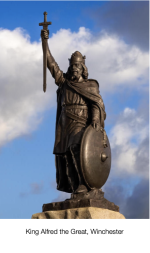
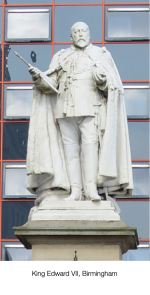
The Great King Edward Mash-Up

Artemisian

Core Member
Active Member
Joined
Aug 22, 2022
Messages
116
Reaction score
250
[Note: due to the character limit, this will be posted in two sections:

Part One Alfred and the First Earlies

The Second Earlies
Part Two Maincrop King Edwards, plus one
The Cleaving of Good Queen Bess ]
Following my train of thought in Postcard from the English Civil War, I looked into the many and various King Edwards offered to us. It is my belief that there are nearly always some crumbs of the truth in the narrative repeated in schools, and elaborated upon by academics; there has to be a framework on which to hang the remnants of a once flourishing kingdom; a story into which relics and new archaeological finds can be fitted, as best suits the preservation of the status quo.

And what else can TPTB do? They can only repeat what they know: their deeds, their history. They delight in relating their vainglorious bloodthirsty successes; they are proud of what they have achieved. They lack the imagination to create a truly new history, and so they weave their threads around what little they bothered to learn of the natives, and then trash the loom.

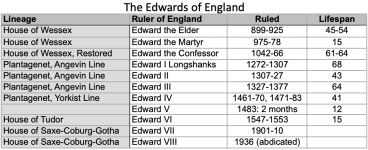
According to the professed narrative, England has had a whopping total of eleven kings called Edward: just two King Edwards in the last 125 years, and the other nine in the 1500’s or earlier.

1740499807813.png


The King Edward is also a very fine potato variety. While I am sure readers do not require a photo of a potato to be able to visualise one, they are particularly attractive.
1740345122627.png

King Alfred and the First Earlies

The first three Edwards, all from the royal House of Wessex, have been given descriptive titles, perhaps to divert attention from the astonishing durability of the name Edward among all royal households for over a millennium.

The first was Edward the Elder, the eldest son of King Alfred the Great (848-899), ruler of the Kingdom of Wessex - which was, generally speaking, the southern half of the area now called England. The Danes invaded the neighbouring Kingdom of Mercia , which became divided between those in the east, suffering under imposed Danelaw, and those in western English Mercia, who were still protected by common, or divine law.

1740345267259.png


Alfred the Great had “a reputation as a learned and merciful man of a gracious and level-headed nature who encouraged education, proposing that primary education be conducted in English rather than Latin, and improving the legal system and military structure and his people's quality of life”. It is interesting to note that Alfred had to protect his subjects from the Papists’ interference in the education of young children, that they were trying to undermine the English language.

The most heinous crime committed by King Alfred was to burn some cakes, when he was pre-occupied with how to handle the invaders, and it certainly wasn’t held against him.

I have been able to find five statues of Alfred the Great in England today, although the one in Manchester is not widely listed. Given its majestic but neglected location, I’m not surprised it’s ignored, for purposes of preserving the narrative… lovely bit of fencing round it.

1740345393749.png


Three are said to be erected 115-125 years ago for commemorative purposes, while two are attributed to the same sculptor in the 1820s, James George Bubb. The base of the statue in south London is recycled from an earlier “Roman” statue, with the top half is made from Coade Stone, which had apparently ceased production in the 1840’s.

1740345473339.png

The statues at Southwark and Manchester are identical. Both gentlemen were also holding something(s) in their hands, possibly a sword and shield as at Winchester and Pewsey, which have since been removed.

Edward the Elder inherited rule over the Kingdom of Wessex, rather than England, as England did not yet exist. He was successful in repelling the Viking invaders and was admired by medieval chroniclers. In the view of William of Malmesbury, he was "much inferior to his father in the cultivation of letters" but "incomparably more glorious in the power of his rule". Wikipedia continues that ‘he was largely ignored by modern historians…, but is now seen as destroying the power of the Vikings in southern England…’

Edward the Elder died of his injuries in Cheshire, shortly after a battle in Chester, and was succeeded by his son Aethelstan. Then came Edmund, Eadred, Eadwig, and Edgar, before Edward the Martyr ascended the throne (975-78), aged just thirteen . Three years later, he was murdered, slain by unknown soldiers while visiting his brother Aelfthryth, aged just sixteen.

Then came Aethelred, and finally another Edmund, bringing an end to the Eds, Eads, Aeths and Aelf, all thrown in to bamboozle. Following this is a run of invaders with fun names: Svein Forkbeard, Canute or Cnut, Harald Harefoot and Hardicanute/Harthacanute. Which set do you think the kids are going to enjoy learning about more?

Finally, in 1042, the House of Wessex is restored, with Edward the Confessor, who, by narrative contortion, is both the nephew of Wessex’s young, slain Edward the Martyr and half-brother of the Viking Hardicanute - seriously? It is suggested that the name Confessor reflects his reputation as a saint who did not suffer martyrdom as opposed to his murdered teenage uncle, King Edward the Martyr. But maybe he would not fall in line with the pro-fessors, and was seen by the invaders as a con-fessor?

These First Earlies are recorded as being pious and well-respected, with the Martyr and Confessor also being saints. The reverent names and fond respect, even today, of the House of Wessex are indicators that the Aristotelian state classification of Monarchy - that is, the “Ideal” state when ruled by one individual - is appropriate.

1740345672859.png


The Second Earlies

The next time that Edward emerges again is nearly four hundred years later, with King Edward I finally making an appearance on the stage in 1272. One of his first acts is to make war against the neighbouring country of Wales, extorting 1 million marks of silver from Prince Llewellyn for peace. When Llewellyn was slain ten years later, King Edward I sent his head to London to be put on display at the Tower.

King Edward also appears as the king of Engelond in the Chronicle of London. The (suspiciously) high volume of detail available about this particular King Edward’s reveals that his ‘reign’ was more ‘campaign’, with high taxes. Aristotle would likely view this as an example of a perverted state of rule, namely Tyranny, and I suspect the deeds attributed to this Edward are those of the heathen invaders.

When Edward I died of dysentery, on the way to fighting the neighbouring Scots, he was succeeded by one of his sons, Edward. The story of Edward II is complicated - rumours of homosexuality, a bitter feud with his wife, and plenty of battles on the Welsh border. Eventually, he was captured and forced to abdicate in favour of his son, you guessed it, Edward.

Edward III was another young king, being crowned at just fourteen years old. Ten years later, he started the Hundred Years’ War (1337-1453) between England and France, with his successes leading to the early years being known as the Edwardian War (1337-1360). He also campaigned against the Scots.

It was during this time that the Black Death arrived in Europe - a notoriously fatal disease blamed on invisible bacteria, with the source under dispute, but widely blamed on rats, rather than bats or pangolins. The Papist London project swooped in, and tried to maintain wages at pre-pandemic rates, and stopped folk from leaving (Statute of Labourers 1351, dusted off recently and revised as the Coronavirus Act 2020). The natives were not impressed, and the result was The Peasants’ Revolt.

Edward III’s eldest son, was, rather predictably, another Edward. Also known as the Black Prince, young Edward fought alongside his father in the Hundred Years’ War, and was created Prince of Wales. Unfortunately, he died before his father, otherwise we would have had a dozen King Edwards.

Edward III’s other sons, William of Hatfield, Lionel of Antwerp, John of Gaunt, Edmund of Langley, William of Windsor and Thomas of Woodstock, were all passed over, without quarrel apparently (probably because they are all fictional characters!), and the crown jumped a generation to land on the head of Richard, so of Edward, Prince of Wales.

[Part Two to follow]
 

Attachments

  • 1740345087214.png
    1740345087214.png
    97.3 KB · Views: 212
  • 1740346227929.png
    1740346227929.png
    371.7 KB · Views: 136
  • 1740346247098.png
    1740346247098.png
    528.2 KB · Views: 128
[Part Two]

Maincrop King Edwards, plus one

We find the next Edward in 1461: Edward IV was the son of Richard, Duke of York, who was descended from Edward III. Father and son fought against the Palatinate of Lancaster, which can be considered the Papist London project regional office in the north-west of England, and successfully seized the crown from the placeholder Henry.

Edward IV married Elizabeth Woodville in secret, a woman of great beauty according to Britannica. She was a widow with two sons from her first marriage, from minor nobility, essentially a commoner, and, apparently, it caused quite a stir 600 years ago. How we come to know any of this is a mystery which is neatly solved by deducting a zero from the timeline.

These were dangerous days. Elizabeth’s father, and one of her five brothers, were both murdered by the Earl of Warwick (then the Neville family, now the Greville family). Warwick then seized and imprisoned the King himself, in July 1469, before Edward regained his freedom three months later. Warwick fled to France, regrouped with his catholic allies, and re-invaded a year later. Surprised, Edward bolted to the Netherlands, where he too regrouped, with his brother, Richard, and they took London on their return six months later, killing Warwick.

Edward IV and Elizabeth had two sons, Edward and Richard (later to become known as the Princes in the Tower), and five daughters. 1n 1471, Edward was made Prince of Wales. When Edward IV died in 1483, his son Edward briefly succeeded him. And when I say brief, I mean brief. It took the Papist London project just two months to oust the poor boy, declaring his father’s marriage to his mother to be invalid, and Edward V and his brother were never seen again. The imaginative narrative has pointed the finger of blame at another Richard, the boy’s uncle.

Edward VI is supposed to be the boy that was the result of all the fuss King Henry VIII made with the Pope, the male heir that had been elusive for six wives. He was crowned in 1537, at the age of nine, and reigned for a total of six years before dying aged just 15.

Edward VII, who gave his name to the Edwardian Era, reigned for just nine years (1901-10), although the “Era” ended with the outbreak of World War I. This gentleman is, I believe, the man who is also Edward the Elder, the Confessor, and others (but not Edward I). The narrative is so desperate to kick him into the Middle Ages and beyond, that it is even claimed that he was not even known as Edward, but “Bertie”, as a pathetic attempt at contiguity with that hideous couple Victoria and Albert.

The most recent was the place/nameholder Edward VIII, familiarly known as David, the fascist sympathiser who encouraged the Holy Roman Empire to bomb the English into submission. As a further repetitive distortion of the past, scandal erupted when he married a divorcee, and he abdicated in 1936. He is not thought of fondly, with many suggesting that, on the evidence, he was nothing more than a little chit.


One observation on the foregoing, is that being a King Edward has got to be one of the most dangerous occupations imaginable: out of eleven, three died before their sixteenth birthday.

Or are these echoes designed to distract from the real last King Edward, young & disappeared son of Edward and Elizabeth, grandson of Alfred?

Many schools and colleges in England today are named after King Edward (numbered or not), we have Edwardian architecture (brick homes for the people, rather than the grander buildings), and the versatile King Edward potato variety is still on sale. It seems an odd mix of the honourable distant past, coupled with a brief blink-and-you-miss-it Era-defining reign from 1901-10, that still holds an every-day, modern influence today.

The only Edward that seems to have statues in his memory is Edward VII, of Edwardian Era fame.
1740517892723.png
1740517913612.png

There’s nothing that really stands out that these two men couldn’t be related…

The Cleaving of Good Queen Bess

Elizabeth I was a popular monarch, earning the nickname Good Queen Bess. She is portrayed as one of Henry VIII’s daughters, from one of his six wives, reigning 1558-1603.

The penultimate Edward, Edward VII, of the House of Saxe-Coburg-Gotha (r. 1901-11), was succeeded by George V, of the new House of Windsor (the story goes that the name had been changed from Saxe-Coburg-Gotha to downplay the family’s Germanic history), who reigned from 1911 to 1936.

Compare the photographs below of Edward VII (1841-1910) and his wife, Queen Alexandra (1844-1925), and George V (1865-1936) and his wife, Mary of Teck (1867-1911). I realise that the men are supposedly father and son, but the wives are said to be from entirely different families: Alexandra was Danish royalty, and Mary was the daughter of German duke.

1740518124728.png
1740518193221.png


What are the chances that an identical couple could succeed the throne? More than that, why would any man, let alone a king, choose a wife who looks exactly like his mother?!


Both kings appear on stamps, with near identical images - King Edward VII left, and George V right. Edward VII looks like a seventy-year old man, who is pictured in his younger years as George V. I have noticed that old postcards with King Edward stamps are far more common than George V, easily 50-1 if not more. And isn't interesting how stamp collecting has been steered by financial reward towards the pristine, unused stamps?

1740518262874.png


Adding to the confusion, Mary of Teck was first engaged to be married to George V’s older brother, Albert Victor, Duke of Clarence & Avondale, but he died, so the story goes, and she married his identical younger brother. Is this even the same woman? Her name alone sounds like an admission that she is fabricated, made by tech! As for the image provided by Wikipedia of Mary of Teck’s party-loving mother, am I the only one who sees an old man in a dress?

1740518574235.png
1740518714969.png


As a double whammy, both wives could also pass for Elizabeth I, who was famous for her pale skin, red hair and beautifully embroidered clothes:

1740518817857.png


The fictitious character of George V could have been created using misappropriated images of King Edward VII, and if so, calls into question the existence of the 25 years of his reign, 1911-36, if not all the Georges.

Images of Queen Elizabeth, the surviving wife of King Edward of Wessex, former Princess of Wales, may have been co-opted and used to populate detail for the place-holder wife of Edward VII (Alexandra) and also wife of the fictitious George V (Mary of Teck).

This theory suggests that the last 200 years of British history has been stretched out, disaggregated, so that simultaneous events appear one after the other. The British kings Alfred and Edward were up against the “kings” of the Romans/Danes/CEOs and Regional Heads of the Papist London project. The last true British king was young King Edward, son of King Edward & Queen Elizabeth, who was murdered, likely with his brother Richard, shortly after the death of his father, a hundred years ago at the most.

If King Alfred did indeed die in 899, and was succeeded by his son, Edward's reign may have died in 911, and his two sons, Edward and Richard, were promptly disappeared. One thousand years was added by the twisted victors, as both convenient for amending masonry and documents, and also to kick British freedom, dignity and self-governance back into 'pre-history'. If George V's reign 1911-36 never happened, then another 25 years were also added. I wonder what happened to Edward's Elizabeth and any other children they may have had.

Which would mean that we are currently in year 1,000 A.D. As the Christians recorded their years since the coming of Christ, it could be that we are due the fulfilment of Biblical prophecy - I'll be checking the sky on St John the Baptist Day, three days after the Summer Solstice on 24 June, in case the Bible holds celestial code !
 
"Following my train of thought in Postcard from the English Civil War, I looked into the many and various King Edwards offered to us. It is my belief that there are nearly always some crumbs of the truth in the narrative repeated in schools, and elaborated upon by academics; there has to be a framework on which to hang the remnants of a once flourishing kingdom; a story into which relics and new archaeological finds can be fitted, as best suits the preservation of the status quo.

And what else can TPTB do? They can only repeat what they know: their deeds, their history. They delight in relating their vainglorious bloodthirsty successes; they are proud of what they have achieved. They lack the imagination to create a truly new history, and so they weave their threads around what little they bothered to learn of the natives, and then trash the loom."


Very interesting speculations about what's presented to us as "history" thank you for posting it here.

From my looking around it seems that MUCH of the structure came from Henry 8th period. There were a lot of Henrys, Georges and Williams weren't there? Why?

There's a wealth of research from this gentleman: Edwin Johnson (historian) - Wikipedia : I found his ideas intriguing to say the least.
One is this:
"... in The Rise of English Culture Johnson made the radical claim that the whole of the so-called Dark Ages between 700 and 1400 A. D. had never occurred, but had been invented by Christian writers who created imaginary characters and events. The Church Fathers, the Gospels, St. Paul, the early Christian texts as well as Christianity in general are identified as mere literary creations and attributed to monks (chiefly Benedictines) who drew up the entire Christian mythos in the early 16th century. As one reviewer said, Johnson "undertakes to abolish all English history before the end of the fifteenth century."[3] Johnson contends that before the "age of publication" and the "revival of letters" there are no reliable registers and logs, and there is a lack of records and documents with verifiable dates."

Johnson
looked especially at the time Henry 6/7/8 for the alleged invention of English Culture. I can't work out whether the State and the Church worked hand in hand ...

Thanks again
 
"Following my train of thought in Postcard from the English Civil War, I looked into the many and various King Edwards offered to us. It is my belief that there are nearly always some crumbs of the truth in the narrative repeated in schools, and elaborated upon by academics; there has to be a framework on which to hang the remnants of a once flourishing kingdom; a story into which relics and new archaeological finds can be fitted, as best suits the preservation of the status quo.

And what else can TPTB do? They can only repeat what they know: their deeds, their history. They delight in relating their vainglorious bloodthirsty successes; they are proud of what they have achieved. They lack the imagination to create a truly new history, and so they weave their threads around what little they bothered to learn of the natives, and then trash the loom."


Very interesting speculations about what's presented to us as "history" thank you for posting it here.

From my looking around it seems that MUCH of the structure came from Henry 8th period. There were a lot of Henrys, Georges and Williams weren't there? Why?

There's a wealth of research from this gentleman: Edwin Johnson (historian) - Wikipedia : I found his ideas intriguing to say the least.
One is this:
"... in The Rise of English Culture Johnson made the radical claim that the whole of the so-called Dark Ages between 700 and 1400 A. D. had never occurred, but had been invented by Christian writers who created imaginary characters and events. The Church Fathers, the Gospels, St. Paul, the early Christian texts as well as Christianity in general are identified as mere literary creations and attributed to monks (chiefly Benedictines) who drew up the entire Christian mythos in the early 16th century. As one reviewer said, Johnson "undertakes to abolish all English history before the end of the fifteenth century."[3] Johnson contends that before the "age of publication" and the "revival of letters" there are no reliable registers and logs, and there is a lack of records and documents with verifiable dates."

Johnson
looked especially at the time Henry 6/7/8 for the alleged invention of English Culture. I can't work out whether the State and the Church worked hand in hand ...

Thanks again
I add this good piece of research (IMO) & repays careful re-readings & follow ups. Took me a while to stumble across it btw ....
'This Realm of England is an Empire': The Tudor's Justification of Imperial Rule Through Legend by Propaganda and Pageantry

Ties in a few more threads perhaps? Plus this cherry on top: The Land Grab ...
Henry VIII and the Reformation 1534 - Manorial Counsel
Contrary to popular belief the Act of Supremacy of November 1534 was an Act of Parliament and not an act by Henry VIII. It was written in the 26th year of Henry’s reign and although not having Henry’s name on it, it was to fundamentally change the position of the church in England.

The important part of the Act that we look to is “the only supreme head on earth of the Church of England” which had previously been the Pope. “The English crown shall enjoy all honours, dignities, pre-eminences, jurisdictions, privileges, authorities, immunities, profits, and commodities to the said dignity.
The first quotation effectively made Henry VIII the owner of the Church of England.
The second quotation confirms that the crown owns all the property of the Church of England.

Who masterminded this -perhaps ... before he "died" in 1540?

https://www.reigate.ac.uk/wp-content/uploads/2020/05/Thomas-Cromwell-1.pdf

Thomas Cromwell - Wikipedia
Thomas Cromwell was a patron of Hans Holbein the Younger, as were Thomas More and Anne Boleyn.
In the New York Frick Collection, two portraits by Holbein hang facing each other on the same wall of the Study, one depicting Thomas Cromwell, the other Thomas More, Cromwell's executed political and religious opponent.[93]
 
Last edited:
Thomas Cromwell - Wikipedia
...he was beheaded on orders of the king, who later blamed false charges for the execution.
I add this good piece of research (IMO) & repays careful re-readings & follow ups. Took me a while to stumble across it btw ....
'This Realm of England is an Empire': The Tudor's Justification of Imperial Rule Through Legend by Propaganda and Pageantry

Ties in a few more threads perhaps? Plus this cherry on top: The Land Grab ...
Henry VIII and the Reformation 1534 - Manorial Counsel
Contrary to popular belief the Act of Supremacy of November 1534 was an Act of Parliament and not an act by Henry VIII. It was written in the 26th year of Henry’s reign and although not having Henry’s name on it, it was to fundamentally change the position of the church in England.

The important part of the Act that we look to is “the only supreme head on earth of the Church of England” which had previously been the Pope. “The English crown shall enjoy all honours, dignities, pre-eminences, jurisdictions, privileges, authorities, immunities, profits, and commodities to the said dignity.
The first quotation effectively made Henry VIII the owner of the Church of England.
The second quotation confirms that the crown owns all the property of the Church of England.

Who masterminded this -perhaps ... before he "died" in 1540?

https://www.reigate.ac.uk/wp-content/uploads/2020/05/Thomas-Cromwell-1.pdf

Thomas Cromwell - Wikipedia
Thomas Cromwell was a patron of Hans Holbein the Younger, as were Thomas More and Anne Boleyn.
In the New York Frick Collection, two portraits by Holbein hang facing each other on the same wall of the Study, one depicting Thomas Cromwell, the other Thomas More, Cromwell's executed political and religious opponent.[93]
[
King Alfred and the First Earlies

The first three Edwards, all from the royal House of Wessex, have been given descriptive titles, perhaps to divert attention from the astonishing durability of the name Edward among all royal households for over a millennium.

The first was Edward the Elder, the eldest son of King Alfred the Great (848-899), ruler of the Kingdom of Wessex - which was, generally speaking, the southern half of the area now called England. The Danes invaded the neighbouring Kingdom of Mercia , which became divided between those in the east, suffering under imposed Danelaw, and those in western English Mercia, who were still protected by common, or divine law.

View attachment 33372

Alfred the Great had “a reputation as a learned and merciful man of a gracious and level-headed nature who encouraged education, proposing that primary education be conducted in English rather than Latin, and improving the legal system and military structure and his people's quality of life”. It is interesting to note that Alfred had to protect his subjects from the Papists’ interference in the education of young children, that they were trying to undermine the English language.

The most heinous crime committed by King Alfred was to burn some cakes, when he was pre-occupied with how to handle the invaders, and it certainly wasn’t held against him.

I have been able to find five statues of Alfred the Great in England today, although the one in Manchester is not widely listed. Given its majestic but neglected location, I’m not surprised it’s ignored, for purposes of preserving the narrative… lovely bit of fencing round it.


View attachment 33374
The statues at Southwark and Manchester are identical. Both gentlemen were also holding something(s) in their hands, possibly a sword and shield as at Winchester and Pewsey, which have since been removed.
I had a look for the mysterious dude opposite Alfred at Heaton Park the Colonnade I think it's called: Lens wasn't helpful

"The statue shown is located at Manchester Town Hall and is likely one of the historical figures represented there. The specific identity of the statue is not explicitly mentioned in the search results, but it is possibly a representation of a figure from antiquity, aligning with the architectural style and historical context of the building.

Manchester Town Hall, a neo-Gothic building built in 1877, features numerous sculptures and statues as part of its design. These often represent figures from history, culture, and civic life. The Town Hall is currently undergoing extensive renovations and is scheduled to reopen in 2026. "

Town Hall Colonnade | Historical buildings and landmarks | Manchester City Council
Re-assembled after main building was demolished in 1912.
https://i.ytimg.com/vi/aYPzhK8eBYY/maxresdefault.jpg
And another pic: https://s0.geograph.org.uk/geophotos/01/74/82/1748224_69b95f4b.jpg
The Old Town Hall Colonnade at Heaton... © David Dixon cc-by-sa/2.0
 
Last edited:
I had a look for the mysterious dude opposite Alfred at Heaton Park the Colonnade I think it's called: Lens wasn't helpful

"The statue shown is located at Manchester Town Hall and is likely one of the historical figures represented there. The specific identity of the statue is not explicitly mentioned in the search results, but it is possibly a representation of a figure from antiquity, aligning with the architectural style and historical context of the building.
Heaton Park looks an interesting place. I don’t buy that the colonnade was moved from its original place, and it’s interesting that the statue isn’t attributed. I guess ‘they’ tried to give Alfred a bit of age, by suggesting the Manchester & Southwark statues are of him.

Thanks for adding your research here!
 
I’m delighted to share these three postcards from the Rotary Photo series, which provide evidence of intentional truth distortion. The first is a cracker - how anyone can believe it is a real photograph is beyond me. The table and hands are drawn in, and the whole composition is ludicrous, with paintings and busts watching over the proceedings.

Ladies and gentlemen, may I present King Edward and His Empire Builders. Three of the background characters are Wellington (1), Gladstone (3) and Nelson (4), and I can pick out a young Winston Churchill (16), but I haven’t had a chance to look into identifying the rest, although a couple look familiar. I have included a numbered picture, too, in case readers know the other figures.

I also find it interesting that he is referred to as King Edward, without numerals, on all three postcards - maybe they hadn’t got the history story quite settled yet. Unfortunately, none have been stamped or posted, so there is no date to go by.

Rotary photo pc - King Edward & His Empire Builders.jpg

Rotary photo pc - King Edward's Empire Builders - numbered.jpg


And here is The Royal Gathering at Windsor, November 17th 1907.

With the first postcard having blown any sensible claim to veracity for the Rotary Photo series, we are entitled to examine this one closely. And we find most of the group are quite rudely ignoring the photographer, and looking off either to the left or the right. In fact, pretty much everyone sat to King Edward’s left could be spliced in.

Rotary photo pc - King Edward royal family.jpg


And finally, Queen Alexandra and King Edward. What’s she looking at, that doesn’t much interest him?

Rotary Photo pc - Queen Alexandra and King Edward.jpg
 
And another one! Introducing King Edawrd, with his younger self, and a teenager in a suit. Again, there seems to be disagreement on where to look when being photographed - eyes right, eyes up or straight on?

Three Generations.jpg
 
I came across this during research and thought it could be relevant here.
From the article Thomas Cromwell was the Islamic State of his day - 22 Jan 2015
...
And then there is his impact on this country's artistic and intellectual heritage. No one can be sure of the exact figure, but it is estimated that the destruction started and legalised by Cromwell amounted to 97% of the English art then in existence. Statues were hacked down. Frescoes were smashed to bits. Mosaics were pulverized. Illuminated manuscripts were shredded. Wooden carvings were burned. Precious metalwork was melted down. Shrines were reduced to rubble. This vandalism went way beyond a religious reform. It was a frenzy, obliterating the artistic patrimony of centuries of indigenous craftsmanship with an intensity of hatred for imagery and depicting the divine that has strong and resonant parallels today.
 
Last edited:
I have been able to find five statues of Alfred the Great in England today…
I have found a sixth statue of King Alfred, hidden discreetly half-way up a unique and magnificent triangular tower, in Wiltshire, Wessex, discreetly called Alfred's Tower - it's easy to see how it was overlooked ;) The usual fantasy has been applied - built in memory of something else, by Duke Blah-Di-Blah, but interesting to see that the Hoare family had ownership for a while - tell us something we don't know!!

It's an incredible structure - so solid and perfect. Access is restricted by the modern-day Hoares, also known as the National Trust, but will try to post the view from the top in due course. The ill-fitting plaque below the statue looks to be a more recent addition, but the statue recess is an intrinsic part of the tower, so more likely to be original. As with Wardour Castle, I'd never heard of it until coming across it by chance, despite living with 100 miles or so for my whole life.

IMG_3333.JPEG
IMG_3330.JPEG
IMG_3331.JPEG
IMG_3332.JPEG
King-Alfreds-Tower-Stourhead-8.jpg
Alfred's Tower N.jpeg
NT text.jpg
 
Another thread has more details of Alfred's Tower, following a visit: The Stourhead Massacre of true English Nobility in 1902.

I’m not sure what to make of this one dollar coin from 1904, featuring King Edward VII. The Chinese on the reverse says one Yuan, maybe readers can help translate the Arabic writing?

I haven't come across an English king on a dollar before - usually the currency is the British pound. The Straits Settlement has the hallmarks of the trader-invaders, so maybe the king was co-opted to give a veneer of respectability to a new coinage.

My Chinese colleague says that it would not likely have been issued in China, as faces are not used on coins, but could have been for trade with Malaysia, for example.
KE Dollar coin - reverse.jpg

KE Dollar coin - face.jpg
 
Another thread has more details of Alfred's Tower, following a visit: The Stourhead Massacre of true English Nobility in 1902.

I’m not sure what to make of this one dollar coin from 1904, featuring King Edward VII. The Chinese on the reverse says one Yuan, maybe readers can help translate the Arabic writing?

I haven't come across an English king on a dollar before - usually the currency is the British pound. The Straits Settlement has the hallmarks of the trader-invaders, so maybe the king was co-opted to give a veneer of respectability to a new coinage.

My Chinese colleague says that it would not likely have been issued in China, as faces are not used on coins, but could have been for trade with Malaysia, for example.
View attachment 35134
View attachment 35135
Its a British Malaysia dollar.
1 Dollar - Edward VII, Straits Settlements
Arabesque pattern surrounding denomination in Chinese and Malay; English lettering around
 
Last edited:
Minted in Mumbai, India. And not recognised tender in Britain… odd!
Not really. Empire coinage was minted outside of the United Kingdom best I can tell.
Legal tender (a somewhat flexible term) only applies to certain coinage and notes struck and printed within the United Kingdom.
Hong Kong dollars are not legal tender here as they were minted in Hong Kong.
The Birth of Hong Kong’s Currency
The "empire" seems to have been run as a separte legal entity to the United Kingdom.
 
Last edited:
Not really. Empire coinage was minted outside of the United Kingdom best I can tell.
Legal tender (a somewhat flexible term) only applies to certain coinage and notes struck and printed within the United Kingdom.
Hong Kong dollars are not legal tender here as they were minted in Hong Kong.
The Birth of Hong Kong’s Currency
The "empire" seems to have been run as a separte legal entity to the United Kingdom.
Interesting. Have you come across any other examples where a monarch’s head is used on coinage that isn’t accepted in that monarch’s country?
 
Interesting. Have you come across any other examples where a monarch’s head is used on coinage that isn’t accepted in that monarch’s country?
Nope. Then again I haven't looked. I know the Dutch Indies guilder existed but don't know if it was legal tender in the Netherlands or not. I doubt it as the Dutch system is a mirror of the UK system.
 
Nope. Then again I haven't looked. I know the Dutch Indies guilder existed but don't know if it was legal tender in the Netherlands or not. I doubt it as the Dutch system is a mirror of the UK system.
This Dutch example has the same currency, the guilder. But the Dollar has never been used in Britain. I maintain that it is, indeed, odd. Lapping up the narrative to dispel an oddity isn't a path that genuine researchers tend to tread.
 
This Dutch example has the same currency, the guilder. But the Dollar has never been used in Britain. I maintain that it is, indeed, odd. Lapping up the narrative to dispel an oddity isn't a path that genuine researchers tend to tread.
Good grief.
Various mints existed "back in the day" in Britain and they minted coinage for colonies and countries.
"Any genuine researcher would tred a path" to find out as much as possible about this practice before slagging off someone who merely answered a question posed
I'm outta here.
 
Tips
Tips
Please respect our Posting Rules.
Back
Top