The Nephilim Looked Like Clowns (conspiracy-r-us)

Conspiracy R Us mentioned Luna Park. This one in Sydney, Australia was the venue for some of the first "covid" "vaccinations" of teens/children;

luna-park-sydney.jpg
Head and crown/corona is like a portal. The mouth is devouring the visitors. And twin towers symbolism.
 
Last edited:
Tell me if not, this lid is decorated with what we know today as Clown.
"Urn lid with jaguar and cocoa pods".


When I saw that image, I couldn't help but be reminded of the warning altar in Indiana Jones and the Temple of Doom.

indyjones2035.jpg

I am also reading Stages of Evil: Occultism in Western Theater and Drama by Robert Lima, and Chapter 2: The Masks of Harlequin: Daemonic Antecedents of the Commedia dell'Arte Character gives some interesting commentary on the origins of clowns and how they have progressed from their 'mysterious origins in the Middle Ages' (to paraphrase the author). I will try to post excerpts soon, when I get the book back from a family member. The author does not strike me as the best sort of fellow, especially given some of the organizations he affiliates with, but that doesn't mean that his commentary might not add value to this discussion.

Clowns have always made me feel irrationally angry, so I stay away from them. This subject has definitely piqued my interest since discovering it.
 
"Antenna People", South Africa. Similar to some of the South American tribes on pg.1;
53b7fb74c30d6febb8e4d7aa468723a9.jpg

35b8ba57000ad790076d797e28348ec6.png


And the Child Catcher from Chitty Chitty Bang Bang. Even has the jester and black and white stripes on his cart;
fXMMqDVnlkOh6OVVLar9LDDDk0msBCIsDP38t-Vg_Di4hG3o8Tgos3r4Ws1CjHl7wZHiAw6P6k8tgSQL1AsEIp_BKaQnok...jpg
 
Last edited:
Apologies, the "Antenna People" refers to rock art found in Sego Canyon, Utah. They're not the African tribe in the photos I posted previously.

Some examples of the rock art depicting the antenna people;
IMG_8086-1024x625.jpg

bbe59040919ccbb18556cd8b5b229d8e.jpg
 
Last edited:
Some examples of the rock art depicting the antenna people;

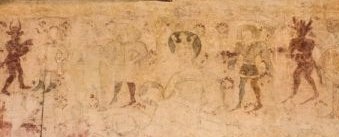
Wall art depicting red 'Antenna People':
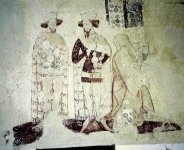
corby_glen_demons.jpg
Detail taken from image below.

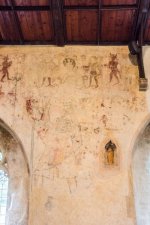
Corby-Glen-3672.jpeg
14/15th century (allegedly) wall painting from St John's Church, Corby Glen, Lincolnshire. Source

Corby Glen: (Google Maps), (Google Streetview), (OpenStreetMap), (NLS), (Flickr images)

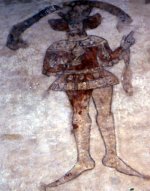
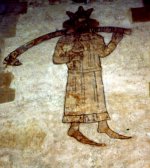
Also at St John's, Corby Glen: clown-like haircuts and long clown shoes:
corbykg2.jpg
Magi 1 Source

corbykg1.jpg
Magi 2 Source
I don't buy ReedDesign's interpretation of the implements in each magi's hands (jars and speech banners) but my interpretations are only guesses. I don't think the images necessarily depict entities bringing gifts. Just as possibly, they are jars of sweets, beads, or toys - vuvuzelas - or some such.

That is, tokens for Mum in exchange for her kid. Ie, money.

Note how in the second Utah rock painting above one of the red entities is holding something like a giant leech in its right hand. Maybe the so-called 'speech banners' in the English wall painting are giant leeches brought along for the post-purchase blood-sucking.

They say:
Both their garments are decorated with ermine, or 'vair' (squirrel backs patched together with various animal belly skins).

Maybe. But the decoration could also be scalps, facial stubble, or perhaps even pube-skin.

From St Peter and St Paul Church, Heydon, Norfolk:
admaheyd.jpg
Adoration of the Magi wall painting. Source

Apparently, the figure on the right is a later re-working. The original figures are the two with clown-like hair styles on the left.

Heydon: (Google Maps), (Google Streetview), (OpenStreetMap), (NLS), (Flickr images)

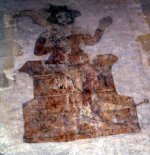
Back at St John's, Corby Glen:
corbyher.jpg
King Herod. Source
They say:
King Herod sitting on a magnificent throne.

I suspect something more like:
Local butcher or cordwainer sitting on font, altar or perhaps base of village cross.

They say:
His legs are crossed, variously a sign of authority, or of a tyrant – in Herod’s case, either or both may be implied.

I say:
Crossed legs are a symbol of Knights Templar. Which - based on the Rev George Oliver writings about nearby Templars - supports the claims of: 'sign of authority' and 'tyrant'.

They say:
The most remarkable thing about him, perhaps, is his shoes, with their exaggeratedly long pointed toes. Such ridiculously extended shoes were the height of fashion in the early 14th century and thus, probably, the painter has drawn attention to Herod’s vanity,

I say:
the shoes suggest he had access to plenty of soft, supple leather. Hence: cordwainer.
 
Last edited:
I think it was Graham Hancock who had a similar experience with Ayahuasca. He said that he found himself at a carnival, where clowns were performing stunts and routines. He had the feeling that, while they were trying to entertain him, they could turn on him at any moment.
I had a waking-dream once, only 5 or so years ago, where I was attacked by evil, ugly circus cronies, beat them up and then a freaky as fk grey, anthropomorphic demon attacked me... i woke up pretty startled!!!
 
I was reviewing the subject and found some other data related to this topic.

  • First Chac Mool is a story by Mexican writer Carlos Fuentes... Filiberto, a forty-year-old lonely man, lover of Mexican pre-Hispanic antiquities, employed in a government office in Mexico City, dies drowned in Acapulco.
    After Filiberto acquires an ancient stone figure of Chac Mool, which over the days will transform into a living being. The god will exercise an increasing control until he completely dominates Filiberto, who will seek to free himself from this slavery by fleeing to Acapulco, where he will find death.
    A stone idol that comes to life and, in order not to look so dead, he puts on makeup, like these sacred clowns. Chac Mool (relato) - Wikipedia, la enciclopedia libre


  • It turns out that Chaac the Mayan god has a huge resemblance to a clown, a mocking face in some representations, children were sacrificed to him, and he has multiple parallels in other cultures and they are all rain gods.

    Chaac - Mayan
    Chaac was an important god of the Maya pantheon, linked to water and especially to rain, he dwelt in the caves or cenotes, in short, at the entrances to the underworld. Today he is still worshiped among farmers, as anthropological studies suggest; however, it is under the name of Saint Thomas, due to the syncretism between the Mayan and Catholic religions.
    Chaac is generally represented with a human body showing reptilian or amphibian scales, and with a non-human head showing fangs and a long, hanging nose.
    Chaac - Wikipedia
    Dzahui - Mixtec
    Dzahui was the patron deity of the Mixtecs, who considered themselves to be protected by this being. Like other ñuhu, Dzahui was also petrified when the Sun, . Dzahui seems to have been related to the Feathered Serpent. In honor of the rain deity, the Mixtecs sacrificed children on mountaintops, especially in times of drought, epidemics or harvest. The cult of rain is related in the Mixtecs to the festivities of San Marcos. Dzahui - Wikipedia
    Pitao Cocijo - Zapotec
    Pitao Cocijo was the pre-Columbian Zapotec deity of rain. He is a deity homologous to Chaac among the Maya; Tlaloc among the Teotihuacan and Nahua; and Dzahui among the Mixtec. God of rain and storm. As payment for bringing rain Cocijo often received human sacrifices, mostly in the form of children, but also, less frequently, adults. Cocijo - Wikipedia
    Tlaloc - Aztec and Nahuas
    The supreme god of rain, Tlaloc is also a god of earthly fertility and water. He was widely worshipped as a beneficent giver of life and sustenance, as well as feared for his ability to send hail, thunder and lightning, and for being the lord of the powerful element of water. Tlaloc is also associated with caves, springs and mountains, more specifically the sacred mountain where he was believed to reside.
    In Aztec iconography, Tlaloc is often depicted with bulging eyes and fangs. Tláloc - Wikipedia, la enciclopedia libre

    800px-EsculturaMaya.jpg
    800px-Dios_Cocijo.jpg
    800px-Dzahui.jpg
    Tlaloc_Coll_Goupil.jpg

  • In Lakota mythology, Haokah is a god of thunder and lightning. He is said to use the wind as sticks to beat the thunder drum. His emotions are portrayed as opposed to the norm; he laughs when sad and shouts when happy, cold marks he sweated and warm marks he shivers.
    The heyoka is a kind of sacred clown in the culture of the Lakota people of the Great Plains of North America. The heyoka is an antagonist, jester and satirist, who speaks, moves and reacts in ways that are the opposite of the people around them. Heyoka - Wikipedia

d68hu2j-031681ac-cc20-45b4-8046-e5aa5c15fe55.jpg
image-asset.jpeg
images (1).jpg
descarga (1).jpg
images.jpg


  • Hopi sacred clowns

02 hopi.jpg

  • This is from Nayarit, Mexico and the Neyeris or Coras, celebrate the Catholic Holy Week, but based on their cosmogony and represent different characters on those days.


View: https://www.youtube.com/watch?v=48FevdTd5qU

Nayarit SH Archive - Tartary - an Empire hidden in history. It was bigger than Russia once...
Mannequin of a masked Cora "Judas" dancer at the National Museum of the Mask. Cora people - Wikipedia

800px-MuseoMascaraSLP19.jpg


The black and white squares are a Masonic representation of the chess design used on the floor.

The Royal Order of Jesters is a male fraternal organization, which allows only Shriners in good standing to join. Entry is by invitation only.
The official website of the Royal Order of Jesters describes itself as follows: "While most Masonic bodies are dedicated to charity, the Royal Order of Jesters is a fun 'degree,' with no serious intent whatsoever.
The order is very anti-publicity. For example, a website made by one of its members was removed after the intervention of the National Court of the Order. Royal Order of Jesters - Wikipedia

jest.jpg
8db64765b7a22a1be37230a412e8964f.jpg

Shriners International , formerly known as the Ancient Arabic Order of the Nobles of the Mystic Shrine ( AAONMS ), is an American Masonic society established in 1870 and is headquartered in Tampa, Florida .
Shriners International describes itself as a fraternity based on fun, fellowship and the Masonic principles of brotherly love, relief and truth. There are approximately 350,000 members from 196 temples (chapters) in the U.S., Canada, Brazil, Bolivia, Mexico, Panama, the Philippines, Europe and Australia. The organization is best known for the Shriners Hospitals for Children it administers and the red fezzes worn by members.
Shriners - Wikipedia

2016July4-Parade-19.jpg
800px-Theshrine.jpg
 
Last edited:
Gold mask, Tumaco Culture
First records: 350 a. C.
Nariño, Colombia
They excelled in working with gold and platinum, the latter especially striking, since Western goldsmiths only achieved their mastery in the 18th century, given its high melting temperature.

315973741_1313042926188455_5410129415329190293_n.jpg


This is what the description of the above video says:
On Good Friday the Jews paint their body colors, masks and wooden sabers and go out to look for Jesus the Nazarene. Personified by a 12 year old boy, dressed in yellow tunic, whom they chase until they catch him, and symbolically put him to death.
Then they dance to the sound of a drum and a reed flute.

fff.png
The Enduring Mystery of the ‘Fool’s Cap Map of the World’
The full meaning of this 16th-century illustration may never be understood.

THE SYMBOL OF THE JEQUET, or the jester or the fool, has inspired thrones, playing cards and comic acts. But there is one particular image of the king's jester that has remained a real mystery among cartographers and historians.
In the engraving above, known colloquially as the Fool's Cap Map of the World, the intricate bust of a court jester-complete with bells and baubles-includes a face depicting the world as it had been mapped in the 16th century. Although researchers closely examine the map, they can only speculate why, when and by whom this peculiar map was made, explains map journalist Frank Jacobs in his blog on strange maps. The Enduring Mystery of the 'Fool's Cap Map of the World'

photo_2022-11-21_00-06-30.jpg
photo_2022-11-21_00-06-31.jpg


Even in Russian lullabies.
The most frightening sleeping song Tili.tili.bom, Russian song.


What about the ice cream men?
They use circus music, they dressed in black and white in their beginnings, they are famous for stealing children both in the USA and in Mexico? black and white, music and children, like the piper.

View: https://www.youtube.com/watch?v=r3M9JR7FeE4
09ae195db16ddee354e5ca0fb4e5d95f.jpg

African Dance Style (Zaouli) | The Most Impossible Dance in the World Explained​


View: https://www.youtube.com/watch?v=5fSQAQ-GOzw

Hopi katchina figurines (Hopi language: tithu or katsintithu), also known as kachina dolls, are carved figures, typically from aspen root, by the Hopi to instruct young girls and brides about katsinas or katsinam, the immortal beings who bring rain, control other aspects of the natural world and society, and act as messengers between humans and the spirit world.
Each year, throughout the period from the winter solstice to mid-July, these spirits, in the form of katsinas, descend on villages to dance and sing, bring rain for the next harvest and give gifts to children. The katsinas are known to be spirits of deities, natural elements or animals, or the deceased ancestors of the Hopi. Before each katsina ceremony, the men of the village will spend days carefully making figures in the likeness of the katsinam represented in that particular ceremony. The Kachina Giver then passes the figures to the daughters of the village during the ceremony. Kachina - Wikipedia

Again the relationship with rain and thunder. The drawing of figures also reminded me of the figures in Nazca.

hopi-figures-1.2.png
images.jpg
CUR.2013.64.11_front.jpg
6-Kachina-doll-CU.jpg
800px-The_mask_of_Kachina_(Hopi_Indians_rain_maker),_village_of_Shonghopavi,_Arizona-single_im...jpg
6a00d8341ce44553ef01b7c8163c9c970b.jpg
6c4131f55ebe899111775c2d091e2167.jpg

I consider these threads to be related as well.

The White Israeli Race
Chaharshanbe Suri and the Burning of Judas
The Inuit, Thule, & Tartarians - Was Jengiz Kaan The 2nd Coming Of Christ?
The Science and Magic of THOR and LOKI
 
Last edited:
interesting new video by conspiracy-r-us:


You know, that is so strange. Another synchronicity. I have watched/listened to all of this guy's videos on the Anunnaki Nephilim clowns theory, and I really feel this guy has hit the mark correctly. Just two days ago I was thinking about that batman movie with the joker in it, and his painted white face, emphasized turned down mouth and large black eyes, made me to think of the fallen Anunnaki Nephilim because I was watching that movie just a short while ago, the dark knight or something, and in it, the way the joker character was behaving, what he was saying when he was dressed as a nurse in white female clothing, was just like a psychopathic fallen Anunnaki Nephilim entity would be acting/talking like...totally contradictory, without emotion, but a nasty residue heard behind its voice/words anyhow, and the seemingly totally intricate intelligent words used, but used so retardedly because it just doesn't make any true sense when you mull it over a bit, and hence, I find that the character in that movie is definitely a clown just the same as the clowns the man talks about in his videos of the fallen Anunnaki Nephilim.

So strange, you know? You find it when you have the knowledge before-hand. So you have to do the research. And earlier, years ago I mean, when I first watched it, it was just a comic book thing come to life in a movie without any real meaning behind it, just an entertainment thing.
 
I heard than the nephilim descendants were the royal families,but who knows....

What Eleazar says is that the ones who looked like clowns (clown ancestors)
were the Pares (Pharaoh),who were the paio kings.
They always were doing blood sacrifices up in the temples.
In spanish clown is "payaso" which comes from "paio".
The sacrifices were done over a table.
Table in spanish is "mesa",and the church religious act we know is called "misa"
which comes from "mesa",cause it was over the mesa the sacrifices...

In the misa we simbolically eat the body and blood of Christ,eating the ostia,
this happens cause in the old times,the pares,literally eated
the flesh and blood of the victims...
The red nose was cause the blood,obviously....

About the red hair,Arlequin said that the elongated head people
were the pares,just like Nefertiti...
and they have discovered a lot of elongated skulls with red hair...
so maybe the red hair was paio too....
(it is said than the 3 marias had different colour of hair
Marta blonde,Margot brunette and Mary red hair....).

Arlequin have said too that he saw Marta in astral trips
(he was supposedly an mkultra since child and worked for the dark masonery for 40 years
cause he have mental powers and was used for astral trips,time travelling,remote vision,...).
He says Marta live right now in Hyperborea and spoke too
about some apples growing from a tree they have ...
and if you eat this apples,your life will be much longer....

He have some blowind mind info about everything...
 
Last edited:
Looks like another video in the series was posted in the last few days:
View: https://youtu.be/iv5Cbsofh6s


He touches on connections to prisoner uniforms (stripes), smiling guys named Bob, and Twin Peaks (which has a smiling Bob and stripe motifs). I remember watching an exceptional dissection of Twin Peaks a few years ago (strap in, it's long) where someone broke down a lot of the thematic symbolism used throughout the entire series, though somehow, he never explores the obvious occult symbolism (which it is rife with). In any case, it's well worth a watch and could definitely be used as springboard to such things for those who have more in-depth occult knowledge.

Why I bring it up, is due to something that specific commentator stated about the wavy stripes used in the Lodge scenes - he posited that they symbolized the signal/energy that was being transmitted to televisions, as this commentator believed that David Lynch used Twin Peaks as a metatextual analysis of film and television and the transmission of ideas therein. While that could be a part of the whole series, I think all of us on this board realize that Lynch is super deep in the occult, given the media he produces. In any case, the idea of the wavy stripes possibly representing a signal/energy is even more interesting when viewed in the context of this strange clown phenomenon and how they might related to extradimensional beings who operate via a specific wavelength.

Just some food for thought!
 
We got a new video in the series once again.


View: https://youtu.be/_2JNlAQv9hA


Another interesting mention of clowns and nephilim comes from the Welcome to Night Vale podcast from the 183rd episode that was released on March 1, 2021. Here's a link to the transcript of the episode, and I am sure you can find ways to listen to it if you desire. The timing is interesting to see, as UnderstandingConspiracy broke the subject at least six years ago before basically disappearing from YT, and CONSPIRACY-R-US didn't start his coverage until July 28, 2021 of last year (as best I can tell).
 
I managed to track down a PDF copy of the book I mentioned in an earlier post. Chapter 2 is of interest to this discussion, though the entire book could be mined for a lot of interesting topics, given that it does cite several older sources.
 

Attachments

  • Stages of Evil_ Occultism in Western Theater and Drama.pdf
    4 MB · Views: 391
Tips
Tips
Please respect our Posting Rules.
Back
Top