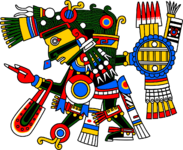
The secret of the twins Quetzalcoatl and Xolotl

HELLBOY

Core Member
Active Member
Joined
Oct 5, 2020
Messages
194
Reaction score
875
HB: I was amazed at the great parallel between Anubis and the Xoloitzcuintle Dog of Mexican origin, but I wasn't thinking of all the ramifications.
I present them to you and please give me your valuable opinion, I would like to know more about this.

19.png

Quetzalcoatl Feathered Serpent, from quetzalli 'feather' and cōhuātl 'serpent', sometimes considered the principal divinity of the Mexica pantheon. God of life, light, fertility, civilization and knowledge. Sometimes also lord of the winds and ruler of the West. Third Tezcatlipoca, associated to the white color.

According to Alfonso Caso, Quetzalcoatl was associated with the planet Venus, as the morning star, and therefore called "the precious twin" because he was considered the brother of Xolotl, the evening star.
Quetzalcoatl - Wikipedia

Xolotl.jpg

Xolotl is considered the bearer and inferno of fire. He is the twin of Quetzalcoatl. He protects the Sun when it travels through the underworld during the night. In art, Xolotl was represented as a skeleton, a man with the head of a dog (San Cristobal).
Xolotl - Wikipedia

52033968_984864091703146_5058152365677346816_n.jpg

The xoloitzcuintle is the name of the Mexican hairless dog (also known as Perro Pelón Mexicano), a canine species native to Mexico and Central America. It is one of many dog breeds native to the Americas. The name xoloitzcuintle (in Nahuatl: xólo-tl + itzcuin-tli 'Dog of Xólotl, The god of the sunset" Monstrous dog') refers to Xólotl because, historically, one of the missions of this dog was to accompany the dead in their journey into eternity, just as the god was the companion of the journey of the Sun through the underworld.

51754605_984864215036467_4630404598299885568_n.jpg

Anubis is the Greek name for the guardian of the tombs associated with death and the afterlife in Ancient Egyptian religion, master of the necropolises and patron of embalmers, depicted as a large black canid lying on its stomach, probably a jackal or wild cat, or as a man with the head of a dog. Anubis was the protector and guide of the deceased, profusely represented in funerary art.
Anubis - Wikipedia

51939232_984864221703133_2534585313766932480_n.jpg

St. Christopher is venerated by the Catholic and Orthodox Churches as a martyr killed during the reign of Decius (Decius), Emperor of Rome (who reigned from 249 to 251) or during the reign of the Roman Emperor Maximinus Daya (Maximinus II Dacianus) (who reigned from 308 to 313). There is a confusion due to the similarity of the names "Decius" and "Dacian".

His veneration appears only in late Christian traditions and he is not widely known in the Western church until the late Middle Ages, although some churches and monasteries were named after him around the seventh century.

His name means "Christ-bearer," thus predicting what he would do in his adult life and indicating that the character may not have a precise historical origin. He could be the same figure as St. Menas. His famous legend, which is known especially in the West and could have been drawn from ancient Greek mythology (it would be the Christianization of the boat of Charon), tells that he carried a boy, whom he did not know, across a river before the boy revealed to him that he was Christ. In any case, he is the patron saint of travelers, and his effigy is worn on medals, bracelets or figures for vehicles by Christians.
Charon - Wikipedia
Saint Christopher - Wikipedia

  • Now let's make the connections.
Lucero dle alba.jpg

The "Morning Star" is the planet Venus visible in the dawn sky, and in Aztec and Toltec culture, it was linked to Quetzalcoatl. Venus is also the "Evening Star" in the evening sky, and was associated with Xolotl. Mesoamerican cosmology was dualistic and through "opposite" gods, symbolized different aspects of the same reality.
If Quetzalcoatl was Life (fertility), Xolotl was Death (Underworld).
If etymologically Quetzalcoalt meant "precious", Xolotl meant "monstrous".
This apparent duality of a single Whole was staged through the belief that Xolotl and Quetzalcoatl were twin brothers.
This dualism is even evident in the name of the god himself, since "Quetzal" means "feather" and "precious", and the particle "coatl", although usually translated as "serpent", also means "twin".
Thus, Quetzalcoatl's name of "feathered serpent" is esoterically also translatable as "precious twin".

Xolotl - San Cristóbal.png

Xolotl was the "dog-headed" god (cinocephalus), who in the Codices carried on his shoulders the symbol of Christ: the cross.
This god was very similar to Saint Christopher of the Orthodox Church, the "dog-headed" saint who carried Christ on his shoulders.
Taking into account that Saint Christopher is the name of Columbus, there is another "curious" circumstance.
Since in Nahuatl the "X" is pronounced as "Ks", the terms "Xólotl" and "Colon" have an extraordinary phonetic resemblance.
Doesn't it seem to you that behind all this symbolism, there is a beautiful syncretic work, a work that testifies to a certain Christian influence?

Do you remember that just at the time of the Discovery, some paintings showed Christ and St. John the Baptist as twins?

Virgen con niño y SAn Juan -  Bernardino Luini.jpg


According to tradition, Saint Thomas was the evangelizer of the Indies. This disciple of Christ did not believe in his Resurrection until he saw it for himself.
St. Thomas was therefore "opposite" or "contrary" to the rest of the apostles, because while they believed by faith, St. Thomas only believed through his logic and experience.
We must recognize therefore, that while St. Thomas' attitude as a believer is very questionable, as a "scientist", he had an unimpeachable attitude.

Santo Tomás 3.jpg

"Because you have seen me you have believed. Blessed are those who have not seen and have believed." (John 20:29)
Thomas saw and believed, and is this not the foundation of "gnosis", to certify for oneself the existence of God?
Precisely in the Gnostic text known as "Acts of Thomas", St. Thomas is explicitly named as "twin of the Messiah", as twin of Christ.
Thus, according to Gnosticism, St. Thomas was the "twin" of Christ, just as Quetzalcoatl was the "twin" of Xolotl. And precisely during the colonization of America, Quetzalcoatl was linked with St. Thomas.

  • The friars of the XVI century tried to find the reason for the presence of the indigenous people in these lands looking for the answer in the Bible, concluding that they were part of the dispersed tribes of Israel. This was reinforced when they found figures of crosses, with which the seed of this thought was given: God had planned that some apostle would come to evangelize before the arrival of the Spaniards.
  • On the other hand, the image of Quetzalcoatl, a character that did not accept human sacrifices and who was chaste, came to the fingertips so that the friars began to consider that it was about some apostle. Fray Diego Durán says: "That venerable man, whom they call Topiltzin [...] was according to the indigenous traditions a chaste and penitent priest, of whom apparently miraculous episodes are remembered [...] this holy man was some apostle that God brought to this land" (Durán, 1967). López de Gómara adds about Quetzalcóatl that he was a virgin, penitent, honest, temperate, religious and holy man; for Fray Bartolomé de las Casas he was white, tall, with a big beard, while Fray Juan de Torquemada agrees that he was white, blond and bearded. In addition, he is credited with having brought the knowledge of agriculture and other contributions.
  • Don Carlos de Sigüenza y Góngora wrote in the second half of the XVII century (Sigüenza y Góngora, 1959) that Quetzalcóatl was the apostle Saint Thomas, who had come to preach the Gospel, which is supported by Eguiara y Eguren in his Biblioteca Mexicana when he says about Sigüenza's work: "...that Saint Thomas, one of the Twelve Apostles, had migrated to this land, whom they called Quetzalcoatl, finding the coincidence of both names by the clothing, the doctrine and the prophecies of the Apostle..." (Eguiara, 1986). But the most serious event happened in 1794, when Fray Servando Teresa de Mier was invited to give the sermon in honor of the Virgin of Guadalupe. Based on data from José Ignacio Borunda, who had written his Clave general de interpretación de los jeroglíficos mexicanos, in which he established that the tilma of Juan Diego where the guadalupana was depicted was none other than the garment of Santo Tomás/Quetzalcóatl, he lashed out against the Spaniards denying that they were the first to evangelize in New Spain, since that had been done centuries before by the apostle in the figure of Quetzalcóatl.
Indeed. For some religious of the time, the similarities between the indigenous and Christian religions could only be justified by recognizing a previous evangelization of this apostle in those lands.
And not only that.
The fact that Hernán Cortés was confused with Quetzalcoatl corroborates that the Indians also recognized a "foreign" influence in their myths. An influence that had given rise to the Toltec culture, the culture that had built the "Atlanteans of Tula".
Curiously, in Nahuatl the term "Toltec" means "builders", in the same way that in Europe, the term "Mason" meant "bricklayer". And St. Thomas, as we already know, is precisely the patron saint of builders and architects.
Yes, we have finally come up against Freemasonry.


Quetzalcoatl- Visconti.png
grecia - copia.jpg
brasc3a3o-de-armas-da-famc3adlia-visconti.jpg

In the prophecies of St. Malachy, Gregory X (1271-1276) is named as "Anguineus vid", "The man with the snake".
Such a striking appellation derives from the coat of arms of his family, the House of Visconti. It shows a man being devoured by a large snake or viper (Biscione). We will discover that this coat of arms bears an extraordinary resemblance to the representations of the Mesoamerican god Quetzalcoatl.

Precisely the twin brother of the serpent Quetzalcoatl was Xolotl, the dog-god of the Underworld. And it is curious because Marco Polo named the Tartar King of Kings, either "Great Can", in Latin "Great Dog" as Xolotl; or Great Kaaan, in Mayan "Great Serpent" as Quetzalcoalt.

From now on, to follow the European trail in America, we will have to make a very different reading of the legends existing on both sides of the Atlantic. And for this, nothing better than to start with the legend of "Preste Juan", the mythical priest-king of the Three Indies, and therefore, of America.

Visconti of Milan - Wikipedia
Prester John - Wikipedia
 
Last edited:
Yes I think here were/are two dragon gods, a female and a male. The comet venus could even interpreted as like a female dragon-god and Velikovsky interpreted Quetalcoatl as Venus.
 
If you have the time to translate this article into English you will see that it has no waste. Do not hesitate to share it because it is very related to several of the characters that appear in the post.

The relationship between the New Chronology of Fomenko and Nosovskiy and the manuscript that is the focus of this work​

April 7, 2019

The unpublished origin of official Christianity, a marriage and/or an Indian project.
Complete work in the book The Chronological Way, available on Amazon.

aqbexines.png
Previous image: coat of arms and sign of Preste Juan, according to a manuscript whose authorship refers to a 15th century chronicler of King Ferdinand of Aragon.
The manuscript

EL BECERRO General
Prester John and the King of the Abexines
The arms of the Kingdom of Hierusalem

First analysis of the manuscript: the law of the Gnostic Christ

Jesus, Thomas, the Magi, Prester John and John the Baptist
Jesus in Kashmir (India)
Jesus against Horus, Apollo, Buddha, Krishna and the Cathars
The Gnosticism of Nag Hammadi, of 1945
The Society of Jesus and the canonical Gospels
The imposition of Christianity, the result of a marriage
The reconstruction: An alliance between two empires, a marriage and Prester John of Ethiopia. The Ark of the Covenant

Second analysis of the manuscript: the historical and chronological reconstruction of the Ark of the Covenant of Solomon.

The Ark of the Covenant of Solomon and Prester John of Ethiopia
The Pope of Rome is Prester John
Discovering reality
Solomon, Sheba and Mary Magdalene
Genoa, the city of John
Everything is much more recent, and has been extended in time.

Third analysis of the manuscript: the myth of Mary Magdalene and the law of the messianic Jesus.

The emperors Constantine and Eleni, in the 15th century, and the origin of official Christianity in Occitan Provence, through the King of Naples and Jerusalem.
The Holy Grail, in Valencia
The messianic Christ, the result of a conflict of legitimacies
1453-1486, 33 years of resurrection
Babylon has always been Cairo, which means "the victorious one".
Who reconstructed history? The Society of Jesus

Fourth analysis of the manuscript: the reconstruction of the powers of the East in the West

The powers of Aragon, Portugal, the Alba and Biscay come from the East.
The Byzantine powers of the Counts of Ribagorza and Cortes, and of the Order of Constantine and St. George.
The Luna, the Ribagorza Cortés and the author of the manuscript
Hernán Cortés: the Byzantine and Catalan-Aragonese power occupying America

El origen inédito del Cristianismo oficial, un matrimonio y/o un proyecto indio
 
Last edited:
If you subdivide the name "quetzaltecutli" into Quetzal te cut li and with the knowing from the Person Erhard Landmann who thought mayan words were another dialect of old-german you got the meaning "Katze des guten Lichtes" (Cat of the good light.) And so the god Quetzaltecutli was a feathered snake with a head from a cat or a lion and with two horns.

Besides this year I was in holiday in the city "Gößweinstein" in Bavaria (Germany) and in it´s city-logo here is a feathered snake. Is here a connection ? I could not find out why they have a feathered snake in its logo.

Goess_logo.jpg
 
If you subdivide the name "quetzaltecutli" into Quetzal te cut li and with the knowing from the Person Erhard Landmann who thought mayan words were another dialect of old-german you got the meaning "Katze des guten Lichtes" (Cat of the good light.) And so the god Quetzaltecutli was a feathered snake with a head from a cat or a lion and with two horns.

Besides this year I was in holiday in the city "Gößweinstein" in Bavaria (Germany) and in it´s city-logo here is a feathered snake. Is here a connection ? I could not find out why they have a feathered snake in its logo.

The closest thing to some kind of god with snakes in Germany I find in some thread on this forum.
Oranienbrucke, Berlin: SH Archive - Single Photo: Lamp post at the Oranienbrucke, Berlin
Kyffhäuser monument.

It has a lot of mythical and occult symbolism, including snakes. "Wise snakes or the demiurge?

K mon 4.jpeg
  • Fuel for the imagination:​

′′′ Mythology ′′ of a snake man ′′ has ancient roots. Nags are depicted with the head of a man. Nag is a symbol of wisdom. There is a snake cult and related festivals. They suggest that snake-nag was the totem of one of the powerful ancient tribes, which was called feet. Patanjali sage is depicted in the form of a nag, the upper half of which has a human appearance. It is claimed that the nags kept the truth secret until people matured to understand it. The planets of Mahatala and Patala (Nagaloka) are inhabited by feet. In the form of a serpent it represents kundalini, the energy raised in man under spiritual practice from the lower psychophysiological center (chakra) to the higher one where fusion with God occurs. Nag Muchalinda protected Buddha from the burning sun with his hood during his meditation before enlightenment.
In Chinese mythology, the ancestor of humanity, the goddess New, and her brother and husband, the first ruler Fusi, are depicted in the form of legs."

  • In the framework of Hinduism, the god Balarama is the elder brother of the god Krisná. Balarama - Wikipedia

In the Bhagavata-purana it is described that after Balarama took part in the battle that caused the destruction of the entire entire Iadu dynasty complete, and after he saw the death of Krisná, he sat down to meditate and passed away.

In other traditions it is said that then a great white serpent came out of the mouth of Balarama, as a reference to his identity as Ananta Sesha (Shesha is a divine male serpent, king of all the nagas (snakes), one of the primordial beings of creation). Shesha - Wikipedia

  • Would the Feathered Serpent Quetzalcoatl be something similar?​

  • The scales were passed for feathers.​

Death_of_Bala_Rama.jpg
These gods in India are very much like watching a movie with lots of special effects.

These characters could be our first demons and gods, I understand that very feared demons suddenly became kind. As if they were psychopathic beings!

"Psychopathy is a personality disorder characterized by narcissism, impulsivity, and controlling and manipulative behaviors. It is often confused with sociopathy, but shows slight differences, not always noticeable to the normal population."

  • I think these Indian gods are similar to the blue lamp genies that coincide with psychopathy (they do not know right from wrong).

    According to the Koran, a book that mentions them about twenty-nine times, they are created from fire (as it says in the sura Ar-Rahman, verses 14 and 158) to worship God, they are endowed with free will and will be judged with humans on the Day of Judgment. In one passage it is even stated that Iblis is "of the lineage of the jinn", Invisible to the human eye, they can take different forms and influence people in a spiritual and psychic way, by means of suggestion or even possession, but they do not do it in a habitual way. Jinn - Wikipedia

Genie_poppy_Dur_Sharrukin_Louvre_AO19869.jpg
I have seen that the gods of different civilizations are usually Blue, Red, Green, White, etc.
I remember for example that Marduk was Red, he had his pet dragon. Would they be the ones who made all these varieties of fantastic animals?
img.jpg
I saw these data in some video and I launched these statements or rather questions...
Are these gods the famous Vampires?
The vedas, Veda+Empire = Vempire
Did you know that red mercury could make "vampires" fly?
Antimony Red Mercury + Oxide
Formula: Sb2O7Hg2 = Hg2 + 2SB + 3 O + O 2
Appearance: cherry red metal liquid
Application: Mainly used in rockets, missiles, military prospecting areas...

vimanas.jpg
Vampires need 3 basic elements to be able to fly their Vimanas, these are:
Garlic, red mercury and lots of gold?
Did you know that UFOs usually smell very bad... Garlic?

ajo.jpg
This all sounds pretty crazy, doesn't it?
What do you think about all this?
 
I noticed that xolotl/tezcatlipoca looks like a modern human with handbag, smartphone and another material things.
Xolotl/tezcatlipoca is also called god of material and opponent of quetzalcoatl. For me quetzalcoatl is like the god or messiah of the life and Xolotl/tezcatlipoca is like the enemy of the life.
 

Attachments

  • Tezcatlipoca_B.svg.png
    Tezcatlipoca_B.svg.png
    505.2 KB · Views: 266
I noticed that xolotl/tezcatlipoca looks like a modern human with handbag, smartphone and another material things.
Xolotl/tezcatlipoca is also called god of material and opponent of quetzalcoatl. For me quetzalcoatl is like the god or messiah of the life and Xolotl/tezcatlipoca is like the enemy of the life.
The gods seem to be archetypes: original model that serves as a guideline to imitate, reproduce or copy, or ideal prototype that serves as an example of perfection of something.
No doubt I find it interesting that so many figurines from different cultures are so similar, if you are interested in seeing this type of figurines I am talking about, I recommend you to visit these sites that specialize in that.
Zaloguj się do Facebooka
https://www.facebook.com/groups/1348678738541574/user/100004865586574
 
A few days ago I saw the 2nd episode of "Acient Aliens" on Netflix and I wondered why people hope for creating a mixed being throught organ transplantation and embryo-experiments and are so fascinated by the figure of the leviathan or the apocalyptic beast with 7 heads. Are these people who have worshipped the beast and after its death hope that it will soon rise again ? Could gene therapy be the key for mutating human-DNA into something like the beast ?
 
A few days ago I saw the 2nd episode of "Acient Aliens" on Netflix and I wondered why people hope for creating a mixed being throught organ transplantation and embryo-experiments and are so fascinated by the figure of the leviathan or the apocalyptic beast with 7 heads. Are these people who have worshipped the beast and after its death hope that it will soon rise again ? Could gene therapy be the key for mutating human-DNA into something like the beast ?
Perhaps they wanted to tell us that duality is within us...but as rationalistic beings we only appreciate our "good side".

"Symbology is not an exact science, but it is not exempt from rules and procedures that make it a "standardized" and "normalized" subject. In the manner of specialists in ancient languages (Greek, Latin, Sanskrit, Hebrew, Sumerian, Akkadian, Coptic, etc.) in relation to manuscripts or inscriptions of the past, the "initiates" (those who know the "symbols") are competent to unravel the hidden meaning of myths."
Competence in symbology makes it possible to identify the messages encrypted in the primordial Tradition (myths, folklore), as well as in certain passages with esoteric reading of standardized religions.
Carl Gustav Jung asserts that these signifying units (symbols) can emerge in dreams or in the hallucinations of modern man, since they somehow remain latent in the "collective unconscious" that we have inherited from our ancestors.
 
I thought of something else. In Norse mythology, two giant beasts played a major role in the end of the world Ragnarok. These were the Midgard Serpent and the Fenris Wolf. The two had been of course also brothers and sisters. Interesting is by the way also that creation myths in Oceania and the Asian area are associated rather with snake gods while creation myths around the Mediterranean/Turkey/Mongolia is associated rather with a wolf (see the wolf which suckled one or two children).
 
I thought of something else. In Norse mythology, two giant beasts played a major role in the end of the world Ragnarok. These were the Midgard Serpent and the Fenris Wolf. The two had been of course also brothers and sisters. Interesting is by the way also that creation myths in Oceania and the Asian area are associated rather with snake gods while creation myths around the Mediterranean/Turkey/Mongolia is associated rather with a wolf (see the wolf which suckled one or two children).
Here I have an explanation that I found about the archetypes, you tell me what you think.
The mythological archetypes
An archetype is a recurrent symbol or motif that constantly appears in narratives and myths, sometimes under different names, but always with the same attributions. Some of the most widespread archetypes in world religions are:
The Heavenly Father, also called "king of heaven". He is the god of the luminous sky.
Among the Greeks, the original Sky God was Uranus ("the one who urinates", because of the rain), but his cult was extinguished to give way to that of Zeus. His most ancient name was Dieus, from which he passed to the Vedic Dyaus, which in Greek became Zeus. The Romans first called him Dyeu pater, then Dyu piter, and whom we know as Jupiter, associated with fertility, thunder and clouds.
In Finnish mythology he is called Ukko: he has a hammer that causes thunder and is god of crops. Among the Hawaiians he is called Wākea. And in Norse mythology it corresponds to Týr or Tiw, in whose honor the second day of the week was named tīwesdæg which in English became tuesday. In Chinese mythology the sky is Tian and has the attributes of the masculine, the active and the luminous. Being one of the most important archetypes, it is not surprising that the Indo-European term Dieus, became the unique "God" in monotheistic religions.
Mother Earth has been venerated in many religions. The Greeks had Gaia, primordial goddess and mother of all life. She was also the mother of Uranus, whom she married. The Romans called her Tella (from which comes the adjective "telluric") and then Terra and her cult was associated with that of Ceres, goddess of agriculture. The Chinese have Houtu as goddess of the earth, mistress of all the local gods. The Incas called her Pachamama: she personified the mountains and earthquakes and was conceived as the origin of everything. And in Norse mythology she was the goddess Sif, whose golden hair represented the wheat fields, and was married to Thor, god of thunder. The pair mother earth - heavenly father is abundant in the religions of the world but, curiously, the Egyptians thought the other way around: the heavenly mother is Nut, goddess of the stars and astronomy and Geb the god of the earth, who made the crops grow and whose laughter caused earthquakes.
Anubis, the embalmer, protector of the tombs. Anubis weighed the hearts of souls and, if they weighed less than an ostrich feather, they could go to heaven. Xolotl, the dog god of the Aztecs who guided the souls to the Mictlan, The Greeks had Charon, who crossed the river Styx with his boat to the land of the dead. The mourners put a coin in the mouth of the deceased to pay for the passage. The Norse Valkyries escorted the warriors killed in battle to Valhalla.
The god of death and judgment. Almost all cultures have a god of the "afterlife" who judges the dead. Mictlantecutli rules the mictlan of the Mexica and Pluto or Hades rules the underworld of the Greeks.
The god of the sun. In practically all cultures the sun has been worshipped: intuitively it has been recognized as the source of energy and life. For the Mexica it was Tonatiuh, associated with the eagles for their movement across the sky, and for the Incas it was Inti, founder of Cusco and origin of the lineage of rulers. For the Greeks and Romans, Helios, who drove his chariot through the firmament, and who was later identified with the god Apollo, god of healing, truth, prophecy and light. Although in most religions the sun is masculine, for the Japanese it is feminine and is personified in the goddess Amaterasu. The Germanic people also saw the sun as female and called her Sun or Sunna, and she was the sister of Máni, god of the moon.
Narrative elements called myths, which are repeated from religion to religion: such as the world tree, the cultural hero or creation from chaos. A very widespread myth is that of the god who resurrects: a divine being who faces death, descends to the underworld and comes back to life. This is present in the myth of the Egyptian Osiris, the Sumerian Tammuz, the Phrygian Attis, the Greek Adonis and of course the Christian Jesus Christ. Even the Aztecs had Nanahuatzin, the most humble god, who sacrificed himself on a bonfire to enlighten the world by becoming the sun.
Why do these archetypes appear again and again, in such different cultures?
There are three theories:
The first is that of common origin.
This says that all myths had their origin in the same place, in a primitive culture tens of thousands of years ago, and that all the myths of the world are descendants of this primitive culture.
The second is that of diffusion: when different cultures interact, they share and exchange myths that can then spread throughout the world.
The third is properly called "archetypal": it says that those who create and tell the stories, even if they do not know each other, have similar characteristics of creative thinking and face the same natural phenomena, so they end up producing similar myths.
For example: it is thought that the idea of divinity that dies and resurrects has its origin in the annual cycles of the seasons: in them there is a time in which everything must die, to be reborn in the spring. It is no coincidence that Catholics and other Christians celebrate the resurrection of Jesus on the first Sunday after the full moon following the spring equinox in the northern hemisphere. The idea of the archetype assumes that these psychosocial patterns are universal and that when a story is created to explain something universal, such as the creation of the world, the power of desire or the inevitability of death, the resulting narratives resonate with individual minds and the collective imagination, and propagate through time and space because, deep down, we humans are more alike than we think.
 
There is still a fourth possibility which Immanuel Velikovsky had already suspected; World-wide big events which were perceived by all people on the earth.
And aspects of these world events were made to gods, because they could not have been understood or processed as a big whole.
 
There is still a fourth possibility which Immanuel Velikovsky had already suspected; World-wide big events which were perceived by all people on the earth.
And aspects of these world events were made to gods, because they could not have been understood or processed as a big whole.
I remember reading a thread about him here on the forum, His books use comparative mythology and ancient literary sources to argue that the Earth suffered catastrophic close contacts with other planets (mainly Venus and Mars) in antiquity.

I also like the work that Fomenko has done, because he has discovered so many historical parallels between histories that should be separated by many years or millennia, which already reveals an obvious chronological lengthening of our history.

For example this small example:

In it, King Arthur is identified with Khan Dmitryi Donskoy (Emperor Constantine) and also with the biblical David. Arthur's well-known battle with a fierce giant is David fighting Goliath. That is once again the battle of Kulikovo. The famous traitor Modred or Mordred who rebelled against Arthur is the reflection of the Gospel King Herod and also, to a greater extent, Judas Iscariot. The scheming Judas is also reflected in the image of King Arthur...
The literature devoted to the legends of Arthur and their reflection in the fictional literature of different times and different people is truly vast.
Jousts (i.e., ancient "gladiatorial" tournaments). In the case of Heracles the picture is similar. The middle of his 'biography' are the 12 famous heroic deeds. They are identical to the tilting matches. Herakles fights various characters and monsters, in addition to this there are some mentions of 'fair damsels'. The "ancient" Heracles behaves like a medieval knight.
We discovered that the 12 heroic deeds of Heracles correspond to the zodiacal constellations. Moreover, it turned out that in some of the constellations the planets were specified. Therefore, the description of the heroic deeds of Heracles is an encrypted zodiac.
We have dated it. It turned out that the astronomical solution exists (which at first glance was far from obvious). More than that, as a result there was a single-digit date, i.e., year 1513. Thus, the beginning and the end of the "biography" of Heracles is one of the first descriptions of the life of Andronicus: Christ. The middle was composed of the events of the XV-XVI centuries.
The image of Andronicus-Christ was strongly reflected both in the real, ancestral Christianity and in the people of the apostles. In royal Christianity he was depicted in particular as the hero and demi-god Herakles (and also as Zeus, Apollo-Apolonius, Dionysus, etc.). It was real Christianity that produced a branch called Judaism with its skeptical attitude towards Christ. Moreover, it turned out that the "biography" of the famous "ancient" hero Theseus (Theos = God) consists of the events of the 12th and 16th centuries cc. By the way, this is already familiar to us from the story of the life of Heracles, which consists of two layers: the story of Andronicus-Christ of the XII century and the events of the XV-XVI centuries.
 
Could they be all these archetypes?

On December 25 before Christ, veterans of the legions, workers, patricians and in general people of all social strata, after a family dinner, moved to the outskirts of the capital of the Empire and in general all the big cities, where there were illuminated temples in honor of Mithra. All the enclosure shone in the light of candles and oil lamps. The priests are dressed in pristine white behind the altar, several children light incense. All fervently believe in Mithras, the good God who came down from heaven and cleansed from sin all Humanity: He was reincarnated as a man and was born in a stable on December 25 in Egyptian lands, where Isis was also worshiped with a child Horus in her arms, the redeemer and savior of humanity....25 of December before Christ; gladiators, prisoners, noblemen in Egypt, Hispania, Gaul or Denmark, all pray to the child God. Hundreds of years later the Roman Catholic Pope Liberius in 354 A.D. made this festivity coincide with that of the birth of Christ to make them coincide and overshadow the millenary celebrations of the paganism of the Unconquered Sun: Old wine in new wineskins.

269723164_1061827277986348_1873459271203273830_n.jpg
269739803_1061827784652964_7168033448444674068_n.jpg
0631be9eb841c39ae729e7770d7e3e50.jpg
269710946_1061827367986339_3308177863105210820_n.jpg
269738755_1061827787986297_7257443799281839723_n.jpg


« Every thousand years a Buddha is born. In my dream the Buddha is born in the middle of the night. A star shines in the sky to announce the birth… When the first rays of the sun touch the knot of the tree, a huge snake comes out. …By some intuition, I form a circle touching the right hip with the right arm ...the snake introduces what it can of its head into the circle, and then I know that the danger has passed. ».
--Robert Johnson, The Balance Between Heaven and Earth

Anthropomorphic Olmec sculpture (1200-900 BC). Imposing-looking male character sitting in a lotus flower position, holding a rattlesnake firmly with his hands.
Particularly notable for his attire, a thick cape, well manufactured and depicted, fastened by a square knot, recalling representations of Heracles / Hercules from the Greco-Roman world, albeit older, or at least contemporary to the earliest Greek artistic manifestations of its kind.

Herakleotikon Hamma, Heracles Knot, Hercules, square or reef knot, It would be "just a knot", but this type of link carries enormous significance; from ancient Egypt to China; from India, where it was the naga symbol par excellence, to South America, Africa and the Greco-Roman world, its meaning varies little, protection, knowledge, healing, unity, good fortune. The link that unites our material world with the spiritual one, the axis of the world.
What is the probability that such cultures can "converge" in such a precise and specific symbologies, without the existence of a contact?

264550459_1075961819896568_406315794112040432_n.jpg

262438611_1075962139896536_7969257363865209795_n.jpg
263463459_1075962659896484_3791651459582755743_n.jpg
262506469_1076028833223200_3447445447995513603_n.jpg
262114250_1076028753223208_5859545889672669329_n.jpg
263291543_1076022099890540_4220686248388749670_n.jpg


The archetypes, the access key to the Unconscious mind
The symbolic representations of the archetypes do not become obsolete, they are adapted to the new times.
According to Jung, the human mind is populated by innate instincts and archetypes, universal symbols such as the great mother, the wise old man, the shadow, the tower, the water, the tree of life and others. He considered that these symbols supported and surrounded the unconscious mind, exerting a profound influence on the lives of individuals, who lived according to these symbols and clothed them with meaning through their experiences, forming what he called the "collective unconscious".
According to his research, their importance is such that they constitute "the precondition and the natal soil of every conscious mental event and, for this very reason, it is an influence that greatly compromises the freedom of consciousness"
That is, this collective unconscious does not develop individually but is hereditary, and its pre-existing forms, the archetypes, are only secondarily conscious, giving definite forms to the psychic contents of the individual.

To what extent has this innate and inherent human symbolism been used to shape his mind and behavior throughout history?

263605458_1075961753229908_6072821541732999212_n.jpg
262780617_1075963853229698_1553790890322181991_n.jpg
264090820_1075962706563146_7105511477128888082_n.jpg
264225053_1075975639895186_3226188142342219497_n.jpg
264213689_1076028559889894_4719132776940167094_n.jpg
Previously they reached the masses through sculpture, painting, engravings, stelae, in such a way that they reaffirmed and fixed ideas in the mind of the observer; rulers, religions, commerce soon found their usefulness; Today they have found their best ally in the media, the message continues to be directed, to sow in the unconscious mind what the interests of governments, corporations and the media at their service, those unconscious impulses with which they want to direct behavior. of the population, in favor of course, of their own interests.
 
Last edited:
Could they be all these archetypes?

On December 25 before Christ, veterans of the legions, workers, patricians and in general people of all social strata, after a family dinner, moved to the outskirts of the capital of the Empire and in general all the big cities, where there were illuminated temples in honor of Mithra. All the enclosure shone in the light of candles and oil lamps. The priests are dressed in pristine white behind the altar, several children light incense. All fervently believe in Mithras, the good God who came down from heaven and cleansed from sin all Humanity: He was reincarnated as a man and was born in a stable on December 25 in Egyptian lands, where Isis was also worshiped with a child Horus in her arms, the redeemer and savior of humanity....25 of December before Christ; gladiators, prisoners, noblemen in Egypt, Hispania, Gaul or Denmark, all pray to the child God. Hundreds of years later the Roman Catholic Pope Liberius in 354 A.D. made this festivity coincide with that of the birth of Christ to make them coincide and overshadow the millenary celebrations of the paganism of the Unconquered Sun: Old wine in new wineskins.

« Every thousand years a Buddha is born. In my dream the Buddha is born in the middle of the night. A star shines in the sky to announce the birth… When the first rays of the sun touch the knot of the tree, a huge snake comes out. …By some intuition, I form a circle touching the right hip with the right arm ...the snake introduces what it can of its head into the circle, and then I know that the danger has passed. ».
--Robert Johnson, The Balance Between Heaven and Earth

Anthropomorphic Olmec sculpture (1200-900 BC). Imposing-looking male character sitting in a lotus flower position, holding a rattlesnake firmly with his hands.
Particularly notable for his attire, a thick cape, well manufactured and depicted, fastened by a square knot, recalling representations of Heracles / Hercules from the Greco-Roman world, albeit older, or at least contemporary to the earliest Greek artistic manifestations of its kind.

Herakleotikon Hamma, Heracles Knot, Hercules, square or reef knot, It would be "just a knot", but this type of link carries enormous significance; from ancient Egypt to China; from India, where it was the naga symbol par excellence, to South America, Africa and the Greco-Roman world, its meaning varies little, protection, knowledge, healing, unity, good fortune. The link that unites our material world with the spiritual one, the axis of the world.
What is the probability that such cultures can "converge" in such a precise and specific symbologies, without the existence of a contact?


The archetypes, the access key to the Unconscious mind
The symbolic representations of the archetypes do not become obsolete, they are adapted to the new times.
According to Jung, the human mind is populated by innate instincts and archetypes, universal symbols such as the great mother, the wise old man, the shadow, the tower, the water, the tree of life and others. He considered that these symbols supported and surrounded the unconscious mind, exerting a profound influence on the lives of individuals, who lived according to these symbols and clothed them with meaning through their experiences, forming what he called the "collective unconscious".
According to his research, their importance is such that they constitute "the precondition and the natal soil of every conscious mental event and, for this very reason, it is an influence that greatly compromises the freedom of consciousness"
That is, this collective unconscious does not develop individually but is hereditary, and its pre-existing forms, the archetypes, are only secondarily conscious, giving definite forms to the psychic contents of the individual.

To what extent has this innate and inherent human symbolism been used to shape his mind and behavior throughout history?

Previously they reached the masses through sculpture, painting, engravings, stelae, in such a way that they reaffirmed and fixed ideas in the mind of the observer; rulers, religions, commerce soon found their usefulness; Today they have found their best ally in the media, the message continues to be directed, to sow in the unconscious mind what the interests of governments, corporations and the media at their service, those unconscious impulses with which they want to direct behavior. of the population, in favor of course, of their own interests.
As far as the story surrounding Jesus Christ is concerned, "Je suis Christus" means something like "I am the Crucified One." Linguist Erhard Landmann claimed that originally, however, the name was "Je suis fiscus" from Old High German and that meant "I am the fish." This would only be logical since the symbol of Christianity is actually the fish and the Pope's cap represents a fish head.
In my view, there was a great fish god who had come to earth and whom people actually worshiped. However, this fish god was split into two beings, e.g. turtle and snake/dragon or wolf and snake. This being had not without reason strong similarities with a tadpole or a gigantic white whale (see Moby Dick) and had been important for our earth. I think it was about the fertilization and transformation of the earth into a higher humankind. The original true name of Jesus is distorted by the false name as "Crucified One". However, Jesus as the child of Mary represents the new humanity that is developing and has not actually been born yet.
 
As far as the story surrounding Jesus Christ is concerned, "Je suis Christus" means something like "I am the Crucified One." Linguist Erhard Landmann claimed that originally, however, the name was "Je suis fiscus" from Old High German and that meant "I am the fish." This would only be logical since the symbol of Christianity is actually the fish and the Pope's cap represents a fish head.
In my view, there was a great fish god who had come to earth and whom people actually worshiped. However, this fish god was split into two beings, e.g. turtle and snake/dragon or wolf and snake. This being had not without reason strong similarities with a tadpole or a gigantic white whale (see Moby Dick) and had been important for our earth. I think it was about the fertilization and transformation of the earth into a higher humankind. The original true name of Jesus is distorted by the false name as "Crucified One". However, Jesus as the child of Mary represents the new humanity that is developing and has not actually been born yet.
  • The Statue of Liberty could be another archetype of several goddesses.
The French sculptor Frederic Bartholdi Frédéric Auguste Bartholdi - Wikipedia designed the Statue of Liberty. Bartholdi did not originate the concept of the statue. The idea of creating a statue of liberty and liberation was first proposed by another Frenchman by the name of Edward Laboulaye Édouard René de Laboulaye - Wikipedia . It was Laboulaye's idea and determination during the American Civil War that took the idea from a simple notion to a real project. Laboulaye, a French Mason proposed the idea of a giant statue replicating a goddess that the Masonic movement idolized.

Laboulaye proceeded to raise financial support and commission Bartholdi to provide the sculpture of this goddess of enlightenment of antiquity. What deity was this? It was the goddess known by several names.

Laboulaye and his fellow Mason, the sculptor Bartholdi referred to her as "Libertas" but she was also early adopted by the Romans from the Babylonian goddess Ishtar or also called Innana.

Libertas was the name of an ancient Roman goddess adopted by the Romans perhaps as early as the fifth century BC and certainly by the fourth century BC. She was referred to as the goddess of personal liberation and freedom. In fact Libertas meant freedom. So freedom means liberation and vice versa.

This goddess was the goddess of freedom, because she promoted the ideals of personal freedom/liberation to do whatever felt good. She was called the matron goddess of prostitution because she promoted gender freedom. In fact, she had invented the concept.
Slaves considered her their goddess in hopes of gaining their freedom. Many women who gained freedom later returned to prostitution to survive and thus retained Libertas as their goddess, especially if they became priestesses in the cult of Libertas. Libertas was also a goddess of Liberty was also a goddess of war in order to fight for freedom. She is also sometimes referred to as the goddess of victory, because freedom must have victory in order to survive. This goddess was also the goddess of immigrants. The idea of immigration connoted the idea of freedom. Her popularity was also unique because of her unique doctrine of listening to personal prayers. This unique doctrine was something that most pagan deity doctrines were unwilling to accept.

Gaius_Cassius_Longinus_and_Lentulus_Spinther._42_BC._AR_Denarius.jpg
248496172_1026848348091316_5071661556640332286_n.png
We know that this goddess existed because of the records left to us. We have the ancient writings of Cicero who writes of this goddess and her Temple on the Aventine Way in Rome. She was depicted on some Roman coins wearing a cap of liberty and having a crown along with a spear or sometimes a sword.
Such coin images were not the only depictions. Sometimes she was well dressed and at other times seductively nude in both sculptures and paintings. We know Libertas was known as the Mother of Harlots by the famous Roman historian (and senator) Cicero. Cicero indicates that she was also a very ancient goddess of the Greeks, even before the early and developed Roman civilization.

In Sumer Innana, granddaughter of Enlil, was the Goddess of Freedom, Love, Innana in the Annunakis was the one who abolished human slavery along with Enki, and decided to stay on earth to stop the evil plans of her ex-boyfriend Marduck to enslave humanity.
Then we find that the Greeks had had knowledge of this being from ancient empires in the Middle East and Egypt. This goddess was called Astarte in Hebrew and in the Greek version of the Old Testament (the Septuagint). Astarte came to be transcribed into Greek as Astarte, which became the early Greek name for the goddess until it was later changed to Aphrodite. The Hebrew term Astarte was itself a transliteration of the Babylonian (Akkadian) dialect term for Ishtar.
Ishtar in the earliest of times was also mentioned by the Sumerian dialect as Inanna meaning The Spoiled One Of Annu.
The Hittites called her Shaushka. The Phoenicians in Cypress initially referred to her as Astarte. Isis was the name the Egyptians gave her. This is how the goddess came to be introduced to the early Greeks. We know this transformation in part due to written texts found by archaeologists in addition to the study of character traits and descriptions. For example, all of these deities were actually one goddess and she was associated with the planet Venus.
Most had phonetic linguistic roots in the transliterated aspects of the name Ishtar and this remained so until the Greeks changed the name to Aphrodite. Later, the Romans referred to her in Latin, initially as Libertas and later as Venus when they accepted more than just the doctrines of Liberty.
Inanna - Wikipedia
Astarte - Wikipedia
Aphrodite - Wikipedia
Isis - Wikipedia
Libertas - Wikipedia
 
This reminds me that in John's Revelation I am puzzled why the whore Babylon has similar characteristics to the mother Mary of Jesus. Are they two sides of one and the same goddess ? That is like with the two women of Adam Eve and Lilith. Eve was the submissive good woman while Lilith was the woman with strong love of freedom and independence.
We are just getting off the subject of the Mexican god twins or it also has something to do with this goddess.
 
This reminds me that in John's Revelation I am puzzled why the whore Babylon has similar characteristics to the mother Mary of Jesus. Are they two sides of one and the same goddess ? That is like with the two women of Adam Eve and Lilith. Eve was the submissive good woman while Lilith was the woman with strong love of freedom and independence.
We are just getting off the subject of the Mexican god twins or it also has something to do with this goddess.
I think it went from being "The secret of the twins Quetzalcoatl and Xolotl" to a different title, perhaps the use of archetypes to represent the same ideas. I was not sure whether to dedicate a thread to each archetype or parallel between gods and finally decided to join them in this one.
Who are those people who insisted on introducing this type of symbols?
History has a tremendous disorder or I don't know how to call it, I have seen here threads with different parallels such as: Napoleon and Hitler, Lincoln and Kennedy, Julius Caesar and Jesus Christ, and others that at the moment I don't remember.
The Swastika is another symbol that appears in several cultures for example, and in fact there is another interesting detail here:
The "Cantigas de Santa Maria" was a work done by Alfonso X the Wise in approximately the year 1285, a year in which the Inquisition was fighting to eradicate the Cathar heresy in Europe. Las "Cantigas de Santa María" - Szukaj w Google

Cantigas de Santa María- esvástica.png

It is not by chance that the Hindu symbol of the swastika appears in a work dedicated to the Virgin Mary, the mysticism of the East treasures the keys to decipher the strange language of the gnosis of the West, a gnosis, which is also intimately linked to Mary.
Nor is it by chance that the Chrismon of Christianity is so similar to the Wheel of Dharma of Hinduism, Buddhism or Jainism.

rueda-dharma.jpg
unnamed.jpg

Nor is it a coincidence that while in the West, the Dharma Wheel or Chrismon is guarded by lions, solar animals, in the East, the Dharma Wheel or Chrismon is guarded by deer, lunar animals.

The West, as a solar culture, has deepened in the conquest of the Outer and Material World, but the East, as a lunar culture, has deepened in the Inner and Spiritual World.

East and West thus stage the duality of our own Humanity, a Humanity that, like our own mind, is always debating between reason (sun) and faith (moon).

unnamed (1).jpg
rueda-del-dharma.jpg

The Sun, in Greek mythology the solar god Apollo, was the twin brother of the lunar goddess Artemis (Diana in Roman mythology).

According to Greco-Latin mythology, the animals that pulled the celestial chariot of Artemis were precisely deer.

As deer were consecrated to this goddess, Artemis was often depicted with this animal.

In Greek mythology, the hunt for the Cerinea deer with golden horns and bronze feet, present in the myth of Heracles, represents the pursuit of wisdom.

And the deer, like the lamb, is a symbol that since ancient times has been associated with the soul of the spiritual seeker, the soul of the mystic who longs for union with God.

But five centuries before the birth of Jesus, deer already symbolized within Buddhism the gentleness and meekness of the bodhisattwas, the disciples who seek enlightenment, desiring not only their personal salvation, but also the salvation of their fellow men.

The Buddha's teachings were based precisely on the so-called "Middle Way". For this reason, bodhisattwas always strive to attain the virtue of the "middle way" also pointed out by Aristotle.

Just as the midpoint between a positive number and its negative is zero, the devotee should strive to attain such deep inner peace that even thoughts cease in his mind. For only an empty vessel can be filled with water, and only an empty mind can be filled with divine wisdom.

The Dharma Wheel that stands between the Buddha deer represents the union of "great joy" and "emptiness".

Sun and Moon, Day and Night as well as Xolotl and Quetzalcoatl sound quite similar to me.
 
We are in a similar phase where the Thunderboltsproject started to interpret all possible symbols as cosmic world events. Only the Thunderboltsproject had interpreted the symbols mainly with a Venus - and Mars catastrophe under consideration of a spherical earth and the electric universe. In our forum here, however, the spherical earth is not particularly considered, but there is the idea of a flat earth, crater earth, concave earth or just my theory of the embryo earth theory. An important reason why I had come away from the Thunderboltsproject has to do with it, because I thought that the surface structures of the earth could have been formed not necessarily by electrical plasma events, but could be also biological origin. The biological structures of blood veins look just very similar to those of Lichtenberg figures from electrical discharges.
Generally I would say that we could also run a thread where it could be generally about similarities between symbols/gods and natural events. We don't have to come up with the same interpretations as the Thunderboltsproject.
 
Tips
Tips
Please respect our Posting Rules.
Back
Top