SH Archive 1684: Machine de Marly

SH.org OP Username
Mojo923
SH.org OP Date
2019-12-11 20:19:07
SH.org Reaction Score
18
SH.org Reply Count
37

Archive

Old SH Archive
Joined
Sep 8, 2020
Messages
17,737
Reaction score
3,164
Doing some in depth research about the Palace of Versailles, I came across a very impressive machine. I believe this one deserves a discussion.

From here: "The Machine de Marly was one of these such puzzles. The design of the machine was very advanced for its time and consisted of a hydraulic system, the purpose of which was to supply the Palace of Versailles with water. The Palace of Versailles is a marvel to witness; its architectural splendor and opulence make it an incredibly well-known and highly frequented tourist attraction."
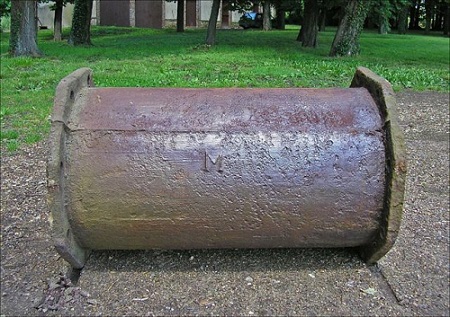
pipe-element-from-the-marly-machine.jpg
Pipe element from the Marly Machine.

Wiki tells us: From the beginning, the construction of the château and the park of Versailles water supply had posed a problem. The site chosen by Louis XIV, a former hunting lodge of Louis XIII, was far removed from any river and high in elevation. The sovereign's will to have a park with more and more basins, water jets and fountains became a hallmark of his reign by the extension and improvement of a permanent water supply system with the construction of new pumps, aqueducts and reservoirs to collect ever more water, from a greater and greater distance.
  • The idea to bring water from the Seine to Versailles had always been under consideration. But more than just the distance - the river is located nearly 10 km from the château - there was the problem of the elevation to ascend, nearly 150 meters (490 feet). Since 1670, Jean-Baptiste Colbert, Louis XIV's Superintendent of the King's Buildings, had opposed several projects, including one proposed by Jacques de Manse, both for reasons of feasibility and that of cost.
  • But Arnold de Ville (1653-1722), a young and ambitious bourgeois of Huy in the Province of Liège, who had already built a pump in Saint-Maur, succeeded in submitting to the king his project for pumping the waters of the River Seine to the Château of Val in the forest of Saint-Germain, demonstrating that the same could be done to supply Versailles. This machine, a sort of small scale model of what the Machine of Marly could be, impressed the king, who then entrusted him with the development of a machine on the Seine to supply not only the gardens of Versailles, but also those of the Chateau of Marly then under construction.
So who is this "architect"?

Well as it turns out, Arnold wasn't even an architect at all.
From here: "A solution to the problem was submitted by a young and ambitious lawyer named Arnold de Ville, who despite his lack of formal training in the field of engineering had successfully built a hydraulic machine to draw water from a river and supply Château de Modave back in his homeland in Belgium. de Ville submitted a similar design for the Palace of Versailles, only this was to be several times larger in magnitude."

Not a lot of info that I could find about him.

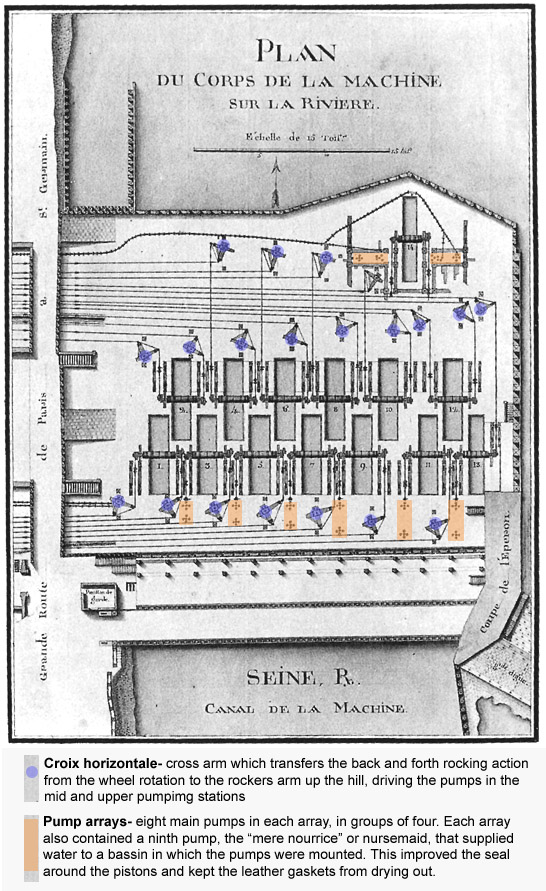
Details of the machine. From here:
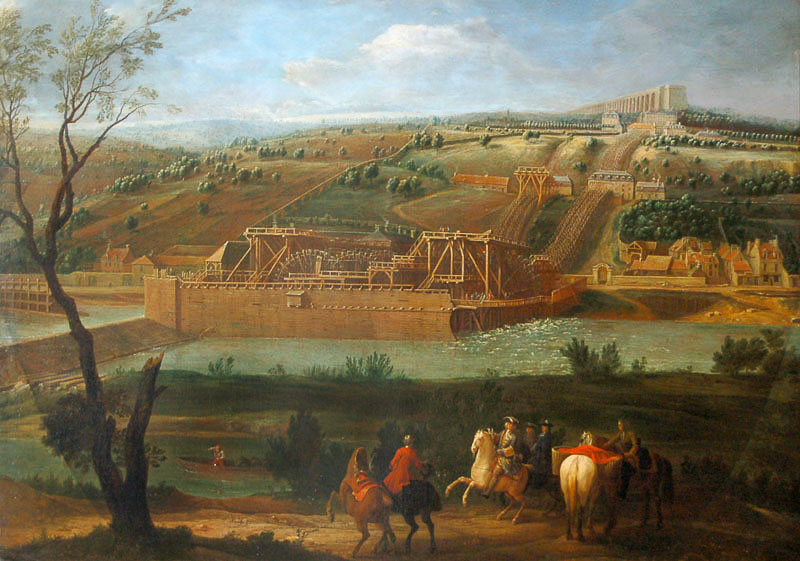
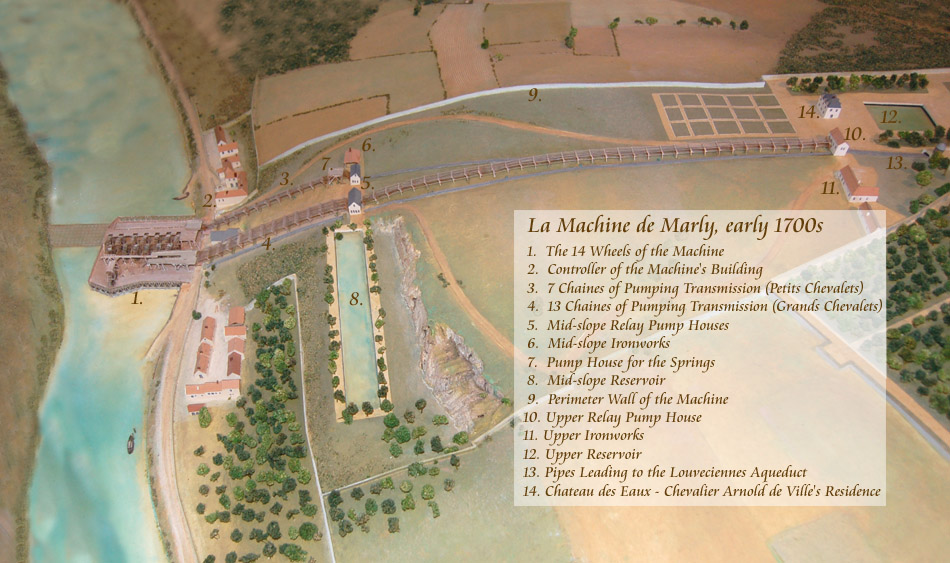
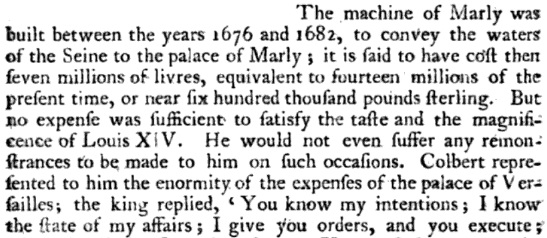
  • The "machine" of Marly was a civil engineering marvel located at the bottom of the hill of Louveciennes, on the banks of the Seine about 12 kms from Paris. Louis XIV had it constructed to pump water from the river to his chateaux of Versailles and Marly. The construction lasted 7 years and was inaugurated in the presence of the King in June 1684. It was considered a wonder of the world at the time, and may have been the largest system of integrated machinery ever assembled to that date.
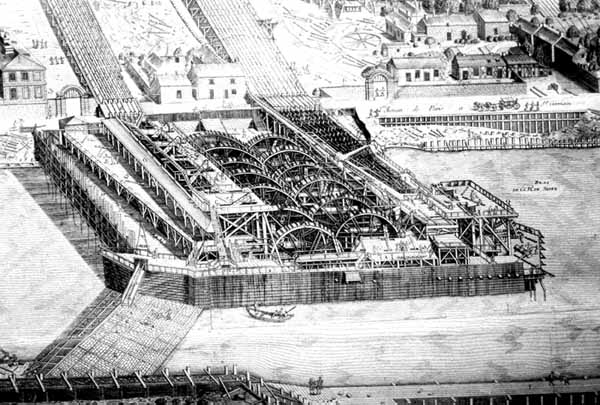
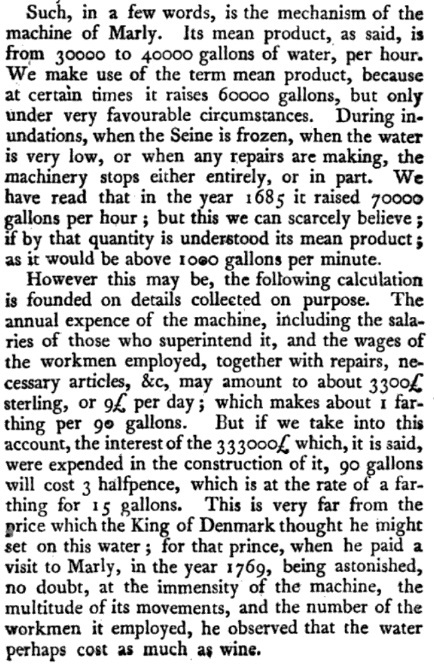
  • Fourteen paddle wheels, each about 38 feet in diameter, were turned by the Seine to power more than 250 pumps, forcing river water up a series of pipes to the Louveciennes aqueduct, a 500 foot vertical rise. In use until 1817, it was subsequently updated and rebuilt, finally ending up as an electrical generator until 1963. The building was demolished in 1968 when that arm of the Seine was rearranged for navigation.
Seems to fit our narrative, doesn't it?

Pierre-denis-martin-view-of-the-marly-machine-and-the-aqueduct-at-louveciennes-1722.jpg
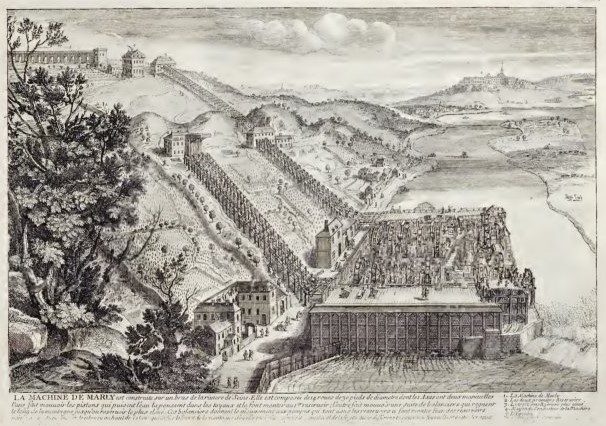
Vue de la Machine de Marly (1723) by Pierre-Denis Martin, showing the Machine de Marly on the Seine, the Louveciennes hillside, and in the background to the right, the aqueduc de Louveciennes to which the water was pumped by the Machine
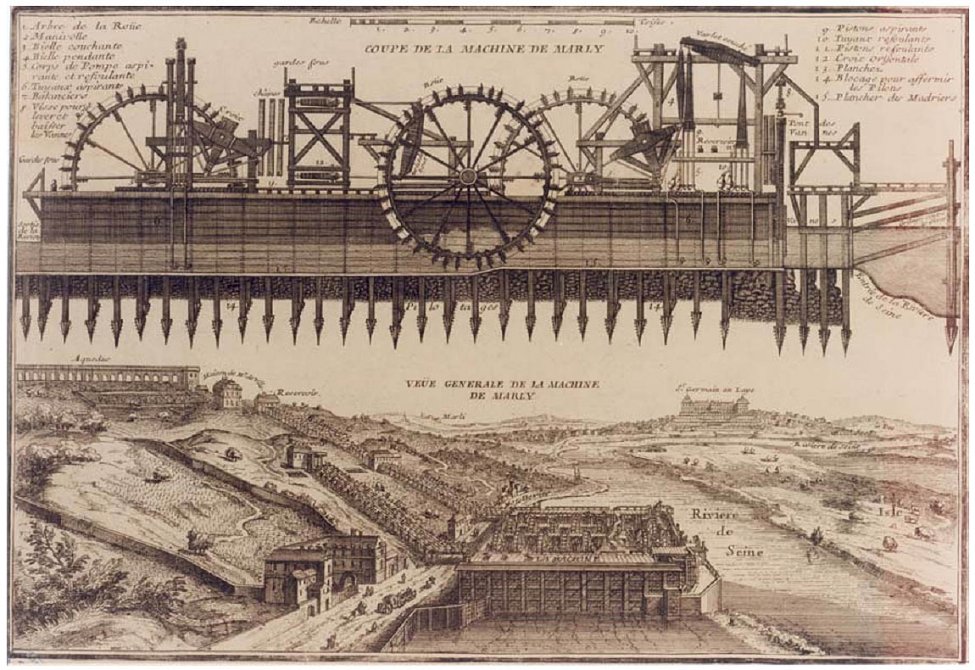
Carte_Machine_de_Marly.jpg

Elevation and perspective of the Machine de Marly (c. 1715) by Nicolas de Fer

Machmarly3D1.jpgMachmarly3D3.jpgMachmarly3D2.jpg
MarlyBirdsye3.jpg

marly-plan.jpg

mengbot1.jpeg
MPmarly1w.jpg
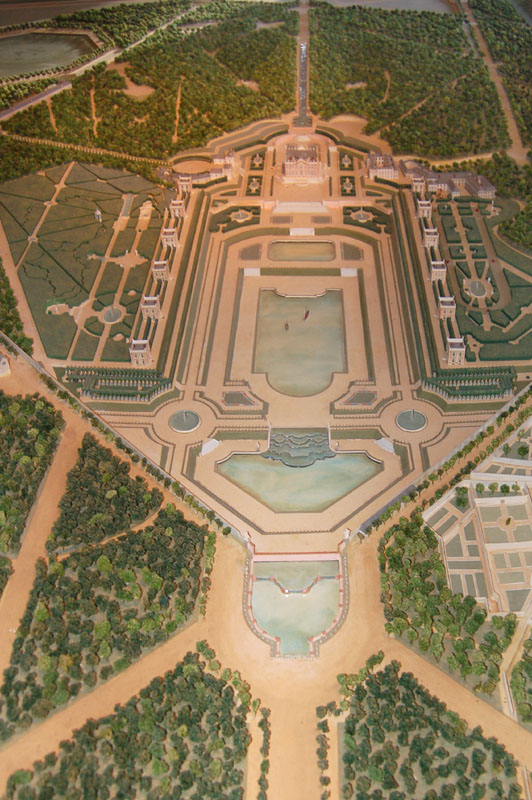
Model of the Chateau of Marly, destroyed after the Revolution. One of the reservoirs filled by the Machine can be seen in the upper left, which supplied both this chateau and Versailles. The model is from the Musée Promenade in Louveciennes.
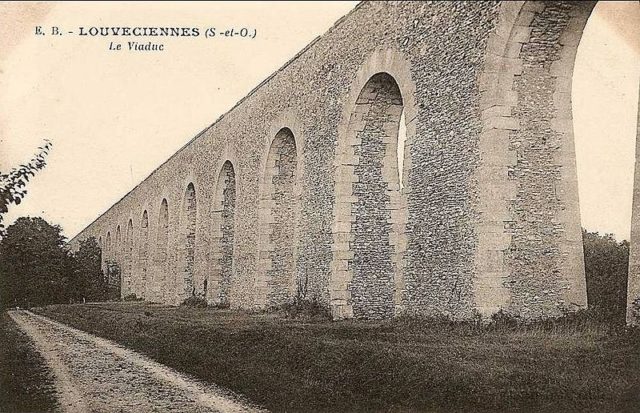
marly-aqueduct-640x413.jpg
Marly aqueduct.​

One more interesting side note: Apparently, there was a tower that was supposed to be a part of this structure that ended up unused here but used at the Paris observatory. From here:
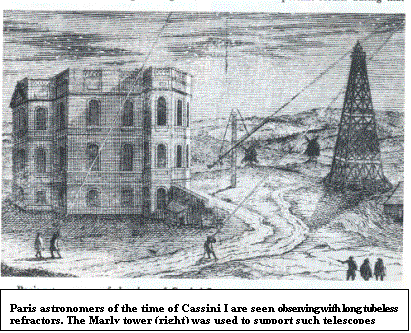
  • Astronomy was entering its golden age, l and noble princes and ladies came to visit e the new observatory out of real interest or t' at least curiosity. Louis XIV came with his court to inaugurate the building on May 1, 1682. The king promised that the o unused Marly Tower, originally built to n lift water for Versailles' reservoirs, would o be moved to the observatory as Cassini 1 had requested. Cassini used the tower to support long-focus telescope objectives for observers on the ground who were following celestial objects through eyepieces.
image009 (1).gif
Note: This OP was recovered from the Sh.org archive.
Note: Archived Sh.org replies to this OP are included in this thread.
 
Note: This post was recovered from the Sh.org archive.
Username: whitewave
Date: 2019-12-11 22:53:45
Reaction Score: 7
That's some amazing engineering skills for a lawyer!
 
Note: This post was recovered from the Sh.org archive.
Username: Aply1985
Date: 2019-12-12 14:03:19
Reaction Score: 3
Link below some nice review about that machine and how many fountains it supplied with water
Screenshot_20191212_155733.jpg
 
Note: This post was recovered from the Sh.org archive.
Username: MagnusOpus
Date: 2019-12-12 14:22:40
Reaction Score: 2
How was that thing supposed to be powered?
 
Note: This post was recovered from the Sh.org archive.
Username: dreamtime
Date: 2019-12-12 16:12:31
Reaction Score: 3
Big question for me is why there are basically no photographs whatsoever even though this thing was only destroyed in the 1960s. I think I only found 3 images, but with bad resolution.
 
Note: This post was recovered from the Sh.org archive.
Username: Starmonkey
Date: 2019-12-12 16:37:48
Reaction Score: 2
Possible steampunk connection with electricity...
Condensed water vapor purified through steam and copper sulfate produce a reaction...
If, and it probably was, Versailles was lit up like CHRISTMAS.
 
Note: This post was recovered from the Sh.org archive.
Username: Cemen
Date: 2019-12-12 18:04:43
Reaction Score: 5
It's them?
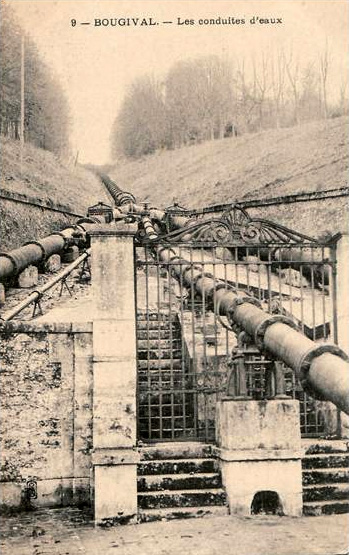
pcDpipes3.jpg
1394273535-78-Bougival-Machine-de-Marly-Dufrayer.jpglarge.jpgpcDmachine16.jpg58740773.jpg
 
Note: This post was recovered from the Sh.org archive.
Username: Starmonkey
Date: 2019-12-12 18:42:04
Reaction Score: 0
And, what's for Christmas this year? Some STDs to go around! For the teased and trussed up barnyard ANIMALS.
 
Note: This post was recovered from the Sh.org archive.
Username: dreamtime
Date: 2019-12-12 19:45:56
Reaction Score: 3
Yes.

What evidence is there for the existence of the supposed first machine except bad quality paintings? Isnt the entire story of the wooden first generation machine a cover story to explain the historical existence of a high-tech machine?
 
Note: This post was recovered from the Sh.org archive.
Username: Plissken
Date: 2019-12-14 01:18:48
Reaction Score: 7
When they found the machine in 1684, they couldn't get it to supply all the fountain. They build it during one of more severe upticks in weather during Maunder Minimum.

In 1684, the winter was so cold the English Channel froze from Dover to Calais, leaving only a league ice free. Drought in France was excessively severe as well. Jean-Dominique Cassini ranked the year 1684 among the warmest in an array spanning 82 years of great heat in Paris, France. One could assume that the river would have been much lower as well.

This was on the heels of years of wild weather and widespread famines. Seems like an inopportune time to build a machine that supplies water to a palace. Maybe because it was already there?

Plissken ?
 
Note: This post was recovered from the Sh.org archive.
Username: Recognition
Date: 2019-12-14 01:51:10
Reaction Score: 1

Wow! It didn't even break- it functioned for like 335 years (if not longer) til they dissassembled! Astounding! I wish I could have seen in action!!!!!!
 
Note: This post was recovered from the Sh.org archive.
Username: Mojo923
Date: 2019-12-14 08:42:00
Reaction Score: 1
Does anybody know what this means? I've been trying to find any info but no luck. Did they rearrange the river?
 
Note: This post was recovered from the Sh.org archive.
Username: KorbenDallas
Date: 2019-12-14 08:49:24
Reaction Score: 5
I think they are talking about a tributary of the Seine river, or an artificial canal where sailing was possible due to certain rearrangements.
kd_separator.jpg
I guess there were three iterations of these. Or they say there were...

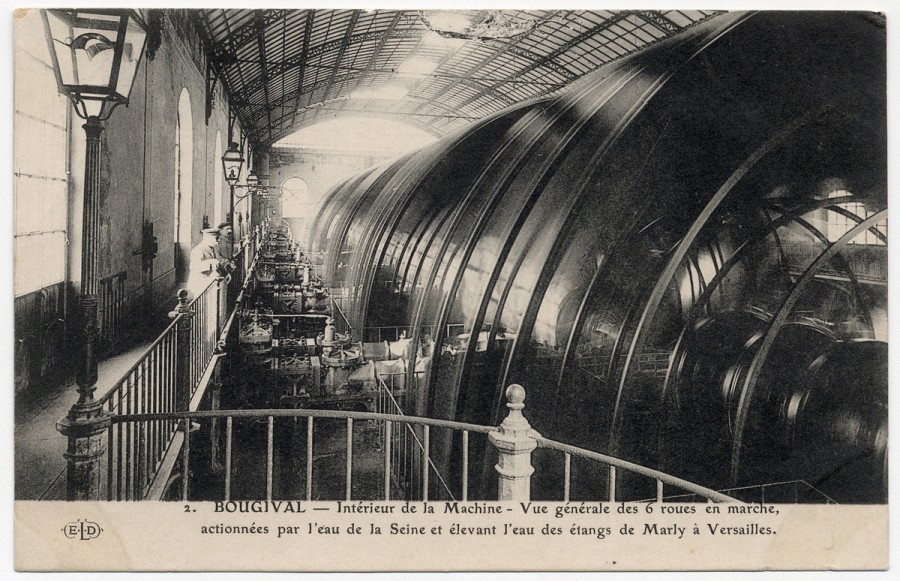
Interior of Marly's 3rd machine
This last machine, more efficient, was developed in 1859 on the plans of the engineer Xavier Dufrayer, author of the network of artificial lakes and rivers of Vésinet. It used a modern hydraulic system, maintained in operation until 1963, and supplying water, in addition to Versailles and Marly, the imperial residence of Saint-Cloud.

Interior of Marly's third machine.jpg
Source

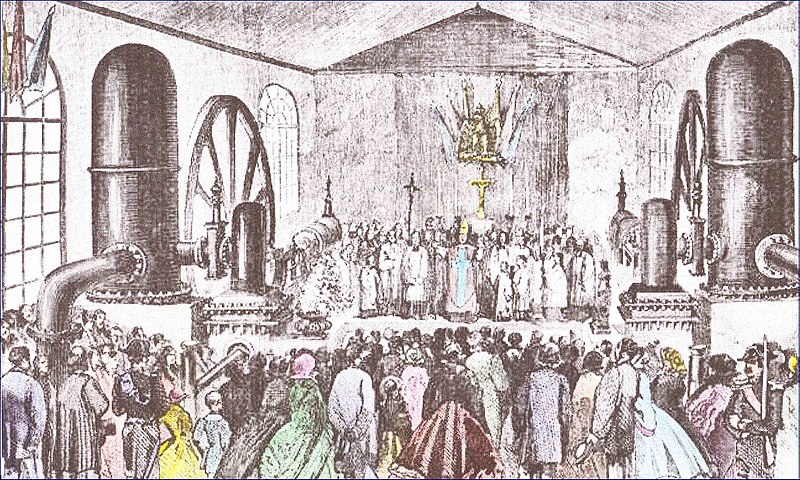
Inaugural of the Machine of Dufrayer
Machines_de_Marly._Innauguration_de_la_Machine_de_Dufrayer.jpg

Source
kd_separator.jpg
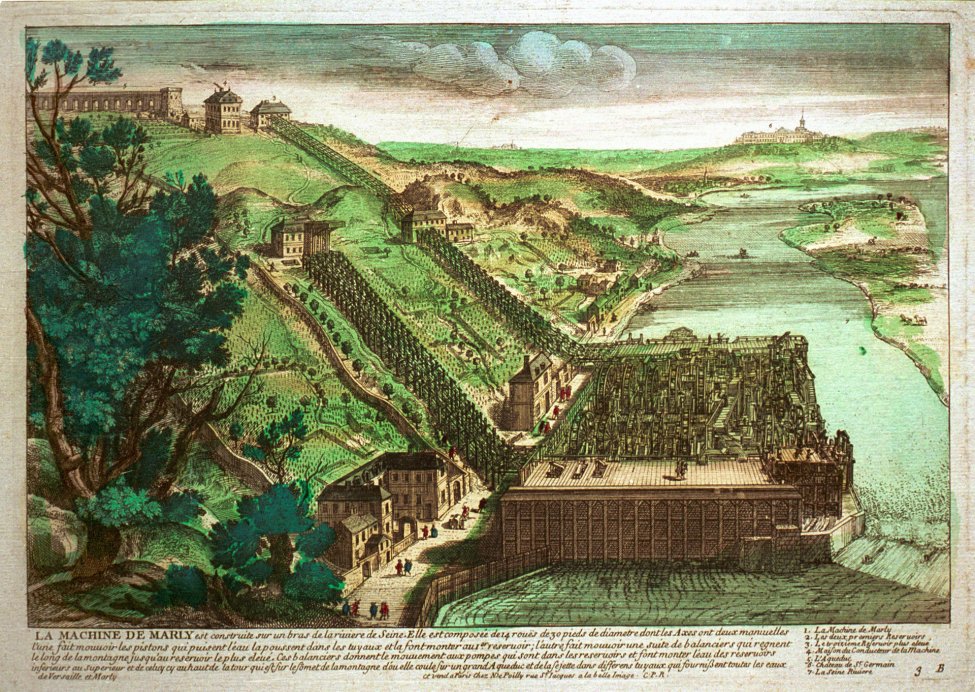
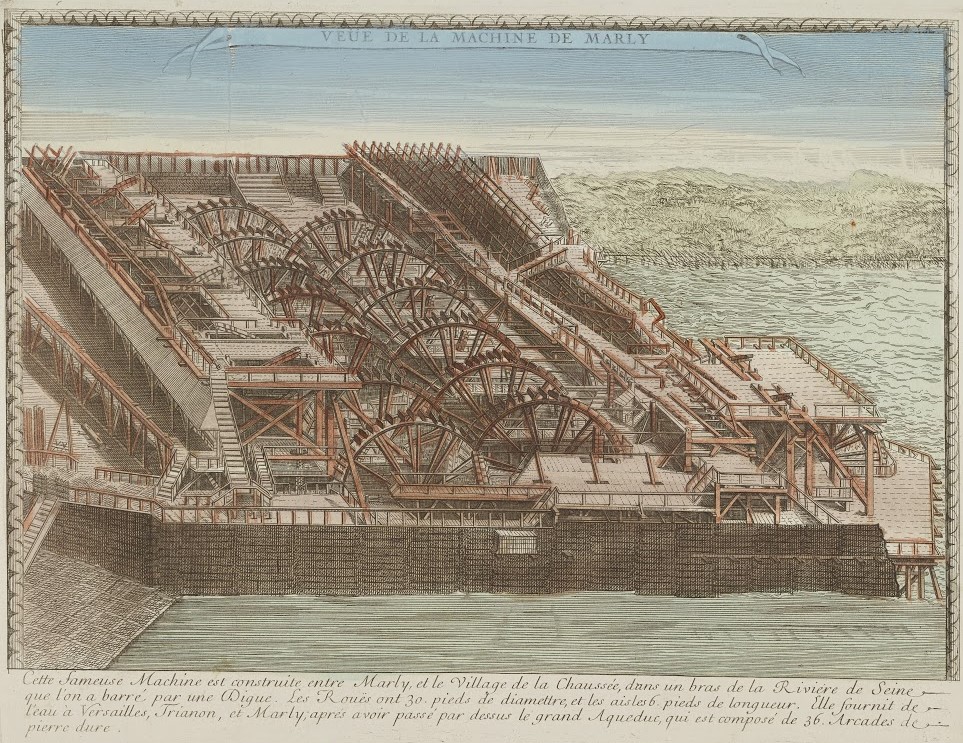
Engraving, hand coloured. Veue de la Machine de Marly, 18th century

marly-old.jpg
Source

machinePlan1.jpg
Source
kd_separator.jpg

1803 Pub
marly-1234.jpg

A diff. 1803 pub - click for more
marly-123.jpg
 
Note: This post was recovered from the Sh.org archive.
Username: jd755
Date: 2019-12-14 09:35:19
Reaction Score: 1
A tributary of the main river or feeder river was straightened, dredged, obstacles such as shallows, rocks, mud banks were removed and possibly canalised to make it naigable, passable,by river going ships or possibly sea going ships.
 
Note: This post was recovered from the Sh.org archive.
Username: Recognition
Date: 2019-12-14 13:28:52
Reaction Score: 1
This video by conspiracy r us


talks about how, in Versaille, at the same time that these glorious fountains were in place and operating, people had zero lavatory facilities and were just defecating on the floor. (2:15 to 19:15). This was the video that made me believe in mud flood. He beautifully makes the point that these structures were more likely built before hand, and the inhabitants who were using these beautiful spaces as bathrooms were probably walked out onto these spaces after a reset, and just had zero idea about how to care for themselves-let alone build something like this. The presence of these unimaginably beautiful fountains, in the presence of the lack of facilities says.it. All.
 
Note: This post was recovered from the Sh.org archive.
Username: jd755
Date: 2019-12-14 15:29:59
Reaction Score: 1
From here; https://wattsupwiththat.files.wordpress.com/2011/09/weather1.pdf

This machine built of wood took seven years to build. It was inaugarated in June 1684.
Here is the weather of the area during those building years according to information the pdf at the link.


Winter of 1676 / 1677 A.D.
The Seine River in France was frozen for thirty-five consecutive days from 9 December 1676 to 13 January 1677.
In 1676 in Paris, France, there were 35 days of frost.
Extreme cold reigned from 2 December 1676 to 13 January 1677 in northern France. The earth was covered with snow, and the river remained frozen thirty-five days.
This winter was very severe in France. Particularly intense was the cold from 2 December 1676 until 13 January 1677. "Thirty-five consecutive days the earth was covered with snow and the Seine River frozen.Then came wet weather. In February we had a few mild frosts and frequent rains. The same weather conditions prevailed in March. The sky was almost completely overcast. The beginning of April was stillcold and wet, but around the middle of the month, the temperature was mild, but soon afterwards came
the cool weather again which held until 22 May." On the frozen river Meuse, they travelled from Christmas to 15 January with heavily laden wagons over the ice.

1680 A.D
In Dijon, France, the grape harvest began on 9 September. This year was a good grain market in France

Winter of 1680 /1681 A.D.
The winter was intensely cold in Europe. The Little and Great Belts in Denmark were frozen, and many people perished. This year the cold was so severe as to split whole forests of oak trees.
In 1680 in southern France, the cold kills all the olive trees.
The winter in 1680 was in Italy and Provence very severe. In Provence, the olive trees froze to death.

1683 A.D.
In Dijon, France, the grape harvest began on 13 September.

Winter of 1683 / 1684 A.D.
Solid ice was reported extending for miles off the coasts of the southern North Sea (England, France and the Low Countries), causing severe problems for shipping and preventing the use of many harbors.
According to some sources, ice formed for a time between Dover (England) & Calais (France), with the two sides joined together.

From a letter by Guillaume Fillastre, monk at Fécamp, France: “Some sailors from St. Valery en Caux, setting out to go fishing, were surrounded by ice nearly three leagues (9 nautical miles) out to sea, opposite the port of Veules, from which people could see them indicating by signs the danger they were in, but could not give them any help. In this extremity, they risked returning to land on foot, across the ice; which they achieved, happily, thanks to two planks which they placed one after the other as they
advanced, to serve as a bridge over the icebergs, which were by no means neatly joined.

The winter of 1684 was excessively cold in northern France.

The winter of 1683-84 was severe in Europe. There was very severe cold in Paris, France from 11 to 17 January. During those seven days, the alcohol decreased in the bulb [alcohol thermometer] down to a point where it had not yet reached during other winters. The academics timed how long it would take wine to freeze in the open. It took 10-12 minutes time. There was an extraordinary amount of snow in the south [southern France]. On the shores of England, France, Flanders and Holland, the sea was frozen a few miles wide in such a way that for more than 14 days, boot packages could not enter the ports on or off. In Holland and Belgium in February and March, all the rivers were frozen over.

1684 A.D.
Jean-Dominique Cassini ranked the year 1684 among the warmest in an array spanning 82 years of great heat in Paris, France. Cassini developed a Fahrenheit thermometer, which he placed against the window of the tower northeast of the Observatory. He took his measurements between noon and three o’clock each day. The summer of 1684 produced sixty-eight days of a temperature of 77° F (25° C), sixteen days of a temperature of 87.8° F (31° C), and three days of a temperature of 95° F (35° C).
The summer of 1684 was the first hot summer, over which we have thermometric data. In England, it was preceded by a very harsh winter and a wet spring. The summer was hot and dry. In France, the drought was exceptionally severe. In Dijon, France, the grape harvest began on 4 September. In Paris, France there were:
Hot days 68 days
Very hot days 16 days
Extremely hot days 3 days
 
Note: This post was recovered from the Sh.org archive.
Username: whitewave
Date: 2019-12-14 16:20:20
Reaction Score: 1
77-87.8 degrees Fahrenheit is considered a super hot summer? Those people would have spontaneously combusted in Oklahoma summers.
 
Tips
Tips
Please respect our Posting Rules.
Back
Top