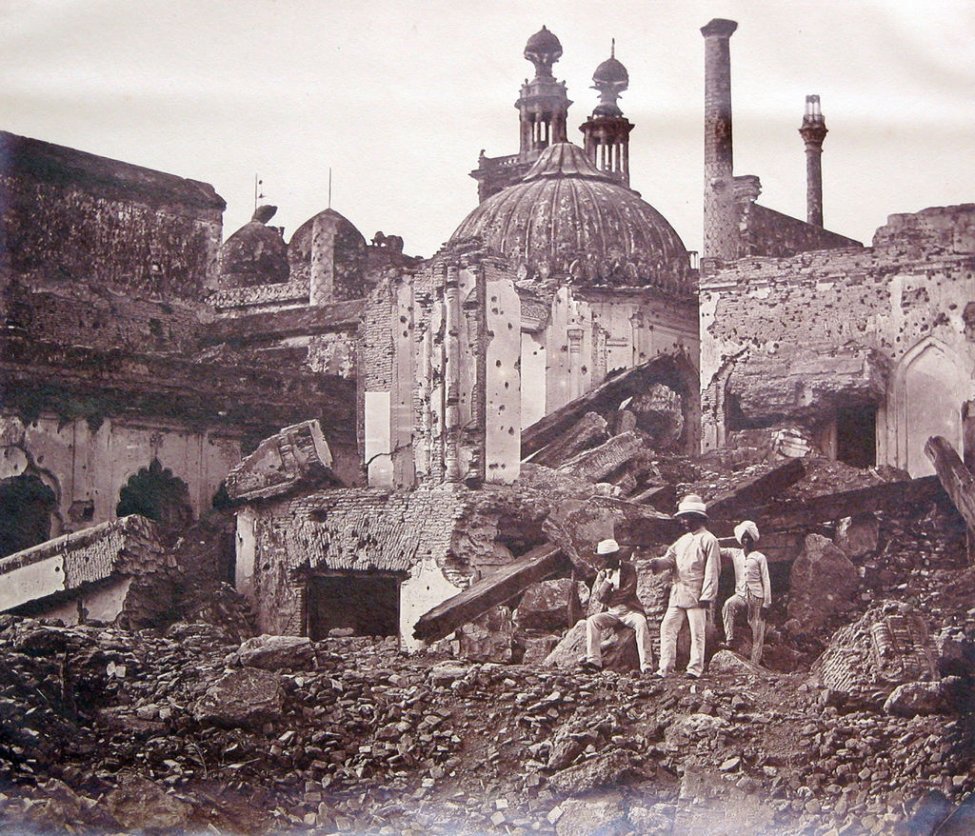
SH Archive 1857-9 Sepoy Mutiny in India: what happened here, and when?

SH.org OP Username
KorbenDallas
SH.org OP Date
2020-03-03 05:30:27
SH.org Reaction Score
12
SH.org Reply Count
25

KD Archive

Not actually KorbenDallas
Active Member
Joined
Sep 22, 2020
Messages
4,691
Reaction score
1,500
Quote: Indian Mutiny, also called Sepoy Mutiny, widespread but unsuccessful rebellion against British rule in India in 1857. Begun in Meerut by Indian troops (sepoys) in the service of the British East India Company, it spread to Delhi, Agra, Kanpur, and Lucknow. The rebellion posed a considerable threat to Company power in that region, and was contained only with the fall of Gwalior on 20 June 1858. The rebellion is also known as India's First War of Independence, the Great Rebellion, the Revolt of 1857, the Uprising of 1857 and the Sepoy Rebellion.
  • By the time it was over, hundreds of thousands or even millions of people had been killed. The British home government had disbanded the British East India Company, taking direct colonial control of the British Raj in India. Also, the Mughal Empire ended, and Britain sent the last Mughal emperor Bahadur Shah Zafar into exile in Burma.
  • To regard the rebellion merely as a sepoy mutiny is to underestimate the increasing pace of Westernization after the establishment of British paramountcy in India in 1818. Hindu society was being affected by the introduction of Western ideas.
  • The immediate cause of the Indian Revolt of 1857 was a seemingly minor change in the weapons used by the British East India Company's troops. The East India Company upgraded to the new Pattern 1853 Enfield rifle, which used greased paper cartridges. In order to open the cartridges and load the rifles, sepoys had to bite into the paper and tear it with their teeth.
  • Rare Photos Of Indian Mutiny / Sepoy Mutiny / Indian Rebellion / Uprising Of 1857
  • Indian Rebellion of 1857 - Wikipedia
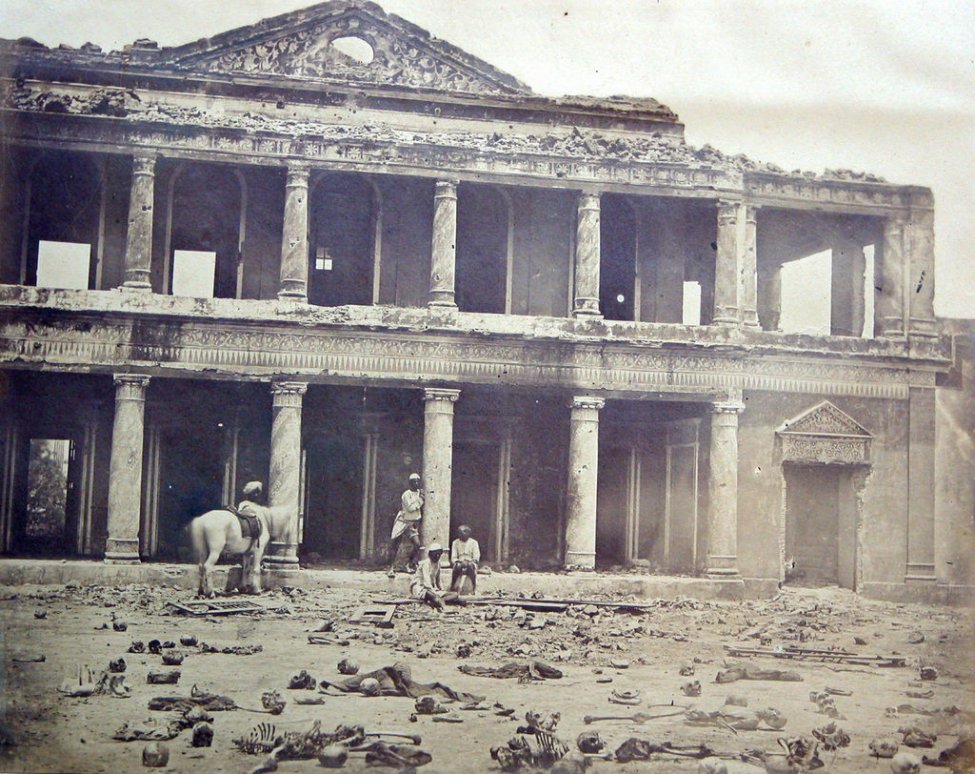
There are quite a few images at the above link, but my questions will pertain to the image below only.

indian-sepoy-mutiny-rebellion-uprising-1857-rare-photos (34).jpg
KD: I doubt these skeletal remains would have stayed in the streets for years. Officially there were people living in the areas of the revolt of 1857-59. There is no way to date the photograph, but we do have an official date of this so-called mutiny.

So, what do you think happened to the bodies? Did they get eaten by animals, or could some flesh stripping Mahabharata type weapon be the root cause of this? This is the timeframe of those abandoned cities we talked about so much.
Note: This OP was recovered from the Sh.org archive.
Note: Archived Sh.org replies to this OP are included in this thread.
 
Note: This post was recovered from the Sh.org archive.
Username: WildFire2000
Date: 2020-03-03 06:32:59
Reaction Score: 3
The wood near the people there doesn't look to be nearly as aged as the skeletal remains closer to the camera, so either some of the rubble was added or those bodies decomposed and left their bones behind at an extremely rapid pace.

Also, no signs at all of their flesh. No blood stains under the bones, only clothing fragments and the one partial mummified looking body in the bottom right.

To answer your questions, I have no idea what happened to those bodies, except that I doubt natural decomposition unless they're the left-over remains discovered in the abandoned cities, pre-clean-up for the "normal" pictures we're shown of the pristine empty cities. Nice picture find, KD.
 
Note: This post was recovered from the Sh.org archive.
Username: Banta
Date: 2020-03-03 12:59:57
Reaction Score: 1
This is partially why, and I know it's boring, I think this photo looks staged. The placement of the remains seem fairly evenly distributed and the shot itself definitely draws your attention to them. And like KD said, it's doubtful they were just left out for a lengthy period of time.

Line between fact and fiction is super thin. The remains could still be real and stripped clean through sensational means and then also placed for the photo op. I also like this suggestion:

 
Note: This post was recovered from the Sh.org archive.
Username: EUAFU
Date: 2020-03-03 14:32:23
Reaction Score: 1
For me it is a piece of propaganda "See what happens if you defy the British empire".

These bodies were desecrated and scattered scenographically around the site, during this staging they were too lazy to take all the bones and gave preference to the skulls.

But the truth that it can be something totally different and even crazier than staging a massacre. I'm not saying that there was no revolt, struggle and deaths, but that this specific photo seems to be a scam.

The world and the past are stranger than I can ever know.
 
Note: This post was recovered from the Sh.org archive.
Username: Timeshifter
Date: 2020-03-03 18:43:41
Reaction Score: 1
Perhas KD, this photo is from 'before' and is placed in the 1857/9 timeline!

Some other event in time entirely!?

Looks like they have stumbled upon some very old remains to me, but the photo could be any when.
 
Note: This post was recovered from the Sh.org archive.
Username: jd755
Date: 2020-03-03 19:51:54
Reaction Score: 1
From: here

These rebel bodies were gathered from a healed battlefield, and placed, along with the figures by Beato to form a narrative. This brutal battle had occurred six months before. With the dry dusty earth his palette, Beato disinterred and gathered clothes, heads, bone shards, ribs, and so on. Shattered doors from the Bagh probably served as stretchers for the detris. It was a battle fought, but nearly forgotten, were it not for his recreation—a photographic memento mori. Beato was not the first war photographer, but he was the first to cover several wars, create connected visual narratives and the first to photograph the bodies (of the defeated enemy)
 
Note: This post was recovered from the Sh.org archive.
Username: KorbenDallas
Date: 2020-03-03 20:43:14
Reaction Score: 1
Forming a narrative is the name of the game.
 
Note: This post was recovered from the Sh.org archive.
Username: jd755
Date: 2020-03-04 08:07:52
Reaction Score: 1
From here

In a sense, photographs of mutiny-affected buildings provided histories that the camera could not have captured early; the exposure time required, the weightiness of the apparatus, and the danger posed by the processing chemicals prevented its use during the period of war. Therefore, when it was over, the buildings in their state of ruin provided evidence of rebellion. Moreover, in the conventions used to picture the ruins — the inclusion of gratuitous empty spaces, angles askew — photographers of mutiny sites arguably emphasized absence, including that of the bodies of the rebels.

The contiguity of bodies and sites as signs of the criminal insurgency is perhaps most powerfully demonstrated by Beato’s Sikandar Bagh photograph (figure 8), which effects a representation of the aftermath of the notorious stand-off at Sikandar Bagh (16 November 1857). Set at an angle, at eye level at a distance from the shelled monument, the photograph draws the viewer’s eye along an expanse dotted with skeletal remains. At the monument itself, the remains are no longer in view; instead, locals sit or stand beside the massive porch columns. The columns draw one’s eye along the façade of the hollowed-out building, to its apex, the raking cornice. The walled garden had been used as a base of activity by the sepoy rebels, many of whom were subsequently slaughtered by the British corps of the Ninety-third Highlanders and the Fourth Punjab infantry to avenge the earlier Kanpur massacre.

Beato exhumed and scattered remains five months after the stand-off, crafting a representation of the slaughter of anonymous Indian insurgents.Through a process of staging and the transformation of human remains into props that could be scattered beside the pockmarked shell of the walled compound of Sikandar Bagh, Beato foregrounded the performance of remains, both architectural and human, as testament to a pivotal moment of Indian intransigence. The moral content of the photograph is compounded by the presence of the docile laborers, permitted life, in a field strewn with the remains of the rebels.

Sir George Campbell, the judicial commissioner at Lucknow, who accompanied him, noted Beato’s process of exhumation, which involved the uncovering and scattering of bodies that had already been set aside for disposal. Quoted in Ray Desmond, Victorian India in Focus: A Selection of Early Photographs from the Collection in the India Office Library and Records (London: H.M.S.O., 1982), 64.

19 page pdf
Aesthetic Bodies: Posing on Sites of Violence in India, 1857–1900
 
Note: This post was recovered from the Sh.org archive.
Username: Reichenbach
Date: 2020-03-04 21:32:53
Reaction Score: 3
My take on all this is that everything everywhere is an HUGE lie; meaning history, culture and religions to name some things and the Sepoy Mutiny is another tale with anything before 1800s not to be trusted. I am attaching a photo from the website with historical photos mentioned at the start of this thread.
indian-sepoy-mutiny-rebellion-uprising-1857-rare-photos (44).jpg

At the top of the buildings are the same things repeated worldwide that just bugs my curiosity; open air columns on top and domes, variants of the Capitol buildings everywhere. These are another buildings from the now extinguished worldwide civilization.
I think the Sepoy Mutiny is like the Patriotic War of 1812 in USA. Or even the 1865 Civil War. Massive cleanups.
Think for a moment how tied together the narratives and the world are ... Elihu Yale Elihu Yale - Wikipedia worked at the East India Company and bequeathed his fortune to Yale University in USA !!!

Before the 1800s a Worldwide Civilization existed with several different cultures and beliefs. The destruction of that civilization is impossible to imagine. What had been left over has been integrated into a fantastic narrative called "History" and "Culture" and "Religions" !!!

The above is how I summarize my opinions and it is the difficult truth one has to face to make any progress. I battle with that truth every moment !!!

I have stopped trusting any narratives !!!
 
Note: This post was recovered from the Sh.org archive.
Username: whitewave
Date: 2020-03-05 09:59:59
Reaction Score: 1
How long does your body take to decompose? It really depends on the cause of the death. Typically placed 6ft down, without a coffin, in ordinary soil, eight to twelve years to completely decompose into a skeleton.
 
Tips
Tips
Please respect our Posting Rules.
Back
Top