I like the idea as referenced in the blindsight article - that we live in a model in our own minds. We are not interacting with the world itself, but with our model of the world. And this model it is a provided model - given to us by education, family, culture. It takes a lot of effort to go back to basics and build our own 'world model' from the ground up, based only on evidence that we have personally verified.
Our provided models have 'hacks' and biases built in - eg at school, work, everywhere really, we are expected to accept authority - this is a hack, and allows for lots of intentional deception - eg virology, 'climate change', government, etc not to mention the unwitting handing over our own children to be indoctrinated in their turn.
Perception: the nonduality of the world
If the center of value is axiomatically the one's self then the unifying principle is perception. So yes, there are extra models, mini-model of our world in our mind that create personas for different areas of life, but it sounds deceptive because the 'real world' is never actually proven to be there.
It's like the 'brain in the vat' example or the 'allegory of the cave'. We are shifting the blame /cause of reality to somewhere else. Perception is necessarily always going to be dealing first with concepts, and never can directly interact with things that 'really are" in any situation.
This can be represented like the black box model. We know the inputs and outputs but can never see inside.
"the black box is an abstraction representing a class of concrete open system which can be viewed solely in terms of its stimuli inputs and output reactions: … In other words, only the behavior of the system will be accounted for."
Dualism from Solipsism: Moon is the mirror of Earth
While there are many mirrors and models that may exist, there implies an order of which comes first. The most essential divsion is dualism. Two things that exist. The example is Earth is the center of the universe (the self) and the reflection is the celestials (the world) .
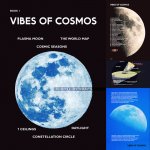
The users godgevlamste and Vibes of Cosmos on Youtube, both have great and entertaining videos and posit that the Moon is the world map, the mirror image of the Earth. (this is not a new theory, I think they say plasma moon theory dates back to the 70s.)
I thnk you point at this later, but yes, if one starts with the solipsistic value as a standard of measure, then what is being measured? The inputs and outputs are from empty space. The same confusion as how could the Earth see itself in 'the mirror' and make the celetials. If Earth sees the celestials--and knows what its looking at--then its most objective statement becomes "my self is real". If that is the case, then the opposite must also be true "the mirror is real too". And if someone says 'mere illusion' I think it comes off as too trivial, because the one is just as real as the other.If its solipsistic, I think it is unavoidably so. The value is only to be found in oneself. There is no value (or meaning) outside
What exactly are these two sets of values?, the self and the mirror? the subjective and objective? And which one came first? The existentialist would certainly argue the objective values. This is a chicken and egg puzzle. The answer seems to be 'both', in they are certain but in different ways, but how is that possible?
Dualism: Yin Yang and axial opposites
Yin makes Yang and vice versa. True opposites will be something that is generated out of each other. Without one, there cannot be the other. e.g. there is no 'rest' without 'motion' or 'being' without 'becoming'. "the influences of yinyang are easy to observe, but its conceptual meanings are hard to define."Yinyang (yin-yang) is one of the dominant concepts shared by different schools throughout the history of Chinese philosophy. Just as with many other Chinese philosophical notions, the influences of yinyang are easy to observe, but its conceptual meanings are hard to define.
Dualistic Problem
I think you are stating this problem; because this dualism type axioms are the reference for everything else How does one check the measure of a ruler but with another ruler? or the time on one clock except with the time on another? These are circular reasoning, but I think this hints at explaining the intrinsic relationship between subjective and objective values.
Solution: Cycle of axial opposites
My belief is 'motion / becoming' is this third axiom that becomes a check, balance, between the self and the mirror.
In Plato's works; there is a necessary cycle for opposites to maintain everything, exactly like the Yinyang. "Plato posited a philosophical assumption that all opposites —e.g. less, greater; weaker, stronger; sleeping, waking; life, death—are generated out of each other. " One application is the "doctrine of recollection" that the ignorant recall their suppressed knowledge and don't actually 'learn' or gain new knowledge. And another is the soul exists after death with the cyclical argument.
(Phaedo 72, Hackett, 2002)
Therefore, he said, if there is such a thing as coming to life again, it would be a process of coming from the dead to the living?
Quite so.
It is agreed between us then that the living come from the dead in this way no less than the dead from the living, and, if that is so, it seems to be a sufficient proof that the souls of the dead must be somewhere whence they can come back again.
I think, Socrates, he said, that this follows from what we have agreed on.
Consider in this way, Cebes, he said, that, as I think, we were not wrong to agree. If the two processes of becoming did not always balance each other as if they were going round in a circle, but generation proceeded from one point to its opposite in a straight line and it did not turn back again to the other opposite or take any turning, do you realize that all things would ultimately be in the same state, be affected in the same way, and cease to become?
How do you mean? he said.
It is not hard to understand what I mean. If, for example, there was such a process as going to sleep, but no corresponding process of waking up, you realize that in the end everything would show the story of Endymion to have no meaning. There would be no point to it because everything would have the same experience as he had and be asleep. And if everything were combined and nothing separated, the saying of Anaxagoras would soon be true, “that all things were mixed together.” In the same way, my dear Cebes, if everything that partakes of life were to die and remain in that state and not come to life again, would not everything ultimately have to be dead and nothing alive? Even if the living came from some other source, and all that lived died, how could all things avoid being absorbed in death?
It could not be, Socrates, said Cebes, and I think what you say is altogether true.
I think, Cebes, said he, that this is very definitely the case and that we were not deceived when we agreed on this: Coming to life again in truth exists, the living come to be from the dead, and the souls of the dead exist.
There's no awakening without sleeping, no consciousness without unconsciousness.
I think this agrees with the Tao as well. "The Tao Te Ching was written in China roughly 2,500 years ago at about the same time when Buddha expounded the Dharma in India and Pythagoras taught in Greece. The Tao Te Ching is probably the most influential Chinese book of all times. Its 81 chapters have been translated into English more times than any other Chinese document"
Tao Te Ching Chapter 40
Compared with Plato's "the living come from the dead in this way no less than the dead from the living," They seem to be in agreement.40
Returning is the motion of the Tao. Yielding is the way of the Tao.
The ten thousand things are born of being.
Being is born of not being.

 not this
  . Smiling begets sad
  .
.