Archive
Old SH Archive
- Joined
- Sep 8, 2020
- Messages
- 17,737
- Reaction score
- 3,168
Note: This post was recovered from the Sh.org archive.
Username: Randolph C
Date: 2020-07-13 21:17:30
Reaction Score: 10
Hello, thanks for the questionsHi !
a. What is the closest to the 'dragon' a 'St. George' killed, according to the available depictions, and where were its fossils found?
b. Do any patterns emerge from mapping the major fossil-finding sites around the globe, like, a different tropic zone and poles' position, seas where is now land, distance/proximity of the sites to ancient civilization centres, etc?
c. Can fossils be created in today's soil, or are we talking about different levels of soil acidity and different soil properties in the planet back then?
d. What of those giant skeletons in the museums is real and what is reconstruction?
ad a. The problem here is the varying depictions of the dragon, was it a four-legged creature with wings or a two-legged one? Or did it not have wings at all? Just look at the varying depictions here, allegedly all of St. George and his dragon Saint George and the Dragon - Wikipedia So I seriously can not answer your question if you don't formulate it more precisely, i.e. which depiction of the dragon do you regard as the most truthful?
ad b. Depends about what fossils we talk to a large extent. That land and sea have not been as today is obvious. I can literally leave my house, go to the next field that has been recently ploughed and pick up fossil sea shells from the Jurassic sea, whenever the Jurassic period actually was. So no question about that. Inversion of the magnetic poles is documented by paleomagnetic data. Paleoclimate is very difficult to handle, as we just do not know to what kind of climate ancient creatures were truly adapted. But it is certainly interesting to find fossil leaves of trees that just look like those in Central Europe or the Mediterranean today at the foot of the Lonyearbyen glacier in Svalbard (a place that I visited), so I am all in for dramatic changes in climate as well.
Regarding ancient civilization centers: there is a dramatic lack of particularly dinosaur and other reptile fossils in Mesopotamia and Iran, although strata of the right age are present there. There are, however, beautiful dinosaur fossils from Egypt, none from Israel (except some footprints), Lebanon, Syria. There is nothing in the Indus valley, but a lot in other parts of India. China is just full of the critters. Nothing in Greece, nothing in Turkey. Talking about conventional civilization centers. So a clear pattern does not emerge, but their almost total absence in the lands of the Sumerians, Babylonians, Assyrians, Persians, Hethitans, Israelites etc. is interesting.
ad c: As fossils are per definitionem older than 10.000 years, they can not be created today
 Just joking here. Most fossils are from marine environments anyway (about 99% of them), and shallow marine environments that is. They have probably never formed in soil. Soil contains humidic acids which dissovle bones, teeth and shells over time, so literally nothing remains. We have practically no fossil record whatsoever in Amazonia! We do not know anything about how those giant rainforests and their thriving wildlife came to be, because we have zero fossil finds. Nada, nothing. There are only few believable ways how fossils of land-living creatures can be preserved. Catastrophic events, like tsunamis, major floods, desert stroms come to mind. A lot of terrestrial sediments around the world (which are rare) are almost completely devoid of fossils. Just hundreds of meters of barren desert sandstone with nothing in there. I assume that the same processes which produced fossils in the past still work today. I assume it, i can not prove it. Uniforitarianism is a postulate of geology (and basically all other natural sciences). It can not be proven, as long as we do not have a time machine.
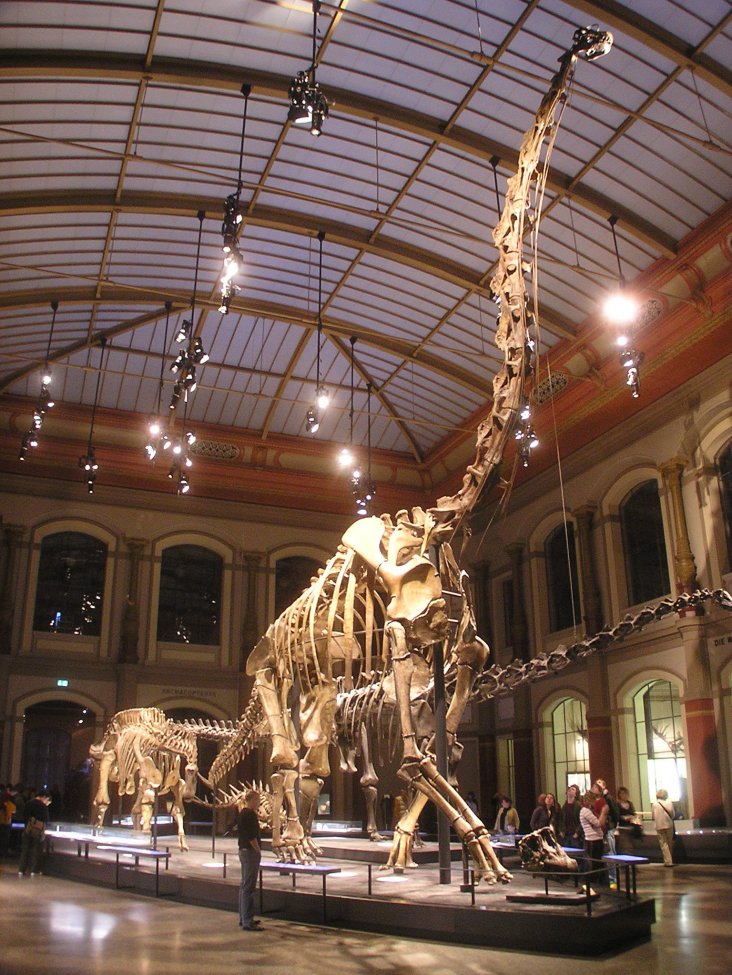
ad d: Most of what is exhibited in museums, particularly in the United States, is junk nowadays. They replaced many of the original skeletons with replicas. There are several reasons for that: 1. Most of the skeletons were largely replicas in the first place, with maybe some original bones in them, because there are actually very few complete dinosaur skeletons. 2. Replicas created with modern techniques just look exactly like the original, we have advanced far beyond the clumsy plaster replicas of the last century. 3. there is a big market for original dinosaur fossils and they pay fantasy prizes for them, so specimens are likely to be stolen. 4. replicas, particularly if they are made out of resin or some other lightweight stuff, are super-easy to mount. Original bones are extremely heavy and you have to be a genius engineer to mount them. It took two decades to mount the skeleton of Giraffatitan brancai in the Berlin Museum, only to dismantle it shortly afterwards because of the second world war. This is one of the few original giant dinosaur skeletons anywhere in the world. It is, however, also a composite of several individuals and the skull is a replica. The original skull, the only ever found of this dinosaur, is stored away, I have investigated it several times.
That is a fair assumption. Dating in geology is a trainwreck actually. It is a system of beliefs and half-assed and error-ridden methods the results of which are heavily trimmed before publication. That book sounds highly interesting and seems to tie in very well with some of my own thoughts on the matter, is it on archive.org or do you have another link to it? I would be much obliged. Sorry I misread the author's name as "Day" instead of "Daly", otherwise the connection to R. A. Daly, who was indeed an eminent geologist, would probably have come to my own mind.The quote is from Reginald M Daly, an academic, a Physicist and a University Lecturer, he is actually slagging the technique off, but apparently advising how the numbers are acheived ie they do tie up with the standard geological timelines. His book is a ruthless dissection of Geology.
The very interesting bit for me is that his uncle was Reginal A Daly, an extremely famous Geologist, a Professor of Geology at Harvard, and the head of department and President of the Geological Society of America. It appears that the nephew has got his inside information from his Harvard uncle. The Professor has minerals and craters on the Moon and Mars named after him, and his house is a national historic landmark. I am wondering if he sold out, then explained how the numbers were crunched to his nephew. It seems a fair assumption, ie the Professor wouldn't wreck his legacy, but would get the facts out there via a third party - who was able to say exactly what he thought about geology and it's 'assumptions'.
Reginald Aldworth Daly - Wikipedia