

- Joined
- Sep 22, 2020
- Messages
- 4,691
- Reaction score
- 1,500
A few days ago I received an email from a gentleman named Nikolai. In the e-mail he says that he is working on getting the Voynich manuscript deciphered. With Nikolai's permission, his e-mail message is published at the bottom of this post. I think most of us are somewhat familiar with this manuscript. For those who are not, here is a short compilation of some general info.
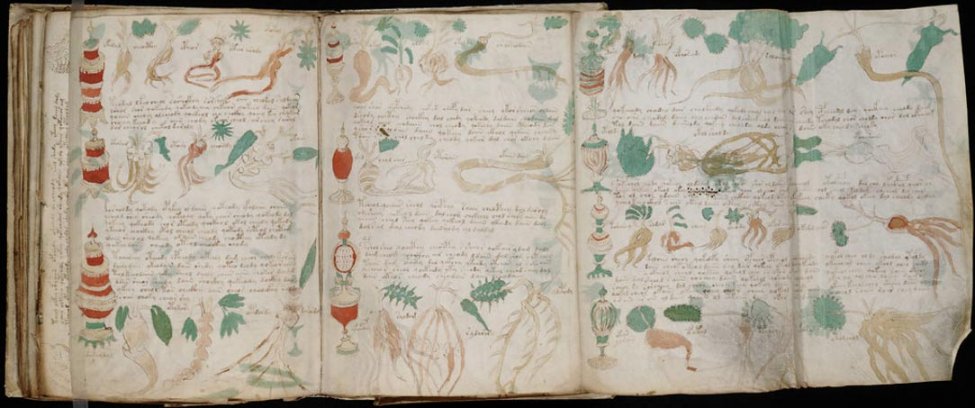
 Written in Central Europe at the end of the 15th or during the 16th century, the origin, language, and date of the Voynich Manuscript - named after the Polish-American antiquarian bookseller, Wilfrid M. Voynich, who acquired it in 1912 - are still being debated as vigorously as its puzzling drawings and undeciphered text. Described as a magical or scientific text, nearly every page contains botanical, figurative, and scientific drawings of a provincial but lively character, drawn in ink with vibrant washes in various shades of green, brown, yellow, blue, and red.
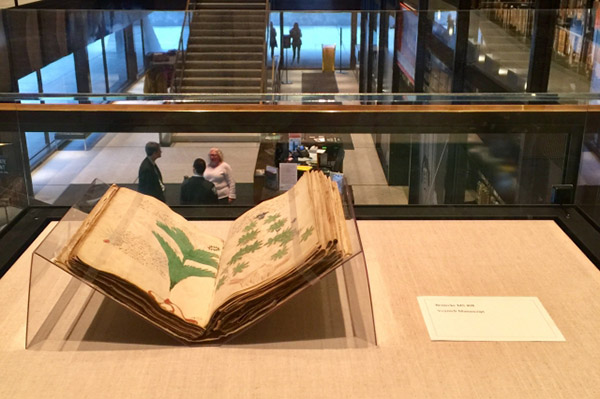
Voynich manuscript on display in Beinecke Library, Yale (Beinecke Library)
Based on the subject matter of the drawings, the contents of the manuscript fall into six sections:
Links and Sources:
am deciphering the manuscript of Voynich and got positive results. There is a key to cipher the Voynich manuscript. The key to the cipher manuscript placed in the manuscript. It is placed throughout the text. Part of the key hints is placed on the sheet 14. With her help was able to translate a few dozen words that are completely relevant to the theme sections.
he Voynich manuscript is not written with letters. It is written in signs. Characters replace the letters of the alphabet one of the ancient language. Moreover, in the text there are 2 levels of encryption. I figured out the key by which the first section could read the following words: hemp, wearing hemp; food, food (sheet 20 at the numbering on the Internet); to clean (gut), knowledge, perhaps the desire, to drink, sweet beverage (nectar), maturation (maturity), to consider, to believe (sheet 107); to drink; six; flourishing; increasing; intense; peas; sweet drink, nectar, etc. Is just the short words, 2-3 sign. To translate words with more than 2-3 characters requires knowledge of this ancient language. The fact that some symbols represent two letters. In the end, the word consisting of three characters can fit up to six letters. Three letters are superfluous. In the end, you need six characters to define the semantic word of three letters. Of course, without knowledge of this language make it very difficult even with a dictionary.
KD: I don't have a horse in this race, and my deciphering skills are next to nothing. I'm looking at this manuscript just like this.
Anyways, opinions on this codex are welcome. If one of you cracks the "signs"... the are on me.
Wilfrid Voynich
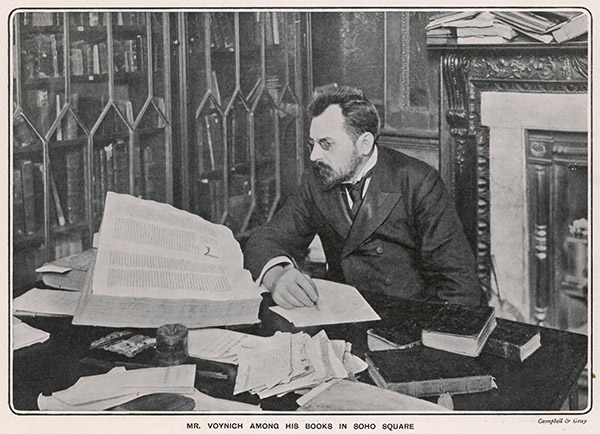
1865-1930
Wilfrid Voynich - born Michał Habdank-Wojnicz - was a Polish revolutionary, antiquarian and bibliophile. Voynich operated one of the largest rare book businesses in the world, but he is best remembered as the eponym of the Voynich manuscript.1865-1930
- Voynich became an antiquarian bookseller from around 1897, acting on the advice of Richard Garnett, a curator at the British Museum. Voynich opened a bookshop at Soho Square in London in 1898. He was remarkably lucky in finding rare books, including a Malermi Bible in Italy in 1902.
- The most famous of Voynich's possessions was a mysterious manuscript he said he acquired in 1912 at the Villa Mondragone in Italy, but first presented in public in 1915. The book has been carbon-dated, which revealed that the materials were manufactured sometime between 1404 and 1438, although the book may have been written much later. He owned the manuscript until his death.
- In 1917, based on rumors, Voynich was investigated by the FBI, in relation to his possession of Bacon's cipher. The report also noted that he dealt with manuscripts from the 13th, 12th, and 11th centuries, and that the value of his books at the time was half a million dollars. However, the investigation did not reveal anything significant beyond the fact that he possessed a secret code nearly a thousand years old.
The Voynich Manuscript
Here is the official version. Written in Central Europe at the end of the 15th or during the 16th century, the origin, language, and date of the Voynich Manuscript - named after the Polish-American antiquarian bookseller, Wilfrid M. Voynich, who acquired it in 1912 - are still being debated as vigorously as its puzzling drawings and undeciphered text. Described as a magical or scientific text, nearly every page contains botanical, figurative, and scientific drawings of a provincial but lively character, drawn in ink with vibrant washes in various shades of green, brown, yellow, blue, and red.Voynich manuscript on display in Beinecke Library, Yale (Beinecke Library)
Based on the subject matter of the drawings, the contents of the manuscript fall into six sections:
- botanicals containing drawings of 113 unidentified plant species;
- astronomical and astrological drawings including astral charts with radiating circles, suns and moons, Zodiac symbols such as fish (Pisces), a bull (Taurus), and an archer (Sagittarius), nude females emerging from pipes or chimneys, and courtly figures;
- a biological section containing a myriad of drawings of miniature female nudes, most with swelled abdomens, immersed or wading in fluids and oddly interacting with interconnecting tubes and capsules;
- an elaborate array of nine cosmological medallions, many drawn across several folded folios and depicting possible geographical forms;
- pharmaceutical drawings of over 100 different species of medicinal herbs and roots portrayed with jars or vessels in red, blue, or green, and
- continuous pages of text, possibly recipes, with star-like flowers marking each entry in the margins.
The Manuscript History
Like its contents, the history of ownership of the Voynich manuscript is contested and filled with some gaps. The codex belonged to Emperor Rudolph II of Germany (Holy Roman Emperor, 1576-1612), who purchased it for 600 gold ducats and believed that it was the work of Roger Bacon. It is very likely that Emperor Rudolph acquired the manuscript from the English astrologer John Dee (1527-1608). Dee apparently owned the manuscript along with a number of other Roger Bacon manuscripts. In addition, Dee stated that he had 630 ducats in October 1586, and his son noted that Dee, while in Bohemia, owned “a booke…containing nothing butt Hieroglyphicks, which booke his father bestowed much time upon: but I could not heare that hee could make it out.” Emperor Rudolph seems to have given the manuscript to Jacobus Horcicky de Tepenecz (d. 1622), an exchange based on the inscription visible only with ultraviolet light on folio 1r which reads: “Jacobi de Tepenecz.” Johannes Marcus Marci of Cronland presented the book to Athanasius Kircher (1601-1680) in 1666. In 1912, Wilfred M. Voynich purchased the manuscript from the Jesuit College at Frascati near Rome. In 1969, the codex was given to the Beinecke Library by H. P. Kraus, who had purchased it from the estate of Ethel Voynich, Wilfrid Voynich’s widow.- Read a detailed chemical analysis of the Voynich Manuscript
- For a complete physical description and foliation, including missing leaves, see the Voynich catalog record.
- William Romaine Newbold
- Joseph Martin Feely
- Leonell C. Strong
- Robert S. Brumbaugh
- John Stojko
- Leo Levitov
- Stephen Bax
- Derek Vogt (Volder Z)
- Nicholas Gibbs
- Greg Kondrak
- Gerard Cheshire
Links and Sources:
Nikolai's Email
... as received and unedited...
... as received and unedited...
I
T
- And most important. In the manuscript there is information about "the Holy Grail".
KD: I don't have a horse in this race, and my deciphering skills are next to nothing. I'm looking at this manuscript just like this.
- Allegedly was written in 1400s.
- Allegedly was acquired in 1912.
- Was unheard of until 1915.
- Its alleged purchaser dealt with manuscripts from the 13th, 12th, and 11th centuries.
- possessed a secret code nearly a thousand years old.
Anyways, opinions on this codex are welcome. If one of you cracks the "signs"... the
are on me.Note: This OP was recovered from the Sh.org archive.
Note: Archived Sh.org replies to this OP are included in this thread.


