SH Archive Christopher Columbus: what do we really know?

SH.org OP Username
KorbenDallas
SH.org OP Date
2020-02-23 04:34:10
SH.org Reaction Score
78
SH.org Reply Count
78
Note: This post was recovered from the Sh.org archive.
Username: nanuko
Date: 2020-02-28 05:21:43
Reaction Score: 5
As much as you delve into this character, you will never reach anything clear. He is Italian, Portuguese, Spanish, Catalan, Galician ... depending on the phases of the moon.

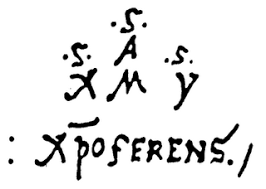
Maybe a clue could be his signature
1582865487692.png
It is really a very strange one and "storians" have been able to see almost everything in it:

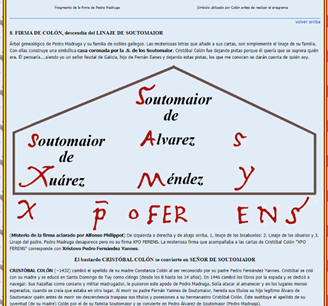
A family tree, with references to Sotomayor, a town in Pontevedra, Spain ...Link

1582865964104.png


Religious keys: XPO FERENS "Christo Ferens" (the one who carries Christ)

Or a "carta de marear" a navigation chart... link

And so on. In my opinion it's more like a registered trademark also used by his "descendants". In this way we would have the "Colon corporation" which could explain these different identities...

... or maybe It's just Colon, "James" Colon ?

1582865034783.png


Thanks for the comment, Nessness. Greetings from Spain
 
Note: This post was recovered from the Sh.org archive.
Username: Starmonkey
Date: 2020-02-28 15:07:18
Reaction Score: 0
Ha! Watched Ritchie's Man From U.N.C.L.E. last night, and I share the above first name, so maybe we're both spies and agent provocateurs for Christ!
Heavy little tike...
 
Note: This post was recovered from the Sh.org archive.
Username: Red Bird
Date: 2020-02-28 15:17:36
Reaction Score: 1
Or, Supreme Court justice:
Sonia Sotomayor - Wikipedia

They’re all related.
 
Note: This post was recovered from the Sh.org archive.
Username: Mabzynn
Date: 2020-02-28 15:44:10
Reaction Score: 11
The Columbus bit is just a distraction... I think it's really just a reference to the Colonna/Columna family. The source I posted above said they were looking for Christians in the Americas. His name would just be a reference to a "Christ Colony" ruled by the Colonna's arriving in that region. They weren't forced to play nice with the Orsini's until 1511. So we're seeing a power grab in the New World between the ruling Phoenician/Vatican based families.

Colonna family - Wikipedia

They would be the "Collins" today -
CIA library and 13 Bloodlines of Illuminati

Carthage was a colony of the Phoenicians/Venetians...
 
Note: This post was recovered from the Sh.org archive.
Username: Shabda
Date: 2020-02-29 15:03:36
Reaction Score: 9
The one thing I have yet to see mentioned, although it is an idea supported by many documents that exist, is that Columbus was not Italian at all, and was perhaps actually an exiled Royal Polish prince. Furthermore, he was well known to Portuguese royalty and for having supposedly been a Genoese weaver he somehow married a noblewoman. At that time such a thing was unheard of, and that is the first indication that he may have been of a noble lineage himself.

This theory goes somewhat further in saying that he was in effect, a Portuguese spy working in Spain for the specific purpose of misleading them away from the actual sea route to India which only the Portuguese knew (though the timing for when that was claimed to have happened may not necessarily be accurate, and the same with the time the Portuguese actually first went to the Americas).

I will post links at articles about this, as well as a link to the book, and end with a video webinar where he speaks about what his investigation discovered, none of which even remotely resembles the "history" of Columbus (Cristobal Colón in Spanish) as taught. If nothing else, I find it extremely interesting. It is also worth noting that Rosa believes him to have been a blond also. I submit this for your consideration because it has been largely ignored elsewhere and in the main stream. If nothing else it is an interesting take on the official history of the man.

Columbus - The Untold Story

Christopher Colombowicz: America's discoverer Polish not Portuguese

Manuel Rosa: Surprising revelations about Columbus’ true identity – Interview

Deception, Trickery & Conspiracy: The End of the Italian Christopher Columbus - Manuel Rosa
 
Note: This post was recovered from the Sh.org archive.
Username: Mabzynn
Date: 2020-03-02 01:11:15
Reaction Score: 5
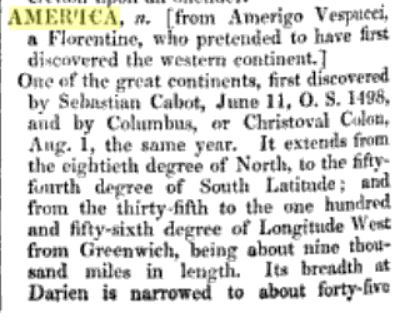
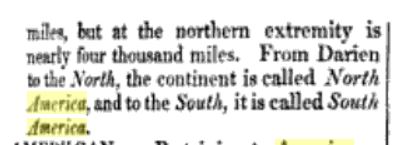
Add 1498 to the discovery year list.

A Dictionary of the English Language - 1832
1.JPG
2.JPG
SOURCE
 
Note: This post was recovered from the Sh.org archive.
Username: Nostradennis
Date: 2020-03-02 03:32:18
Reaction Score: 1
THE LIFE OF CHRISTOPHER COLUMBUS FROM HIS OWN LETTERS AND JOURNALS by Edward Everett Hale

His name, and that of his family, is always written Colombo, in the Italian papers which refer to them, for more than one hundred years before his time. In Spain it was always written Colon; in France it is written as Colomb; while in England it has always kept its Latin form, Columbus. It has frequently been said that he himself assumed this form, because Columba is the Latin word for “Dove,” with a fanciful feeling that, in carrying Christian light to the West, he had taken the mission of the dove. Thus, he had first found land where men thought there was ocean, and he was the messenger of the Holy Spirit to those who sat in darkness. It has also been assumed that he took the name of Christopher, “the Christ-bearer,” for similar reasons. But there is no doubt that he was baptized “Christopher,” and that the family name had long been Columbo. The coincidences of name are but two more in a calendar in which poetry delights, and of which history is full.

The Life of Christopher Columbus, by Edward Everett Hale,
 
Note: This post was recovered from the Sh.org archive.
Username: KorbenDallas
Date: 2020-03-02 04:04:54
Reaction Score: 6
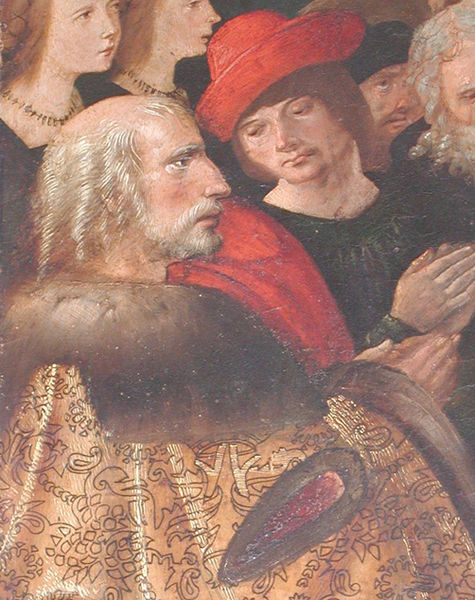
I'd recommend watching this video posted by @Shabda. The theory is somewhat interesting. Manuel Rosa thinks that this here is Christopher Columbus. Of course, this image is described like this:
  • A painting by Alejo Fernández between 1531 and 1536.
  • It is the only state sponsored portrait of the First Admiral of the Indias called Don Cristoval Colon known today as Christopher Columbus in English.
  • Photo by historian Manuel Rosa.
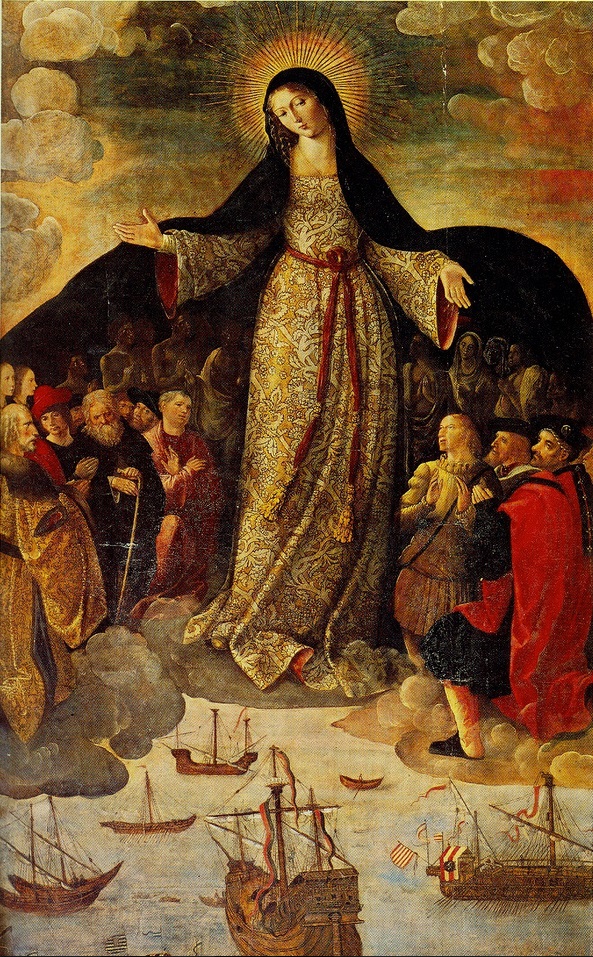
As far as I understand, the above close up belongs to this painting titled "Virgen de los Navegantes". It appears that its full description sounds like this (google translated):
  • Photograph of the altarpiece of the Virgen de los Navegantes, work by Alejo Fernández from 1535 located in the Room of the Admiral of the Royal Alcazar of Seville, located in the Plaza del Triunfo of the Andalusian city. Different characters appear from the discovery and conquest of the Americas sheltered under the mantle of the Virgin.
virgen de los navegantes.jpg
Based on many things, including a certain clothing design (available on the above painting), Manuel Rosa came to a conclusion that our Columbus was related to Władysław III of Poland. The king did not die in 1444 during the Battle of Varna. Mr. Rosa is convinced that Columbus was this king W's son. For more info you will have to watch this:
 
Note: This post was recovered from the Sh.org archive.
Username: wild heretic
Date: 2020-03-02 11:26:57
Reaction Score: 1
Copied over from another thread as per requested.

Thanks for that. After looking at the text of that map, my opinion is as follows...
I think the 1 is the same font as the i without a dot but it actually is a 1. They just used the same font without a dot.

The j is definitely a j and i think it means julian because there are interchanging uses of j and 1 throughout. It makes perfect sense that they are dates from two different calenders. The dates match very well too. It is also evidence of a 1000 year shift in chronolgy as julian moves up a thousand years.
"the julian calendar has gradually been abandoned since 1582." and "By the 40s BCE the Roman civic calendar was three months ahead of the solar calendar. Caesar, advised by the Alexandrian astronomer Sosigenes, introduced the Egyptian solar calendar, taking the length of the solar year as 365 1/4 days. The year was divided into 12 months, all of which had either 30 or 31 days except February, which contained 28 days in common (365 day) years and 29 in every fourth year (a leap year, of 366 days). Leap years repeated February 23; there was no February 29 in the Julian calendar. To align the civic and solar calendars, Caesar added days to 46 BCE, so that it contained 445 days. Because of misunderstandings, the calendar was not established in smooth operation until 8 CE."

So switching over from 1582 matches beautifully with the dates on the 1652 columbus map. It also puts julius ceasar at 960ad not 40 bc. As that matches the j dates very well.. Aka starting at 1000ad. So it seems the georgian calendar added the thousand years.

Also 1582 matches the massive earth expansion at the end of the 16th century very very well that affected ireland horrifically.

There are questions I've thought of that need answering too. Such as if the crossover happened in 1582, all dates prior must read J... and not 1... Does this denote any document that reads 1.... is a fake? Thinking of the German book newly appeared with the 1472 date for Pliny and Pompeii.

Why write J... anyway? They would only write J... to differentiate the date from the previous calendar. I have no idea what that calendar was. I've seen a couple of roman numerals written on documents from the middle ages. These are probably authentic. I wonder how they wrote dates pre-Julian?
 
Note: This post was recovered from the Sh.org archive.
Username: KorbenDallas
Date: 2020-03-02 15:37:21
Reaction Score: 0
I see J being used as 7 as well. But then we have small i’s for Columbus/Spilberg and j’s for others, and those mean 1. There is something to this difference, but what?
 
Note: This post was recovered from the Sh.org archive.
Username: Felixnoille
Date: 2020-03-02 16:48:13
Reaction Score: 1
I've read your Britannica link, but I don't see where the extra 1000 years came from to be honest.

Apparently it took 300 years to switch-over: "Turkey was the last country to officially switch to the new system on January 1, 1927." Source This would explain the necessity to differentiate between the two calendar systems. However, I find it hard to imagine there being a 1000 year difference between neighbouring European countries for 300 years.

I think it may be relevant to point out that, in continental Europe, the number one is often drawn like a seven with a large serif at the top to distinguish it from an I and the seven is drawn with a horizontal bar across it to distinguish it from a one. I tried to find images of this, but with no joy.
 
Note: This post was recovered from the Sh.org archive.
Username: JWW427
Date: 2020-03-02 18:26:01
Reaction Score: 6
We have one more theory by philosopher Manly P. Hall.
In WW2, 33º Mason President Franklin Roosevelt had the Hall library in California microfiched for posterity and safekeeping in case of Japanese invasion. Wow. That's tens of thousands of books. Circa 1941-42.


Manly P. Hall website. Background:

The Manly P. Hall Archive – Manly Palmer Hall Media Archive and Memorial

Manly Palmer Hall
(March 18, 1901 – August 29, 1990) was a Canadian-born author and mystic. He is perhaps most famous for his work, The Secret Teachings of All Ages: An Encyclopedic Outline of Masonic, Hermetic, Qabbalistic and Rosicrucian Symbolical Philosophy, which is widely regarded as his magnum opus, and which he published at the age of 25 (or 27, 1928)

He has been widely recognized as a leading scholar in the fields of religion, mythology, mysticism, and the occult while being well respected by those in philosophy, theosophy and psychology circles including Carl Jung whom when writing Psychology and Alchemy, had borrowed material from Hall’s private collection.

In 1934, Hall founded the Philosophical Research Society (PRS) in Los Angeles, California, dedicating it to an idealistic approach to the solution of human problems. The PRS claims to be non-sectarian and entirely free from educational, political, or ecclesiastical control, and the Society’s programs stress the need for the integration of philosophy, religion, and science into one system of instruction. The PRS Library, a public facility devoted to source materials in obscure fields, has many rare and scarce items now impossible to obtain elsewhere.

In 1973 (47 years after writing The Secret Teachings of All Ages), Hall was recognized as a 33º Mason (the highest honor conferred by the Supreme Council of the Scottish Rite), at a ceremony held at PRS on December 8th, despite never being initiated into the physical craft.

In his over 70-year career, Hall delivered approximately 8,000 lectures in the United States and abroad, authored over 150 books and essays, and wrote countless magazine articles.


On Columbus:

A NEW IDENTITY FOR CHRISTOPHER COLUMBUS

Many scholars were fully aware of the global form of the earth
in the time of Columbus, who, according to early historians, State documents,
and his own son, was not an Italian of humble station and uneducated
but was a Greek Prince with an excellent classical education. ...
It was from a Greek port that he sailed on the celebrated voyage of discovery.
He was accompanied by a mysterious stranger, which has suggested
that Columbus was an agent of the society of unknown philosophers. ...
The pattern of the democratic ideal was beginning to assert itself over the tyranny of decadent aristocracy.
A new world was necessary for a new idea. ... When it was necessary, it was discovered.


His book: The Secret Destiny of America:

Destiny.jpeg

"AS stated earlier, there can be little doubt that the Greeks were aware of the existence of the American continent long before the beginning of the Christian era. If information is not general on that point, it is equally surprising how little is known about the man Christopher Columbus who is accredited with the discovery of the new world. The date of his birth is unrecorded, and twenty cities claim Columbus as a native. So many legends have sprung up about this strange man that it is difficult to distinguish fact from fancy.

In 1937 a little book was published, entitled, Christopher Columbus Was A Greek. According to its author, Spyros Cateras, the real name of Columbus was Prince Nikolaos Ypsilantis, and he came from the Greek Island of Chios. The statement is backed by quotations from numerous early historians and State documents.

The author of this little book has documented his opinions in a manner to bring joy to the critical reader. He mentions the following Greeks who navigated the Atlantic ocean in ancient times: Hercules, Odyssus, Colaeus, Pytheus, and Eratosthenes. He points out that the language of the ancient Mayas of the American continent contains many words of pure Greek belonging to the Homeric period, and, to quote the book: "Years ago, in the republic of Uruguay, South America, were discovered traces of the army of Alexander the Great, swords and thoras with the inscription 'PTOLEMEOS ALEXANDROY'!".

All modern research on the life of Columbus tends to prove that he was not a man of humble station, poor or uneducated, and the story of Queen Isabella and her jewels is rapidly becoming recognizable as fiction. Columbus is emerging as a man of impressive personality with marked abilities as a leader and organizer and an excellent classical education.

Like most Greeks of his time he admired the writings of Plato and the other classical philosophers; he had the Greek birthright of legend and tradition, and was mentally well suited for interpretation of classical lore. There is much to indicate that Columbus was inspired for his voyages by Plato's account of the lost Atlantis and the records of early navigation to the West. Furthermore, Europe was not without some knowledge of geography and in his day there were many scholars aware of the spherical form of the earth.

A great trade with Asia had long passed over the caravan routes of the Near East, as the Arabs for the most part were a friendly people; but with the rise of the Turkish Empire to power most of these routes were closed to the infidel. When even the Crusades failed to keep clear the roads of commerce, it became ever more desirable to discover a western passage to the Orient. It was for this purpose that Columbus sailed, and not from an Italian or Spanish port, but from the Greek port of Mahon.

It is astonishing how difficult it is to ascertain the facts about the celebrated voyage of discovery and the life of one so prominent in history as Christopher Columbus; it appears that history entered into a conspiracy to conceal the truth. Possibly an elaborate misrepresentation was intentional, for certainly the confusion began before the death of Columbus. His own son refers to his father as a Greek. It has been suggested that Columbus changed his name because of religious or political pressure, but this is in the field of conjecture.

Then too, in browsing about among old records I have run across a dim figure involved in the life of Columbus, a strange man who seems to have served the explorer in die capacity of counselor. Nothing very tangible has as yet come to light, but it is hinted that this mysterious person accompanied Columbus on his first voyage. He was not included in the list of the mariners. He did not return, but remained in the West Indies; beyond this, no further mention is made of him.

This mysterious stranger is reminiscent of the black-robed man who guided the destiny of Mohammed. Were these obscure figures ambassadors of the secret government?--Columbus being one of the agents through which the society of unknown philosophers accomplished its purposes ?

It is my opinion that he was such an agent. The signature of Columbus, composed of letters curiously arranged and combined with cabalistic designs, certainly conveys far more than is inherent in the signature of a private citizen.

The importance of Columbus in the larger scheme of things is to be estimated from his relationship to the pattern of his own time. Europe, passing from the obscuration of the medieval period, was coming into the light of the modern way of life; the motion of the Renaissance had spread like ever widening ripples over the surface of a stagnant pool. Printing had been discovered; the mental emancipation of man from the tyranny of ignorance, superstition, and fear was gradually being accomplished. The democratic ideal was beginning to assert itself over the tyranny of decadent aristocracy.

As the mental horizon broadened, the physical horizon extended also. The Crusades had broken up the structure of feudalism. Principalities were forming themselves into nations, and the tribal consciousness was disappearing from the theater of European politics. This progress was opposed at each step by vested interests. But the human mind was becoming aware of its own powers, in a motion of continuing irresistible force.

A new world was necessary for a new idea. When it was necessary it was discovered. That which is needed is always near if man has the wit to find it.

Today we are again seeking for a new world. No longer do there remain undiscovered continents to serve us as laboratories for social experiments, so we are turning our attention to other kinds of worlds--worlds of thought, inner spheres which must yet be explored by daring navigators. Science in the last fifty years has discovered a new universe--the universe of the mind. The infant psychology has but to come of age for us to fully discover a new sphere for new exploration in the science of living.

The voyages of Columbus were followed by two centuries of enlarging our geographic knowledge of the earth. Explorers who sailed the seven seas seeking wealth, brought home knowledge; it released human thought from its Mediterranean fixation and accomplished the still greater end of breaking the power of a Mediterranean theology and a Mediterranean way of life. Men began to think world thoughts, began to realize that while the whole earth was one land divided into continents and oceans it still was a gigantic unity. Out of the global wanderings of stout sea captains in little wooden ships was developed our so-called global thinking of today.

SIG.jpeg

The concept of a global world, at least in terms of geography, is now our common inheritance. After four hundred and fifty years we accept it without question, but mainly to toy with the belief that we will accomplish something in terms of ultimates if we can industrialize the entire planet. Our world is still too large for us to know how to use it. We have discovered much, but the greatest voyage still lies before us.

Our venture will be into that greater ocean that lies beyond the boundaries of the known. The new voyages will be made in laboratories, and the contrary currents will be the cosmic rays that move through the seas of universal ether.

This will require of each man that he make a long journey of discovery within himself, searching out the hidden places of his mind and heart. As Socrates so wisely observed, all mankind lives along the shore of an unknown land. This unexplored world abounds in wonders and is filled with riches beyond the wildest dreams of old Spanish conquistadores. In this land beyond the sea of doubt the wise men dwell together in shaded groves, and here, according to the old tradition, the scholar, the musician, the artist, and the poet--who makes the discoveries that science and philosophy must later prove--have already found the better way of life.

Christopher Columbus sailed his little ships for a land which by the writings of ancient philosophers he knew existed. And each of us in the fulness of time will make our own voyage in search of a philosophically-charted better world--to follow the advice of Homer, to prepare our ships, unfurl our sails, and facing the unknown go forth upon the sea to find our own far distant native land."
––MPH


My thoughts?
So, whoever Columbus really was, he had a great knowledge of the Americas. He had maps, intelligence, knowledge on currents, Ley Line info, and probably first hand accounts. He also believed in Atlantis and her colonies in the Americas: pyramid cities, ports, mounds, the lot. AND...he had funding galore. He was connected big time.
IF...some Templar secret group in Switzerland funded him (those Templar red crosses on his sails), he would have to have had impeccable secret society credibility and membership.
I don't think the New World of the Americas was ever "discovered," just found again by Europeans. Certain small groups of people always knew it was there.
JWW
 
Note: This post was recovered from the Sh.org archive.
Username: Pale Rider
Date: 2020-03-02 19:12:40
Reaction Score: 0
I would imagine that at least some of the "tangible" proof, lies beneath the public catacombs under the Vatican. I would love to raid that place.
 
Note: This post was recovered from the Sh.org archive.
Username: wild heretic
Date: 2020-03-02 20:36:02
Reaction Score: 1
The logic comes from the assumption that j means julian calendar in a date. So j526 means 526 years from the beginning of the julian calendar. However britannica says the julian calendar came into being between 40bc and 8ad, aka 0ad, therefore if the britanica is correct the j526 date should read j1526 not j526. But it does not, therefore the julian calendar started around 1000ad. Under this assumption, the only way britannica can be correct is if columbus discovered america in 592ad per the map. Personally i think that is a huge unrealistic stretch on many fronts, not least of which are the maps.

Modern use of the julian calendar such as russian orthodox church or ur turkey example up to 1927 obviously use the added thousand years. So the orthodox church would say columbus discovered america in (j)1492 for example. The lost millenium was added in 1582 by the survivors of that earth expansion in my theorem to put their history much further in the past for some political purpose i am not yet aware. It obviously needs a lot of further study, but its an inital idea that deserves proper research imo.
 
Note: This post was recovered from the Sh.org archive.
Username: Felixnoille
Date: 2020-03-03 01:24:34
Reaction Score: 2
Just to make it more confusing, there's the name 'Iacobo' at the end of the 3rd line from the bottom, which is obviously Jacobo. Apart from the 1s that look like Js,there are no other Js anywhere in that text because in Latin the J sound is written as the letter I or i. This means that the 1s that look like Js cannot stand for Julian because it would be written Iulian, just like Iacobo. However, maybe the 1s that look like an i do stand for Iulian.
 
Note: This post was recovered from the Sh.org archive.
Username: nanuko
Date: 2020-03-07 09:20:08
Reaction Score: 5
Interesting theory. I did not know about the work of this guy but he has a channel with very few subscribers but I think it is worth checking out.
link

In any case, the number of theories is so great that I think it makes any conclusion impossible. The masters of deception have done it pretty well.

Another IMHO interesting video not too far from the SH line
DID 'CHRISTOPHER COLUMBUS' REACH AMERICA IN ROMAN TIMES?! MIXED UP WITH ANOTHER EXPLORER?!

Thanks for the thread.
Jacob , Aug. , Llago , Yago , Jaime , Santiago , Tiago and Diego , are variants in Spanish of the Hebrew proper name Ya'akov ( in Hebrew , יַעֲקֹב ). It was the name of the patriarch who was later called Israel ; sometimes also transcribed as Jacob
Link wiki "Jacobo"

Just as a curiosity
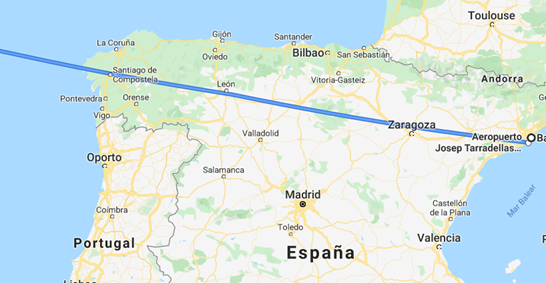
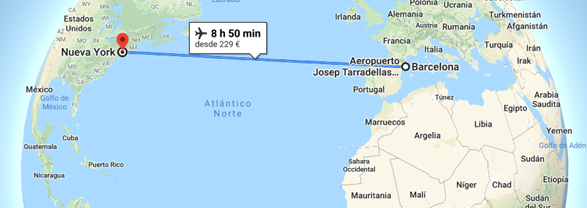
The extension of the Santiago road from Barcelona reaches exactly New York.

1583574234493.png

1583574262629.png
 
Note: This post was recovered from the Sh.org archive.
Username: Columbo
Date: 2020-03-08 02:53:07
Reaction Score: 2
Fascinating topic! While I was reading through the post and all of the forms of Columbus, Columbia, Columbine, etc that we are inundated with were rolling around in my head, boom, ? it hit me COLUMBO! ba-dum ching ?
To add to what's already been discussed, it is interesting to note the association of of Columbia with Goddess worship. The following article covers it succinctly:

Columbus Day and the Illuminati goddess agenda - IlluminatiWatcher

To me three things stick out:
1) Why are TPTB so fixated on hammering in the whole 'In 1492 Columbus sailed the ocean blue' paradigm? If you boil mainstream history down, as it is taught in school, the figures that tower over the history of America would be Columbus, Washington, Lincoln and Martin Luther King.
2) As the readers of SH well know, this period at the dawn of the sixteenth century is a nexus in our timeline. We have the expulsion of the Moors from the Iberian Peninsula at the same time the "New World" is discovered. At the risk of sounding extremely cliche, could this be the inception of the new world order that now holds sway?
3) And finally, with respect to the excerpt I quoted above, is it over the top to consider that Columbus is the Prince of the Power of the Air (Ephesians 2) come to ascend the throne of his world?

Better stop now before I reach the border of conjecture... ?
 
Note: This post was recovered from the Sh.org archive.
Username: nanuko
Date: 2020-03-08 08:02:35
Reaction Score: 1
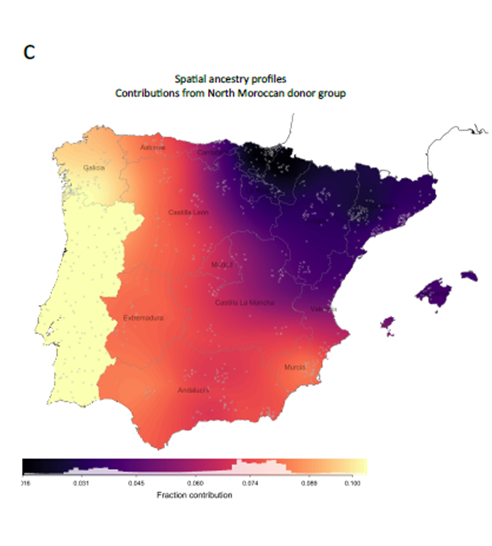
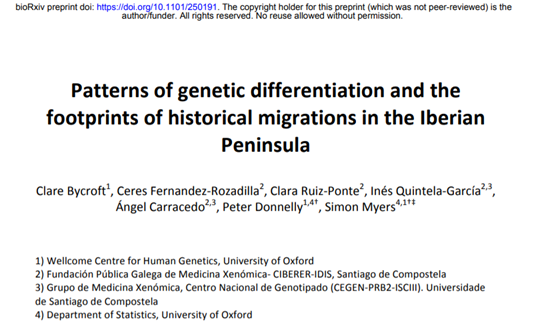
The North African genetic footprint is Spain is greater in the northwest (lighter areas) than in the rest. Curiously, the Moor presence in that area has been irrelevant, according to official history.

At least 10% moor blood is a expulsion? :unsure:


But we, the Spaniards, have also expelled Jews, Jesuits, French... can imagine that with similar results.
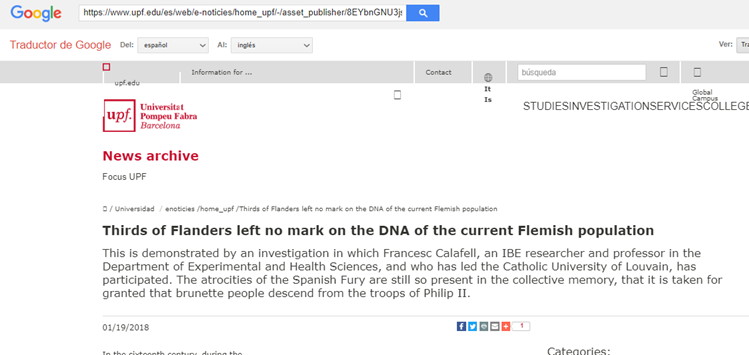
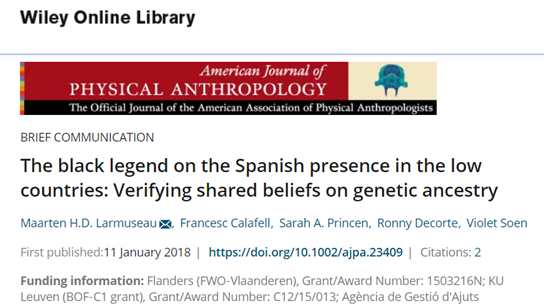
Of course, after a century of raping women in Holland there is no trace of Spanish genetics in that area ???

80 years war
The black legend on the Spanish presence in the low countries


At this point I consider myself as a metasocratic. I just know that I know nothing and also know that I will not know anything ever.
 
Note: This post was recovered from the Sh.org archive.
Username: Felixnoille
Date: 2020-03-08 14:55:24
Reaction Score: 3
Perhaps, just like Columbus, The Moors weren't who we've been led to believe they were? Maybe they were the Circassian Mamluks who ruled Egypt for some centuries and maybe they left no genetic imprint because they were a genetically diverse confederacy to begin with?

(With apologies for going a bit off topic.).
 
Note: This post was recovered from the Sh.org archive.
Username: Red Bird
Date: 2020-03-08 15:11:06
Reaction Score: 1
There’s a lot there. For instance one of my first thoughts when finding out 300-1000 years (the middle, dark ages) can be taken out was what about Mohammed/Islam? But that is another subject.
 
Tips
Tips
Please respect our Posting Rules.
Back
Top