SH Archive Christopher Columbus: what do we really know?

SH.org OP Username
KorbenDallas
SH.org OP Date
2020-02-23 04:34:10
SH.org Reaction Score
78
SH.org Reply Count
78
Note: This post was recovered from the Sh.org archive.
Username: Onijunbei
Date: 2020-03-08 20:10:32
Reaction Score: 2
What if Columbo was Jewish, and his crew was Jewish, and he was financed by Conversos. And what if the Moors were Jewish... I believe they are the keepers of Kabala or Kabala type mysticism.. And what if the Jews of Spain were just letting in their own people into Spain, which then caused their expulsion and Conversion. Didn't Columbo leave Spain on the exact same day as the expulsion?
 
Note: This post was recovered from the Sh.org archive.
Username: nanuko
Date: 2020-03-10 04:59:54
Reaction Score: 2
You're right, Felixnoille. I apologize. My comment is out of this thread.
Maybe when when I have a little more time will start a new topic on the contradictions between TPTB history and science focused on the Iberian Peninsula.

Thanks and best regards from Spain.
 
Note: This post was recovered from the Sh.org archive.
Username: Felixnoille
Date: 2020-03-10 10:18:51
Reaction Score: 3
No need to apologise, we all do it now and again. I look forward to your new topic. ?

Best regards also from Spain :)
This may also appear later in another post I am researching, but I couldn't sit on it any longer...

Christopher Columbus is the Anglicised version of the Spanish 'Cristóbal Colón'.
  • Colony - from Latin colonia "settled land, farm, landed estate," from colonus "husbandman, tenant farmer, settler in new land," from colere "to cultivate, to till; to inhabit; to frequent, practice, respect; tend, guard," Source
  • Colony - 1350–1400; Middle English colonie (< Middle French) < Latin colōnia, equivalent to colōn(us) colonus + -ia -y Source
  • Colonist - An Americanism dating back to 1695–1705; colon(y) + -ist Source
  • Cult - (n.) past participle of colere "to till, to inhabit" (see colony). Source
Viewed in that it way it really looks like someone was taking the p*ss and the name was chosen to mark the beginning of the European Colonisation (not discovery) of the New World by a cult who were 'in the know'.
 
Note: This post was recovered from the Sh.org archive.
Username: Damas
Date: 2020-04-04 17:04:36
Reaction Score: 6
On Christopher Columbus - What do we know.
1- In Spain his name was "Cristóbal Colón" - This name was an assumed identity to cover up his real name
His son Hernando wrote that "così quello che tocca alla varietà di cotal nome e cognome non avvenne senza mistero." Meaning, what has to do with him choosing such first name and last name is not without mystery. Later on he explains that the name was chosen for its underlying meaning, Christo-pher Colón=Christ ferrying Member.

2- Neither "Cristoforo" nor "Colombo" [Christopher Columbus] were his names of birth, as the son explained and the correct Latin version of the name is Christophorus Colonus. That as a coincidence, the name COLÒN was chosen due to its Greek root meaning "member" and also because it was the ancient name given to his Roman ancestor who was Consul as well as a Tribune. [The Greek and Latin terms for colon are κῶλον and membrum,]

3- Both the courts of Portugal and Spain knew his true identity and both courts assisted in keeping it secret from the public.

4- Neither Cristóbal Colón nor his two brothers, Bartolomé and Diego, could write Italian. They wrote between themselves in Castillian. When Cristóbal tried to write a short note in Italian, his errors include "yo" for "I" instead of "io"- meaning he did not even know how to I [me] in Italian.

5- in 1578, when the lawsuit for Colón's inheritance begun in Spain [lasted 1578 to 1609] no Italian Colombos could prove any connections to the Colón family. Those Columbus who came to Spain to steal the inheritance from Colón's descendants were proven to carry forged documentation and rejected by the Spanish Tribunal. That false documentation is utilized today by many historians as proof oh Colón's Genoese birth. Such is the case of the 1498 Last Will, in which Colón supposedly claimed to have been born in Genoa. The Spanish Tribunal called it as "worthless as a blank piece of paper" when the impostor Baltazar Colombo presented it.

For over five centuries the family and the courts managed to keep Cristóbal Colón's true Identity secret - but we now have broken through the lies and soon, through DNA, may know his real name and parents thanks to Manuel Rosas's 30 years of research into this case [ www.Manuel-Rosa.com ].
 
Note: This post was recovered from the Sh.org archive.
Username: KorbenDallas
Date: 2020-04-04 17:14:39
Reaction Score: 0
@Damas, hello.

Is there a single surviving original authored by the man? As in a document written by his hand.
 
Note: This post was recovered from the Sh.org archive.
Username: Damas
Date: 2020-04-04 17:30:34
Reaction Score: 2
If you mean writings from the explorer Cristóbal Colón, Yes there are about 50 letters and hundreds of notes on the margins of the books he owned.
However, there are also some forgeries - especially letters kept in Genoa cannot be trusted -around 1892 one letter came up for sale in USA that is an exact forgery of a letter in Genoa.
You can search the web for "cartas de Cristóbal Colón" to see some images - John Boyd Thacher's book ( Christopher Columbus: His Life, His Works, His Remains ) published in 1904 has several images of Colón's letters, although low quality - The Archivo e Indias in Seville has some aslo online - here you can see part of one letter showing how C.C. signed his name in secret code - some letters will have a "./" after FERENS meaning "semi-colon ; " - https://elhabitasculo.files.wordpress.com/2007/05/carta-de-colon.jpg

As a side note, the 1492 voyage was a complete ruse planned by Portugal against Castle, (Portugal's only European enemy) with Colón acting as a secret agent forKing John II to convince Castile America was India
 
Note: This post was recovered from the Sh.org archive.
Username: KorbenDallas
Date: 2020-04-04 17:44:36
Reaction Score: 1
Where can these 50 handwritten by Columbus letters be seen?
 
Note: This post was recovered from the Sh.org archive.
Username: Damas
Date: 2020-04-04 17:46:08
Reaction Score: 2
Greetings Felixnoille-
While it is true that every dictionary and translation software will give you this result "Christopher Columbus is the Anglicised version of the Spanish 'Cristóbal Colón'." in actuality this is a translation mistake.

As you may know, Columbus in Latin and Colombo in Italian will give you Palomo in Spanish, all three: Columbus/Colombo/Palomo mean Pigeon.
However, Colón in Spanish will never be the same as Palomo in Spanish, nor can it be, for the name Colón comes from the Greek κῶλον (kólon) which in Latin is colon and semi-colon - This error of translation was first seen in Pedro Posa's printing of Colón's letter in April 1493, where Posa changed Colón's name to "Colom".

This simple error had huge implications because Colom in Catalan, where Posa's letter was printed - Colom means Pigeon.
And voilá - Colom/Colombo/Columbus all mean pigeon - Now you can see how a simple letter can give us a complete wrong meaning.
Columbus in now way equals Colón - You can learn more from www.Manuel-Rosa.com

As I mentioned in the previous post, John Boyd Thacher published several images of the explorer's letters in his 1904 book you can see it here, although not good quality:
Christopher Columbus: His Life, His Works, His Remains.

Look at Chapter CXXI - The Handwriting of Columbus
 
Note: This post was recovered from the Sh.org archive.
Username: Damas
Date: 2020-04-04 18:08:22
Reaction Score: 1
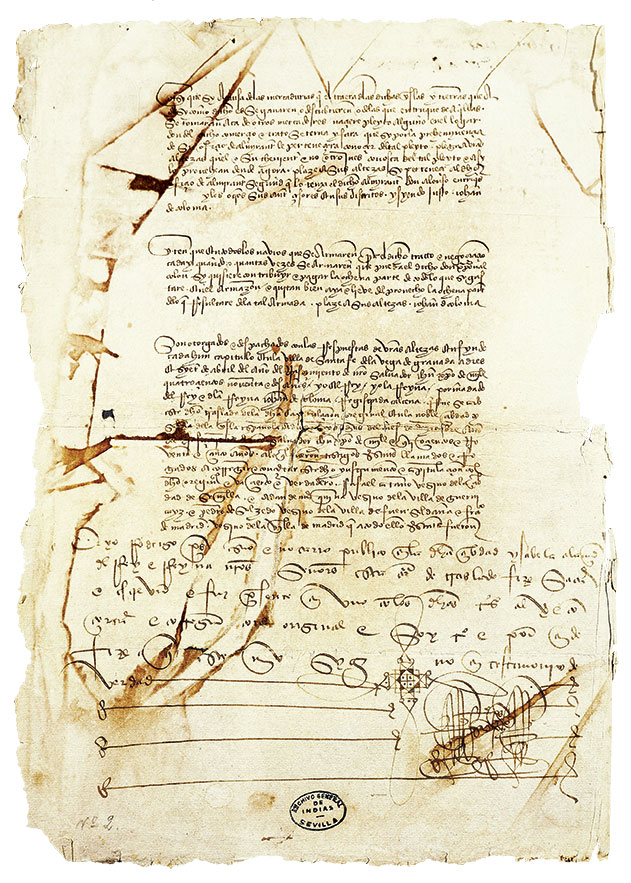
I do not know what this one is, it is not signed by him, so I do not know on this one.

But this one is original written by the discoverer
El Archivo de Indias de Sevilla exhibe una carta original de Colón en la muestra 'La carta en el camino'

Here is another original written by the discoverer
Cristóbal Colón carta autógrafa escrita a su hijo Diego el 5 de febrero de 1505, fue dado Foto & Imagen De Stock: 212465491 - Alamy
 
Note: This post was recovered from the Sh.org archive.
Username: KorbenDallas
Date: 2020-04-04 19:24:13
Reaction Score: 0
What year are the first independent records any of these letters were mentioned in?
 
Note: This post was recovered from the Sh.org archive.
Username: jd755
Date: 2020-04-04 19:35:20
Reaction Score: 1
I love the way ll these documents get stamped with an official stamp. This leads me to feel we are only ever shown copies & not originals.
 
Note: This post was recovered from the Sh.org archive.
Username: Damas
Date: 2020-04-04 19:47:34
Reaction Score: 1
KorbenDallas, both friar Bartolomé de Las Casas and Colón's son, Hernando Colón mentioned in their books that they had the original letters of Cólon in their possession.
Also, many letters from Colón to the court were archived. Navarrette publisher transcriptions of them in his books.

Many originals are kept at the Archivo de Indias in Sevelle... you can search here: Portal de Archivos Españoles (PARES)

If you put the word search "Colón" and search within the years 1484 and 1508 you should find many. related to Cristóbal Colón, sus descendientes y los pleitos de éstos con la Corona.

JD755 - the stamp you see usually is the stamp of the Archivo de Indias - Archive of Indies in Seville
 
Note: This post was recovered from the Sh.org archive.
Username: KorbenDallas
Date: 2020-04-04 20:21:57
Reaction Score: 1
I am not sure we are speaking the same language here, @Damas.

1904 is 400 years after the events, and is 100% irrelevant.

Pick a letter of your choice of those 50. Are we capable of establishing its track record from the creator to where it’s at today? If so, I would love to see such a record.
 
Note: This post was recovered from the Sh.org archive.
Username: Damas
Date: 2020-04-05 03:44:40
Reaction Score: 1
It seems you misunderstood.
In 1904 JohnBoyd Thacher printed images of some of Colón's letters from the Archives, it does not mean they only found them in 1904.
Colón's letters that he sent to the court were kept in that kingdom's archives - many were transcribed by Navarrette circa 1825.
Colón's letters to his family members were kept in the family archives, many of those letters were then handed over to the state archives by Colón's descendants centuries later.
All noble families handled their documents carefully, they kept an archive of all their important papers, land grants, titles, etc. - Colón's descendants did no different. Today many noble European houses still hold onto their archives.

Cristóbal Colón had a metal box at the Monastery of Las Cuevas in Seville where he housed al his documents. His descendants utilized the same box to archive their documents. After D. Luis Colón, 3rd Admiral and Duke of Veragua died with no legitimate heir the archive was inventoried for its major contents. In 1609, after Nuño Álvares Pereira Colón y Portugal inherited the posts and titles of his great-great-grandfather he had the archives transferred out of Las Cuevas to Duke of Veragua's personal residence in whose descendants they were kept until they were transferred to the Archive of Indies.

So, I am not sure what your questions is.
Many of the letters were quoted by Las Casas, (a friar who served in the New World under Cristóbal Colón's son D. Diego) in his Historia de las Indias
And also quoted in the Historia written by Cristóbal Colón's second son Hernando before 1539. Historie del S.D. Fernando Colombo; : nelle quali s'ha particolare, & vera relatione della vita, & de' fatti dell'Ammiraglio D. Christoforo Colombo, suo padre: et dello scoprimento, ch'egli fece dell'Indie Occidentali, dette Mondo Nuovo, hora possedute dal Sereniss. Re catolico: : Colón, Fernando, 1488-1539 : Free Download, Borrow, and Streaming : Internet Archive

As for the notes in the margins of books C. C. owned, you can see them at the Colombian Library inside the Cathedral of Seville, such as this page which was annotated by the discoverer: https://i1.wp.com/elretohistorico.com/wp-content/uploads/2015/07/un-bibliofilo-del-renacimiento-hernando-colon-L-n5slna.jpeg?resize=700,508&ssl=1
 
Note: This post was recovered from the Sh.org archive.
Username: KorbenDallas
Date: 2020-04-05 04:08:13
Reaction Score: 2
So far this conversation is about nothing. I am not gonna talk about all 50 letters in general and at the same time. Pick one of his letters and establish its track record.

An example of an available track record looks something like this.
In the above link you can see an example of what historians consider to be "good enough" to claim authenticity of the book, and its contents.
  • This link demonstrates that such official records, when carefully looked at, form a pattern of lies. Some history PhD, who wanted to prove the point in this section, chose to abandon the discussion.
Pick a letter (one of those 50), and track the history of the document from the very beginning. As in:
  • What year that particular letter was written
  • When the letter was first mentioned in any independent source
  • Where it was kept year by year based on on independent sources
If a letter was written in, for example, 1495, but the first time it was mentioned in 1539, I would like to know where it was for 44 years. At this point there will be a set of additional questions.

Only a credible track record can establish some sort of history to prompt further research.

I am perfectly ok if what you mentioned above is enough for you. It's not enough for me, and for a few additional people on this forum.
 
Note: This post was recovered from the Sh.org archive.
Username: Damas
Date: 2020-04-05 05:03:09
Reaction Score: 1
I now understand your point - You want a track record of a letter, for example, the letter that was written at sea February 15, 1493 and sent off on on March 4, 1493 once he reached Lisbon, to Luis Santángel which was then printed by Pedro Posa in Barcelona in April, 1493 - of which the New York Library has a rare copy.
Seen Here: Letter of Columbus to Luis de Santangel, dated 15 February 1493

So that particular original does not exist, nobody knows what Santángel did with it. Should we doubt? I don't know.

Now, for the other letters, C.C. dated them at the end - that would establish its date of being written.

It is not a task I would endeavor to pursue. I believe there is enough evidence to accept them as they are, for instance there are letters to Queen Isabel in the court's archives and then replies from Queen Isabel in Colón's archives.

It is not a task for me, that is, I am not the person to go investigate the history of each letter and where it was sitting from 1506 until it was mentioned in 1539. Obviously, if the son wrote that he was quoting his father's letters and letters from the court to his father and the courts archives also confirm this, I don't see what else is needed.
Furthermore, there is a Book of Profecies written by the discoverer, which is still in the archives as well as 4 bound copies that he had made in 1502 of his privileges and grants from the court - the Library of Congress has one copy - America-Spain: Parallel Frontiers: Columbus

Therefore, what you ask for, I don't even know if it is possible to compile.
There is no track record of when a letter was sent, and to who, and when it was received, etc.
But, as I said, Thacher, Navarrete and many others have published the transcription of these letters, and just a few months ago there were found in a noble's archive in Spain, 2 letters from king John II of Portugal from May 1493 to Queen Isabel and Fernando talking about C. C.- letters that nobody knew existed until just this year. They are now at the Spanish Archives and you can see them here: Carta misiva de Juan II de Portugal a Fernando el Católico por la que le comunica la llegada de Cristóbal Colón al puerto de Lisboa, y que le envía a Rui de Sande a tratar en su nombre ciertos asuntos.

This is the same website where you can search for Colón's letters. Keep in mind that the discoverer was not an insignificant peasant, he was a Viceroy and an Admiral, as well as Governor of the New World. He was very well connected to King John II of Portugal plus his wife was cousin of King John II's Lord Chamberlain, cousin of the wife of King John II's Captain of the Guard, her half-sisters were cousins to King John II's Mistress and second cousins to King John II's son. C.C.'s brother-in-law was one of King John II's guards and Captain of the Island of Graciosa in the Azores, plus another brother-in-law was Captain of the Island of Porto Santo in Madeira. Furthermore, C.C.'s wife was a Comendadora of the Portuguese Military Order of Santiago, where King John II was Grand Master. Meaning she was so elite she got rents from a commandery of the order. All of this to point out that the tale of Colón being a peasant Genoese wool weaver Colombo is a great myth.

You may doubt these 2 letters, but the writing and the seal are same as other letters from King John II.

Regards,
 
Note: This post was recovered from the Sh.org archive.
Username: jd755
Date: 2020-04-05 09:45:26
Reaction Score: 1
You miss my point.
The document is deemed to be authentic as in the hand of whichever name is said to have written it.
Then some idiot goes and stamps it with a seal of some sort that is then taken as evidence of the veracity of the documents authenticity thus destroying the authentic document by putting something that isn't authentic on the bloody thing.

Furthermore there is no more exploration or investigation allowed on that document thus putting it beyond further use.
Upon this whole academic careers get built and within short order the possibility of it being bogus of it being a fake or even of it being written by some bugger else unknown to history gets shut down and it becomes gospel.

If there are such things as original documents kicking around somewhere and I like everyone else here have no way of knowing and no means nor mechanism of establishing the veracity of the claim of originality, then they are not availble for anyone to study, research, test, explore.
So sad to read that.
I won't bother you again
 
Note: This post was recovered from the Sh.org archive.
Username: Felixnoille
Date: 2020-04-05 10:42:19
Reaction Score: 1
I think this is the 'Tratado Columbino'. Which was a contract between Luis de Santángel, a wealthy marrano Jew who put up five million maravedíes of his own money, interest free, to finance the new ‘business’. This was confirmed in the Capitulaciones de Santa Fe, a place near Granada, which stipulated the conditions of the new ‘Colombian Company’, (the prototype of the later East India Companies) as signed by its secretary, Luis de Santángel.

This arrangement was a loan that was repaid with the income from Castilla, at the behest of the Catholic Monarchs to largely exclude the Aragonese Crown from participation in matters relating to the New World.

Absolutely. 'Pigeon' can also be taken as 'Dove':

The New World was believed to be where the 10 lost tribes of Israel would be found and reunited. This is also linked to why Colón's first voyage coincided exactly with the time limit for the expulsion of the Jews from Spain.

@Damas, thank you very much for sharing all of this information. It's been very helpful to me.
Living in Spain I can assure you that they still, even today, stamp absolutely everything. In this case, I think it just shows when they officially received it rather than its authenticity. (y)
 
Note: This post was recovered from the Sh.org archive.
Username: jd755
Date: 2020-04-05 11:13:58
Reaction Score: 1
Thankyou.
 
Tips
Tips
Please respect our Posting Rules.
Back
Top