SH Archive Christopher Columbus: what do we really know?

SH.org OP Username
KorbenDallas
SH.org OP Date
2020-02-23 04:34:10
SH.org Reaction Score
78
SH.org Reply Count
78
Note: This post was recovered from the Sh.org archive.
Username: wild heretic
Date: 2020-04-05 12:16:12
Reaction Score: 0
For sure. Ive read all the new world guys were conversos around that time.

Interesing about the expulsion. Must look into that some time.
 
Note: This post was recovered from the Sh.org archive.
Username: Damas
Date: 2020-04-06 04:48:11
Reaction Score: 1
Very little truth to this. If Colón had been Jewish he never could have married Filipa Moniz in 1479 in Portugal.
Especially knowing that Filipa Moniz was daughter of a noble Knight of Prince Henry the navigator's household, who was Captain of Porto Santo Island in Madeira.
Plus knowing that she was a Comendadora at All-Saints Monastery of the Military Order of Santiago (property today houses the French Embassy in Lisbon: Link )

Furthermore, Filipa Moniz was cousin of these Portuguese noble Perestrelos ALL Great-Grandkids of King Fernando I and of King Henrique II of Castile:
1- Pedro de Noronha (Perestrelo) commander-major of the Military Order of Santiago, Lord Chamberlain of King John II, Ambassador to Pope Innocent VIII - Father of D. Martinho de Noronha whom King John II sent from Vale do Paraiso to Lisbon March 8, 1493, to bring the discoverer to the Portuguese court at Vale do Paraiso.
2- D. Fernando de Noronha (Perestrelo) - Capitan of the King's Guard and later Governor of House of Queen Juana (Beltraneja)
3- D. Isabel de Noronha (Perestrelo), Marquesa of Montemor, sister-in-law to the Duke of Bragança
4- D. Inês de Noronha (Perestrelo), Countess of Abrantes - her husband was D. João de Almeida, 2nd Count of Abrantes and Capitan of King John II's Royal Guards
5- D. Catarina de Noronha (Perestrelo), Countess of Penamacor, her husband was D. Lopo de Albuquerque, 1st Count of Penamacor, King Afonso V Chamberlain and Royal Falconer.

Filipa was also:
1- Sister of Bartolomeu Perestrelo II, 3rd Captain of Porto Santo, Madeira
2- Half sister of Izeu Perestrelo, married to Pedro Correia, 2nd Captain of Porto Santo (1458-1473), Captain of Graciosa Island, Azores, one of King John II's 25 royal guards. Izeu Perestrelo was also cousin of Anna de Mendonça, King John II's lover and mother of Prince Jorge Lancastre, 2nd Duke of Coimbra. Izeu Perestrelo's great-aunt was the of Kind Duarte's daughters: Joana - later Queen of Castile and Loenor, later Holy Roman Empress by marriage to Frederick iii holy roman emperor.

Filipa, Colón's wife, was also niece of:
1- Rui Gil Moniz, a Knight of the House of King Afonso V and royal treasurer for Lisbon.
2- Diogo Gil Moniz, Knight of Prince Henry the navigators household, and of Prince Fernando's
3- Vasco Gil Moniz, raised in King Duarte's household, later a Knight of Prince Pedro (Regent of Portugal 1439-1449) - Vasco Gil Moniz, Colón's uncle by marriage, married Leonor de Lusignan, granddaughter of King Jean II de Lusignan.

I won't go into more of these family connections, because it should not be necessary to understand that the guy who changed his name to Cristóbal Colón in Spain, was a blue blood when he married in Portugal in 1479 and became nephew and cousin by marriage to these and more Portugese nobles all connected to the Portuguese court at the highest levels.


Regards,
 
Note: This post was recovered from the Sh.org archive.
Username: Felixnoille
Date: 2020-04-06 15:36:10
Reaction Score: 2
The edict of expulsion for the Jews and Moors from Spain demanded that any who had not become 'New Christians' must be out of the country by midnight on the 31st July 1492. This was exactly the same day that all of the passengers boarded Colón's 3 ships. They all remained on-board without sailing for the following two days. It is apparent from the records that the sea was perfect for sailing, but nevertheless they remained in dock. In 1492 the date of the 2nd of August was actually the 9th of April in the Hebrew calendar. This date is the anniversary of the destruction of the first and second Temple in Jerusalem. Hebrew tradition requires all Jews to go into mourning on this day and therefore not go off on voyages - to do so would bring disgrace upon the offenders. It was for this reason that the 3 ships didn't actually set sail until the 3rd of August.

There are some details that allude to Colón being of Jewish converso or marrano descent. He had an excellent knowledge of the Old Testament, which the vast majority of Christians from that time did not share as they were not allowed to read it unless they were in the presence of a priest. Colón was completely reticent regarding his background and it was never officially investigated, which was curious for those times. Letters written by Colón to his son, Diego and his brother Bartolomé display Hebrew characters at the beginning. Colón's signature can equally be interpreted as an acrostic profession of the Hebrew faith as well as Christianity.
Source: Conversos y judíos en el descubrimiento de América. - Espejo de navegantes

The men who supported Colón on his first voyage, Pinzón, Niño, Santangel, Sanchez, Deza and Senior, were all Jewish conversos as were most of the sailors who went with him..
Source: Salvador de Madariaga, “ Vida del Muy Magnífico señor Don Cristóbal Colón” , capítulo XI.

F: Luis de Torres was the official interpreter on the first voyage. He was Jewish, but became a converso just before the voyage. He spoke Hebrew, Spanish, Portuguese, Arabic and Aramaic. Fine if they were expecting to find people there who spoke any of those languages I suppose.

In the first letter that Colón sent from the New World to the Spanish monarchs, Colón advised that he could not consent to anyone being sent to the new lands who was not a "good" Christian. This may not sound unusual, but at the time it was perfectly normal and common practice to differentiate between 'old' and 'new' (converso) Christians. In the "Letter of Privileges" he was granted by Queen Isabel, Colón demanded the inclusion of a stipulation that no branch of the Inquisition would be established in the land under his control. There was no Christian priest on-board any of the 3 ships.
Source: 'Sails of Hope: The Secret Mission of Christopher Columbus' by Simon Wiesenthal.

In spite of all this we are expected to believe that the character of Cristóbal Colón was played by a Christian?
 
Note: This post was recovered from the Sh.org archive.
Username: Damas
Date: 2020-04-06 17:59:47
Reaction Score: 2
Please provide your source for claiming the sailors went aboard and waited on the ships for 3 days...
This silly claim has been made over and over again by those who have done nothing but take a quick look and then create a theory out of nothing.
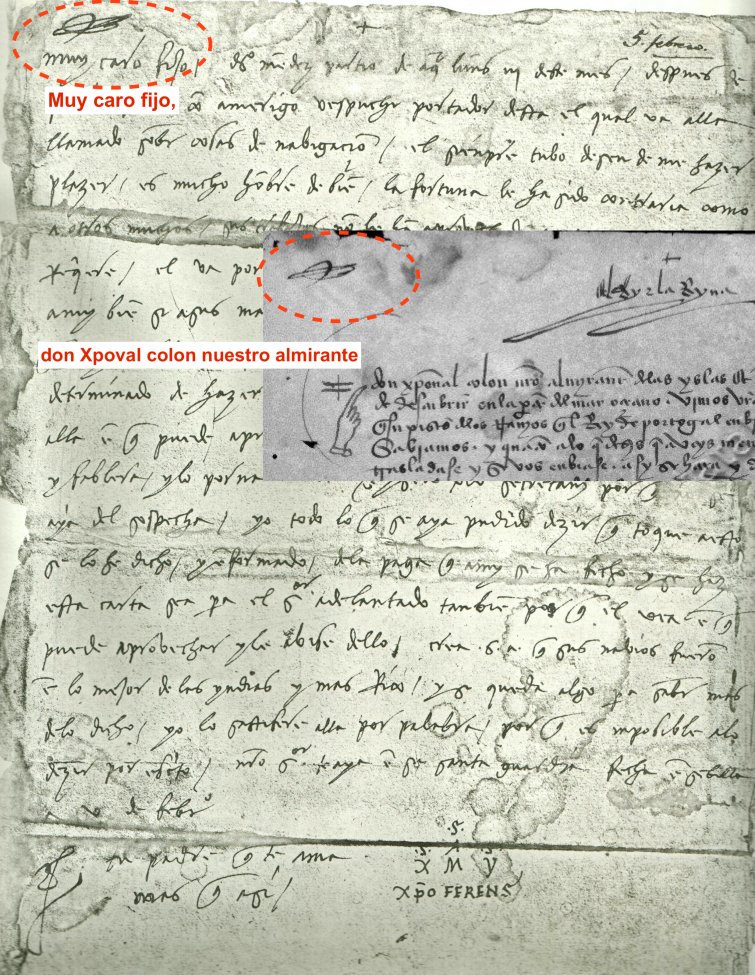
The so-called "Hebrew characters" that Wiesenthal mentioned in his book also appear on Queen Isabel's letters to Cristóbal Colón, as you can see in the composite image here, O Rabisco Hebráico.
Therefore, one would wonder how Queen Isabel is writing the same exact thing on the upper left corner to C.C. as C.C. was writing to his son which is supposedly a Jewish blessing?
The said scribble appears to be nothing more than a mark made by someone, possibly inventorying the letters in C. Colón's archive.

carta diego copy.jpg
One of the many C. Colón letter to his son superimposed with a snippet of Queen Isabel's letter to Colón.
The only known converse on the voyage was Luis de Torres - there is no proof the Pinzón brothers were converso. None.
This all adds up to more disinformation, taking "thoughts" and putting them down in writing does not make them factual.
 
Note: This post was recovered from the Sh.org archive.
Username: dejavu
Date: 2020-04-06 22:46:27
Reaction Score: 1
While continuing research on things related to my E Pluribus Unum thread, I accidentally came across something that linked with Columbus that I was not aware of and found interesting. I didn’t see it mentioned in the two threads discussing Columbus history, so I wanted to share – wasn’t sure which thread to post it in, so I chose this one.

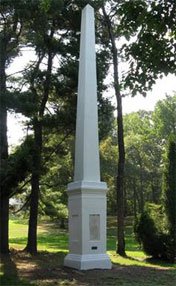
According to the Commission for Historical and Architectural Preservation (CHAP) in Baltimore, there is an obelisk dedicated to Columbus in Maryland. The “Columbus Obelisk” is said to be the oldest monument in the nation erected in his honor. It was originally housed on private property at the estate of Charles François Adrien Le Paulmier d’Anmour, a French Consul to the City of Baltimore, who later donated it to the city in 1792 to commemorate the tricentennial anniversary of Columbus’ arrival to the Americas. From what I have found in my brief search, it is not clear if the obelisk originally held a connection to Columbus or if that was given to it after it was donated to the city.

Columbus-Obelisk.jpg

The obelisk is said to have the inscription: “Sacred to the memory of Chris. Columbus, Octob. XII, MDCCVIIIC.” It was unveiled at Herring Run Park on August 3, 1792, in honor of the date Columbus’ ships La Nina, La Pinta, and La Santa Maria set sail to the New World from Palos, a town in the Andalusia region of Spain.

This obelisk is one of three monuments dedicated to Columbus in Baltimore, so it seems there is a strong connection and feeling of honoring him there. It might be that more information can be found by searching this further to see if there are links to things already discussed in this thread that might offer additional clues to his historical accounts.

Sources:

Monuments and Conservation

Columbus Monument - A Controversial Obelisk on Harford Road | Explore Baltimore Heritage
 
Note: This post was recovered from the Sh.org archive.
Username: Felixnoille
Date: 2020-04-07 10:52:26
Reaction Score: 6
As you said...

Searching on the internet will bring up thousands of (even 'scholastic') references to the "misinformation"' and "silly claims" I have posted, but I'm sure I would be wasting my time presenting any of it to you. The entire Columbus episode is one big mess of misinformation from start to end and in my humble opinion, the way to unravelling it is not through focusing on minutiae, but by understanding the bigger picture.

You clearly have a very specific idea about Colón and his mission, which is fine. However, it isn't what usually goes on here. At StolenHistory.org the information, the disinformation and even the "silly claims" all get equal attention, because usually such derogatory labels have been given for very good reasons (in the sense of obscuring something). Arguing with another member against individual points of the 'official narrative' inside this forum isn't something I care to waste my time on.
 
Note: This post was recovered from the Sh.org archive.
Username: Trouvare
Date: 2020-04-07 12:03:57
Reaction Score: 1
SH exists to question and examine "historical documents/records."

We bring our own beliefs and values along for the ride; and they will be scrutinized and lambasted here.

For me, CC was likely some manner of Jew, who filled boats with others in his tribe.

Why change names and create mythology if it's all out in the open and on record? Many names have remained unmolested through linguistic transliterations.
 
Note: This post was recovered from the Sh.org archive.
Username: Damas
Date: 2020-04-07 17:02:15
Reaction Score: 1
Sorry, I was not demeaning you or our post - I was merely stating that the claim of C.C. being a Jew was silly and had no factual basis in the known documentation nor in the actions he took.
The theory was promoted by Weisenthal based on a scribble on C. C.'s letters that Wiesenthal believed to be a secret blessing from the navigator to his son - however, as the image I posted shows, several letters from the queen to C. C:. also have the same scribbles.

There is no record that the sailors went aboard days before the day of setting sail, C. C: says they went aboard the night before and set sail just before sunrise.

Furthermore, C. C. was married in Portugal in 1479 to a high noble lady whose relatives were, for the most part, in high posts at the Portuguese court, an impossibility for a Jew, which in Portugal were locked up in their judaria (ghettos) at sunset.

The Jewish theory appears to have been discarded by DNA as well, since the 2003-2004 DNA study at the University of Granada showed C.C.'s the DNA to be mostly of Caucasian origin... not that this proves religion, but all together the chances of C. Colón being a Jew are slim to none - the nobles of Europe guarded their bloodlines carefully against Jewish tarnishment and it would be unwise to accept that King John II had authorized Filipa Moniz, one of his elite comendadoras of the Order of Santiago to marry a Jew in 1479.

Regards
All good to examine and scrutinize "historical documents/records." Manuel Rosa has spent 30 years in doing this with the Cristóbal Colón case.
Several things he has shown quite convincingly in Columbus, the untold story ( www.Columbus-Book.com ):
1- C.C. was born a of a noble Portuguese family (he had Portuguese as his mother tongue and even in March 1493 called portugal "mi tierra" My Homeland )
2- the Last Will of 1498, where C.C. supposedly wrote "being I born in Genoa" is a forgery written 80 years after he died and presented by Baltazar Colombo to the Spanish Tribunal in an attempt to steal his vast estate and titles - the document was declared worthless at that time.
3- The name Cristóbal Colón (or Cristoforo Colombo) were not the name he used before 1484 - this was an alias.
4- C.C. always knew he was not sailing to India but was actually on a decoy voyage working as a secret agent for the King John II of Portugal to take Spanish ships as far from India as possible
5- Both the Portuguese court and Spanish court helped to hide his true identity by never given us any hint of who his parents were, contrary to all practices of nobility at the time, and not telling us his place of birth
6- C.C.'s cousin by marriage (John of Braganza Marquis of Montemor and Lopo de Albuquerque, Count of Penamacor) were traitors of King John II and attempted to kill him with the aid of Queen Isabel of Spain in 1483-1484 - both fo them went into hiding in Spain - Lopo de Albuquerque changed his name to Pedro Nunes.... At this same time, the navigator left Portugal for Spain with his two cousins and changed his name to Cristóbal Colón...

As it appears the assassination attempt by Queen Isabel and C.C.'s cousins were the spark that initiated both the change of name and the false voyage of discovery against the enemy of King John II

Rosa explains that this is why there is so much mystery around his true identity and why even the court of Spain had him arrested in 1500 and helped to spread false rumors of a wool weaver from Genoa.

Regards
 
Note: This post was recovered from the Sh.org archive.
Username: Banta
Date: 2020-04-12 15:01:46
Reaction Score: 2
And this is the crux of the issue with lots of historical documents... there's little independent third party verification to be found because often it's just the family's word at the end of the line. This is deemed as acceptable provenance for most historians (letter was in the family for 400 years, then was donated to a museum, where it was eventually sold to a private collector, etc). Whether that's acceptable to the individual researcher is a personal decision. To me, there are essentially no documents I would date/verify with 100% certainty.
 
Note: This post was recovered from the Sh.org archive.
Username: Damas
Date: 2020-04-12 17:54:52
Reaction Score: 1
Banta,
Understood.
However, would your viewpoint change if there are references to the letters?
Another words, the son wrote in 1539 about a letter to the court and then you find a letter in the court archives?
Or, the son wrote that a letter from the court was received and there is a letter from the court?

Also, some letters were transcribed into lawsuits starting in 1511 due to the court refusing to keep up their part of the 1492 contract.
Furthermore, some notaries also have registrations of documents in their notary books.

Plus, C. C. in 1502 made 4 copies of many of his important documents and grants - because he did not trust the Spanish court to keep up their agreement - 3 copies were distributed to confidants of C. C. while he kept 1 for himself.
And, as Manuel Rosa mentions in his book, C.C. was very carefull with his letters and documents to the point of getting notarized copies of things that were already expired and he kept everything in a metal safe inside the Las Cuevas Monastery under safeguard of the Friar Gaspar Gorricio. There were inventory lists made at several times in the 1500s.

"Many historians saw nothing wrong with this 1498 document not having any witnesses. They wrongly presumed that admiral Colón would sign it, without having his signature witnessed. Authentic documents from Colón show that he was very concerned with following the legal requirements – registering with a public notary and having several witnesses – for validating his documents. Note the following letter, written in the same year that Colón supposedly wrote the controversial 1498 Mayorazgo:
16 of November of 1498 at Santo Domingo on the island of Espaniola: At the time that the King and the Queen, my Lords, which was in the year of 1492, agreed that I should go discover the Indies, I made a contract with Their Highnesses, that I would have one-eighth of all gain resulting from the armada that I was preparing, contributing I the one-eighth part of the expenses, as can be seen more detailed in the said agreement... Even thought Their Highnesses have already granted me the said award and this document has expired, save it very carefully and have the said notary sign it, firstly making a copy of it here by a public scrivener who swears [to its accuracy] and then take it to Palos, and after, have it put with the other valuable documents in Las Cuevas [Monastery] of Seville.(204)
As these instructions indicate, admiral Colón understood perfectly well the established regulations that important documents were subjected to in order to be legal. Both originals and copies needed to be notarized, witnessed, and, because of their importance, very well guarded. Colón’s documents were so safeguarded that he kept a steel box in the Las Cuevas Monastery to store them in. [ROSA, Columbus the Untold Story, p.111]

(204. Cristóbal Colón, Textos y documentos completos, eds. Consuelo Varela and Juan Gil (Madrid: Alianza Universidad, 1997), 414–15.)

As the discoverer's own letter to his son shows, he guarded his documents carefully and some are cross-referenced by Notaries or Court archives. He also kept "borrones" which are first drafts of letters he would send out, either because they had mistakes he wanted to fix or wanted to be sure he had a copy of what he wrote. Upon his arrest in 1500, he wrote a long letter to the tutor of the Prince Heir which he kept a copy of.

Also, "the Second admiral, don diego Colón, initiated a complaint against the Crown of Spain to enforce his deceased father’s contract, signed in 1492, the Capitulaciones de Santa Fe. While interviewed as a witness in this court case, Vespucci admitted that he: “knew very well the handwriting and signature of Don Cristóbal Colón because this witness had seen him write and sign many times, and because he was an official of the said Don Cristóbal Colón and kept his books and because of this he has a good memory of his handwriting.”(284) [ROSA, Columbus the Untold Story, p.149]

(284. Enrique de Gandía, Historia de Cristóbal Colón. Análisis crítico de las fuentes documentales y de los problemas Colombinos, Buenos Aires, 1942, p. 126.)

While it is true that only a forensic investigation of handwriting, ink and paper could expel all doubts, it seems C. C. was extra careful with preserving his texts.

Regards (www.CristovaoColon.com)
 
Note: This post was recovered from the Sh.org archive.
Username: KorbenDallas
Date: 2020-04-12 18:01:19
Reaction Score: 1
This is where the issue is. From this point on, everything becomes a fruit of the poisonous tree. A mere fact of someone's belief does not establish the authenticity. This is just my opinion, but the issue is a common as far as our recorded history goes. We do not properly investigate the sources.
 
Note: This post was recovered from the Sh.org archive.
Username: KorbenDallas
Date: 2020-04-12 19:06:27
Reaction Score: 1
In this case sources would be what we base our opinions on, I’d guess.
 
Note: This post was recovered from the Sh.org archive.
Username: Starmonkey
Date: 2020-04-12 19:22:30
Reaction Score: 1
I wonder if another symbolic similarity to pigeon and dove would be parrot, and all implications.
The other nauseous and nauseating noxious bit of trivia is all of the DELIBERATE obfuscation. Wild goose chases, dead ends, colorful fictions and other malarkey. ESPECIALLY around this time, it appears.
So, who knows but possibly several such excursions happened simultaneously under different guises. Some to mislead, some under other purposes entirely and some not at all.
Doesn't make sense to put all of your eggs in one basket. Even hard-boiled. I bet, even if those three fantastical vessels made it across the ocean and together in one piece, they most likely split up on reaching the Americas, to spread and maximize their reconnaissance.
And you don't all of a sudden strike out in some dubious and unknown direction without having a little inside information. Or you're just wishing in the wind or throwing away resources.
 
Note: This post was recovered from the Sh.org archive.
Username: Damas
Date: 2020-04-12 20:28:10
Reaction Score: 2
C. C.'s invented name of Colón, had nothing to do with "pigeon" - the name came from he Greek κῶλον (kólon) meaning member but Italians corrupted it to Columbo in 1493 when they translated the letter for the printing press.
Therefore one must completely discard pigeon since that was not his name. His son even clarified this mistake in 1539.

Everything regarding the voyage was planned and executed perfectly by C. C. and his Portuguese co-conspirators.
There was already a route planned, ahead of time. The Santa Maria never sank, it was placed ashore and shot with a cannonball by C. C. to disable it and maroon 39 sailors. There was no presenting of the plan to Portugal, nor to England, nor to France. But, instead, the kings of England and France helped the King of Portugal and C. Colón to deceive Spain.

"After seven long years of rejections, the future admiral continued stubbornly insisting that only Queen Isabel’s kingdom sponsor his great voyage:
To serve [only] Your Highnesses I refused to make any agreement with France, or England or Portugal, from which Princes Your Highnesses saw their letters by the hand of the doctor Villalano [Alonso de Villalón of the Court’s Council]. (355)
In another excerpt from a letter to King fernando, written around 1505, the admiral states:
Our Lord miraculously sent me here so that I serve Your Highness... because there were letters of behest from three Princes, which the Queen, that God has, saw and they were read to her by Dr. Villalón. (356)
On yet another occasion, he wrote:
I persisted in this with love, and I told France and to England and to Portugal: that for the King [Fernando] and the Queen [Isabel], my Lords, were those lands and lordships. The promises of reward made [from France, England and Portugal] were neither few nor hollow.
Consider how did Cristóbal Colón manage to get these letters from the Kings of France, England and Portugal, in order to show them to the hesitant Queen Isabel?
Colón had shown Queen Isabel, who constantly refused his proposal, letters from the kings of England, France and Portugal offering to sponsor his great voyage. But Colón rejected these ready, willing and able sponsorships because he was saving the great voyage to “India” only for Spain. This fact requires us to ask “why were the Spanish Monarchs so important to this voyage?” [COLUMBUS, The Untold Story, p 212]

(355. D. Fernando Colón, Historia del Almirante, Capítulo XIII.)
(356.
Consuelo Varelal Cristóbal Colón, Textos y documentos completos, Edición de Consuelo Varela, Nuevas Cartas: Edición de Juan Gil, Alianza Universidad, Madrid, 1997.)


The key to understanding the 1492 voyage and its false India is knowing that Queen Isabel of Spain tried to kill King John II of Portugal in 1483-1484 by aiding Colón's Portuguese relatives in their treason and then giving those relatives sanctuary in her court.
This is why John II sent Colón to Spain to give them a false India - give them lands already discovered by Portugal, but not worth much at the time: no trade, no industry, no cities, just free roaming natives without a dime to their name.

I won't keep quoting Rosa here, but his work, which has some 500 footnotes, is pretty solid and praised by many who read it:
"As Figure 13.2 shows, King João II already, before March 1493, knew exactly where the bulge of the South American continent was located, just as Colón reported.
Cristóbal Colón not only kept the information about Brazil secret until João II’s death, but also provided false information to Queen Isabel. These hidden maneuvers by Colón and the court of Portugal confirm that the existence of Brazil was known long before its “official” discovery in 1500.
Duarte Pacheco Pereira also visited the land of Brazil in 1498, the same year that admiral Colón was trying to sail there, raising the possibility that Colón may have been coordinating his Third Voyage with the Portuguese. This is not as far fetched as it sounds since, in 1498, Colón made his way to the Portuguese Cape Verde islands before heading Southwest across the Atlantic. In his Esmeraldo de Situ Orbis,§ Pacheco Pereira, of João II’s Council of Mathematicians says:
In the year of our lord 1498 in which Your Majesty sent us to go discover at the west, passing beyond
the grandeur of the Ocean Sea where there is a great continent that we navigate.
Duarte Pacheco’s 1498 expedition was just one of many secret Portuguese expeditions to Brazil before its official discovery. Fortunately for us, duarte Pacheco decided to register it, even if only in passing reference.....
...Nevertheless, in the middle of all this, [negotiations of Treaty of Tordesillas] João II’s traitors were advising Queen Isabel of the ruse Portugal was perpetrating with Colón’s discovery to the west. In a long secret letter to Queen Isabel by a Portuguese traitor, who dared not sign it, (see Figure 13.3) is very clear in stating:
That our adversary [John II], enemy of all good, who is the devil... [To keep your] successors perpetually diverted from this which is facing you and at your door, has placed across your path two false and vain things, not only not productive, but harmful costly and dangerous. One of them, to your right hand [New World] and the other to
your left hand [Northen Africa], so that you can be diverted from the one which is in the middle [African trade if the Atlantic and India] and where all the good is to be found... that which this old and wicked devil has put across your path to the right, secured from the good and true, was these to which they call Indias, making you believe in contrary and wrong opinions... “this India to the West was and is a deception and false representation by your enemy to occupy Your Highness in this and spend money and people from your reign and to divert you from the place where all good is [Western Africa trade and Indian spices].(371) [COLUMBUS, The Untold Story, p 218-219]

(371. El Memorial Portugues de 1494 – Una alternativa al Tratado de Tordesillas” – István Szasdi Leon-Borja e Katalin Klimes-Szmik, Edição 1994 – Ministerio de Cultura, p. 119-137)

Regards,

§ Esmeraldo de Situ Orbis - Wikipedia
 
Note: This post was recovered from the Sh.org archive.
Username: Banta
Date: 2020-04-12 20:52:28
Reaction Score: 1
Yes, that can definitely add credibility (sometimes a lot) but I cannot completely dismiss it all being a well-orchestrated forgery, in almost any situation. It is unfortunate, but there very little way to completely verify anything with 100% certainty. That doesn't mean that I don't assess degrees of confidence in certain sources, but it's something that I need to do on extensively on each individual topic.

I do not feel I have researched Cristóbal Colón enough to get a firm reading on the reliability of the documents in question, but generally speaking, there's no written document that I would ever treat as "gospel" (pun intended?), because there's always that shadow of a doubt.

I hope this does not sound like a handware dismissal. For me, it's a way to make sure I do not get too absorbed in any one narrative because there is always a chance the foundations are faulty, when dealing with any suppositions about history.
 
Note: This post was recovered from the Sh.org archive.
Username: nanuko
Date: 2020-04-13 17:29:29
Reaction Score: 1
You forgot the main "official" definition :giggle:
English version...
Traductor de Google

a colonoscopy is not pleasant, at least for me-;)
 
Note: This post was recovered from the Sh.org archive.
Username: Damas
Date: 2020-04-13 21:52:57
Reaction Score: 1
Nanuko,
Keep in mind that you are using a current dictionary to translate an invented name from 536 years ago.
You do not know the intentions of of the Discoverer when he chose that name for himself.
As a test, please try to get the meaning of this "Break a leg" ?

When people say this, they actually mean "good luck" !!!!

In order to understand the Latin "Colon" coming from the Greek kólon, it is important to undertastand that our English symbol : (colon) and ; (semi-colon) have their roots in the Greek κῶλον.

Now read what D. Hernando Colón wrote about his father's false identity:
"Et per conseguente gli venne a proposito il cognome di Colon, ch'ei ritornò a rinovare; pertiche in greco vuol dire membro... as you can see here in the Historie

Now when you look at the meaning of κῶλον in Greek, what do you get? Verify it here:
κῶλον - WordSense.eu

D. Hernando Colón says that, because most of what his father did had a bit of mystery around it, that which has to do with his new NAME and new LAST NAME also involved a bit of mystery.

Then, D. Hernando Colón goes on to explain that his father chose both his first name of Christophorus and this last name of Colonus because it came to him like a premonition that fit the discoverer so perfectly as a "member of Christ", so that, not only was the name COLON one of his ancient Roman ancestors, but taking the complete name "Christ-Ferrying Member" described what he was about to do by taking the Savior to those natives lost in the darkness.

So one can seek more in this name than is said, but colon was chosen because one of its meanings in Greeks is "member".

Regards,
 
Note: This post was recovered from the Sh.org archive.
Username: Felixnoille
Date: 2020-04-14 11:50:21
Reaction Score: 0
Other opinions and explanations are available along with a whole list of alternative names and claims to his origin (see earlier posts in this thread.)

Personally, I'm coming round to the view that he was a 'Judeo-Christian' - a Jew who 'converted' to Christianity, a 'converso' or 'New Christian', In other words a Jew who was baptised and acknowledged Jesus, but retained his Jewish culture and connections.

He was obsessed with the apocalypse as defined in the Book of Revelations. Checkout his 'Scriptural Book of Prophesies'.

I bet this book will be deemed a fake :)
 
Tips
Tips
Please respect our Posting Rules.
Back
Top