Collecting Historical clues for calendar manipulation

How did you come to presume they are dates?
Is there any other text carved in them?
Are they located together?
Are there other headstones nearby bearing conventional dating?
Replying to myself as it saves tablet typing, never fun.

The reasons why I asked those questions.
I have interest in the I and J and 1 dating discrepancies and have myself looked into them on maps and wall carvings, though only via digital photography, along with digital books and scans these investigations in concert with other members are in the archive somewhere.
The only non digital example I have come across is i have a mid 1700's book by Voltaire called The Life of Charles XII of Sweden. In there the I and the 1 are used for dating, no J.

The stones themselves are different sizes. The first extends beyond the photograph and has room for a lot more information about the person whose remains are underneath it.
Is there any additional information carved upon it on either side or is it just H S and J 777 ?
Do you presume the H and S refer to the Christian and Surname of the person?

Given the room for carving on that stone if its devoid of any other text that suggests a couple of things to me.
Whoever paid for or made the stone either didn't have the money for more carving or they wanted to hide or play down some scandal and arranged an out of parish burial.
Another possibility is there are two bodies buried there though I would have thought an 'and' would be between the H S.
Having examined the physical object does it look like the same hand carved text and numbers?


The other stone is physically much smaller and there is little room for anything else on that face of it. Does this stone have anything carved on the back face?

The reason for asking if theyy are located together is the possibility they have been moved at some point. Believe it or not fashion is a thing in graveyards. Its clearly visible in my local municipal cemetery.
The disparity in size is so marked that it is a possibility worth consdideration if they are located close together. If the headstones around them feature conventional 1 dating then its likely those pictured have either been moved as if they were of antiquity they would be closer to the church building as they would if they were graves of former clergy.
How close are they both to the church?

The smaller of the two is well into the degrading process in stark contrast to the latter is it made from different stone?

I suppose you have looked but in case you haven't have you read through any surviving parish registers, specifically the burial registers for this church?
These days if they survive they will likely be digitised but the digitising doesn't always add in margin notes.
When I began searching my genealogy in the early eighties I could request the actual registers at the Record Office in town and go see those they didn't have at the church's themselves. I could read the physical burial registers of the municipal cemetery but these days those records are no longer available to read openly.
I appreciate this church went out of use in 1973 but the registers may still be viewable in the Records office local to it.

Reason why the physical register is the thing to read is you may well find a margin note on the burial that sheds light on stones numbering, text and those buried.
I'm not telling you how to suck eggs just making suggestions and observations from my own experience of wandering around headstones.

I can tell you that 95% of the damage cited throughout the historical record was occasioned to the East facing elevations (where you find the Chancels).
This is interesting.
There is a clear, crystal clear, pattern in what you have found. Is there any correlation with prevailing wind and weather systems amongst these damaged and repaired churches?
If they werre all damaged in the same event it would be extraordinary and a clear indicator of the way storm and wind work on the stone work that faces the storm in that part of the island.

Or it could be a pattern of deliberate damage done to put the building beyond use. A destroyed Chancel does render a church useless.

I for one look forwards to you posting your findings from this most interesting endeavour.
 
Last edited:
Thanks for that.

The reason for me concentrating on the churches are that they are the only ‘historical monuments’ in this neck of the woods with perhaps the only exception being the sea wall flood defences that may date back to “Roman” times, however, curiously, no archaeology has been undertaken on these literally miles and miles of embankments, back lakes, sluices, etc that dominate the eastern coasts. Most other structures in this area date from late 19th century onwards. So for me the history of the churches, or more so, the dates of construction, reconstruction, renovation and repair works to each individual church has been one of my focuses which happily I’ve now completed as one part of the jig-saw. I can tell you that 95% of the damage cited throughout the historical record was occasioned to the East facing elevations (where you find the Chancels).

Some may argue but my advice would be ignore claims of ‘cultural layers’ as this notion doesn’t stand the test of proper scrutiny, at least not in my opinion, and it’s a poor attempt to deflect attention from what is simply a layer of earth deposited in one short event by way of red herring cover story. My own house is over a 100 yrs old and I’m still waiting for the start of a build-up!

I think you’re right in suggesting that post catastrophe life would have been a throwback to a past age, at least until recovery set in, yet today the evidence of such life would be erroneously cast back in time beyond it’s actual place in history.

Will post further in due course...

No worries guys. Difficult times for some, patience gives way ‘to just wanting answers’ that are frustratingly elusive. No offence taken.
This is my understanding of ‘J’ & ‘I’ dates:
I quite naturally initially took the ‘J’ to be a reference to Jesus, this was reinforced upon learning that the ‘I’ could be a reference to Iesus (Jesus in Greek). I was relatively happy at this stage.
This understanding was swayed when I investigated the Julian calendar, perhaps the ‘J’ stood for Julius and the numbering started at the point of Caesars reign, say 46 BC in modern terms. The consequence would be to move the ‘J’ date back 47 years on our modern timeline, thus J-777 would equate to AD 730 or with the millennium shift AD 1730. This seemed all well and good but what about the ‘I’ dates?
Then I learnt about the late introduction of the letter ‘J’ to the alphabet and for a period of time the letters were not exclusive to each other, meaning they could be happily transposed. (Similar to the letters ‘f’ and ‘s’).
I’m currently leaning towards the Julius Caesar timeline only because the Medieval Latin Roman Catholic Church worshiped pagan gods, which is of no surprise when you consider that the so called ‘Roman occupation’ of these fair isles falls within this same so called medieval period. Pagan worship was not completely eradicated from this country until the late 1700’s in modern terms (earlier on the continent commencing after Papal Bull late 1500’s onward). Those brits never did like to toe the line!
I’m also attracted by this slip of 47 years. A round thousand year shift (unless accidental, which I very much doubt) seems a little amateurish in a field of woven deceits.
Jesus and Julius (if they existed at all!) were contemporaries so who do you think got the vote?
Perhaps I’m wrong but it’s the best I can do....
Shit! Didn't see your edit this morning. I blame browser caching, not really, I missed it, how embarrassing.
 
The reason for me concentrating on the churches are that they are the only ‘historical monuments’ in this neck of the woods.
Interesting, in itself! We’re littered with obelisks and castles in the west & mid south. Have you noticed any basements in ‘Victorian/Georgian/Edwardian’ properties?
Jesus and Julius (if they existed at all!) were contemporaries so who do you think got the vote?...
If Jesus is the light, and Julius is the sun, then they may be contemporaries ;-)
I am more inclined to think that they refer to a cosmological ‘starting point’.
 
Oh do stop being offended on behalf of other people. It adds nothing to this thread. My questions were entirely on topic and the reply given didnt answer them. My response is honest and Lofwe wasnt offended.

Do these areas both here and in the Netherlands suffer from storm surges in modern times?
By modern times I mean from 1900 till the present day?

I recall some bloke suggesting that many valleys that today are river valleys were in earlier times actually lakes. When i remember his name and or where i come across it I'll add it in as it may help you.
I think he argues sea levels were higher and that was the reason for the lakes being there. It might well have a bearing on the damages to the old churches of which St Leonards is obviously one that was damaged.

Brain cell 346gt fired and i remebered his name Robert Langdon and here is his website;
Prehistoric Britain
The only historical event of any impact within this area of Essex was the Colchester earthquake late 1800’s that apparently shook a few houses and toppled a few chimney stacks. The alleged English civil wars bypassed this area. Regarding the Reformation, who knows!

For you information this area of Essex under study is predominantly rural agricultural land and is recognised as having been sparsely populated throughout it’s history, which is a little surprising when you consider it’s only an hour’s journey to London. Much (>50%) of the land is no more than 2m above chart datum and thus is protected by a sea wall (clay embankment) that encompasses the whole of the peninsular’s coastline. The remainder of the land is formed of soft rolling hills with a maximum height of 60m.

Storm surges deposit water onto land which drains back after a relatively short period following repairs to flood defences, if necessary, but they don’t deposit substantial depths of clay onto the land. It’s interesting to consider, what exactly is clay? Gravel, sand, silt and clay are all one and the same, formed from the same material, rock, it’s just a matter of scale depending on how long the material has spent in the grinder so to speak. Cataclysmic events, given enough kinetic energy, can liquify rock. For example let’s say a cataclysmic event in the Northern region of this world released sufficient energy to cause liquefaction of the lands and in turn caused a tsunami that washed through much of the Northern Hemisphere depositing beds of literally ground up everything, that we now refer to as clay beds. I’m not saying it did but hopefully you get my point, it’s possible.

I’m afraid that I don’t subscribe to the gobbledygook word salad nonsense referred to as Geology and most especially it’s alleged timeline, casting the formation of the lands we walk on back millions of years to rest in time periods sounding important only due to the difficulty in their pronunciation. I prefer to use common sense and rational thought.

Take a look at a geological map of Britain, is it not abundantly clear that the clay beds have washed in from the East? Consider for instance the beds of London Clay that form a large part of the East Coast, together with the Thames Valley and Estuary. If you were to exclude all the different types of clay from such maps
Replying to myself as it saves tablet typing, never fun.

The reasons why I asked those questions.
I have interest in the I and J and 1 dating discrepancies and have myself looked into them on maps and wall carvings, though only via digital photography, along with digital books and scans these investigations in concert with other members are in the archive somewhere.
The only non digital example I have come across is i have a mid 1700's book by Voltaire called The Life of Charles XII of Sweden. In there the I and the 1 are used for dating, no J.

The stones themselves are different sizes. The first extends beyond the photograph and has room for a lot more information about the person whose remains are underneath it.
Is there any additional information carved upon it on either side or is it just H S and J 777 ?
Do you presume the H and S refer to the Christian and Surname of the person?

Given the room for carving on that stone if its devoid of any other text that suggests a couple of things to me.
Whoever paid for or made the stone either didn't have the money for more carving or they wanted to hide or play down some scandal and arranged an out of parish burial.
Another possibility is there are two bodies buried their though I would have thought an 'and' would be between the H S.
Having examined the physical object does it look like the same hand carved text and numbers?


The other stone is physically much smaller and there is little room for anything else on that face of it. Does this stone have anything carvrc on the back face?

The reason for asking if theyy are located together is the possibility they have been moved at some point. Believe it or not fashion is a thing in graveyards. Its clearly visible in my local municipal cemetery.
The disparity in size is so marked that it is a possibility worth consdideration if they are located close together. If the headstones around them feature conventional 1 dating then its likely those pictured have either been moved as if they were of antiquity they would be closer to the church building as they would if they were graves of former clergy.
How close are they both to the church?

The smaller of the two is well into the degrading process in stark contrast to the latter is it made from different stone?

I suppose you have looked but in case you haven't have you read through any surviving parish registers, specifically the burial registers for this church?
These days if they survive they will likely be digitised but the digitising doesn't always add in margin notes.
When I began searching my genealogy in the early eighties I could request the actual registers at the Record Office in town and go see those they didn't have at the church's themselves. I could read the physical burial registers of the municipal cemetery but these days those records are no longer available to read openly.
I appreciate this church went out of use in 1973 but the registers may still be viewable in the Records office local to it.

Reason why the physical register is the thing to read is you may well find a margin note on the burial that sheds light on stones numbering, text and those buried.
I'm not telling you how to suck eggs just making suggestions and observations from my own experience of wandering around headstones.


This is interesting.
There is a clear, crystal clear, pattern in what you have found. Is there any correlation with prevailing wind and weather systems amongst these damaged and repaired churches?
If they werre all damaged in the same event it would be extraordinary and a clear indicator of the way storm and wind work on the stone work that faces the storm in that part of the island.

Or it could be a pattern of deliberate damage done to put the building beyond use. A destroyed Chancel does render a church useless.

I for one look forwards to you posting your findings from this most interesting endeavour.

Morning, good questions, I'll answer them in turn:

The two gravestones in question are in fact footstones rather than headstones. They are generally of a smaller size than their corresponding headstone and the information inscribed on them is therefor brief. Unfortunately in this instance their corresponding headstones are absent. Here's another few photos, again from local churchyards:

1676109135389.png
1676109435944.png
1676109075469.png


Next time I'm out and about I'll take some better photo's and publish so you get a better view. With regard to the footstone lettering, as in the case above, S - H, I don't presume anything but I can't imagine they would be anything other than the deceased's initials. Presumably there were rules to follow in terms of what was or was not allowed!

There is absolutely no doubt that the gravestones have been moved or disturbed in the past. Many of the graveyards themselves are in a complete mess, there are different datum levels everywhere, some graves appear raised others almost completely buried. If I didn't know better I would have wondered whether the whole site had been inundated with ~800mm of mud and dug-out after!! Photo below of the now deconsecrated church of St Lawrence, Asheldham (as an example).


1676110874470.jpeg


Parish records I tend to avoid. Records exist simply because they're 'allowed' to remain in place. I distrust anything that could be a forgery or that may have been manipulated in any way. What is the veracity of old parish records? I'm not suggesting it's all fake but, you know, once bitten twice shy! So, under my remit, I choose to be risk averse wherever possible. My focus is what I can see with my own eyes and feel with my own touch because then you know it's real and tangible, that's knowledge. Under my historical analysis of the local churches I disregard anything that does not form part of the buildings fabric including fonts, plaques attached to walls and floors, etc as these items, which are often used for establishing dates, could have been transported there from the dark side of the moon as far as I'm concerned. Gravestones I would have normally discounted as well because as you say they may be non-local, however, that really isn't the point. Regardless of where these stones originated, Timbuctoo if you like, the essential point is that there existed a method of dating that differs from the modern form and most importantly, of which the modern record makes no mention. Forgery has certainly taken place because each of the 'J' dates are recorded in the Essex Archives with a 1 replacing the letter, similar to the 'I' dates. An important point to consider is what is not being said. The silence around this matter is deafening. There can only be one rational explanation and that's because the historical record is unable to defend its position and therefore HAS to remain silent, otherwise the occulted millennium shift would be exposed. You can't argue a point absent interaction from your opponent. Moving on...

Regarding your interest in the church works, three tables below summarise the totality of the construction works, all taken from mainstream records (sorry about the colour scheme!):

1676117234117.png
1676117259395.png

1676117284875.png


Summarised as:

1676117634077.png

And:

1676117674066.png

And:

1676117893273.png

The prevailing wind is as you probably know from the south-west. These are substantial stone structures with buttressed walls so it's going to take a little more than a winter/summer storm to exact the extent of this past damage.

Another interesting fact relating to this 'historically non-eventful and peaceful mud bank' that I live on, which is incidentally made mention of in the Doomsday Book (make of that what you will!), is that various churches depicted on antique maps have disappeared, sort of memory holed. For instance churches that once stood at Snodham, Lawling and Ramsey Island. Further, the following churches were ruined and rebuilt on new sites, local to the old, where you can still find the original footprints and graveyards: Steeple, Mayland and Latchingdon.

Common sense demands a more robust explanation for what really is behind a litany of pretty catastrophic damage that's been occasioned to these old monuments. It requires a leap of faith!

Got to go, its the wife!!!!!!!
Interesting, in itself! We’re littered with obelisks and castles in the west & mid south. Have you noticed any basements in ‘Victorian/Georgian/Edwardian’ properties?

If Jesus is the light, and Julius is the sun, then they may be contemporaries ;-)
I am more inclined to think that they refer to a cosmological ‘starting point’.
This area is very rural. Prior to this drive by the authorities to build new houses on what was once protected greenbelt land there were very few buildings but lots of churches. There are very few of the allegedly Georgian buildings in the villages that dot this landscape. Some old structures in Burnham-on-Crouch but with the exception of the churches the old manor houses, called in these parts 'Halls', are generally found adjacent to the churches but I believe them to be mostly late 19th century. Not many basement round here I'm afraid,
I agree with regard to astrological events...
Sorry, I'm still getting used to this interface. Hopefully I'll tidy up.
 
Last edited:
There can only be one rational explanation and that's because the historical record is unable to defend its position and therefore HAS to remain silent,
This is my take on everything I have ever looked into. Glad its not just me.

I'm not onboard with the allowed to remain idea. Its much easier to eradicate documents and to a lesser extent buildings than leave them in place unless of course confusion is the intention.
All I can say is from the parish records, the paper not the digital, I have looked at they have much in them that shows they are not faked. That said I used them as a guide not as cast iron truth.

That table does indeed seem to put the storms out of the picture.
Assuming its a storm surge that is the cause of the destruction it must have completely overwhelmed a large part of the protective mud bank to destroy so many.
Perhaps the content of the weather PDF above will provide some pointers to such an event.
As buttresses feature so heavily my penny would be on deliberate destruction by humans unknown. Like the current crop of food producers going up in smoke.

The two gravestones in question are in fact footstones rather than headstones.
Foot stones. That in itself is intriguing. Here in the north west foot stones are not present in any of the cemeteries I've been in. Probably just a fashion thing but also could point to different versions of religions?

As for clay this entire peninsular I live on is sandstone and limestone as the rock types with the soils being predominantly clay.
Haematite is very common here.
Sand as you might guess features strongly around the coasts and to a degree inland from the coast.
There are sandstone and limestone quarries here and large sand and gravel workings with a not inconsiderable amount of rounded cobblestones primarily of pink granite on an island just off the Irish sea coast which are buried in sand. These also appear on all beaches as pebbles in a collection of different stone types. How they got there is anyone's guess.
Morecambe Bay is on the east coast of this peninsular at it is pure mud with pockets of sand. Mud being wet clay in my understanding.

There is no evidence of major storm surges around east, west or south coasts of this peninsular. There is a surge of a sort when an onshore gale coincides with a spring tide and this often overtops the sea wall defences on the Bay coastline but it inundates quite passively. It doesn't wash the road out or damage buildings though it can flood those closest to the sea.
The road is covered in sand when it recedes and the land beyond the road gets the clay. Finer particles travel further it seems.

The house I am sat in sits on the floodplain of a small beck which itself has been put into culverts and pipes so become invisible but it still flows today. An electricity cable blew in the road outside last year so had a chance to have a good look at the subsoil as thee repair involved two huge holes dug down to 9 or 10 feet.
Its a skin of tarmac sat on brick rubble and a scattering of skelpings which together form a layer perhaps 8 to 10 inches deep. There is a hint of a long dead organic soil layer directly under the brick rubble perhaps an inch thick and then its straight into clay mixed with pebble sized small stones.
This layer extends to the base of the hole and as it does the number of stones reduces and they disappear completely about four feet from the bottom.
About a hundred and fifty feet away from this hole in the direction of the sea, the clay subsoil is partly replaced by sand. I know this as a friends parents house began subsiding about forty years ago and to underpin it the builders had to go down six feet before they got to the clay layer which would support the concrete raft.

This house I'm in did not exist until 1910. The land to the immediate north of it was farmland interspersed with woodland prior to its construction. The beck ran on the surface as it did until 1999 when the housing estate that's now there had its groundworks begun.
In fact the entire peninsular was sparsely populated prior to the creation of the town I live in. In the early 1800's Villages and hamlets were all quite small and dispersed. There is an abbey and a ruined castle. Many of the villages are listed in the Domesday book but like you I feel that means little.
There is an enormous natural harbour running off from the bay and it too is shallow and mud bottomed just like the bay itself.

Point of telling you all that is wheneverr the sea and winds combine to create a flood event its devastating for those people directly affected and mud is always left behind in the flooded buildings but the evidence for a widespread catastrophic flooding which damaged structures is just not there.

Having traced my genealogy back to the late 1700's there is no evidence within it for any devastating event. Its fair to say despite most of the men in three of the four parental lines being labourers, for want if a label, ideal soldier fodder none entered military service until WW1 and of those that did none were killed during its duration.
This to me is further evidence none of the events we get told about are what they tell us they were.

For what its worth I don't trust the people paid to work in any ology. Many may well be aware things are not as they portray but universally career and pay overrides spilling the beans.

The tiny J is an enigma. I've never seen it nor the I instead of 1 carved in any stone in these parts. Any date is always 1. I will redouble my efforts when I am tramping about though most of the buildings near to me barring the possibility of the abbey have been built post 1800 . There are two farmhouses not far away with dated stone lintels over their doors so will see if they have I or 1 on them and grab a photo, assuming I remember to take the camera!
 
This is my take on everything I have ever looked into. Glad its not just me.

I'm not onboard with the allowed to remain idea. Its much easier to eradicate documents and to a lesser extent buildings than leave them in place unless of course confusion is the intention.
All I can say is from the parish records, the paper not the digital, I have looked at they have much in them that shows they are not faked. That said I used them as a guide not as cast iron truth.

That table does indeed seem to put the storms out of the picture.
Assuming its a storm surge that is the cause of the destruction it must have completely overwhelmed a large part of the protective mud bank to destroy so many.
Perhaps the content of the weather PDF above will provide some pointers to such an event.
As buttresses feature so heavily my penny would be on deliberate destruction by humans unknown. Like the current crop of food producers going up in smoke.


Foot stones. That in itself is intriguing. Here in the north west foot stones are not present in any of the cemeteries I've been in. Probably just a fashion thing but also could point to different versions of religions?

As for clay this entire peninsular I live on is sandstone and limestone as the rock types with the soils being predominantly clay.
Haematite is very common here.
Sand as you might guess features strongly around the coasts and to a degree inland from the coast.
There are sandstone and limestone quarries here and large sand and gravel workings with a not inconsiderable amount of rounded cobblestones primarily of pink granite on an island just off the Irish sea coast which are buried in sand. These also appear on all beaches as pebbles in a collection of different stone types. How they got there is anyone's guess.
Morecambe Bay is on the east coast of this peninsular at it is pure mud with pockets of sand. Mud being wet clay in my understanding.

There is no evidence of major storm surges around east, west or south coasts of this peninsular. There is a surge of a sort when an onshore gale coincides with a spring tide and this often overtops the sea wall defences on the Bay coastline but it inundates quite passively. It doesn't wash the road out or damage buildings though it can flood those closest to the sea.
The road is covered in sand when it recedes and the land beyond the road gets the clay. Finer particles travel further it seems.

The house I am sat in sits on the floodplain of a small beck which itself has been put into culverts and pipes so become invisible but it still flows today. An electricity cable blew in the road outside last year so had a chance to have a good look at the subsoil as thee repair involved two huge holes dug down to 9 or 10 feet.
Its a skin of tarmac sat on brick rubble and a scattering of skelpings which together form a layer perhaps 8 to 10 inches deep. There is a hint of a long dead organic soil layer directly under the brick rubble perhaps an inch thick and then its straight into clay mixed with pebble sized small stones.
This layer extends to the base of the hole and as it does the number of stones reduces and they disappear completely about four feet from the bottom.
About a hundred and fifty feet away from this hole in the direction of the sea, the clay subsoil is partly replaced by sand. I know this as a friends parents house began subsiding about forty years ago and to underpin it the builders had to go down six feet before they got to the clay layer which would support the concrete raft.

This house I'm in did not exist until 1910. The land to the immediate north of it was farmland interspersed with woodland prior to its construction. The beck ran on the surface as it did until 1999 when the housing estate that's now there had its groundworks begun.
In fact the entire peninsular was sparsely populated prior to the creation of the town I live in. In the early 1800's Villages and hamlets were all quite small and dispersed. There is an abbey and a ruined castle. Many of the villages are listed in the Domesday book but like you I feel that means little.
There is an enormous natural harbour running off from the bay and it too is shallow and mud bottomed just like the bay itself.

Point of telling you all that is wheneverr the sea and winds combine to create a flood event its devastating for those people directly affected and mud is always left behind in the flooded buildings but the evidence for a widespread catastrophic flooding which damaged structures is just not there.

Having traced my genealogy back to the late 1700's there is no evidence within it for any devastating event. Its fair to say despite most of the men in three of the four parental lines being labourers, for want if a label, ideal soldier fodder none entered military service until WW1 and of those that did none were killed during its duration.
This to me is further evidence none of the events we get told about are what they tell us they were.

For what its worth I don't trust the people paid to work in any ology. Many may well be aware things are not as they portray but universally career and pay overrides spilling the beans.

The tiny J is an enigma. I've never seen it nor the I instead of 1 carved in any stone in these parts. Any date is always 1. I will redouble my efforts when I am tramping about though most of the buildings near to me barring the possibility of the abbey have been built post 1800 . There are two farmhouses not far away with dated stone lintels over their doors so will see if they have I or 1 on them and grab a photo, assuming I remember to take the camera!
My point about 'allowed to remain' was rather tongue in cheek. They remain because they suit the narrative and therefore such records must be treated with caution. Smoke and mirrors my friend.
 
They remain because they suit the narrative and therefore such records must be treated with caution. Smoke and mirrors my friend.
As do the foot and headstones. Such records must also be treated with caution.
 
Before we move away from the churches there's something else that I spotted which will perhaps provide us with evidence of another glitch in the chronological matrix. Photo below is of the upper North Wall of St. James church, Dengie Village. As can be seen immediately below the Bell-Cot there are three carved face corbels.


1676142489690.jpeg

Now pardon me for saying but they don't strike me as being 'Christion' in any way shape or form! What they are in my opinion are forms of Pagan (Bacchillic) Art, the centre corbel representing the face of the Pagan God Bacchus or more precisely the Roman God Dionysus. The below image taken from DuckDuckGo (search term Bacchus) and I'll just leave it here for you to decide....

1676142991659.png
Do you see a similarity? How can this be when we are told that Pagan worship ended in the first millennium and why would the church authorities allow these inclusions as part of the building fabric of a church? Note that the bell-cot is said to have been added in the 19th century, so sometime in the 1800's, yet these corbels were either added at that stage or were part of the original building fabric and allowed to remain in place.

Let's see what light 'Historic England' can shed on this anomaly ( CHURCH OF ST JAMES, Dengie - 1111784 | Historic England )
"...to gable apex a C19 stone bellcote, the chamfered base of 3 carved face corbels - 2 lions and a man, supporting 2 ogee arches..."

Scholars will tell you that this is The Green Man so lets see what our friend Wiki has to say about this Green Man:
The Green Man is a legendary being primarily interpreted as a symbol of rebirth, representing the cycle of new growth that occurs every spring. The Green Man is most commonly depicted in a sculpture, or other representation of a face which is made of, or completely surrounded by, leaves.[1]
The Green Man motif has many variations. Branches or vines may sprout from the mouth, nostrils, or other parts of the face, and these shoots may bear flowers or fruit. Found in many cultures from many ages around the world, the Green Man is often related to natural vegetation deities. Often used as decorative architectural ornaments, Green Men are frequently found in carvings on both secular and ecclesiastical buildings. "The Green Man" is also a popular name for English public houses, and various interpretations of the name appear on inn signs, which sometimes show a full figure rather than just the face.
Some speculate that the mythology of the Green Man developed independently in the traditions of separate ancient cultures and evolved into the wide variety of examples found throughout history.


I say more smoke and mirrors but note the "found in many cultures from many ages around the world" that perhaps lends credence to our somewhat revisionist understanding of when this alleged Roman Empire ruled our lands....
 
The below image taken from DuckDuckGo (search term Bacchus) and I'll just leave it here for you to decide....

1676142991659-png.png
Is it just me, or does this face look less like "Bacchus" and more like a Der Stürmer caricature of a scheming Jew with hooded, sinister eyes, a long hook nose, a recessive chin, and an obscene leer? He could also be a Neanderthal and indeed it has been suggested that the "classic" Jewish phenotype is a result of Neanderthal DNA.

If Jesus is the light, and Julius is the sun, then they may be contemporaries ;-)
I am more inclined to think that they refer to a cosmological ‘starting point’.
Are you referring to the Electric Universe idea that Jesus, Julius, and others were fabricated when the solar system finally settled into its current stable (?) setup? The old planet gods had disappeared and the serfs needed a new religion/history that reflected the new heavens and new calendar. Enter the Zodiac cults and the Sun gods. The new electromagnetic or energetic profile of the solar system made previously functioning "magic" technology impossible, so it was necessary for the new God to be essentially human.

Is the face in the photo a self-portrait of one of the men who created the new religion, eternally mocking the believers?
 
Last edited:
I cant even understand what footstones are for. Nothing i my native language.

I visited perhaps the oldest church cemetery in the North. There was a lot of snow which made it difficult to read but also the fact that the church removes stones after a number of years. They are used for landscaping walls and house walls I guess, like the rune stones did when today's old churches and "churches" were built. Some are saved but of course it is easy to continue nature's natural wear and tear and remove a J for example.
 
Moving swiftly on with this thread....

Next I'm going to share with you some general mainstream information about the Dengie Peninsular so that you can build a picture of the area. So lets set the scene.

The following image is an extract from map by Fred Roe, which you can find on-line, depicting the Dengie Peninsular, or as he refers to it, the Misty Moon Marshland in the mid-19th century. Perhaps rather tongue-in-cheek but I lust like it's quirkiness..
1676206240998.png


Below, image of modern map that shows the areas relatively close location to good ol' London Town:
1676206767282.png


Taken from Guardian Newspaper article (my underlining):
"The Dengie Peninsular, Essex, England.
In a much misunderstood county, the Dengie Peninsula is a hidden gem; an Area of Outstanding Natural Beauty pinned by the North Sea to the east, the River Crouch to the south and the River Blackwater to the north. Its isolation has amounted to a miniscule population (the peninsula's largest town, Burnham, has just 7,500 inhabitants) despite being just an hour from London. Dengie itself is a local hamlet (population: 100) whose etymology eludes everyone we meet."


Lets narrow the area down....
1676207488815.png


More narrative from the web (my underlining):
"Dengie is a peninsula in Essex, England, that once formed a hundred of the same name (sometimes spelled Dengy).
The peninsula is formed by the River Crouch to the south, the Blackwater to the north, both of which are tidal, and the North Sea to the east. The eastern part of the peninsula is marshy and forms the Dengie Marshes. The western boundary of Dengie hundred ran from North Fambridge to a bit west of Maldon. The peninsula forms about half of the Maldon local government district. The soil on the Dengie Peninsula is very rich. The area usually has mild winters The saltmarsh here is the largest continuous example of its type in Essex and is home to internationally important wintering populations of wildfowl and waders. This area has been a human home since Neolithic man discovered the rich soil and the mild maritime climate. The Romans came to built forts, roads and homes then they were followed by the Saxons who gave the area its Dengie name and attracted St Cedd who built his chapel which has become a nationally important monument"


These are the locations of churches that have been under scrutiny:
1676209823420.png
The yellow line in the image above represents the boundary line of my research which takes in most of the peninsular. The blue line is an approximate demarcation between the low and high grounds.

Let's finish this 'General' section with a mention of Dengie village, after which the peninsular is named. Image blow is a map extract with an associated narrative by WIKI. (emphasis mine) (Link to Map – Allegedly 1777 (1764) Digital Map of Essex 1777 by John Chapman & Peter André )

1676211616964.png

DENGIE VILLAGE
Dengie /ˈdɛndʒiː/ is a village and civil parish in the Maldon district of Essex, England, with a population of 119 at the 2011 census.
It gives its name to the Dengie peninsula and ‘hundred’ and to the Dengie Special Protection Area.
The place-name 'Dengie' is first attested in a manuscript of between 709 and 745, where it appears as Deningei. It appears as Daneseia in the Domesday Book of 1086.
The name means 'Dene's island' or 'the island of Dene's people'.
Wiki

You will see in the above image that the church of St James stands adjacent to Dengie Hall. Sparsely developed land and therefore sparse population but wow, they get their own church, notwithstanding St Lawrence church at Asheldam is not far down the road and Tillingham church is not that far up the road, so as to speak!

More soon...
 
I cant even understand what footstones are for. Nothing i my native language.

I visited perhaps the oldest church cemetery in the North. There was a lot of snow which made it difficult to read but also the fact that the church removes stones after a number of years. They are used for landscaping walls and house walls I guess, like the rune stones did when today's old churches and "churches" were built. Some are saved but of course it is easy to continue nature's natural wear and tear and remove a J for example.
They are grave markers that are always located at the foot end of the grave. Most often they are present with a headstone at the head end.
Fashion changes and they went from being standing upright stones to laying flat stones. They carried bare amounts of text. Often just initials of the deceased sometimes the date of death.
Can't tell I've been looking into them can you!
 
I cant even understand what footstones are for. Nothing i my native language.

I visited perhaps the oldest church cemetery in the North. There was a lot of snow which made it difficult to read but also the fact that the church removes stones after a number of years. They are used for landscaping walls and house walls I guess, like the rune stones did when today's old churches and "churches" were built. Some are saved but of course it is easy to continue nature's natural wear and tear and remove a J for example.

Hi Tsigan see image below:

1676215786753.png

The graves I've seen are quite plain rather than the decorative one in the forefront I've seen them connected with railings rather than stone and also with sarcophagus type coffins between the two stones. Notice the head and footstones match in terms of design. I'll take some snaps of the ones I've seen locally....
 
Now pardon me for saying but they don't strike me as being 'Christion' in any way shape or form! What they are in my opinion are forms of Pagan (Bacchillic) Art, the centre corbel representing the face of the Pagan God Bacchus or more precisely the Roman God Dionysus. The below image taken from DuckDuckGo (search term Bacchus) and I'll just leave it here for you to decide....

I recall there's a segment in one of Fomenko's books about this particular issue. It was presented there that the whole Bacchanal phenomenon occured during early Christianity with the priests themselves taking part, and the events were later thrown back to 'pagan antiquity' as part of the new Church's war against it.
I can't remember right now which chapter that was.
 
Moving swiftly on with this thread....

Next I'm going to share with you some general mainstream information about the Dengie Peninsular so that you can build a picture of the area. So lets set the scene.

The following image is an extract from map by Fred Roe, which you can find on-line, depicting the Dengie Peninsular, or as he refers to it, the Misty Moon Marshland in the mid-19th century. Perhaps rather tongue-in-cheek but I lust like it's quirkiness..
View attachment 27364

Below, image of modern map that shows the areas relatively close location to good ol' London Town:
View attachment 27365

Taken from Guardian Newspaper article (my underlining):
"The Dengie Peninsular, Essex, England.
In a much misunderstood county, the Dengie Peninsula is a hidden gem; an Area of Outstanding Natural Beauty pinned by the North Sea to the east, the River Crouch to the south and the River Blackwater to the north. Its isolation has amounted to a miniscule population (the peninsula's largest town, Burnham, has just 7,500 inhabitants) despite being just an hour from London. Dengie itself is a local hamlet (population: 100) whose etymology eludes everyone we meet."


Lets narrow the area down....
View attachment 27366

More narrative from the web (my underlining):
"Dengie is a peninsula in Essex, England, that once formed a hundred of the same name (sometimes spelled Dengy).
The peninsula is formed by the River Crouch to the south, the Blackwater to the north, both of which are tidal, and the North Sea to the east. The eastern part of the peninsula is marshy and forms the Dengie Marshes. The western boundary of Dengie hundred ran from North Fambridge to a bit west of Maldon. The peninsula forms about half of the Maldon local government district. The soil on the Dengie Peninsula is very rich. The area usually has mild winters The saltmarsh here is the largest continuous example of its type in Essex and is home to internationally important wintering populations of wildfowl and waders. This area has been a human home since Neolithic man discovered the rich soil and the mild maritime climate. The Romans came to built forts, roads and homes then they were followed by the Saxons who gave the area its Dengie name and attracted St Cedd who built his chapel which has become a nationally important monument"


These are the locations of churches that have been under scrutiny:
The yellow line in the image above represents the boundary line of my research which takes in most of the peninsular. The blue line is an approximate demarcation between the low and high grounds.

Let's finish this 'General' section with a mention of Dengie village, after which the peninsular is named. Image blow is a map extract with an associated narrative by WIKI. (emphasis mine) (Link to Map – Allegedly 1777 (1764) Digital Map of Essex 1777 by John Chapman & Peter André )

View attachment 27375
DENGIE VILLAGE
Dengie /ˈdɛndʒiː/ is a village and civil parish in the Maldon district of Essex, England, with a population of 119 at the 2011 census.
It gives its name to the Dengie peninsula and ‘hundred’ and to the Dengie Special Protection Area.
The place-name 'Dengie' is first attested in a manuscript of between 709 and 745, where it appears as Deningei. It appears as Daneseia in the Domesday Book of 1086.
The name means 'Dene's island' or 'the island of Dene's people'.
Wiki

You will see in the above image that the church of St James stands adjacent to Dengie Hall. the area is sparsely developed and therefore sparsely populated but wow, they get their own church, notwithstanding St Lawrence church at Asheldam is not far down the road and Tillingham church is not that far up the road, so as to speak!

More soon...

Next we'll take a look at what may be the oldest 'ancient monument' on the peninsular and one that is curiously overlooked! It's the sea defence embankment that is referred to as the Sea Wall and which runs around the peninsula's shoreline. Lets have a look at a few images:

1676221959153.png
1676222038791.png
1676222001666.png

The third photo above shows a WW11 pillbox built into the existing embankment.

Below images taken from Map 1st Ordinance Survey, dated allegedly 1805 – (1880?) [Old series Ordnance Survey maps of England and Wales] [cartographic material]
1676222304972.png
1676222370258.png

What do Historic England have to say with regard to these sea defences, well, remarkably little....
Roman and Medieval Sea and River Flood Defences | Historic England

You will note from this document (which is a good read) that the author gives the impression of being somewhat perplexed by the lack of archaeology undertaken on what could be 'roman' works. The scale of construction works associated with these flood defences is staggering to say the least. The system includes a network of back ponds with interconnecting waterways and sluiced outlets. Bear in mind that at high water the land upon which these embankments were constructed would have been flooded to a minimum depth of 2.00m!! All of this built with horse and cart and with one assumes a colossal portion of elbow grease. Suffice to say it makes my mind boggle! Yet there are no records! It makes one scratch ones head does it not? Always bear in mind this area of the country has been an uneventful backwater, peaceful and quiet according to mainstream history.

Taken from Historic England's article is the following image. In their consideration the flood defences were built somewhere between AD 100 and AD 1600. That one hell of a margin for error!

1676282018003.png


Before I finish this post lets have a quick look at the famed Doomsday Book, allegedly dated AD 1086, the detail of which I have summarised below:

1676282372481.png


1676282300852.png
1676282409058.png


I apologise for the material in my posts being, thus far, rather mundane but there is importance in all of this standard data which will be revealed shortly. If you've stuck with the thread so far then thanks. Next post will include information that will I hope raise your eyebrows, it's gonna get exciting....
I recall there's a segment in one of Fomenko's books about this particular issue. It was presented there that the whole Bacchanal phenomenon occured during early Christianity with the priests themselves taking part, and the events were later thrown back to 'pagan antiquity' as part of the new Church's war against it.
I can't remember right now which chapter that was.
Hi Gladius,
Well remembered. I'm totally on board with Fomenko in terms of his mathematical/statistical analysis of the 'accepted' chronology. I have reservations with regard to some of his theories as to 'why and how' but you can't fault his data. I've got a section on his work coming up. If you subscribe to the 1000 year shift then you can make a great deal more sense out of the matter you have raised...
Next we'll take a look at what may be the oldest 'ancient monument' on the peninsular and one that is curiously overlooked! It's the sea defence embankment that is referred to as the Sea Wall and which runs around the peninsula's shoreline. Lets have a look at a few images:

1676221959153.png
1676222038791.png
1676222001666.png

The third photo above shows a WW11 pillbox built into the existing embankment.

Below images taken from Map 1st Ordinance Survey, dated allegedly 1805 – (1880?) [Old series Ordnance Survey maps of England and Wales] [cartographic material]
1676222304972.png
1676222370258.png

What do Historic England have to say with regard to these sea defences, well, remarkably little....
Roman and Medieval Sea and River Flood Defences | Historic England

You will note from this document (which is a good read) that the author gives the impression of being somewhat perplexed by the lack of archaeology undertaken on what could be 'roman' works. The scale of construction works associated with these flood defences is staggering to say the least. The system includes a network of back ponds with interconnecting waterways and sluiced outlets. Bear in mind that at high water the land upon which these embankments were constructed would have been flooded to a minimum depth of 2.00m!! All of this built with horse and cart and with one assumes a colossal portion of elbow grease. Suffice to say it makes my mind boggle! Yet there are no records! It makes one scratch ones head does it not? Always bear in mind this area of the country has been an uneventful backwater, peaceful and quiet according to mainstream history.

Taken from Historic England's article is the following image. In their consideration the flood defences were built somewhere between AD 100 and AD 1600. That one hell of a margin for error!

1676282018003.png


Before I finish this post lets have a quick look at the famed Doomsday Book, allegedly dated AD 1086, the detail of which I have summarised below:

1676282372481.png


1676282300852.png
1676282409058.png


I apologise for the material in my posts being, thus far, rather mundane but there is importance in all of this standard data which will be revealed shortly. If you've stuck with the thread so far then thanks. Next post will include information that will I hope raise your eyebrows, it's gonna get exciting....

Hi Gladius,
Well remembered. I'm totally on board with Fomenko in terms of his mathematical/statistical analysis of the 'accepted' chronology. I have reservations with regard to some of his theories as to 'why and how' but you can't fault his data. I've got a section on his work coming up. If you subscribe to the 1000 year shift then you can make a great deal more sense out of the matter you have raised...
Moving on.
Prior to going into the next tranche of information lets have a little recap so far in terms of what we may call curiosities or as the archaeologists like to call anomalies.
1. We've discussed the J & I dating systems and after searching high and low we've proven their existence, why therefore is the information not readily available in the historical record. I stand in front of a gravestone, touch it even, but my queries are met with walls of silence form the great institutions?
2. We have established a 1000 year shift in the accepted chronology that occurred at the transition point between the J/I system and the AD system. I think this is so beyond argument and with the weight of evidence the ball is fixed firmly in the establishments court should they choose to refute. Or perhaps there was gap at the end of the J/I system until a resumption 1000 years later but I think not! There is no evidence that the number 1 has ever been written as a J or an I. Why are the scholars silent over this matter and not even venturing a cover story.
3. We have seen that the Dengie Peninsular is a sort of Shangri-La. A most pleasant spot to be, a nature reserve, a landscape of soft rolling hills and flat arable lands {that were previously salt marsh) most exceedingly fertile, protected from the ravages of the sea by monumental flood defences to its north, east and south shores, tis just an hours train ride from Southminster to London Liverpool Street station, yet the area seems to be relatively unknown to most. Furthermore the area has been blessed with peace throughout its long history, this according to the lack of historical events in the mainstream narrative.
4. We've seen from the historical record that the areas churches have suffered an astonishing level of rebuild and repair, with some churches having disappeared altogether just leaving their footprints staring up at the skies, others have been rebuilt in new locations. The level of destruction exacted upon these structures can only be ascertained from the 'rebuild works' that are presented to us by the historical record. There is no narrative as to the how, when, why, what etc, in terms of the destructive forces, be it nature or man. Just to reiterate this point lets have a look at St Leonards church, Southminster.

1676304878755.png
1676305123728.png


My sketch not to scale. So the destructive events were as follows:
Between the 12c and 15c the tower was destroyed along with the upper walls of the nave and the roof. (We can't comment on the history of the original chancel that must have existed as it was rebuilt in the 19c). Between the 15c and the 19c the nave's roof was destroyed.
The fact that the word 'minster' forms part of 'Southminster' reflects the once ecclesiastical importance of this monument, but nevertheless we are confronted with a silent history.
5. We've discovered from the 'common narrative' that this area of land has been inhabited since Neolithic times. Then along came the Romans and then the Saxons...
6. We've learnt from Wiki that the word Dengie was first used on a manuscript in AD 709 & 745 and that the name translates to Dene's Island.
7. We've discovered that the monumental sea defences have been overlook by archaeologists in that no one know how old they are and the construction date could be anywhere between AD 100 - 1600.
8. We've discovered that the area has a mention in the Doomsday Book dated the alleged year AD 1068.

I think it's going quite well so far, more soon...
 
Last edited:
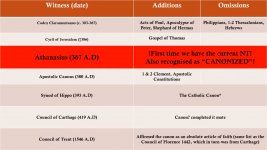
Slightly off-topic, or maybe not. Something I like to keep up with is fringe biblical scholarship; I doubt there's any "Truth" to any of it, it's still endlessly interesting. Anyway, I came across a presentation on the establishment of the Christian canon, and one thing in particular stood out to me - see the attached screenshot. Of course, this isn't definitive proof of a fictitious millennium added onto our history, but it is a bit puzzling. You know, the time between the Council of Carthage and the Council of Trent.

The screenshot was taken from this video presentation, around 27 minutes in. I'm sure none of you need to be told this, and certainly not by me, but please don't bother either the scholar or the host of the show. I don't think either of them would be open to ideas of radically revised chronology. Gunnar Heinsohn has appeared on that channel in the past, and sadly it didn't seem like he was taken very seriously, for the simple reason that he questioned mainstream chronology.
 

Attachments

  • canon.jpg
    canon.jpg
    350.1 KB · Views: 158
I was just having a discussion in another post about a different topic but saw this on the latest posts section...
we were discussing a possible increase in the earth's area over time,
or possible increases in the time the sun and moon took to complete movements in the sky over recorded history.
could the inclusion of additional months, and the addition of days within certain months be due to such factors?
if the area that the earth consisted of increased over recorded time,
and or the suns movement from dawn to the following dawn,
took gradually more time to achieve over recorded time.
at a certain point the calendar system in effect then, would cease to represent the seasons as they were occuring.
would this not be a sensible and valid reason to extend the calendar system in an attempt of balancing such misrepresentation?

equally so thinking outside the box,
or the place we call earth if you will.
if such an increase occured between the periods of recorded time.
Which would be unaccounted for time which lay between those historical ages.
(Im thinking along the lines of the mayan calendar and the cycles they denote their passing of time through)
Then each cycle which occured would begin with a greater area and or a larger solar orbit to complete than the one that preceeded it.
During that unnacounted for period, that area or orbit would continued to increase.
The span of time for such events to take place would be ever extending.
But that increase would not be reflected in history,
until the recorded time period recommenced.
Making each point in time that this occured a drastic increase instead of a gradual one.
Each passing cycle producing a greater increase than the one before it.
The civilizations present at those points in time would need to adjust the calendar quite drastically in order for it to represent the additional time a solar day would take to complete.
So too to match with the seasonal periods by which those days and months were tied.
A Theory, but one i feel compelled to consider given the indicators presented to us.
Has Calendrical time ever been shortened at any point in human history?
if not, then this suggests to me that there may be truth in such a theory.
 
Let's see if we can do better than the learned historians and archaeologists and hang a date on the construction of the sea wall. I get the feeling that the correct placement of these works onto a timeline will provide a strong anchor point and reference point, the reason being that should the sea wall suddenly vanish in a puff of smoke then the demarcation lines between land and sea would change dramatically rendering the peninsular into more or less an island.

Below is an image taken from an online topographical viewer with a note taken from the web:
1676551192637.png

Much of the Dengie Peninsular lies between plus/minus 1m relative to sea level (high water mark). The shores of the peninsular are protected by a sea wall (dyke) and this defence ensures that a large part of the land does not revert to salt marsh. Other than the low lying reclaimed marshland the remainder of the peninsular is formed of soft rolling hills.

The above image is self-explanatory however to reiterate this same point lets turn to the website 'Essex Live' for information about the catastrophic effects of sea level rise resulting from the ongoing climate hoax.
Scary maps show towns Essex could totally lose if global temperatures rise by 2C
The image below reflects the consequence of of a 2C rise in temperature resulting in a 1m rise in sea level (yawn!).
1676560836550.png


What I think we ought to consider here is that the exact same effect would arise from a consistent and even reduction of 1m in the height of the land relative to sea level. Conversely, if you take the above map and raise the land by 1m then you get back to where we are presently in terms of the coastline. I'm not convinced that sea levels fluctuate at all within a closed system, I do however accept that lands rise and fall relative to the sea level and I have a sneaky suspicion that that is a balancing mechanism that counters a rise with a fall.

So with what we now know it's time to look back at some extracts of antique maps to see if we can discover when the coastline was changed once the sea wall was in place.

1. Modern Times / 2. AD 1375 / 3. AD 1436
1676562232791.png
1676562333887.png
1676562506528.png

Map 2 above shows Thames Estuary as a wide bay. Map 3 above a similar wide bay but with an island at the entrance.

4. AD 1448 / 5. AD 1492
1676562613884.png
1676562668336.png

Map 4 above shows a wide bay. Map 5 above shows again a bay or even a sea judging from the size of it.

6. AD 1541
1676563171017.png
Map 6 shows 2 islands off the Thames Estuary.

7. AD 1546
1676562783953.png

Map 7 shows land where once was sea. New headland to north bank of Thames Estuary further north of which is an island in a bay.

8. AD 1556
1676562942217.png
Map 8 above shows star shaped island in a bay to the north of the Tames Estuary.

9. AD 1558
1676562997749.png

Map 9 above as Map 8.

I'll leave these here for you to peruse and with my next post I'll attach links to the above map extracts.
NB - I don't vouch for the veracity of these maps, they are available on-line and I've chosen from a variety of countries and sources. However I believe they paint a picture of coastline changes that aren't taken account of in the historical narrative.
 
Does it not seem strange that the i and j has befuddled many of us for long now. You'd think the answer would be readily available from any author talking about dates, or a history buff, or professor, but I dont see anyone providing any answers from that lot. How and why would such a thing not easily be answered.
 
Tips
Tips
Please respect our Posting Rules.
Back
Top