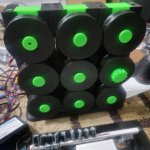
Exploring the technology of Prof. Nigel Cheese: Quantum Battery

Hello all!

So I posted awhile back on attempting Nigels battery.

I have since directed my efforts elsewhere.

I truely believe this may be a way to achieve free energy.

Sorry for the shoddy camera work, but the method is there.


I used this gentleman's idea of magnets with bearings and attached step motors to them.

From there I saw this youtube video where this guy sets up step motors to generate energy.

I combined the 2, and bought a door electro magnet on Amazon.

If I could print enough magnet wheels to generate a pulse in the Adriano board, then any wheels i make after that I would assume would be free energy.

Anyway, let me know your thoughts!


Here's my video.

Fr33-3n3rGy-Idea.mp4
Here's the youtube video for the generator.

Here's a video I downloaded awhile back on spinning magnet wheels.

Youtube-Recording

Youtube video of step motor generator:

View: https://youtu.be/twtgBgkBZPI?si=x5vDvOosxjeqtS1O

Very nice! How long to fully charge an iPhone 16?
 
Very nice! How long to fully charge an iPhone 16?
Lol no idea, but it seems to be improving the more I keep adding.

And if this eventually pans out, then you would never need to charge your iphone16 ever again haha just scale it down
 
Last edited:
Hello all!

So I posted awhile back on attempting Nigels battery.

I have since directed my efforts elsewhere.

I truely believe this may be a way to achieve free energy.

Sorry for the shoddy camera work, but the method is there.


I used this gentleman's idea of magnets with bearings and attached step motors to them.

From there I saw this youtube video where this guy sets up step motors to generate energy.

I combined the 2, and bought a door electro magnet on Amazon.

If I could print enough magnet wheels to generate a pulse in the Adriano board, then any wheels i make after that I would assume would be free energy.

Anyway, let me know your thoughts!


Here's my video.

Fr33-3n3rGy-Idea.mp4
Here's the youtube video for the generator.

Here's a video I downloaded awhile back on spinning magnet wheels.

Youtube-Recording

Youtube video of step motor generator:

View: https://youtu.be/twtgBgkBZPI?si=x5vDvOosxjeqtS1O

Nice work! If you are aiming for more voltage out of this device you may want to consider winding up a step up transformer. (If you haven’t already thought of it)
Seeing as you already intend a spinning magnet, you could always wind a coil around it and use inductance to generate voltage as well and then into a step up transformer as well. You could probably chain step up transformers in series if you are aiming for something that’s out of reach of a single one. Though you have to make sure to match the current rating on them. It’s additive when you wire in series, but the current will be equal to your lowest one. Then once it’s spinning you are getting usable voltage out of it.
There are a ton of places that can program multipolar magnetic wheels nowadays, though they may have a minimum order quantity
 
Thanks for the advice!.

This method seems promising.
Since i could literally create am unlimited amount of tep motor additions to keep adding more voltage or current by stacking and stepping up, until I have a workable amount.

I have a few different ideas that I may try out.

I have since added 2 more and a crank wheel, also,i had way too many capacitors, I took a bunch off and powers up pretty easily now.

New vid soon!
 
Thanks for the advice!.

This method seems promising.
Since i could literally create am unlimited amount of tep motor additions to keep adding more voltage or current by stacking and stepping up, until I have a workable amount.

I have a few different ideas that I may try out.

I have since added 2 more and a crank wheel, also,i had way too many capacitors, I took a bunch off and powers up pretty easily now.

New vid soon!
Depending on what kind of power you are generating you could also run it into a non inverting opamp and then into a step up if you need it even bigger. Opamps regularly amplify from the millivolts range to volts. Chain a few of those systems together and you’ll be cooking.
 
Thanks, You seem like you know a hell of a lot more than I do about circuits.

I would love your input and help along the way with this process if you're up for it.

I modified the model, got rid on the screws, organized the breadboards a bit better, and added some capacitors to each breadboard before it feeds to the main. The light goes on way easier now.

I made a crank attachment for the time being for easier spinning. I may just make the electromagnet pulse the crank around by added metal on it.

The thing about this is...

I am spending no more energy to spin 1 or 1 million generators.

There has got to be a number of generators to make the energy for the initial spin. From there, its stack stack stack stack stack currents and voltages

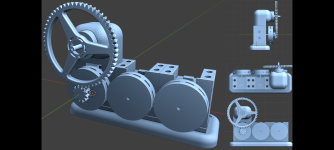
Here's a 3d model of the intended crank and a quick updated clip


Edit:
Credit to Tim for the crank model.


View: https://m.youtube.com/watch?v=tb3iN4m9Bik&pp=0gcJCR4Bo7VqN5tD

-Eric
 

Attachments

  • 20251218_152047.mp4
    39.3 MB
  • Screenshot_20251218_154539_Gmail.png
    Screenshot_20251218_154539_Gmail.png
    1.8 MB · Views: 33
Last edited:
Very cool. There's someone on facebook called Resonate 369 whose developing his own variations too.

Did you skim over the contents page of that free energy device doc? I bet there is at least 1 device with a similar design to yours. Each entry has the full schematics or at least describes the circuitry involved.
 
Very cool. There's someone on facebook called Resonate 369 whose developing his own variations too.

Did you skim over the contents page of that free energy device doc? I bet there is at least 1 device with a similar design to yours. Each entry has the full schematics or at least describes the circuitry involved.
No I havent , but I did download it. I will definately take a look thanks for sharing!
 
Thanks, You seem like you know a hell of a lot more than I do about circuits.

I would love your input and help along the way with this process if you're up for it.

I modified the model, got rid on the screws, organized the breadboards a bit better, and added some capacitors to each breadboard before it feeds to the main. The light goes on way easier now.

I made a crank attachment for the time being for easier spinning. I may just make the electromagnet pulse the crank around by added metal on it.

The thing about this is...

I am spending no more energy to spin 1 or 1 million generators.

There has got to be a number of generators to make the energy for the initial spin. From there, its stack stack stack stack stack currents and voltages

Here's a 3d model of the intended crank and a quick updated clip


Edit:
Credit to Tim for the crank model.


View: https://m.youtube.com/watch?v=tb3iN4m9Bik&pp=0gcJCR4Bo7VqN5tD

-Eric

That invention on page 18 of that free energy pdf is the best and most doable solution I’ve seen beats any idea I had in this thread by miles. I’m not a very experienced electrical engineer or anything. I mainly have experience with passive inductance circuits. Specifically the type used in electric guitars and fender rhodes and such. This idea is super simple and is related to your design. A wheel with four magnets with north oriented outwards, and two electromagnets, probably copper wrapped around ferrite and hooked up to a battery and some kind of timing circuit. The coils energize in time to pull the magnets towards it, then shut off as it passes. The field briefly reverses as it shuts off, which has the effect of pushing the wheel’s magnet away and it continues rotating. You could probably use reed switches placed where they sense the passing magnet and send the signal to the electromagnets to fire for the timing. That pdf is super interesting.
1766250580771.jpeg
 
The reason my ideas wouldn’t have worked is because you need current in order to get usable work out of this stuff, and it’s always going to be stuck at the smallest generator of current. The losses incurred and power required will sap any gains with a step up transformer or opamp, and you wouldn’t be able to hit 9 volts steadily most likely. Have you taken any measurements of the power you are getting off your design?
 
I kind of disassembled for the time being.

I am making the 3d prints better and more exact in terms of the wheel distances.

Right now, i am individually making sure that each motor and breadboard is working properly.

Then I will combine them all once I am sure each one works.

I also connected a little motor up to it, and sure enough it spins. I just need to figure out how much would get that little motor to spin a magnet wheel connected to it.

That's one method. The other is an electro magnet.

Either way, I can use the arduino board to time the spins/pulses.
 
Progress...


Edit:
@AthroposRex

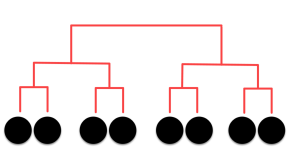
So what i think I may be needing some help on I'd say is going to be where I start attempting to combine currents and voltages. Best way to describe it is.... I have a penny and by the use of series and parallels, somehow increase both to usable energy.

Hopefully this picture explains it.

Cus I have no idea how to wire that stuff up....
 

Attachments

  • Screenshot_20251221_151204_Gmail.png
    Screenshot_20251221_151204_Gmail.png
    103.7 KB · Views: 29
Last edited:
Ok sorry about that will do!
Nw, I don't own/run the site but I'm sure it'll help. If you can, edit your previous posts to swap the local file for an off-site link.
Anyway, very cool experiments you're doing.
 
Nw, I don't own/run the site but I'm sure it'll help. If you can, edit your previous posts to swap the local file for an off-site link.
Anyway, very cool experiments you're doing.
It won't let me edit for some reason... sorry
 
a little update.

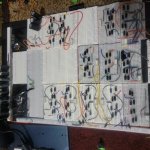
I cleaned up the wiring and reprinted some wheels,
To the best of my novice abilities.

Seems to do pretty well, but I will most likely need a lot more stepper motors and a larger table haha

I ran out of motors, waiting for some from Amazon.


We will seee!!

Keep the dream alive! Lol

-Eric

testing-update.mp4
 
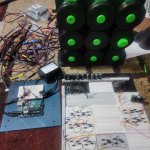
So here's where I am at:

I got the Arduino to run the step motor using a small external rechargeable battery I got from Amazon for like 20 bucks.

The spinning motor was tested and does in fact, spin as many generators as I want to stack.


Currently I am stacking as many generators as I can that will hopefully become enough to power the small battery bank, hence a self powering device.

I realize that the world is such a way as a self propetuation device does not exist. So I am not getting my hopes up just yet.

But I will continue to add generators.


I scrapped the crank idea, only maybe to start it up.


I also srapped the electro magnet idea since I was able to program the arduino to spin the motor.


The goal now is to infinity stack generators to feed the small power bank.
Fingers crossed 🤞

-Eric
 

Attachments

  • 20251224_135255.mp4
    4.9 MB
  • 20251224_135718.jpg
    20251224_135718.jpg
    2.3 MB · Views: 22
  • 20251224_135726.jpg
    20251224_135726.jpg
    2.2 MB · Views: 27
  • 20251224_135714.jpg
    20251224_135714.jpg
    1.6 MB · Views: 20
Tips
Tips
Please respect our Posting Rules.
Back
Top