- Joined
- Aug 31, 2020
- Messages
- 76
- Reaction score
- 610
Some people say freemasonry* has been around for five hundred years or so. Others, however, claim to trace freemasonry all the way back to Moses. What if they're both right?
I claim, in contravention of orthodox history and theology that:
1) the stories related in the first five books of the Old Testament (the Pentateuch) were written in the early 16th century and relate events centered on the explusion of Jews from Spain and the Conquest of Mexico.
2) the Biblical Moses is primarily based on the figure of conquistador Fernando Cortés.
3) all the events described in the Bible took place, if they took place, in the Americas (specifically the American Southwest).
4) the Protestant Reformation and the invention of the printing press provided the opportunity and means of injecting the aforesaid texts (and others) into the standard Bible canon.
 ABOVE: Why is Cortés constantly compared to Moses?
Before I adduce positive evidence for these claims, I remind you that the traditional view, placing these events in the area of the Middle East and thereabouts, rests merely on the correspondence of like geographic placenames, and (I guess) the perceived implausibility of faking something like that. The other forms of evidence for the traditional view, the kind that you'd expect to be all over the place, are conspicuously absent.
Most strikingly, the ground in the "Holy Land," per its conventional location, hasn't yielded any archaeological evidence for the many events, battles, landforms, cities, structures, or persons described in the Old Testament scriptures. And it's not for lack of anybody of trying to find them. Researchers have spent centuries looking for something to scientifically legitimate the Biblical narrative in Palestine. The true believers in these efforts are willing to tolerate a standard of evidence that is minimal indeed but even they can't do better than submit their constrained conjectures apologetically.
You'll see a lot of statements like these, taken from Finegan's The Archaeological Background of the Hebrew-Christian Religion, which is typical of the genre:
Apologetes like Finegan end up having to pretend that these problems constitute a special form of proof. The sacking of Jerusalem, he says in this line, "is reflected only too clearly in the archeological realm by the paucity of important materials." And as for the Conquest of Caanan, he notes that "Joshua evidently did a thorough job of destruction." Tautologies like these and the occasional excavated well that nobody can prove wasn't the one Joseph drew his water from is about all there is connecting the Bible to the "Bible lands."
Unless, that is, you count the fake antiquities. I don't. The only way the Dead Sea scrolls could look any more fake was if they were found stuffed in a Bud Light bottle. Even the pyramids of Giza appear to be modern creations, constructed during Napoleon's Egyptian campaign. Most of the famous Egyptian relics were allegedly found at the same time and must likewise come under suspicion.
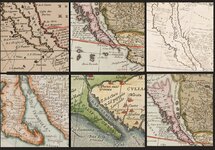
 ABOVE: The Sea of Cortez (Gulf of California)
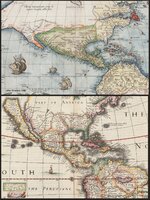
In America we don't have this problem. The evidence is right in front of our faces. Even the geographic place-markers for the scriptural events are still around. Just look at any map. I'm just going to post a couple examples of buildings in California whose builders and original residents have disappeared. I think everyone is familiar with these things, so I won't belabor the point. Individually these don't point infallibly toward Mosaic conquest, but if you examine these along with the names of counties, cities and other place-names in California and Arizona a very compelling pattern emerges. Why are there so many Egyptian place-names on the West Coast? Does Exodus XV: 27 refer to Palm Springs?
 ABOVE: A cluster of strange buildings in Kings County in California's San Joaquin Valley. Was this the scene of a Biblical battle?
Now, in identifying Moses as Cortés, it is not necessary that there be a single historical individual having the name and corresponding precisely with the historical personage of Fernando Cortés as we know him. At the very time the conquistadors were marching across Mexico, Spain herself was rocked by the revolutionary comunero (communist) movement uprising, which group identified its governmental pretensions by the name of "cortés" as well. It is hard (unless you're an historian I guess) not to infer a conspiratorial link between the two events, the conquest abroad and the revolution at home. But whether one was named for the other or both in reference to a concept significant to the cause doesn't affect my claims. By "Cortés" I mean nothing more than "the leader of the Conquest."

Of course there are several obvious similarities between the two men. Moses assumed his position of influence among the Egyptians by means of infiltration. Cortés likewise made use of intrigue to attain his leadership position for the conquest. Furthermore, his curious habit of attributing judgments to "the Christians," suggests substantial versimilitude along religious lines as well. Moses is said to have written five books. Cortés wrote five letters. They both carried a staff, etc.
The unusual variation historians have imposed on Cortés' first name ("Hernan") provides another clue. Doesn't it seem bizarre to change the man's name? All contemporary accounts refer to him as Fernando, with the occasional Ferdinand or Fernandus thrown in. But nowadays it's always "Hernan." Why? I suggest that the variant form is intended to signify Moses' brother "Aaron" (the Spanish h is silent).
 ABOVE: The Sea of Cortés is also known as the "Red Sea"
Another point of coincidence is found in the naming of the Gulf of California, or "Sea of Cortez," which was historically known as the "Red Sea," or "Vermillion Sea" (vermillion is a scarlet red) under which names it appears on the old maps. It may be objected that this is a somewhat generic descriptive term. But there are good reasons to regard this circumstance as significant.

First, there is not, besides the familiar one located along the Sinai Peninsula, any other body of water, to my knowledge, that is named the "Red Sea." Second, Eusabius Kino (real last name Kuhn) a Jesuit rector of Sonora, Mexico who upon reconfirming the continuity of California with the North American landmass in 1702 (most people thought California was an island at the time--and maybe it was) declared that his discovery gave confirmation to the Exodus of Moses as recorded in the Bible. If he didn't equate Moses with Cortés then that would be a ridiculous thing to say, right?
 ABOVE: Is California the real "holy land"?
I contend that the Biblical names listed in the right-hand column below refer in fact to the corresponding New World cognate-forms on the left:
King Ferdinand Pharaoh
Gila River The Nile
Mojavites Moabites
Carribean Sea Arabian Sea
Pacific Ocean Mediterranean Sea
Salton Sea The Dead Sea
 ABOVE: What do those flaming red castles represent?
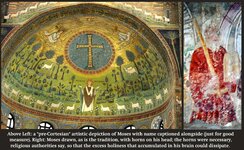
The most obvious objection to my claims is the priority of the Old Testament scriptures. As usual, however, the evidence for this "obvious truth" crumbles under inspection. Mainstream authorities invariably claim very great antiquity for the Pentateuch but the oldest possible extant edition, as far as I can tell, is from 1537 or so. And that edition is not something I could find a copy of on the Internet. The Wycliffe Bible, which predates the conquest, is supposed to contain the Old Testament, but again, as far as I can tell, the Wycliffe Bible never included anything but the New Testament alone. If I am correct here, the claimed Wycliffe Old Testament is the sort of lie that would testify strongly for my thesis. It also looks to me like the Old Testament was originally written in a language other than Hebrew, but I'm not sure.
 ABOVE LEFT: The Wycliffe Bible--No Old Testament
Then you have the supposedly ancient art depicting the events of the Old Testament. I will just say that the circumstances attending an investigation into these claims are much the same as related above.

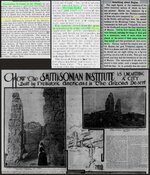
The implications of these claims, supposing their truth, are deep and far-reaching. I have a lot more to say on the topic but I will end this post with a few more old-time newspaper clippings.
Thanks for reading!

*I mean the kind of freemasonry that destroys things; not the "operative" kind that theoretically builds things.
I claim, in contravention of orthodox history and theology that:
1) the stories related in the first five books of the Old Testament (the Pentateuch) were written in the early 16th century and relate events centered on the explusion of Jews from Spain and the Conquest of Mexico.
2) the Biblical Moses is primarily based on the figure of conquistador Fernando Cortés.
3) all the events described in the Bible took place, if they took place, in the Americas (specifically the American Southwest).
4) the Protestant Reformation and the invention of the printing press provided the opportunity and means of injecting the aforesaid texts (and others) into the standard Bible canon.
Before I adduce positive evidence for these claims, I remind you that the traditional view, placing these events in the area of the Middle East and thereabouts, rests merely on the correspondence of like geographic placenames, and (I guess) the perceived implausibility of faking something like that. The other forms of evidence for the traditional view, the kind that you'd expect to be all over the place, are conspicuously absent.
Most strikingly, the ground in the "Holy Land," per its conventional location, hasn't yielded any archaeological evidence for the many events, battles, landforms, cities, structures, or persons described in the Old Testament scriptures. And it's not for lack of anybody of trying to find them. Researchers have spent centuries looking for something to scientifically legitimate the Biblical narrative in Palestine. The true believers in these efforts are willing to tolerate a standard of evidence that is minimal indeed but even they can't do better than submit their constrained conjectures apologetically.
You'll see a lot of statements like these, taken from Finegan's The Archaeological Background of the Hebrew-Christian Religion, which is typical of the genre:
"we may say that Egypt affords us no direct evidence of the sojourn of the Israelites."
"the much-to-be-desired evidence at Jericho is lacking."
"At the time of the Israelites, there was no city [Jerusalem] there"
Apologetes like Finegan end up having to pretend that these problems constitute a special form of proof. The sacking of Jerusalem, he says in this line, "is reflected only too clearly in the archeological realm by the paucity of important materials." And as for the Conquest of Caanan, he notes that "Joshua evidently did a thorough job of destruction." Tautologies like these and the occasional excavated well that nobody can prove wasn't the one Joseph drew his water from is about all there is connecting the Bible to the "Bible lands."
Unless, that is, you count the fake antiquities. I don't. The only way the Dead Sea scrolls could look any more fake was if they were found stuffed in a Bud Light bottle. Even the pyramids of Giza appear to be modern creations, constructed during Napoleon's Egyptian campaign. Most of the famous Egyptian relics were allegedly found at the same time and must likewise come under suspicion.
In America we don't have this problem. The evidence is right in front of our faces. Even the geographic place-markers for the scriptural events are still around. Just look at any map. I'm just going to post a couple examples of buildings in California whose builders and original residents have disappeared. I think everyone is familiar with these things, so I won't belabor the point. Individually these don't point infallibly toward Mosaic conquest, but if you examine these along with the names of counties, cities and other place-names in California and Arizona a very compelling pattern emerges. Why are there so many Egyptian place-names on the West Coast? Does Exodus XV: 27 refer to Palm Springs?
Now, in identifying Moses as Cortés, it is not necessary that there be a single historical individual having the name and corresponding precisely with the historical personage of Fernando Cortés as we know him. At the very time the conquistadors were marching across Mexico, Spain herself was rocked by the revolutionary comunero (communist) movement uprising, which group identified its governmental pretensions by the name of "cortés" as well. It is hard (unless you're an historian I guess) not to infer a conspiratorial link between the two events, the conquest abroad and the revolution at home. But whether one was named for the other or both in reference to a concept significant to the cause doesn't affect my claims. By "Cortés" I mean nothing more than "the leader of the Conquest."
Of course there are several obvious similarities between the two men. Moses assumed his position of influence among the Egyptians by means of infiltration. Cortés likewise made use of intrigue to attain his leadership position for the conquest. Furthermore, his curious habit of attributing judgments to "the Christians," suggests substantial versimilitude along religious lines as well. Moses is said to have written five books. Cortés wrote five letters. They both carried a staff, etc.
The unusual variation historians have imposed on Cortés' first name ("Hernan") provides another clue. Doesn't it seem bizarre to change the man's name? All contemporary accounts refer to him as Fernando, with the occasional Ferdinand or Fernandus thrown in. But nowadays it's always "Hernan." Why? I suggest that the variant form is intended to signify Moses' brother "Aaron" (the Spanish h is silent).
Another point of coincidence is found in the naming of the Gulf of California, or "Sea of Cortez," which was historically known as the "Red Sea," or "Vermillion Sea" (vermillion is a scarlet red) under which names it appears on the old maps. It may be objected that this is a somewhat generic descriptive term. But there are good reasons to regard this circumstance as significant.
First, there is not, besides the familiar one located along the Sinai Peninsula, any other body of water, to my knowledge, that is named the "Red Sea." Second, Eusabius Kino (real last name Kuhn) a Jesuit rector of Sonora, Mexico who upon reconfirming the continuity of California with the North American landmass in 1702 (most people thought California was an island at the time--and maybe it was) declared that his discovery gave confirmation to the Exodus of Moses as recorded in the Bible. If he didn't equate Moses with Cortés then that would be a ridiculous thing to say, right?
I contend that the Biblical names listed in the right-hand column below refer in fact to the corresponding New World cognate-forms on the left:
King Ferdinand Pharaoh
Gila River The Nile
Mojavites Moabites
Carribean Sea Arabian Sea
Pacific Ocean Mediterranean Sea
Salton Sea The Dead Sea
The most obvious objection to my claims is the priority of the Old Testament scriptures. As usual, however, the evidence for this "obvious truth" crumbles under inspection. Mainstream authorities invariably claim very great antiquity for the Pentateuch but the oldest possible extant edition, as far as I can tell, is from 1537 or so. And that edition is not something I could find a copy of on the Internet. The Wycliffe Bible, which predates the conquest, is supposed to contain the Old Testament, but again, as far as I can tell, the Wycliffe Bible never included anything but the New Testament alone. If I am correct here, the claimed Wycliffe Old Testament is the sort of lie that would testify strongly for my thesis. It also looks to me like the Old Testament was originally written in a language other than Hebrew, but I'm not sure.
Then you have the supposedly ancient art depicting the events of the Old Testament. I will just say that the circumstances attending an investigation into these claims are much the same as related above.
The implications of these claims, supposing their truth, are deep and far-reaching. I have a lot more to say on the topic but I will end this post with a few more old-time newspaper clippings.
Thanks for reading!
*I mean the kind of freemasonry that destroys things; not the "operative" kind that theoretically builds things.