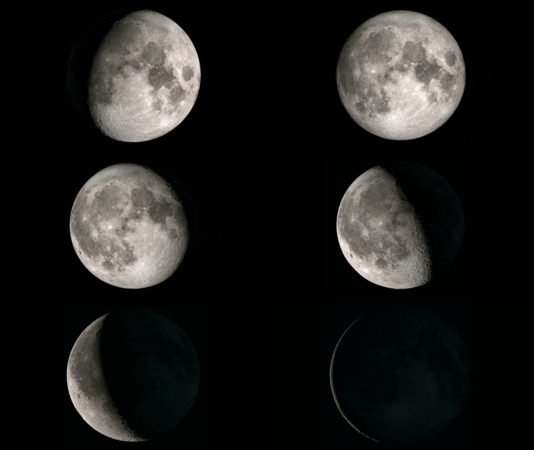
The Copernican model explains why the face of the Moon appears to rotate with the passage of time.
This sketch shows the spherical Earth with the North pole at the top. The stick figure is at latitude 51 degrees (
London). Assuming you could be hovering in space at a point in line with the equator, then this is what you would see during a twelve hour period. You can see that the stick figure has rotated by 78 degrees. 2 x (90-51) = 78
So the Copernican model predicts that someone observing the Moon over a twelve hour period from latitude 51 (London) would see the Moon rotate by 78 degrees.
The Copernican model also predicts that the rate of rotation of the Moon's face would not be consistent throughout the night. The Moon would appear to rotate faster in the middle of the night and slower at either end of the night.
Furthermore the Copernican model predicts that the Moon's face would not appear to rotate at all if you were at latitude zero, on the equator.
Liberated Collective has suggested that the Moon's face should rotate the same speed as the hour hand on a clock, performing one complete rotation every 24 hours. I'm assuming on a flat disk model of the Earth this also means the rate of rotation of the Moon's face would be the same at every point on the Earth.
So we can test the models by measuring the rate of rotation of the Moon's face at different latitudes. If it appears to rotate at the same rate at all latitudes, that would support the flat disk model. If it rotates at different speeds at different latitudes that would support the Copernican model.