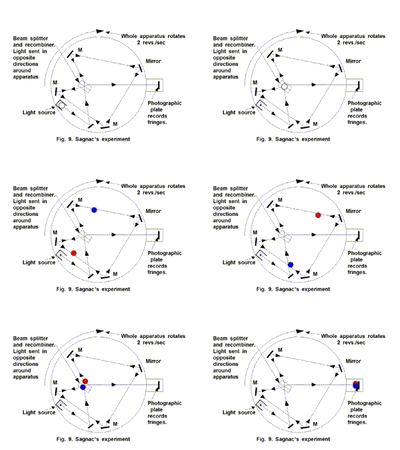
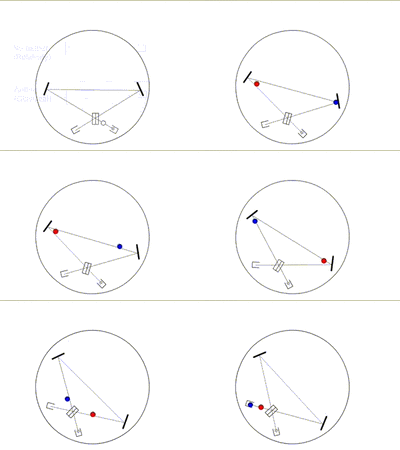
Sagnac effect definition:
If two pulses of light are sent in opposite directions around a stationary circular loop of radius R, they will travel (in terms of any inertial coordinate system, such as that in which the center is at rest) the same distance at the same speed, so they arrive at the end point simultaneously. If the loop itself is rotating during this procedure, the counter-rotating pulse will arrive at the "end" point slightly earlier than the co-rotating pulse.
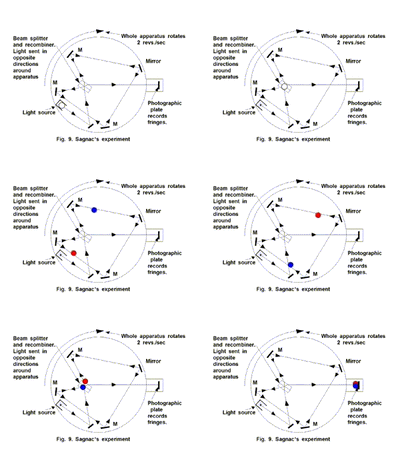
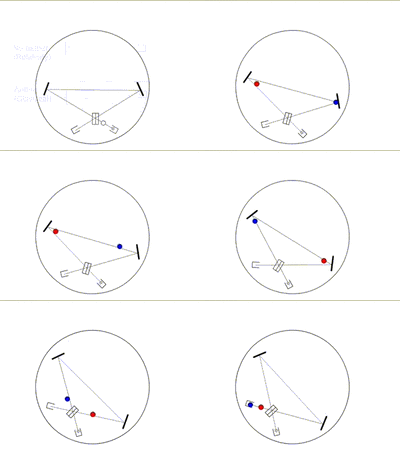
Quantitatively, if we let ω denote the angular speed of the loop, then the circumferential tangent speed of the end point is v = ωR, and the sum of the speeds of the pulses and the receiver at the "end" point is c–v in the co-rotating direction and c+v in the counter-rotating direction. Both pulses begin with an initial separation of 2πR from the end point, so the difference between the travel times is

History of the Sagnac effect:
https://signallake.com/innovation/andersonNov94.pdf
Coriolis effect definition:
An effect whereby a mass moving in a rotating system experiences a force (the
Coriolis force ) acting perpendicular to the direction of motion and to the axis of rotation. On the earth, the effect tends to deflect moving objects to the right in the northern hemisphere and to the left in the southern.
The Coriolis effect is a mechanical effect, proportional to thea area and angular velocity of the interferometer.
The Sagnac effect is an electromagnetic effect, proportional to the velocities of the light beams; it does not feature an area, or the angular velocity.
Derivation of the Coriolis effect formula for light interferometers:
http://www.ias.ac.in/article/fulltext/pram/087/05/0071
Dr. Ludwik Silberstein, a physicist on the same level with Einstein and Michelson, partially inspired and supported the Michelson-Gale experiment.
In 1921, Dr. Silberstein proposed that the Sagnac effect, as it relates to the rotation of the Earth or to the effect of the ether drift, must be explained in terms of the Coriolis effect: the direct action of Coriolis forces on counterpropagating waves.
http://www.conspiracyoflight.com/Michelson-Gale/Silberstein.pdf
The propagation of light in rotating systems, Journal of the Optical Society of America, vol. V, number 4, 1921
Dr. Silberstein developed the formula published by A. Michelson using very precise details, not to be found anywhere else.
He uses the expression kω for the angular velocity, where k is the aether drag factor.
He proves that the formula for the Coriolis effect on the light beams is:
dt = 2ωσ/c^2
Then, Dr. Silberstein analyzes the area σ and proves that it is actually a SUM of two other areas (page 300 of the paper, page 10 of the pdf document).
The effect of the Coriolis force upon the interferometer will be to create a convex and a concave shape of the areas: σ1 and σ2.
The sum of these two areas is replaced by 2A and this is how the final formula achieves its final form:
dt = 4ωA/c^2
A = σ1 + σ2
That is, the CORIOLIS EFFECT upon the light beams is totally related to the closed contour area.
"Sagnac effect is a change in propagation time for light going in a closed path. The time delay Δt appears when a test equipment is rotated with an angular velocity Ώ. Sagnac effect is frequently used in rate gyros in navigational systems. Fiber optics is used with light-speed c inside the fiber in a circular light path. The difference in propagation time Δt for two opposite directions of light is described as
Δt = 4AΩ/c^2
Where A is enclosed area. Δt is derived based on an integration of Ω over A.
According to Stokes' rule can an integration of angular velocity Ω over an area A be substituted by an integration of tangential component of translational velocity v along the closed line of length L limiting the given area. This interpretation gives
Δt = 4vL/c^2
producing the same value as the earlier expression. This can also be demonstrated by geometrical relations.
These two integrations have different physical implications. We must therefore decide which one is correct from a physical aspect. Mathematics can not tell us that. So the decision is whether the effect is caused by a rotating area or by a translating line. Since Sagnac effect is an effect in light that is enclosed inside an optical fiber we can conclude that Sagnac effect is distributed along a line and not over an area.
No light and no rotation exists in the enclosed area. Sagnac detected therefore an effect of translation although he had to rotate the equipment to produce the effect inside the fiber.
We conclude that the later expression
Δt = 4vL/c^2
is the correct interpretation."
http://www.gsjournal.net/Science-Journals/Research Papers-Astrophysics/Download/2159
"Sagnac effect is distributed along a line and not over a surface. The assumption that starts from an integration over a surface (2Aw; rotation) is mathematically correct (due to Stokes' rule) but equal to a line integral (vL; translation). We must decide if the reason is a translating line or a rotating surface from a physical point of view. The rotation theory is correct only mathematically. Since the effect is locked inside an optical fiber the translating line is the correct interpretation. Classification as a rotational effect is wrong."
So far, so good: for an interferometer whose center of rotation coincides with its geometrical center, the SAGNAC EFFECT formula coincides with the CORIOLIS EFFECT formula, the distinction is made in terms of Stokes' theorem: the Sagnac effect features a velocity of the light beams, the Coriolis effect is related to the area and the angular velocity.
Sagnac had no knowledge of these intricacies (as did no one else at that time, 1913), and delivered the formula which features an area in his paper.
Now, we move that interferometer on the surface of the Earth: its center of rotation will no longer be identical to its geometrical center, that is, the interferometer is stationary upon the surface, and we try to detect rotation.
So, Michelson and Gale built a huge interferometer in Clearing, Illinois, in 1925, here is the derivation of their formula:
https://www.theflatearthsociety.org/forum/index.php?topic=30499.msg2024700#msg2024700
What Michelson did is to derive the CORIOLIS EFFECT formula for the light beams: it can detect either the rotation of the Earth or the rotation of the ether drift above the surface. It is a slight lateral deflection of the light beams, not related to their velocities.
Michelson then claimed that this is the SAGNAC EFFECT formula for his interferometer, the same formula used today for ring laser gyroscopes (which are much smaller Michelson-Gale interferometers actually). Since Sagnac detects rotation, he then claimed that it is the Earth which is rotating.
No other physicist said anything, no one tried to detect this error, for the past 100 years.
That is why modern physicists are having a field day with geocentrists, when the latter try to prove that the Earth is stationary (even using those 200 proofs).
They will immediately point in the direction of the MGX, or even produce a small ring laser gyroscope, which, under the eyes of the geocentrist, will indeed record rotation.
In a court of law, the geocentrists will present the 200 proofs in front of the judge and of the jury. The mainstream physicists will sit quietly without any objections. Then, they will show a ring laser gyroscope to the judge and to the jury: rotation has been detected. Then, the jury will rule against the geocentrists.
So, what the geocentrists need is a SAGNAC EFFECT formula for the MGX.


 This makes you a valuable resource to this forum. You've covered a lot of ground, uncovered a lot and probably have much left to disclose.