France - Biblical Israel

I'm suggesting a Celtic connection.

What does 'Celtic' mean and where does the term come from? Don't worry, that was a rhetorical question only, meant to suggest that the whole 'Celtic' identity thing is no more certain than anything else.

Does it mean people who play bagpipes? People who eat with spoons? People who can whistle backwards? Etc...
 
What does 'Celtic' mean and where does the term come from? Don't worry, that was a rhetorical question only, meant to suggest that the whole 'Celtic' identity thing is no more certain than anything else.

Does it mean people who play bagpipes? People who eat with spoons? People who can whistle backwards? Etc...
Does its root 'Celt' even refer to people?

Does 'Celt' mean 'killed'?

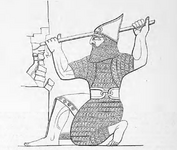
Does 'Celt' mean 'A quarrying, construction and military wrecking tool'?

Perhaps the legendary 'Shamir':
...which was said to have been able to cut and shape stone with ease.
 
Last edited:
Interesting suggestion. In Russian there is a word колоть/kolot' which means to stab/to kill. In Lithuanian there is a word kalavijas (sword), which is related to the word kalvis (a smith). The Celts are supposed to be famous for their metallurgy skills.

Speaking of excellent metallurgists: Scythians allegedly called themselves Skolotoi, which is associated with the word сокол/sokol (falcon).
People of the word, cross, sun, sword and birds, all throughout Eurasia? What's the etymology of the word Mughal?
 
Interesting suggestion. In Russian there is a word колоть/kolot' which means to stab/to kill. In Lithuanian there is a word kalavijas (sword), which is related to the word kalvis (a smith). The Celts are supposed to be famous for their metallurgy skills.
Interesting connections. Iron-bearing chalybeate springs are associated in England with old locations and medicinal spa-baths.

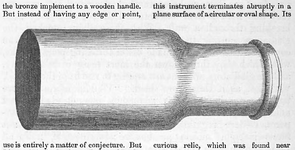
From that On the Use of Bronze Celts PDF:

blade or beam.png
Blade? Or beam? Image source

its use is entirely a matter of conjecture.png
"Its use is entirely a matter of conjecture." Source
Download Video

"Anything about these images that jumps out to you?" Source: Westworld S01 Ep07
 
Last edited:
In the UK the term "Celt" seems to mean "not Anglo-Saxon". It's quite common to hear historians use the term "Romano-Celt", implying that even the Romans were "basically Celts". A way of saying "Well the Romans weren't Anglo-Saxon, so who's splitting hairs right?".

In fact even the French are basically considered "Celts", which is why they're often referred to as "Gallic".
 
It's quite common to hear historians use the term "Romano-Celt", implying that even the Romans were "basically Celts"

Yes, twaddle like that is on the increase lately. We also have 'Indo-European', which began as a language group, but now refers to a racial type. Soon it will be Indo-Eurasian or something equally daft to conform with the 'melting-pot' agenda.

I have heard it said the 'Celt' was a term used by those within the Noroman Empire to refer to those who were not. Like 'Sassenach' means outsider in Scots, but has now come to mean English.

Too late! Indo Eurasian
 
Does its root 'Celt' even refer to people?
I'll offer a another alternative meaning to Celt, occasionally written as Kelt or Kelti.

In Old Hungarian Script only the first vowel is written if subsequent vowels are the same. I'll give two examples to the possible meaning from that possible origin;

Kelt - risen (but unlikely as this is the past tense of the word Kel - rise)
Kelet - East
Keleti - Eastern

So according to Hungarian etymology, the Celts were Easterners = Scythians.
 
I'll offer a another alternative meaning to Celt, occasionally written as Kelt or Kelti.

In Old Hungarian Script only the first vowel is written if subsequent vowels are the same. I'll give two examples to the possible meaning from that possible origin;

Kelt - risen (but unlikely as this is the past tense of the word Kel - rise)
Kelet - East
Keleti - Eastern

So according to Hungarian etymology, the Celts were Easterners = Scythians.
OK, throwing in another...

In Britain, the place names "Cold Harbour" and "Coldharbour" are quite common. There are "hundreds" according to W Smythe below. The "Harbour" is easy to derive but the "Cold" is not. There are also place names like "Cold Kitchen Hill", "Cold this..." and "Cold that...".

Some examples of "Cold+Harbour":
Cold Harbour Gate in London
Mag's Well, Coldharbour Wood, Surrey

Explanations:
Based on the most common features of "Cold Harbour" noted by these writers, they seem associated with known or suitable collection, watering and resting places for farm animals during animal transportation. What we call "lairage" today. Or, in US English, a 'lay-up'.

If you accept that 'celt' is related to - or derived from - the same root as 'kalt' and 'cold', then it is feasible that our word 'celt' once had a meaning that hovered around 'killed' or 'culled'. Not definite but feasible.
 

Attachments

  • W Smythe - On the Designation of Cold Harbour.txt
    9.6 KB · Views: 211
  • Coldharbour_notes_on_place_name_by_Tim_Healey_Oct_2018.pdf
    184.6 KB · Views: 181
Last edited:
A few more - the word Chaldean (pronounced Kaldean). There was a link somewhere, where Sumerians were identified with Chaldeans, which makes them contemporary to Greeks (Hellenes?).

Speaking of Hellenes - the Tartarus is hell. Could the word Tartaria be just a code word for the Asian extension of the Gallic (Hellenic, Galatian, Celtic etc) Belt:
SH Archive - Tartaria: formerly known as Scythia
SH Archive - Tartar or Tatar?

P.S.
And even more of a stretch - (h)Alaska?
SH Archive - 16th century Tartarian King Tartarrax ruled Quivira Regnum in North America
 
Last edited by a moderator:
I'm not on par with the thread, but since we are talking about Celts I would like to understand why we use this word, first and foremost. As far as I know this is a Greek word (Keltoi) and its Latin equivalent was Gauls. There was apparently no doubt about it.
Fun fact is that Greeks (aka Byzantines aka Romans/Romaioi) actually called the French with that same term Keltoi during the 'middle-ages'. It seems to me that France took its name from the Ile-de-France and not the other way around. There are multiple maps and king titles referring to that country as Gaul, not France.
So I would say that the word Celt is a late addition to the vocabolary, unless someone can prove me wrong, and I bet some coins on the introduction of this word via the Greek 'revival' happening during the Renaissance and the beginning of the so-called 'modern era'.
Therefore I would be much more interested in understanding the origin of the word Gaul, which I think is more 'true' to the real identity of modern French people.
I would also be particularly interested in how/when/who the word Celtic was introduced in the English vocabolary. Are the Irish manuscripts talking of Celts? Of Gauls? Or they talk about Irish? Or maybe they were written in Latin and so they talk about Hibernians... is it right? And the Welsh? What was their name? In any case I suspect that the word Celtic was a late addition. But maybe I'm wrong and some of you can tell me how things really are... possibly with some documentation from some primary sources🤨
 
Wish I could remember where I read the article or who the author was but nevertheless the author argued for Celts being a product of Victorian historical revisions used to support colonisation narratives for the British Isles. Wouldn't be in the least bit surprised if he is on the money.
 
Wish I could remember where I read the article or who the author was but nevertheless the author argued for Celts being a product of Victorian historical revisions used to support colonisation narratives for the British Isles. Wouldn't be in the least bit surprised if he is on the money.
I partially agree with you. I agree that it was some sort of late add to the vocabolary, but I don't know anything about local Irish/Welsh/British traditions, language and books, so maybe I'm wrong. But if you say so than I'm probably right.
What I don't understand/agree is the colonisation part, since it's obvious that the word Celt was just a synonym for Gaul, so why not talking about Gaulish Britain and Ireland? Why using a Greek word instead of the word actually used by French to describe themselves during the middle-ages/antiquity? I'm not pretending an impossible answer!
 
Thought I'd posted it here but no. SH Archive - History of Britain as told in the British Records

Sorry I know not the motives of the revisionists but would guess that is a burying of truth akin to abandoning Khumry as a label for a people and inventing or adopting a new one in this case Welsh. I often wonder what language Gauls spoke though never figured it out. I also wonder if there was a universal language back in the day that acted in the same way English does today and its abandonment is what led to this threads and others in that the bibles locations could be applied to many places. Wilson and Blackett make a very convincing argument that the star map of the holy land is encoded geograhically in features on the land of Wales and phonetically in place and site names.
 
And during the Renaissance, the strange Franks for some reason began to associate the word "Gaul" with the word "rooster" and even made the latter a symbol of Gaul, not realizing that this is just an homonymy of gallus (in Latin means both a Gaul and a rooster).
To begin with, let's turn to Fasmer's dictionary and find in it the Old Russian word гологолить (gologolit‘): "to talk", Old Slavonic глаголъ (glagol) "word", глаголати "to speak", Czech hlahol "talk, speech", hlaholiti "to sound, to proclaim".

The double root seems to be related to the word голос (voice) and Middle Irish gall "glory; swan", Cymraeg galw "to call", Old Icelandic kalia "to call, to sing", Upper-Middle German kaizen, kelzen "to talk, to boast"; see Thorpe 41; Elquist 1, 435; Holthausen, Awn. Wb. 148; Berneker 1, 323; Meye - Vayan 31. A comparison with the Old Indian gargaras "type of a musical instrument" or Old Indian ghargharas "thundering, gurgling, noise" (see Berneker 1, 320; Meyer, Et. 229) is doubtful, because here “g” is of Indo-European origin, as in the Greek γαργαρίζω "gurgle". Hardly a better comparison with the Old Icelandic gala "to sing" (see галдётъ и галитъся), as well as with Armenian gai. galium "strepito, susurro" (from *ghl-ghl-); see Petersson, ArArmSt. 99.
Ukrainian голос, Belarusian голас, Old Slavonic гласъ φωνη, Bulgarian гласът, Serbo-Croatian niâc, Slovenian glâs, Czech. hlas, Polish glos, Upper-Sorbian hiös, Lower-Sorbian gîos. || Formation of -so is similar to Lithuanian garsas "sound", Old Indian bhäsä "speech, language", Lithuanian balsas "voice": bilti "to speak|| Middle Ossetian yalas "voice" (Hubschman, Osset. Et. 33), further, Old Icelandic kalia "to shout, to speak", Irish gall (*galno-) "famous", Cymraeg galw "to call, to summon"; see Fortunatov, AfslPh 4, 578; Berneker 1, 323; Trautman, BSW 77; Thorpe 42; Meyer, MSL 14, 373; Persson 852 (according to which, correlation to Latin gallus "rooster"; against see Walde - Hofm. 1, 580 and pp.); Stokes 107. Next, here is нагал "password".

Fasmer was unable not to point out the kinship of the Russian golos and the Latin gallus (rooster). This was above his Germanophilia and Russophobia.

Let's remember this magnificent passage and open the dictionary of Dahl, who wrote that the голосовик (golosovik) is "a bird with a good, loud voice; vocal."
I have to say that this is an extremely good explanation.👏👏👏
Today I'm not going further with the reading though. There are some things I don't necessarily agree upon but this explanation above made my day.
 
Last edited by a moderator:
Never seen it written like that ever in my life.

Do you have an example of Celts being spoken about as 'Kelts' in Old Hungarian script?

It was over a decade ago since I read that quote and I can try and find it again, but the one mentioned by Silveryou comes very close below:

As far as I know this is a Greek word (Keltoi) and its Latin equivalent was Gauls. There was apparently no doubt about it.

Its difficult to pinpoint where and how words were actually originated as we can see that many languages share much etymology. Personally, I don't accept the current academically accepted language groupings as many linguists have mixed opinions on the matter outside of the mainstream (and even inside).

As I previously mentioned, the Scythians were probably of one language with various dialects and I suspect that the many so-called loan words were not loan-words at all but were the remnants of the original language.
 
the one mentioned by Silveryou comes very close

Except it meant 'Gauls' not 'Eastern'.

Its difficult to pinpoint where and how words were actually originated

These days most people seem to be using a new version of The Name Game to make words fit with their particular agenda.

I don't know anything about local Irish/Welsh/British traditions, language and books, so maybe I'm wrong.

Cymru is the name of Wales in the Welsh language. In Latin it was Cambria - almost Sicambria.

The Irish spoke Old Irish which became Scottish, Irish and Manx Gaelic in the 13th century. Presumably the Gaels of Scotland just didn't speak to each other at all before that. The pre-Noroman British spoke Brythonic/Brittonic with regional dialects, such as Welsh and Cornish. The Brythonic language was also spoken in Brittany (France) and Northern Spain. The Welsh spoke Brythonic until it evolved into Old Welsh. The few texts and manuscripts that weren't transcribed by the Christian monks from oral sources were mostly in Old Welsh, or Gaelic in the case of Ireland. I don't think anything survives written in Brythonic, but I'd like to be wrong about that. Pre-Christianity, everything was oral, if you'll pardon the expression, meaning the bards would remember and recite all the events pertaining to their particular locale. That's the official line on it all anyway.
 
Tips
Tips
Please respect our Posting Rules.
Back
Top