SH Archive Is the American Civil War part of the War of 1812?

SH.org OP Username
NowhereMan
SH.org OP Date
2019-07-05 17:27:07
SH.org Reaction Score
9
SH.org Reply Count
3

Archive

Old SH Archive
Joined
Sep 8, 2020
Messages
17,737
Reaction score
3,164
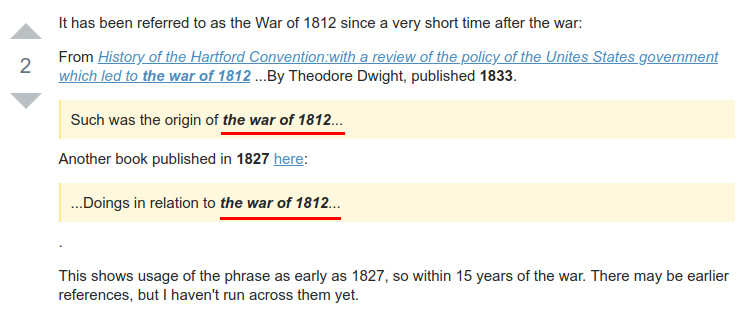
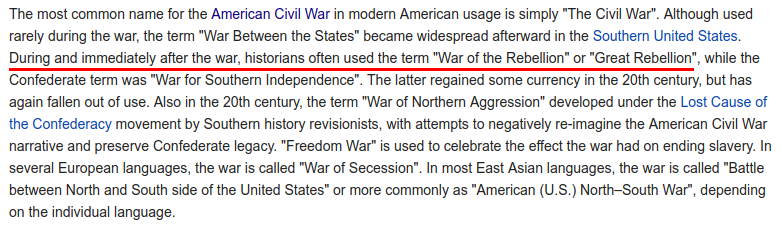
other names for war of 1812.png early names for civil war.png
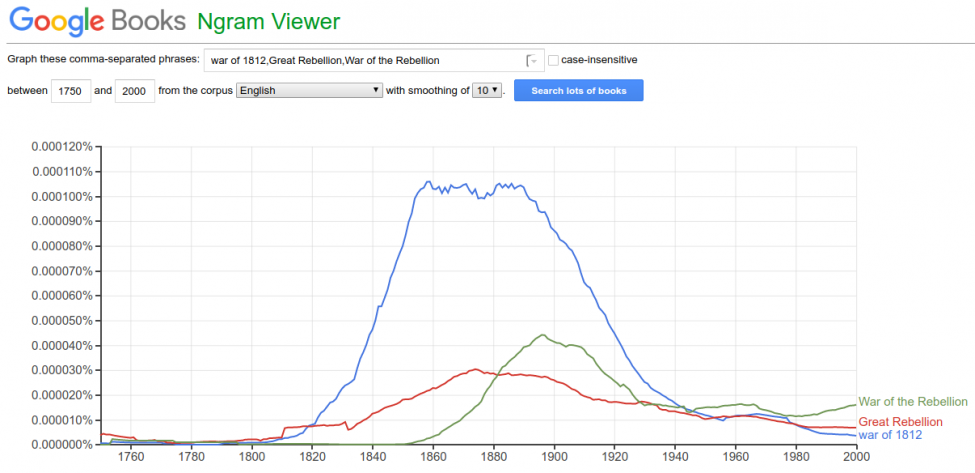
When searching google Ngram for the original terms of both the War of 1812 (lowercase 'war of 1812') and the American Civil War ('Great Rebellion', 'War of the Rebellion'), it makes me question the chronology of both wars and that judging by the sizes of data sets, one could get the idea that the American Civil War is actually part of a larger War of 1812, if we were to consider @KorbenDallas Phantom Time theory:

war of 1812,Great Rebellion,War of the Rebellion.png

I know this coincidence isn't actually concrete evidence, but I did not expect the overlap. It appears by this that the history of War of 1812 is pushed up into the era of the Civil War. Why is there 3x to 4x more references to the War of 1812 during the Civil War than the Civil War at that time? What do others think?
Note: This OP was recovered from the Wayback Archive.
Note: Archived Sh.org replies to this OP are included in this thread.
 
Note: This post was recovered from the Sh.org archive.
Username: Japod
Date: 2019-07-05 19:13:45
Reaction Score: 1
We need Fomenko to look in to this
 
Note: This post was recovered from the Sh.org archive.
Username: Red Bird
Date: 2019-07-05 20:45:37
Reaction Score: 2
When did civil war come into use I wonder? Who named it the great rebellion? Now I think of it why not name the war of 1812 something like British Invasion of 1812...
These may be clues.
 
Note: This post was recovered from the Sh.org archive.
Username: Mabzynn
Date: 2019-07-05 22:04:17
Reaction Score: 9
Yep. It was a long drawn out war.


I think the Battle of Copenhagen in 1807 reveals their hand and what they were capable of:

The Second Battle of Copenhagen (or the Bombardment of Copenhagen) (16 August – 5 September 1807) was a British bombardment of the Danish capital, Copenhagen in order to capture or destroy the Dano-Norwegian fleet, during the Napoleonic Wars. The incident led to the outbreak of the Anglo-Russian War of 1807, which ended with the Treaty of Örebro in 1812.

Britain's first response to Napoleon's Continental system was to launch a major naval attack on the weakest link in Napoleon's coalition, Denmark. Although ostensibly neutral, Denmark was under heavy French and Russian pressure to pledge its fleet to Napoleon. In September 1807, the Royal Navy bombarded Copenhagen, seizing the Danish fleet, and assured use of the sea lanes in the North Sea and Baltic Sea for the British merchant fleet. A consequence of the attack was that Denmark did join the war on the side of France, but without a fleet it had little to offer.

The bombardment included 300 Congreve Rockets, which caused fires.[a] Due to the civilian evacuation, the normal firefighting arrangements were ineffective; over a thousand buildings were burned.


Where else do we similar infrastructure damage? All over every coastal town that "burned" in America.
 
Note: This post was recovered from the Sh.org archive.
Username: KorbenDallas
Date: 2019-09-25 15:45:45
Reaction Score: 2
1812 time frame is paramount for our research. Wars have to be married with catastrophes throughout the world, with a close attention being paid the the western United States area.
 
Note: This post was recovered from the Sh.org archive.
Username: Starmonkey
Date: 2019-09-25 16:28:12
Reaction Score: 0
?
Getting closer...
 
Note: This post was recovered from the Sh.org archive.
Username: jd755
Date: 2019-09-25 17:07:30
Reaction Score: 5
Here's a google translation of a Danish article about the background to the bombardment of 1807.
Interesting indeed that the Danish side view the attack as a terror attack and the English (not the British note!) were acting on false information, what a shocker!
Article is here; Københavns Bombardement 1807

... in the European context

Before 1807 Danish merchant ships had been able to freely navigate the ports of the belligerent countries on the basis of the principle of free ship gave free charge. But in response to France's decree of 21 November 1806 on economic isolation of England, the English government decided that the neutral countries should be prevented from entering ports that English ships had no access to (Order in Council of 7 January 1807 ).

In March 1807, a new English government joined George Canning as Foreign Minister. The government wanted to act militarily more actively.

The Danish government had chosen to lay down the fleet in the hope that it could convince the belligerent countries that the fleet would remain in the Port of Copenhagen. But anyway, Canning was informed that the fleet was being made ready, which is why he decided to take action against Copenhagen. Incidentally, the notification was incorrect. But Canning didn't know that.

Napoleon's successful progress in Central and Eastern Europe meant that England had to evacuate its army from Rügen in northeastern Germany. This enabled both this military unit and the fleet to conduct the evacuation to be deployed in an attack on Copenhagen.

Subsequently, Canning received notice that England's allies, Russia, had suffered defeat to France and therefore initiated peace talks in the city of Tilsit.
At the English Parliament's inquire debate in the spring of 1808, Canning referred to these intelligence as the real reason for the demand for extradition of the Danish Navy and the Copenhagen bombing.

In mid-July, Admiral Hood was ordered to sail to the Baltic to secure the withdrawal of Lieutenant-General Cathcart and his forces from the area of Rügen (then-Swedish Pomerania), where the British forces had the task of supporting Swedish forces against Napoleon.

And in early August, Admiral Gambier arrived in the Sound with an English navy. At the request of the commander of the Danish guard ship in the Sound, he stated that he was unaware of his task and of the length of the stay, as it would depend on the circumstances.

This allowed the English government to still change political course without losing face
On August 16, the English began to land their forces north of Copenhagen. The day before, the officers had received their orders, and at. At 5 in the morning, the hills at the landing area near Vedbæk were occupied with light artillery from a light brigade, after which infantry with similar equipment and a squadron of light dragoons were landed with horses for two artillery brigades and the staff. The landing of troops, horses and supplies from Rügen took place further south at Charlottenlund and continued on 25 August.

The English demanded that the Danish fleet be handed over. Of course, even though it was supposed to be a mortgage, it was rejected, which is why Copenhagen was attacked. The bombing began on the evening of September 2, and after three days of devastating bombing, Copenhagen's commander, Major General Ernst Peymann, asked for a ceasefire on September 5.

Now the English demanded the fleet handed out as property! The Copenhagen bombing was a disaster for Denmark; from being one of Europe's great powers, the country became one of Europe's small states. Denmark and Norway were separated. Denmark went bankrupt.

It is limited how much has been written about the Copenhagen bombing (see the Literature List). But the source material - the records of the military leaders and the logs of the ships - shows that the defense of Copenhagen was a hopeless battle against a mighty enemy and against an inefficient division of command, but also characterized by persistent defense. Similarly, the English had difficulties to contend with: lack of geographical knowledge of the Sound and constant time pressure. Admittedly, the bombing of Copenhagen can be attributed to the successes of British military history, but the cost of this was a terror bombing that was not accepted at the time. In English history, the bombing of Copenhagen is remembered only to a limited extent; however, in the spring of 2007, the English historian Thomas Munch-Petersen published a book on the English attack on Copenhagen in 1807.

 
Note: This post was recovered from the Sh.org archive.
Username: KorbenDallas
Date: 2019-09-25 17:26:06
Reaction Score: 2
When we look at the change of power happening throughout the entire world at the time, and consider all the crazy weather and cataclysm related stuff... the conclusions could be rather interesting.

We are taught at school that all of those were separate events. It starts to appear that it was one and the same event presented to us in a way convenient for TPTB.
 
Note: This post was recovered from the Sh.org archive.
Username: Mabzynn
Date: 2019-09-25 21:19:13
Reaction Score: 3
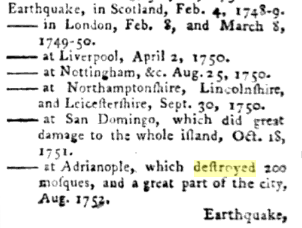
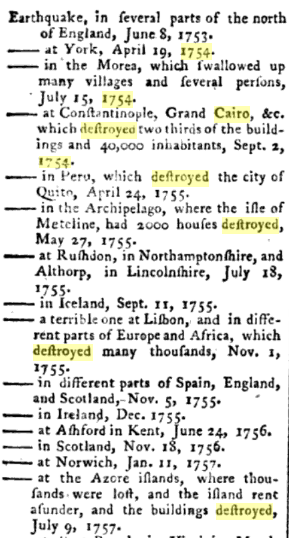
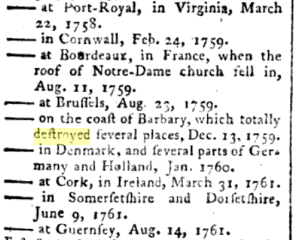
I think we really need to figure out the flood event in the 1750's that destroyed most of the world... This is when it starts for me. Also that most of these items are just missing from every histories timeline tells me this is one of the biggest clues.

1569445894925.png
1569445921657.png
1569446024775.png

Did ya'll know the roof of the Notre-Dame caved in... in 1759? I wonder if they collected donations to fix it back then as well...
 
Note: This post was recovered from the Sh.org archive.
Username: KorbenDallas
Date: 2019-09-25 21:26:36
Reaction Score: 1
And then we have the Declaration of Independence...
 
other names for war of 1812.png early names for civil war.png
When searching google Ngram for the original terms of both the War of 1812 (lowercase 'war of 1812') and the American Civil War ('Great Rebellion', 'War of the Rebellion'), it makes me question the chronology of both wars and that judging by the sizes of data sets, one could get the idea that the American Civil War is actually part of a larger War of 1812, if we were to consider @KorbenDallas Phantom Time theory:

war of 1812,Great Rebellion,War of the Rebellion.png

I know this coincidence isn't actually concrete evidence, but I did not expect the overlap. It appears by this that the history of War of 1812 is pushed up into the era of the Civil War. Why is there 3x to 4x more references to the War of 1812 during the Civil War than the Civil War at that time? What do others think?
I‘ve been looking into the war of 1812 and I think it was a full-on attack of the Dark Forces/Dutch India Company/Cabal people wiping out the last of the peaceful world—Tartaria which was a dark featured people who lived in America. Lumeria? A weapon was used from a ship(comet) that shook the midwest for months, causing floods, making CA part of the mainland. This war was the last stand against the cabal—and a showing off of their victory by way of world’s fairs which included displays of native peoples.

Penny Kelly, in her The Big Picture Video gives a lot of insight into who the Cabal is—basically a group of technological/wizard types who were always aggravating the world so they were expelled to Mars.
Then they came back in their ‘ark’ to takeover the world that kicked them out. But this time they were smarter and kept their presence on the down-low, using humans to do their dirty work. They actually built a race of humans which is talked about in the Bible—cloned-soulless psychopaths who we see evidence of in our institutions.
 
Tips
Tips
Please respect our Posting Rules.
Back
Top