"Mythical" Islands from Welsh folklore turn out to be real

dreamtime

Administrator
Staff member
Joined
Aug 25, 2020
Messages
2,005
Reaction score
8,103
ggh1.jpg
Gough_Kaart_(hoge_resolutie).jpg

Gough Map or also called Bodleian Map, presumebly one of the oldest map of (Great) Britain​

Lost islands cited in Welsh folklore and poetry are plausible, new study of coastal geography and a medieval map suggests

Historians conveniently refer to lost islands marked on historical maps as "phantom islands". There are countless islands on old maps, especially from before 1500, for which there is no known equivalent in our present times. The Island of Frisland is one of those lost islands.

Mainstream historians usually dismiss these maps as fantasy constructs of our ancestors, thus ridiculing them.

On Wikipedia, this arrogance reads like this: "The oldest phantom islands have their origins in ancient or Christian legends. Antilia, the Saint Brendan Islands or Hy Brasil were inscribed on nautical charts because cartographers and sailors believed that saints and bishops had built ideal empires in the Atlantic. If such land could not be found, it was assumed to be further west. That's why such phantoms appear on early modern maps."

Now researchers have taken on a specific case of a supposed phantom island and found out that the so-called "Welsh Atlantis" actually existed and the so-called "Gough map" was probably based on reality. This map appeared only from the 18th century and newer researches show that it was probably made only in the 15th century. Thus, it can probably be assumed that the two disappeared islands off Wales existed about 500 years ago, probably even much longer.

The researchers suspect that the islands disappeared only in the 16th century:

"They suspect that the islands may be the remains of a low-lying landscape created by soft glacial deposits during the last ice age. Since then, erosional forces have eroded the land and reduced it to islands before they too were eroded and disappeared in the sixteenth century."

The "Welsh Atlantis" is said by legend to have been struck by a catastrophic flood and is mentioned in the poetry of the Black Book of Carmarthen and in later folklore. As late as 1846, one author describes the ruins of these sunken islands:

"In the sea, about seven miles west of Aberystwyth in Cardiganshire, is a cluster of loose stones called Caer Wyddno, "the fortified palace of Gwyddno"; and near it are the remains of one of the southern roads or causeways of Catrev Gwaelod."

Even though the maps are mostly from the Middle Ages, they are often backdated to several thousand years ago. The last alleged ice age 10,000 years ago is often considered the authoritative event, and this is justified by arguing that these medieval maps refer to Ptolemy, who according to official chronology lived about 2,000 years ago. The contradiction that maps from 500-1000 years ago refer to a time about 1000-1500 years earlier is ignored. This would be similar to using a source from the 10th century A.D. for today's city maps for practical orientation - this is an absurd idea and lacks any basis.

Thus placing the many stories of floods in central Europe connected with the Biblical Flood myth far into the distant past is a tool of the history falsifiers and is maintained only by the arrogance to see in our ancestors naive idiots who did not understand their world. This is probably just the projection of a society that has lost any rooting in its own history and place in the world and has to resort to meaningless alienated narratives that take away our connection to both the past and the objective reality around us.
 
Cannot understand why you push this academic twaddle. Read the linked article its a puff piece for the climate change agenda. Full of weasel words based entirely in quackademic guesswork.

Our research increases our understanding of potential coastal processes acting along the coast of Cardigan Bay. It can also help with future research on post-glacial evolution of similar lowlands in other parts of northwest Europe.

Understanding coastline dynamics has never been more important. Some towns along the area we studied are vulnerable to climate and sea-level change, and it has been suggested that it may lead to some of the first climate change refugees in the UK”.
 
Cannot understand why you push this academic twaddle. Read the linked article its a puff piece for the climate change agenda. Full of weasel words based entirely in quackademic guesswork.

Did you read the full academic PDF that did actually come linked with the article?

View of The ‘lost’ islands of Cardigan Bay, Wales, UK: insights into the post-glacial evolution of some Celtic coasts of northwest Europe

The PDF doesn't mention climate once, though I could see where if you just skimmed the blog post discussing the research - looking for things you don't like you could pick that out.

Do you have any comment or related criticism regarding the research on the islands themselves? Or is your intention to stop the discussion before it begins because you ignored the relevant content?
 
I am truly gobsmacked you pose this question. Truly and utterly gobsmacked after all our exchanges through both incarnations of stolenhistory.

I did not read the PDF because the intent of the academics who authored it is clear, crystal clear.
It is a climate change puff piece made to order to back and promote the climate change agenda.
Academics paid to produce such rubbish are legion.They do whatever they are paid to do. There is no academic integrity these days. That's not cynicism it comes from reading enough articles/papers to see it, realise it and finally accept it.

As for the map just how on gods earth did you or dreamtime or the authors determine the age of the thing?
What method was employed?
Where is it published and detailed for people to look at and test for themselves?
Or has such a thing as veracity lost all relevance here?

If the veracity of the thing cannot or has not been proven beyond reasonable doubt then any article about the thing is mere speculation and opinion no different to a novelist writing a fantasy story.

Read the article it is full of weasel words, do I have to list them out?
Its complete guesswork mashing geographical features and an unproven history together to produce a possible scenario that is not proven, in a mainstream academic article. The things that deserve to be questioned andvpicked apart as rthey always have been on here. I recall you used to do this yourself not so long ago.
But now because it seems to fit a line of thought it gets posted without query or question or am I missing something?

Having a administrator post a thread with an erroneous title is quite eye opening too.
There is nothing at all in the article which let's be frank here, is as far as most people will go, that supports the word "real" in the thread title.

Instead of asking me questions why not post the bits from the PDF that prove my point to be fallacy?

Edit to add

The only two people with the power to shut down any discussion are you and dreamtime.
 
Last edited by a moderator:
Why not directly posting it in the main thread then? In any case there's no link to the above in the original article, unless I'm blind.
In any case, as interesting as it is, it reamins the point that this 'study' comes out right now in the middle of the immigration-climate crisis, which are BOTH mentioned in the link provided in the main thread, as reported by kd-755, unless you are blind.
 
I am truly gobsmacked you pose this question. Truly and utterly gobsmacked after all our exchanges through both incarnations of stolenhistory.

I did not read the PDF because the intent of the academics who authored it is clear, crystal clear.
It is a climate change puff piece made to order to back and promote the climate change agenda.
Academics paid to produce such rubbish are legion.They do whatever they are paid to do. There is no academic integrity these days. That's not cynicism it comes from reading enough articles/papers to see it, realise it and finally accept it.

As for the map just how on gods earth did you or dreamtime or the authors determine the age of the thing?
What method was employed?
Where is it published and detailed for people to look at and test for themselves?
Or has such a thing as veracity lost all relevance here?

If the veracity of the thing cannot or has not been proven beyond reasonable doubt then any article about the thing is mere speculation and opinion no different to a novelist writing a fantasy story.

Read the article it is full of weasel words, do I have to list them out?
Its complete guesswork mashing geographical features and an unproven history together to produce a possible scenario that is not proven, in a mainstream academic article. The things that deserve to be questioned andvpicked apart as rthey always have been on here. I recall you used to do this yourself not so long ago.
But now because it seems to fit a line of thought it gets posted without query or question or am I missing something?

Having a administrator post a thread with an erroneous title is quite eye opening too.
There is nothing at all in the article which let's be frank here, is as far as most people will go, that supports the word "real" in the thread title.

Instead of asking me questions why not post the bits from the PDF that prove my point to be fallacy?

Edit to add

The only two people with the power to shut down any discussion are you and dreamtime.


1662477603505.png1662477635063.png

Regarding the veracity of the sources - it is addressed in the paper.

The two ‘lost’ islands of Cardigan Bay are shown on the Gough Map, which is the earliest known map of Great Britain (Pelham 1933; Parsons 1958; Skelton 1959). The historical map is held in the Bodleian library of the University of Oxford (ms. Gough Gen. Top. 16) and is so named after its previous owner, Richard Gough, who donated it to the library in 1809. For many years it hung on the wall in the Map library of the Bodleian but its significance is such that a major project undertaken by the Gough Map Panel (Delano-Smith et al. 2017) has digitised it and made it available online for researchers to utilise (linguistic Geographies Project 2021). The date of the map is debated with estimates ranging through the fourteenth and fifteenth centuries with ca. 1360 often cited (e.g., Parsons 1958; lilley et al.2009), but with advocates for a later date around 1400 or later (e.g., Smallwood 2009). it has also been suggested that it is based on an earlier original estimated to date from around 1280 with the surviving version being a revised copy (Birkholz 2004, 2006).The use of historical maps in general should be made with caution; however, in this case a level of reassurance is reasonably provided by specialist opinion. For example, lloyd and lilley (2009) state that “one of the attributes of the Gough Map ... consistently remarked on by scholars is the apparent geographical truthfulness of its content, particularly the shape of the British coastline and islands ...” (p. 29). Therefore, based on such academic views and notwithstanding early survey techniques and resultant cartographic distortions, the fundamental geographical features shown on the Gough Map might be considered reasonably secure. nevertheless, the outline of Wales is strange in shape on the Gough Map and the current embayed configuration of Cardigan Bay is absent, a fact that Bower (2015) attributes to the poor combination of separate surveys used to construct the map. nevertheless, the lack of curvature of Cardigan Bay on the Gough Map does not cast significant doubt in itself on the distinct occurrence of the two ‘lost’ islands depicted on the map offshore the Cardigan Bay coast.Asecond historical source is Ptolemy’s Geographia,coll-ated CE 120–160, and the geographical references for coastal locations in Roman Britain that it lists (Strang 1997). Ptolemy’scoordinates for places listed in Cardigan Bay have been corrected by north (1957) and may be used to establish historical positions for those locations to permit comparison. Some authors have produced maps of Roman Britain based on Ptolemy’s coordinates (e.g., Strang 1998) but as a few locations only are listed for Cardigan Bay, such an exercise connecting the points is of limited benefit locally.A literature search and review fo r other relevant historical sources is undertaken using searchable online literature databases, such as the University of Oxford’s Search Oxford libraries Online (SOlO) service, and hard-copy sources in the collection of the Celtic library of Jesus College, Oxford

Naturally, a similar question is raised by the researchers as to the legitimacy of the map. The map might be from the 13th-14th century, it may be earlier, for all we know it could be a forgery from the 19th century. That said, there are geological elements that do align this map with more modern discoveries in the area. They go even farther to make qualifications later - which in my mind lends credibility in that they are not taking this information at pure face value.

Relevant historical sources are the 6th-century De Excidio et Conquestu Britanniae by Gildas and the 9th-century Historia Brittonum formerly attributed to nennius (Giles 1841; Dumville 1975; Winterbottom 1978), Geoffrey of Monmouth’s De Gestis Britonum [Historia Regum Britanniae](Reeve and Wright 2007), medieval saga poetry and triads, the Mabinogi, and local antiquarian accounts, such as Meyrick’s (1808) history of Cardiganshire. Some of these sources provide historical statements as well as reflecting literary and folkloric accounts, which nevertheless have geomythological value (see below), but caution must be exercised where the boundary between history, literature, and tradition may have become blurred. For example, the subtitle of Meyrick’s (1808) history is ‘collected from the few remaining documents which have escaped the destructive ravages of time, as well as from actual observation’, suggesting that some of the content is based on unspecified material that, if it ever existed, may now be lost, and, therefore, not all content may be corroborated by surviving sources. Relevant details from these sources are introduced below and in the Discussion section where appropriate.

1662478070141.png


They also reference a secondary source as part of their reseach: Celtic Folklore: Welsh and Manx (Volume 1 of 2)

According to Welsh folkloric traditions (see below), a ‘lost’ landscape, often regarded as a submerged landscape locally, once occupied what is now Cardigan Bay and is variously referred to as Cantre’r Gwaelod (the ‘lowland Hundred’ or ‘lowland of the Depth’, a ‘cantref ’ being the intermediate administrative division of medieval Wales) or Maes Gwyddno (‘The Plain of Gwyddno’). in the 17th century, antiquarian Robert Vaughan, in his ‘Survey of Merioneth’ (national library of Wales ms. 472B), considered Sarn Badrig to be the remains of the defensive wall of Cantre’r Gwaelod (north 1957, p. 153). J. E. lloyd tentatively suggested that the Cantre’r Gwaelod story involves ‘reminiscences handed down through many generations of the effects — at times, perhaps, startling — of this gradual subsidence [in Cardigan Bay] attested by geology’ (lloyd 1911 vol. 1, p. 5). Bromwich (1950 p. 227, 231) is more circumspect, suggesting that it is an attempt to explain the observed geological formations in Cardigan Bay, rather than a direct recollection of inundation events.in recent folklore, Gwyddno is presented as the ruler of Cantre’r Gwaelod and the inundation is the result of the negligence of the drunken gatekeeper, Seithiennin, while, in medieval versions of the tale, Seithiennin is the focus, probably the lowland’s/island’s king, and Gwyddno is mentioned only indirectly in the name Maes Gwyddno. A tradition that seems to go back to triads, possibly forged by iolo Morgannwg in the 19th century, portrays Gwyddno as King of Ceredigion in the 5th and 6th centuries (north 1957 p. 152–153). Gwyddno is also linked to the mythologicalfigure of Taliesin in Ystoria Taliesin, a tale attested from the16th century. Here, Gwyddno’s castle is located specificallyin Aberystwyth (in most versions of the tale) or somewhatfurther north, between the Ystwyth and the Dyfi (inllywelyn Siôn’s version of the same tale, Cwrtmawr ms. 20)(Ford 1975, p. 453; Wood 1980). A number of 15th-centurygenealogies claim descent to Gwyddno through his sonElffin.The folkloric traditions build on earlier traditions that find literary form in a number of medieval Welsh sources (Bromwich 2014, p. 391–392). Elffin is mentioned in a number of poems of the Gogynfeirdd (Poets of the Princes). Porth Wyddno ‘Gwyddno’s Harbour’ is mentioned in a medieval Welsh triad (Bromwich 2014, p. 246) as being in the north (of Britain); and Gwyddno is listed as one of Gwŷr y Gogledd ‘the Men of the north’, and a descendent of Dyfnwal Hen (Bromwich 2014, p. 256). Thus, an early tradition links him with the Old north (today’s southern Scotland). Whether his name was associated with the submersion of Cantre’r Gwaelod in the Old north or only after he became known in Wales is unclear. Evidence of place names links him both to Ceredigion and the Conwy estuary: places named Cored Wyddno ‘Gwyddno’s weir’ are found both in Aberconwy and in Ceredigion, and there is a stream called Gwenwyn meirch Gwyddno in Arfon (Williams 1957, p. 5; Bromwich 2014, p. 392).The fate of Cantre’r Gwaelod itself is mentioned in a poem in the Black Book of Carmarthen (mid-13th century), the first stanza of which is given here in Rachel Bromwich’s interpretation and translation:Seithenhin sawde allanac edrychuirde varanresmor maes guitnev ry toes.‘Stand forth, Seithenhin,and look upon the fury of the sea;it has covered Maes Gwyddneu.’ (Bromwich 1950, p. 217)As noted above, Gwyddno is here not the ruler of Cantre’r Gwaelod, as in the later folkloric tradition, and appears only in the name of the land inundated. A similar presentation is found in Bonedd y Saint, a list of genealogies of saints first redacted in the 12th century, in which a number of saints are listed as sons of ‘Seithennin Vrenhin o Vaes Gwydno a oresgynnvs mor ev tir’ (‘Seithennin king of Maes Gwyddno, whose land the sea overran’) (Wade-Evans 1944, p. 322).The tale of Cantre’r Gwaelod suggests the lowland was suddenly inundated and overwhelmed by a flood which Meyrick (1808) asserts occurred in CE 520, although he provides no evidence to support this date.

As per usual, the research paper is taken and used by others, like this article, and used to serve as a means to an end, which is the religious of climate change and gradual sea level rise. However the paper itself completely contradicts this, in the discussion.

On Bathmetry:

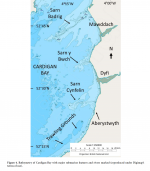
The 13th–14th-century Gough Map provides cartographic evidence for the existence of two ‘lost’ offshore islands located in Cardigan Bay. Considering the geological setting, any such islands are likely to have comprised unconsolidated Pleistocene deposits that were susceptible to lateral erosion. it is also likely that the geomorphology of island coasts, at least on the exposed seaward sides, would be analogous to present-day coastal settings in Cardigan Bay with eroding cliffs of unconsolidated deposits fronted by coarse-clastic storm beaches, sand terraces and gravel-lag deposits. The recession of the cliffs would have resulted in the areal reduction of the islands with marine action in the surf zone further eroding the exposed surface of the Pleistocene deposits. indeed, Garrard (1977) recognised that such erosion across the region resulted in “a thin but extensive cover of lag gravel, resting on a distinct plane of marine erosion” (p. 91). The more sheltered, landward-facing, leeside, island coasts may have been different in character and supported depositional landforms comprising more fine-grained sediments.Bathymetrically, the two islands depicted on the Gough Map appear to be located approximately coincident with Sarn Cynfelin, between the Ystwyth and Dyfi estuaries, and Sarn y Bwch, between the Dyfi and Mawddach estuaries, suggesting that the coarse clasts of these sarns may have ‘anchored’ the islands resulting in significant gravel lag accumulations following erosion of the diamicton’s finer-grained matrix. Furthermore, the height of the land surface of the islands may be estimated if the altitude of the 20–30 m-high cliffs of Pleistocene deposits that remain along theCardigan Bay coast is extrapolated westward. This approachsuggests the land surface height of the islands in the areasof the two sarns might have been up to 15–25 m above sea-level in areas enclosed by the present-day 5 m isobath or10–20 m in waters enclosed by the 10 m isobath. However, due to surface lowering, through simultaneous weathering and erosion of the unconsolidated sediments, it is likely that the altitude was lower than these maximum estimates.it appears that the erosion of the two islands was completed by the mid-16th century, as the islands do not appear on later maps, such as Thomas Butler’s Mape off Ynglonnd dated to 1547–1554 (Birkholz 2006). Therefore, the disappearance of the two ‘lost’ islands may represent a stage in the gradual planation and removal from Cardigan Bay of the top decametres of unconsolidated Quaternary deposits due to marine action operating on the Holocene sea-level high-stand, a process that has not yet been fully completed, as substantial areas of Quaternary deposits remain as terraces and exposed in cliffs along the Cardigan Bay coast as observed in the field seaward of the relict pre-glacial coastline (e.g., Fig. 6).

On gradualism versus severe, sudden changes to the environment:

A number of authors have considered the legend of Cantre’r Gwaelod to represent a folk memory of gradual landscape submergence through rising sea levels during the Holocene marine transgression (e.g., Matthews 1993; Nunn et al. 2021; see also Kavanagh and Bates 2019). However, the association of this memory with a sudden inundation tends to contradict this view. Elsewhere, coastal submergence due to gradual post-glacial sea-level rise is represented in traditions, such as in Australian Aboriginal myths, that either recall “how two landmasses, now separated by a water gap, were once joined” or “how people once crossed a water gap (by wading or swimming) from one landmass to another, a feat that would be impossible today” (nunn 2016, p. 397). in Wales, the Mabinogidescription of Bendigeidfran’s crossing to ireland, with only two navigable rivers lying in between, aligns well with the second of these tradition types involving gradual sea-level rise, but the sudden inundation of Cantre’r Gwaelod does not align with a sea-level rise explanation for its demise and instead evokes a more rapid event or series of events
Whether such an inundation(s) was due to storm surge or tsunami is not possible to discern but an interesting account (the legend of Aber llyn lliwan) included in the 9th-century Historia Brittonum, and repeated by Geoffrey of Monmouth (Reeve and Wright 2007), recounts a marine phenomenon linked to the 5th or 6th century that describes unusual tidal conditions and a mountainous wave in the Severn Estuary along the south Wales coast (Rhŷs 1901). Evans et al. (2008) have suggested that this refers to a specific site where whirlpools occur near the coast; however, it may also be describing a tsunami event and, moreover, Bryant and Haslett (2007) and Haslett and Bryant (2007) present historic and physical evidence suggestive of historic tsunami events in south and north Wales respectively. it is clear that this question requires further investigation in the future

Their hypothesis is as follows:

1. During the late Glacial, Cardigan Bay was occupiedfrom the north and west by Irish Sea ice and Welsh ice from the east. In southern Cardigan Bay, the Irish Sea ice deposited glacial till approximately 10 km inland of the present-day coastline up to 250 m above present sea-level. In the northern part of Cardigan Bay Welsh ice extended ca. 10–12 km west of the present coastline. The Welsh ice deposited significant accumulations of coarse clasts, in-cluding those that comprise the present-day sarns of Cardigan Bay.
2. Unconsolidated Pleistocene deposits, including glacialtill, were deposited across Cardigan Bay seaward of a relict pre-glacial coastline producing a depositional subglacial landscape. Remaining cliffs of unconsolidated deposits that occur along the modern coastline suggest a surface altitude of up to 30 m above present sea-level for these uncon-solidated deposits
3. The post-glacial erosion of the unconsolidated Pleisto-cene deposits may have followed a template provided byland drainage and Holocene sea-level rise. initial retreat oftheIrish Sea ice, from the present shoreline of southernCardigan Bay, forced emerging rivers, such as the Afon Teifi and Aeron, to flow southwards excavating the Trawling Grounds channel. More northerly rivers, such as the Afon Ystwyth, Dyfi, and Mawddach flowed westward as the Welsh ice retreated eastwards from its confluence with irish Sea ice. Once irish Sea ice had fully retreated to the west and north, the Holocene transgression would begin to act on the western margin of the deposits and establish estuarine conditions in the coastal river valleys. Run-off from upland bedrock areas between the rivers is likely, in places, to have removed material fronting the relict pre-glacial cliffline.
4. As erosion progressed, the landscape would becomedissected by westward flowing rivers eroding laterally to widen their valleys, coastal erosion and eastward retreat of the western margin, and erosion and north-south removal of materials from the foot of the inter-river upland bedrock areas, perhaps eventually connecting southwards with the Trawling Grounds channel. This process might have resulted in the formation of islands in the cores of these dissected areas, such as the two ‘lost’ islands depicted on the Gough Map positioned between the lines of rivers.
5. Marine inundation(s) and continued down-wearing ofthe interfluves and marginal erosion removed the two remaining islands by the 16th century and the process continues in eroding and removing areas along the present-day coast underlain by unconsolidated Pleistocene deposits.Through this process, the river valleys, including the Trawling Grounds channel, became submerged landscapes, preserving post-glacial deposits in palaeochannel infills. However, islands of unconsolidated Pleistocene deposits forming the inter-river areas were not submerged but removed through lateral erosion to produce a plane of combined fluvial and marine erosion constituting a stratigraphic unconformity between underlying Pleistocene deposits and overlying modern seabed sediments.The mean rate of removal of the depositional landscape in the period between the recording of Ptolemy’s coordinates and the drafting of the Gough Map is estimated to be ca. 10 m/yr if marine erosion only of the coastline was responsible for retreat of the shore back to the approximate position of the present-day coast. However, a dissection model with combined marine and fluvial erosion would require a lower mean removal rate of ca. 5 m/yr to erode towards the core of remnant islands within a dissected landscape, a rate that might be accelerated due to gradually deepening water adjacent to the coast bringing higher energy waves to the shore and occasional high-magnitude marine inundation(s). Although the current rate of erosion along the Cardigan Bay coast is estimated to be up to ca. 1 m/yr (West Wales Shoreline Management Plan Consultation 2011), coastlines on the more protected coast of eastern England, with cliffs comprising similarly unconsolidated Pleistocene sediments, have retreated ca. 5.5 km since Roman times (ca. 2.75 m/yr) along the Yorkshire coast (Sistermans and nieuwenhuis2013) and rapid cliff erosion of up to ca. 6 m/yr in Suffolk (May 2003).Across the north Sea in the German Bight, historical cartographic evidence indicates that the island of Heligoland has experienced a major reduction in size (Hebbeln et al. 2003) from 60 km in length in CE 800 to 25 km in 1300 and 1.5 km in the 20th century (Bryant 2005). Presently, the island’s shoreline has retreated to a resistant core of Mesozoic rocks (Kelletat 1992) but is surrounded on the seafloor by a basement of Pleistocene sediments (Wunderlich 1980) indicating that the material removed through historic coastal erosion comprised unconsolidated deposits. indeed, Hebbeln et al. (2003) attribute very high historic sedimentation rates in the nearby Helgoland mud area to the disintegration of the island.Elsewhere in the north Atlantic, the exposed shore of nova Scotia in Canada has experienced rapid erosion of cliffs in unconsolidated Pleistocene deposits, such as drumlins, with recent measured rates of 5.4 m/yr, and perhaps up to 7.6 m/yr, on the western inlet of Chezzettcook inlet (Shaw et al. 1993), and ca. 8.33 m/yr through a six-year period at Cap la Ronde on isle Madame (Force 2013). Furthermore, an island mapped offshore nova Scotia in the eighteenth century, Fish isle, has subsequently been removed though erosion and is “now represented only by intertidal boulder shoals” (Force 2013, p. 37), which shows a similarity to the ‘lost’ islands of Cardigan Bay where the Sarns, and/or associated gravel lag deposits, may be considered to be analogous to the ‘boulder shoals’.Taken together, the rates of historical erosion proposed for the ‘lost’ islands of Cardigan Bay are entirely plausible within the context of other coasts where unconsolidated Pleistocene deposits are exposed in coastal cliffs and occur within a high-energy wave environment. Moreover, the geological and geomorphological similarity between Cardigan Bay and other areas along the northwest European coast, such as the Celtic coasts of Brittany and Cornwall, along with similar geomythological evidence, might suggest marine and fluvial dissection and erosion of ‘lost’ landscapes underlain by unconsolidated Pleistocene deposits provides a credible model to further investigate coastal evolution in these regions.

The reseachers also include 3 pages of bibilography for further research.

I read this entire paper - at no point did I discover any "weasel words", lazy science, or any of the other trappings we so often find in articles like the OP. It is unfortunate dreamtime linked to an article discussing it for climate change purposes, instead of linking directly to the research. However - you don't have to hunt for this information - they at least linked it at the end of the article which is more than most rags tend to do.
 
However - you don't have to hunt for this information - they at least linked it at the end of the article which is more than most rags tend to do
It's a news article published by Swansea University. The author of it is Kevin Sullivan of the Swansea University Press Office.

As to the PDF. Bolding is my emphasis.
This is the title of the paper.
Copyright © Atlantic Geoscience 2022Gough Map Panel (Delano-Smith et al. 2017) has digitised it and made it available online for researchers to utilise (linguistic Geographies Project 2021). The date of the map is debated with estimates ranging through the fourteenth and fifteenth centuries with ca. 1360 often cited (e.g., Parsons 1958; lilley et al.2009), but with advocates for a later date around 1400 or later (e.g., Smallwood 2009). it has also been suggested that it is based on an earlier original estimated to date from around 1280 with the surviving version being a revised copy (Birkholz 2004, 2006).The use of historical maps in general should be made with caution;, in this case a level of reassurance is reasonably provided by specialist opinion. For example, lloyd and lilley (2009) state that “one of the attributes of the Gough Map ... consistently remarked on by scholars is the apparent geographical truthfulness of its content, particularly the shape of the British coastline and islands ...” (p. 29). Therefore, based on such academic views and notwithstanding early survey techniques and resultant cartographic distortions, the fundamental geographical features shown on the Gough Map might be considered reasonably secure. nevertheless, the outline of Wales is strange in shape on the Gough Map and the current embayed configuration of Cardigan Bay is absent, a fact that Bower (2015) attributes to the poor combination of separate surveys used to construct the map. nevertheless, the lack of curvature of Cardigan Bay on the Gough Map does not cast significant doubt in itself on the distinct occurrence of the two ‘lost’ islands depicted on the map offshore the Cardigan Bay coast.

So clearly the authors rely totally and utterly on their fellow academics for veracity purposes. Weasel words abound.
How you missed this I do not know but clearly there is no method available to verify the date of production of any paper document beyond reasonable doubt let alone this map and what it shows.

I couldn't give a monkeys what this pair then go on to speculate on or which other academics they reference at the end of it.
Its all paper built on references to more paper and academic opinion. They all reference each other and opine for each other.

They even put the word "lost" in parentheses!
 
Read the linked article its a puff piece for the climate change agenda. Full of weasel words based entirely in quackademic guesswork.

Thanks for clarifying this, since maybe not everyone reads the linked article. The climate stuff is certainly a red flag, as usual, but no reason to throw out the baby with the bathwater, imho.

I think all here in the forum are aware about the climate change agenda and that many studies are framed in support of man-made climate change to get them published. When it's about climate change itself, this usually means the study is complete bullshit in it's entirety, but this is not the case here.

Regarding the word "real" - I made it clear multiple times, e.g. by using the word "probable" etc., that I just share a possibility, and don't believe in this stuff blindly, so please don't just focus on specific words I use while ignoring the context. I just find it interesting that this study made a case for the existence of a "phantom island", because this is very rare. Beyond sharing the press release, I am not interested in looking through the study in detail to take it apart or confirm it, because the topic is not so important to me currently. Everyone can add his or her take to this thread, though, and add more in-depth information.
 
Beyond sharing the press release, I am not interested in looking through the study in detail to take it apart or confirm it, because the topic is not so important to me currently.
Begs the question why bother sharing it in the first place.

I first came across these claims of Cardiff Bay island a few years back when the idea of putting a tidal energy barrage in place and creating a lagoon behind it was all the rage.
There were two comperting claims for what had happened to Cardiff bay in times past.
One was this idea of islands no longer extant but the academics of the day suggested they were in reality small hills on what was once dry land that slowly inundated by rising sea level.

The other was a sudden and catastrophic inundation by tsunami or as they were known back then a tidal wave. They guessed it removed the old seashore and swept over it permanently flooding the hinterland to create the present day outline.

Trouble with both theories was there is no evidence of either supposed event afflicting land either side of the current bay.
 
It's a news article published by Swansea University. The author of it is Kevin Sullivan of the Swansea University Press Office.

As to the PDF. Bolding is my emphasis.
This is the title of the paper.


So clearly the authors rely totally and utterly on their fellow academics for veracity purposes. Weasel words abound.
How you missed this I do not know but clearly there is no method available to verify the date of production of any paper document beyond reasonable doubt let alone this map and what it shows.

I couldn't give a monkeys what this pair then go on to speculate on or which other academics they reference at the end of it.
Its all paper built on references to more paper and academic opinion. They all reference each other and opine for each other.

They even put the word "lost" in parentheses!

Is your issue that the entirety of the research should be thrown out due to the issue of academic referral and not being able to confirm your existence of the map? Or is it that any research that may be connected to the current Climate religion should be de facto dismissed?

I think one of the biggest issues with this type of research is that in order for scientists to get anything funded - it has to be approved and connected with the modern Climate religion. This is a most unfortunate development, and can lead to poor research and lazy conclusions. After reviewing the actual research, I think it is an interesting argument to be made, and doesn't dip its toe too deep into religious territory - unlike the press statement. Of course I don't take it as 100% truth, but it is nice to see this type of work being done by the mainstream, even if it is used for unfortunate ends.

At risk of turning this thread into a more meta discussion on science and research - it is worth mentioning that the perfect is the enemy of the good. It is difficult to take academic research at face value - while I am cynical towards it I do not dismiss all academic research out of hand. Like with anything else - you pick the useful bits out from the chaff. Personally - I find it plausible that California was for a period of time, an island. It would be interesting to see similar research principals applied to determine what type of geological evidence may be present to support older maps depictions. Moving a lot of the research on this site forward into the realms of plausibility is going to require delving into scientific principles and in many cases - geological research. It goes without saying that the stated intention of this research would be dismissed out of hand by mainstream academia, as it does not relate to the Climate religion. However - I know for a fact there are at least a handful of participants here on SH that do work in mainstream academia, and do not carry the same dogmatic principles of their peers. This is one of the few places where people like that feel comfortable to voice their opinions with little risk of job security or securing funding for their own research. The trick would be developing a way to perform this research without falling into the same modern academic trappings - funding, political/social motivations, and academia referencing other academics to make a scientific claim seem more sound.
 
I must be crap at explaining myself.
As I have already said, twice, but will have one last bash, unless the veracity of the map can be established beyond reasonable doubt anything that uses it, references it, builds a paper upon its content etc the entirety of what is speculated on top of it is moot.

It could have been drawn up at any time.

The authors of the paper looked at the geological evidence which is extant on the seabed and then looked at the maps content to weave a story which is self supporting. The seabed proves the map, the map proves the seabed.
All sources for the maps possible veracity are other academics opinion. That's it. No method, no process just peoples opinions.

Were it just this academic paper I would not have bothered tapping a screen other than stating the obvious use of its content by a university press officer to keep the climate change gravy train rolling but its not singular in its construction.
I have yet to find an original academic paper on anything historical that doesn't referrence someone else's work and opinion .

Frankly academia is not there to discover or uncover anything. It is there to obfuscate reality whilst supporting whatever narrative ensures careers continue.
There have been a couple of academics wander in here to answer questions none of them ever did.
In regards the maps content ignoring veracity for a moment. Either it is an accurate presentation of Cardiff Bay at the time it was drawn up or it isn't.
It is as clear cut as that. There is nothing on the map itself which points to a specific date or specific event, who it was drawn up for let alone where it was drawn.
Is it a navigation map?
Is it a land ownership map?
Is it a map drawn up by a spy for an invader?
Is it a resource map?

These sorts of questions are silenced completely by academic opinion and the thing itself is locked away from public scrutiny so nobody from outside a select academic/expert few can see it with their own eyes to decide for themselves what they are looking at.

Were I cynical I'd say how convenient.

Edit to fix typos/surplus words.
 
Last edited by a moderator:
Gough Map or also called Bodleian Map, presumebly one of the oldest map of (Great) Britain​

Lost islands cited in Welsh folklore and poetry are plausible, new study of coastal geography and a medieval map suggests

Historians conveniently refer to lost islands marked on historical maps as "phantom islands". There are countless islands on old maps, especially from before 1500, for which there is no known equivalent in our present times. The Island of Frisland is one of those lost islands.

Mainstream historians usually dismiss these maps as fantasy constructs of our ancestors, thus ridiculing them.

On Wikipedia, this arrogance reads like this: "The oldest phantom islands have their origins in ancient or Christian legends. Antilia, the Saint Brendan Islands or Hy Brasil were inscribed on nautical charts because cartographers and sailors believed that saints and bishops had built ideal empires in the Atlantic. If such land could not be found, it was assumed to be further west. That's why such phantoms appear on early modern maps."

Now researchers have taken on a specific case of a supposed phantom island and found out that the so-called "Welsh Atlantis" actually existed and the so-called "Gough map" was probably based on reality. This map appeared only from the 18th century and newer researches show that it was probably made only in the 15th century. Thus, it can probably be assumed that the two disappeared islands off Wales existed about 500 years ago, probably even much longer.

The researchers suspect that the islands disappeared only in the 16th century:

"They suspect that the islands may be the remains of a low-lying landscape created by soft glacial deposits during the last ice age. Since then, erosional forces have eroded the land and reduced it to islands before they too were eroded and disappeared in the sixteenth century."

The "Welsh Atlantis" is said by legend to have been struck by a catastrophic flood and is mentioned in the poetry of the Black Book of Carmarthen and in later folklore. As late as 1846, one author describes the ruins of these sunken islands:

"In the sea, about seven miles west of Aberystwyth in Cardiganshire, is a cluster of loose stones called Caer Wyddno, "the fortified palace of Gwyddno"; and near it are the remains of one of the southern roads or causeways of Catrev Gwaelod."

Even though the maps are mostly from the Middle Ages, they are often backdated to several thousand years ago. The last alleged ice age 10,000 years ago is often considered the authoritative event, and this is justified by arguing that these medieval maps refer to Ptolemy, who according to official chronology lived about 2,000 years ago. The contradiction that maps from 500-1000 years ago refer to a time about 1000-1500 years earlier is ignored. This would be similar to using a source from the 10th century A.D. for today's city maps for practical orientation - this is an absurd idea and lacks any basis.

Thus placing the many stories of floods in central Europe connected with the Biblical Flood myth far into the distant past is a tool of the history falsifiers and is maintained only by the arrogance to see in our ancestors naive idiots who did not understand their world. This is probably just the projection of a society that has lost any rooting in its own history and place in the world and has to resort to meaningless alienated narratives that take away our connection to both the past and the objective reality around us.
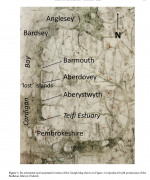
This reminds me of a book I read several months ago. The book was about life savers/rescue boats off the coast of England in the 19th century. Within the book, the author ( who was a contemporary of the lifesavers he was writing about) mentioned a 'myth' that there was once a land bridge across the English channel, which had a Castle on it that disappeared in the 11th century if I recall correctly.
The author himself was arguing against the possibilities but named a few sources which I followed up on at the time.

Unfortunately I cannot now remember the title of the book but I had a discussion with @MgvdT about it in chat at the time.
As I am currently locked out of chat, I can't find it, perhaps he can remind me if he sees this post before I can log back in.

Then there is also the sunken land of Lyonese off Cornwall which I've mentioned in this post in another thread some time ago.
Lyonesse Disappeared Under Water In A Single Night
The oldest written account of a lost country outside Cornwall's coast is described in "Irinerar" dated to 14th century and written by William of Worcester, who mentions fields, forests, and 140 parish churches that disappeared in the region of the Isles of Scilly, an archipelago of around a hundred islands and islets southwest of Land's End in Cornwall, southwestern Britain.

My point is that there definitely seems to have been a disappearance of land around the island of Britain within those times.

Very nice maps, thank you.

Edited for autocorrect spelling.
 
Last edited:
As for the map just how on gods earth did you or dreamtime or the authors determine the age of the thing?
What method was employed?
Where is it published and detailed for people to look at and test for themselves?
Or has such a thing as veracity lost all relevance here?

If the veracity of the thing cannot or has not been proven beyond reasonable doubt then any article about the thing is mere speculation and opinion no different to a novelist writing a fantasy
I have to agree here, appart from the obvious climate doomsday, one question must be asked: what happened to said map between the alledged 13-15th century until 19th century "discovery"?? If there's no reference to anything, then there's a high chance that the map is indeed made in the whereabouts of the 19th century. If only "historians" understood how quickly organic materials can deteriorate, maybe the discussions would be more factual and honest......
 
I read about this story recently, and I found it interesting because of something else I'd previously read about.

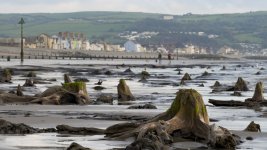
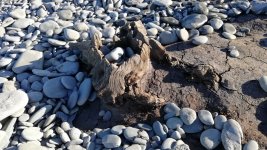
In 2019 after Storm Hannah, the remains of a petrified forest became visible on a Welsh beach on the Cardigan Bay coastline.

Storm Hannah uncovers Borth 'sunken' underwater forest

_107116819_6445bd3b-d403-404b-9a4a-df5a50afba9d.jpg
A prehistoric forest which was buried under water and sand more than 4,500 years ago has been uncovered by Storm Hannah.
The petrified trees lie between Ynyslas and Borth in Ceredigion county.
The forest has become associated with a 17th Century myth of a sunken civilization known as 'Cantre'r Gwaelod', or the 'Sunken Hundred'.
See: Storm Hannah uncovers Borth 'sunken' underwater forest

Storms in 2020 revealed more petrified trees further down the Cardigan Bay coastline.

Storm Francis uncovers more 'sunken' forest in Cardigan Bay

_114304018_img_20200831_085917.jpg
A forest which was buried in sand more than 4,500 years ago may stretch further than thought after Storm Francis uncovered more hidden trees.
The petrified forest can often be seen in Borth, Ceredigion, after storms, but new trees have been seen 13 miles (21km) south in Llanrhystud.
Tests are being carried out at the Llanrhystud site to determine its age.
Dr Hywel Griffiths, from Aberystwyth University, said the find was "both exciting and worrying".
Dr Griffiths is part of a joint research project between groups in Wales and Ireland looking at coastal environmental change.
See: Storm Francis uncovers more 'sunken' forest in Cardigan Bay

Naturally the BBC articles do throw in the 'climate change agenda' :rolleyes:, but putting that aside, I don't know if anyone actually made any attempts to try and 'date' any of these petrified tree stumps, or whether they're just going on 'belief'.

In my opinion, this is evidence at least that sea levels have risen in the past, and if there was a forest where much of Cardigan Bay is now, it is surely not beyond the realms of possibility that low-lying islands could also have been submerged.

This could also help to explain why the coastline of Wales shown on the old Gough map looks so different.

Just to add as an aside, I did actually visit Borth myself in 2019 - though I did not see any trees on the beach! The village itself runs along the coast road, with most of the habitation sitting between it and the railway line. Beyond the railway line, the land is very flat and marshy.
Since my visit there, it appears to have been renamed (on Google Maps at least) as Morfa Borth, 'morfa' being the Welsh word for 'marsh'.
 
I have now read through the document. It is precisely what I said above.
Speculation and opinion built on top of speculation and opinion.

Changing tack I went looking for the map and found this.
About - Gough Map

More and more guess works and speculation frankly.
Even the maps surfacing in 1809 is suspect to say the least.

It is named after Richard Gough, who bequeathed the map to the Bodleian Library in 1809. He acquired the map from the estate of the antiquarian Thomas "Honest Tom" Martin in 1774.

Honest Tom!
In my youth anyone given the title " honest " was given it because they weren't.

As for the flooding of land.
The sea is level all around this island therefore if the sea level rose to flood what were coastlines putting them underwater today then coastlines all around the coast would be inundated in the same instant which to my mind would leave copious evidence in diverse parts of the island which could be identified by development of a method and corraleted to put beyond doubt a sea level rise occurred.
No need to date such a thing just provide evidence it happened.

This would also give a base to look at the continental coastline and that of Ireland. In fact Ireland would be the ideal place to work out the method of evidence gathering as it is physically smaller than Britain. Mind the Isles of Man, White and Anglesy are smaller again.

However if there was a dune system protecting low lying land behind it on the Cardigan coastline or something like Chesil beach in Dorset then it is highly likely any sea inundation came from the dunes being destroyed in storms or a current changing course and scouring the dunes.
Its also possible the current changes themselves created an inundation which flooded low lying land which was protected by marshes until the current scoured them away.
Moving river estuarties could be yet another cause of local to Cardigan inundation. Despite appearances estuaries and their channels are highly dynamic. Often a large storm or prolonged rain event or snow melt is enough to change a channels course over a single winter season.
The amount of spoil these riverrs carry is a subject rarely investigated as far as I can ascertain but land clearance around river headwaters and by that I mean tree and shrub cover which binds the soils leads to increasing amounts of soil being washed into the river system which it is able to carry easily as long as the riparian cover remains intact but once it hits flat land and spreads out or the riparian cover is removed the water warms and drops its sediment further and further upstream from the estuary causing silting problems.
If the riparian cover stays intact the silt/sediment falls out near the estuary and builds mud banks and marshes which dry and solidify remarkably quickly in decades but crucially this land is susceptible to flooding by river and sea in storm surges or earthquakes, though the latter are rare here.

There is also the distinct possibility that widespread tree clearance in the area altered the rivers and their estuaries dramatically and the removal and extermination of the master water flow regulators, beavers, would have had a catastrophic effect on the erosion and land building process in estuaries.

All things considered I cannot see these supposedly flooded woodlands being inundated that long ago. A few hundred years ago. If had to guess my penny would be on land use changes, river channel changes, current changes and the removal of the beaver from this area of this island not a catastrophic or gradual sea rise.

Edit to correct auto correct. Apparently it registers a mistyped silt and replaces it with adult.
 
Last edited by a moderator:
I find this coincidentally amusing as I am currently working on an article that covers, not only the Hy Brazil phenomena, but also Lyonesse, the Scottish Islands and all of the intertidal peat deposits and sunken forests around the coasts of the UK and Ireland.

Yes, it's all being subverted for the climate change agenda, but that's the only way researchers get any funding these days, sadly. It's actually evidence of something much more dramatic that happened in the 10th century which is also linked to Felix's 'Arthur in Hyperborea' post.... imo. They have to maintain the 'thousands of years old' mantra, of course, as they have so much invested in it.

Regarding the maps, It's my belief that the basic skill of cartographers has always been copying older maps. That's why we get 'slip-ups' whereby, if we're lucky, we see pre-10th century geography in maps copied during the 2nd millennum. The world looked quite different then, but no one really noticed the anomalies on the maps until they were able to get out more.
 
Sorry, I forgot to mention, Hy Brazil is off the west coast of Ireland, not Wales. There are other phantom islands off of Wales that were still being reported right up into the 20th century, but they weren't Hy Brazil. After all, if it was between Wales and Ireland then it could hardly be considered in the Atlantic, or 'Atlantis'. All the St. Brendan stuff is nothing but Catholic propaganda with information leeched from the Inventio Fortunata... imo.

image1.jpg

Map of Abraham Ortelius 1570, cropped, showing the island of Hy Brasil west of Ireland.
(Public domain)​
 
maybe "the" post-ice age flood was simply an inundation in a lot of places, and the initial flood water settled to a still-low level (maybe a slight enough increase to cover some certain atlantic regions..).

I feel that the subsequent sea level rising probably took place either slowly, or in stages, over the next several millenia.

It would certainly explain the comparatively modern memories of Doggerland, Frisland, Hy Brazil, and all of these small, disappeared lands
 
View attachment 24956 View attachment 24957
Gough Map or also called Bodleian Map, presumebly one of the oldest map of (Great) Britain​

Lost islands cited in Welsh folklore and poetry are plausible, new study of coastal geography and a medieval map suggests

Historians conveniently refer to lost islands marked on historical maps as "phantom islands". There are countless islands on old maps, especially from before 1500, for which there is no known equivalent in our present times. The Island of Frisland is one of those lost islands.

Mainstream historians usually dismiss these maps as fantasy constructs of our ancestors, thus ridiculing them.

On Wikipedia, this arrogance reads like this: "The oldest phantom islands have their origins in ancient or Christian legends. Antilia, the Saint Brendan Islands or Hy Brasil were inscribed on nautical charts because cartographers and sailors believed that saints and bishops had built ideal empires in the Atlantic. If such land could not be found, it was assumed to be further west. That's why such phantoms appear on early modern maps."

Now researchers have taken on a specific case of a supposed phantom island and found out that the so-called "Welsh Atlantis" actually existed and the so-called "Gough map" was probably based on reality. This map appeared only from the 18th century and newer researches show that it was probably made only in the 15th century. Thus, it can probably be assumed that the two disappeared islands off Wales existed about 500 years ago, probably even much longer.

The researchers suspect that the islands disappeared only in the 16th century:

"They suspect that the islands may be the remains of a low-lying landscape created by soft glacial deposits during the last ice age. Since then, erosional forces have eroded the land and reduced it to islands before they too were eroded and disappeared in the sixteenth century."

The "Welsh Atlantis" is said by legend to have been struck by a catastrophic flood and is mentioned in the poetry of the Black Book of Carmarthen and in later folklore. As late as 1846, one author describes the ruins of these sunken islands:

"In the sea, about seven miles west of Aberystwyth in Cardiganshire, is a cluster of loose stones called Caer Wyddno, "the fortified palace of Gwyddno"; and near it are the remains of one of the southern roads or causeways of Catrev Gwaelod."

Even though the maps are mostly from the Middle Ages, they are often backdated to several thousand years ago. The last alleged ice age 10,000 years ago is often considered the authoritative event, and this is justified by arguing that these medieval maps refer to Ptolemy, who according to official chronology lived about 2,000 years ago. The contradiction that maps from 500-1000 years ago refer to a time about 1000-1500 years earlier is ignored. This would be similar to using a source from the 10th century A.D. for today's city maps for practical orientation - this is an absurd idea and lacks any basis.

Thus placing the many stories of floods in central Europe connected with the Biblical Flood myth far into the distant past is a tool of the history falsifiers and is maintained only by the arrogance to see in our ancestors naive idiots who did not understand their world. This is probably just the projection of a society that has lost any rooting in its own history and place in the world and has to resort to meaningless alienated narratives that take away our connection to both the past and the objective reality around us.
I do find it interesting that the map shows more rivers then what actually exist today. The only research I know that proves the UK has dry river beds every where is by an archeologist named Robert John Langdon. The difference is from this map and today's maps is the rivers depicted in the old map don't exist in todays maps or areas. The map shows that Langdon has proven that the area did indeed have rivers but they have long been dried up. some 4000 years ago.

1666042939157.png

1666042998145.png
You can see that when stonehenge was built it was on a waterfront.
Prehistoric Map Series of Wiltshire
 
I am truly gobsmacked you pose this question. Truly and utterly gobsmacked after all our exchanges through both incarnations of stolenhistory.

I did not read the PDF because the intent of the academics who authored it is clear, crystal clear.
It is a climate change puff piece made to order to back and promote the climate change agenda.
Academics paid to produce such rubbish are legion.They do whatever they are paid to do. There is no academic integrity these days. That's not cynicism it comes from reading enough articles/papers to see it, realise it and finally accept it.

As for the map just how on gods earth did you or dreamtime or the authors determine the age of the thing?
What method was employed?
Where is it published and detailed for people to look at and test for themselves?
Or has such a thing as veracity lost all relevance here?

If the veracity of the thing cannot or has not been proven beyond reasonable doubt then any article about the thing is mere speculation and opinion no different to a novelist writing a fantasy story.

Read the article it is full of weasel words, do I have to list them out?
Its complete guesswork mashing geographical features and an unproven history together to produce a possible scenario that is not proven, in a mainstream academic article. The things that deserve to be questioned andvpicked apart as rthey always have been on here. I recall you used to do this yourself not so long ago.
But now because it seems to fit a line of thought it gets posted without query or question or am I missing something?

Having a administrator post a thread with an erroneous title is quite eye opening too.
There is nothing at all in the article which let's be frank here, is as far as most people will go, that supports the word "real" in the thread title.

Instead of asking me questions why not post the bits from the PDF that prove my point to be fallacy?

Edit to add

The only two people with the power to shut down any discussion are you and dreamtime.
But New York City, London and Boston are all under twenty feet of water today - none of the
buildings escaped damage due to global warming and rising waters. Oh. Wait.
That's in another holographic universe - sorry. No they seem to be high and dry. :)-
 
Tips
Tips
Please respect our Posting Rules.
Back
Top