Archive
Old SH Archive
- Joined
- Sep 8, 2020
- Messages
- 17,737
- Reaction score
- 3,168
Note: This post was recovered from the Sh.org archive.
Username: ISeenItFirst
Date: 2018-12-19 09:54:31
Reaction Score: 2
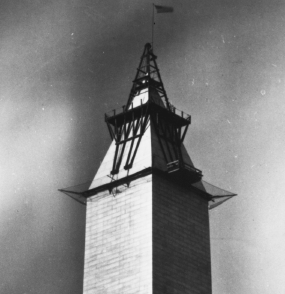
I dunno about any of this. Those photos look a little odd. I'd guess that they were enforcing the foundation, but tough to be sure. I doesn't look like the kind of scaffolding for heavy building. I could see it as being there to add or remove something from the top, it looks like a peak for a rope or pulley at the top. I see no steps, ladders or walkboards for actually doing any work on it.The image of the obelisk stump behind the scaffolding is very interesting. To my eyes, the structure looks too small to be the Washington monument. There is a freight wagon(1) near the base of the structure and it appears to be oriented in the same direction as the cross beams(2) on the scaffold as well as the mystery structure(3) behind the scaffolding. This allows us to approximate the dimensions of the scaffolding and the mystery object behind.
I found a similar freight wagon from that era, designed to haul heavy loads. The width of the cargo box is 43".
View attachment 14130
So, using the width of the cargo wagon example, I measured the beam going across (2) and it came out to 24 feet in length (which is a standard U.S. lumber length).
Then using those ratios to measure the width of the mystery object behind...
I get 6.75 feet or a bit over 2 meters in width!
Isn't the obelisk supposed to be 55 feet wide?
Maybe we found the tomb of Jimmy Hoffa!
The height was a bit more difficult to estimate because we can't really see the bottom of the base. So, as close as I could estimate, it appears about 60 feet high.
My thoughts on this are as follows:
There appears to be a cap on the obelisk in the photo, but it may be an illusion caused by the scaffolding.
This may indeed be an older obelisk type structure. The little we can see looks very much like one.
I feel the measurements are accurate because when one builds scaffolding, the goal is to get it up as quickly as possible. Thus, you don't make special cuts unless necessary. Since 24 feet is a standard length board, and the longest length usually available, I felt this was a good confirmation of the math. From there the eye can see the scaffolding is only about 75 feet high, and indeed the math says 70 feet from the bottom of the scaffold to the top platform.
I've seen a few cargo wagons in my day and they usually are around four feet wide. So I am confident in the example.
If the wagon were larger, the measurements of the structure turn out even smaller.
The only thing that would make the object larger is if that wagon were parked significantly closer to the camera. To my eye, it looks like it's parked just in front.
Please correct me if you see a different distance as this is important in the calculations.
The way the scaffolding is built could indicate additional building above, but it doesn't look that way to me. It looks more like this scaffolding was built to widen the structure. If they were going up, the scaffolding would probably be more stout at the bottom to support more levels above. But even if it were built to go up, the scaffold structure still isn't wide enough to match the dimensions of the current monument.
But I am not in the construction industry, so I am no expert. That is just an opinion.
I think they were covering up the old obelisk.
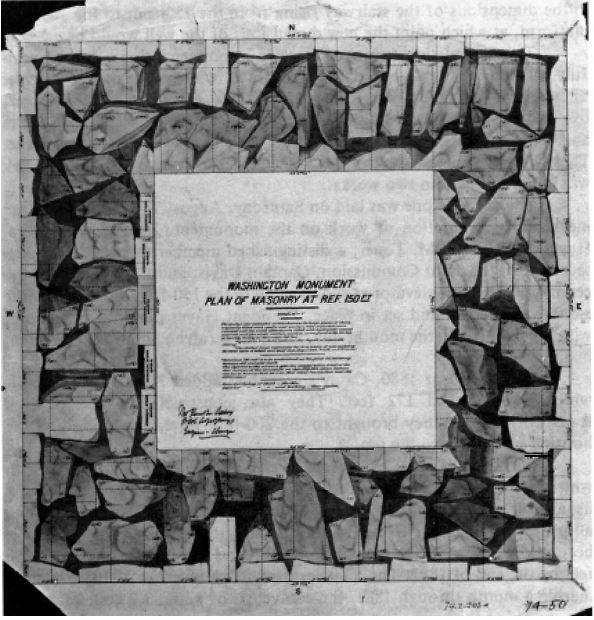
They were putting that first layer of bricks around an older monument that we see at the conclusion of the first phase of work. Before they went up, they had to build the base out. Pretty obvious really. In fact, that is part of the official story. From the National Park Service: History & Culture - Washington Monument (U.S. National Park Service)
"By a joint resolution passed on July 5, 1876, Congress assumed the duty of funding and building the Washington Monument. The U.S. Army Corps of Engineers, led by Lt. Col. Thomas Lincoln Casey, was responsible for directing and completing the work. Casey's first task was to strengthen the foundation of the monument, which he determined was inadequate for the structure as it was designed. For four years, the builders carefully beefed up the support at the base of the foundation to support the massive weight of the superstructure to come."
I feel this is a photo of the widening of the "stump," which was probably important to conceal what was inside; a 6 foot by 60 foot object from a prior civilization. Hence, the lack of urgency to finish the structure. If one were planning on building a 555 foot tall structure, logic tells us they would build a suitable foundation first. They wouldn't start with a skinny obelisk then build out. They'd start at the bottom with the needed dimensions at the base to support the entire height of the finished structure.
First cover it up, then figure out what to turn it into later.
24 foot lengths may be about as long as you can order now, but over a hundred years ago they used longer lumber. The type of framing required it. In fact, one of the reasons for coming up with platform framing, was that 30,40,50 foot lumber was getting harder and harder to come by in the early 1900s.