SH Archive Norumbega: Washington Monument and the Roman Empire

SH.org OP Username
KorbenDallas
SH.org OP Date
2018-11-16 10:07:43
SH.org Reaction Score
47
SH.org Reply Count
47
Note: This post was recovered from the Sh.org archive.
Username: ISeenItFirst
Date: 2018-12-19 09:54:31
Reaction Score: 2
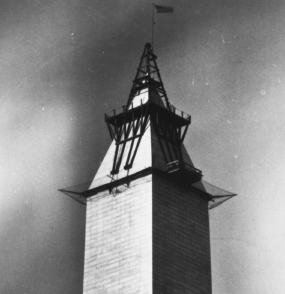
I dunno about any of this. Those photos look a little odd. I'd guess that they were enforcing the foundation, but tough to be sure. I doesn't look like the kind of scaffolding for heavy building. I could see it as being there to add or remove something from the top, it looks like a peak for a rope or pulley at the top. I see no steps, ladders or walkboards for actually doing any work on it.

24 foot lengths may be about as long as you can order now, but over a hundred years ago they used longer lumber. The type of framing required it. In fact, one of the reasons for coming up with platform framing, was that 30,40,50 foot lumber was getting harder and harder to come by in the early 1900s.
 
Note: This post was recovered from the Sh.org archive.
Username: ripvanwillie
Date: 2018-12-20 01:10:34
Reaction Score: 2
I suppose we shouldn't expect more than a cheesy copy from someone who has never designed or built anything before.
You're skeptical of my work, that's good. I like your take on the scaffolding. I may be old, but I wasn't around back then to see what lumber they used, and I've never researched that history.
I stand by my measurements. They are accurate. Maybe someone else should measure it to get a second look. Photoshop has a really good measuring tool. The math is easy.
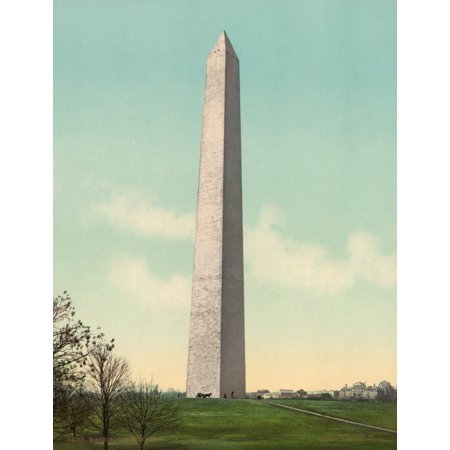
When one compares the scaffold image with an image of the finished first section, they appear about the same size. But when one looks at the objects in the field of view, it's easy to see that one is a photo of a significantly larger structure taken from further away.
The reference in the scaffolding picture is a horse drawn wagon, quite small. About the size of a car. In the second, we see houses adjacent to the monument, on both sides.


It's obvious to the naked eye. Compare the size of the wagon to the size of the house, then to the obelisk. How large would the wagon appear if it were parked next to the obelisk in the other image? And visa versa.
Since we know the size of the finished base to be 55 feet, it's easy to approximate the size of the houses.
The second image was clearly taken from a much further distance, hence the illusion of similar size.

On a side note, what the heck are those ramshackle houses on the left? They appear to be falling down. Only held up with 2X4's. Debris scattered all around them. Looks almost like a homeless camp.
 
Note: This post was recovered from the Sh.org archive.
Username: whitewave
Date: 2018-12-20 23:20:10
Reaction Score: 1
I think you hit the nail on the head.
 
Note: This post was recovered from the Sh.org archive.
Username: KorbenDallas
Date: 2019-01-11 17:45:12
Reaction Score: 1
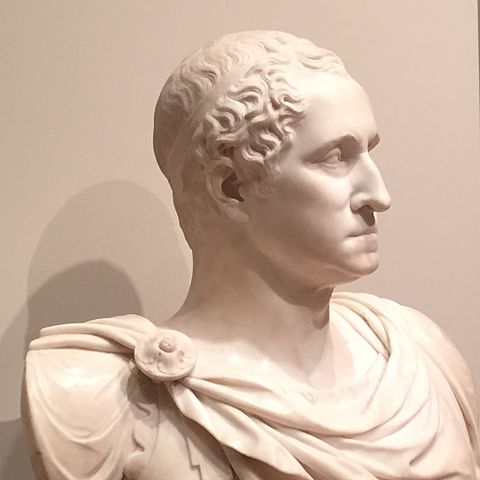
Here is another interesting depiction of George Washington. It was done in 1795.

George Washington is a marble bust portrait of George Washington, done in the style of a Roman emperor, by the Italian sculptor Giuseppe Ceracchi. It was created as part of a campaign by Ceracchi to build a larger monument to Washington. The bust was thought by many to be one of the most lifelike. It was later used as a model of Washington for works by other sculptors and engravers.
  • Ceracchi portrayed Washington in the style of a Roman emperor, with short wavy hair, wearing a toga, which is pinned by a rosette brooch.
  • The original work is inscribed on the back in Latin, "CERACCHI FACIEBAT PHILADELPHIAE, 1795" ("Ceracchi made this in Philadelphia, 1795").

Official story: In the spring of 1791, Ceracchi came to Philadelphia, then the seat of the United States government, in an attempt to get a commission from Congress for a "Monument designed to perpetuate the Memory of American Liberty" featuring an equestrian statue of Washington. While waiting for congressional action, he made bust portrait models of several of the founding fathers, such as John Jay, Thomas Jefferson, and Alexander Hamilton. Initially, Washington did not want to pose for the sculptor, but eventually did so in late 1791, early 1792. Ceracchi left for Europe in 1792, and then returned to Philadelphia in 1794. He then had Washington sit for him again to finish the bust from life in 1795.

And of course, it's the so-called "marble"...
 
Note: This post was recovered from the Sh.org archive.
Username: dreamtime
Date: 2019-01-12 11:06:13
Reaction Score: 2
Something similar can be seen with the statue of King Ludwig I in Walhalla memorial - Wikipedia

Supposedely addd in 1890, it doesn't look similar to the other images of Ludgwig that survived. I wonder if he really built the Walhalla and the Ruhmeshalle (Munich) - Wikipedia

Maybe until 1700 or so the leaders were still running around in such robes, and the post-reset leaders simply renamed the artefacts, buildings, statues, etc.
 
Note: This post was recovered from the Sh.org archive.
Username: KorbenDallas
Date: 2019-01-12 15:30:41
Reaction Score: 2
I share this opinion. Additionally it had to be pretty warm to run aroud in a bedsheet and sandals.

I do not see how else one can reasonably explain all these statues, as well as all of the sudden discoveries of the “ancient” statues in the 18-19th centuries.
 
Note: This post was recovered from the Sh.org archive.
Username: Deleted_x7
Date: 2019-01-19 22:21:47
Reaction Score: 3
some very interesting info about George Washington that may or may not fit in:

from George Washington's Vision & Pre-1800s Freemasonry

probably worth a read, just another sharp angle (perspective) to add into this mix. great thread KD!
 
Note: This post was recovered from the Sh.org archive.
Username: BStankman
Date: 2019-01-20 11:15:23
Reaction Score: 5
More images. It certainly looks like they were covering up something much older.


140512-washington-monument-base-11a_eaf8841df62ab5bd4cc7787a95c04a42.jpg 3a31280r.jpg 28308v.jpg

And did some treasure hunting.

digging-monument.jpg
 
Note: This post was recovered from the Sh.org archive.
Username: whitewave
Date: 2019-01-21 01:55:08
Reaction Score: 7
Found this tidbit today about Norumbega written (allegedly) in 1500's.

*In the American City Norumbega, live a People that speak the same Language, and observe the same Customs with the Mexicans.

In this by-Corner are found also some Alavards, or Longobards, or Lombards, as they say. Now the Spaniards call that New Mexico because last discover'd, though indeed the old, cramm'd with People eight hundred years since: for the Mexicans of New Mexico do not lie so far Northerly, as to the North-west: for this Mexico lies in sight of California, which is believ'd to border on Tartary, or at least separated from it by a narrow Channel. But Norumbega (if ever such a Place was) must, according to the West-Indian Records, have been situate where a part of New France lies, now planted by the English: between which and New Mexico lies an almost unmeasurable vast Tract of Land. Mean while here is not the least sign of this City Norumbega to be found: neither do the In∣habitants dwell in Cities, but live in Tents, or moveable Villages, which change their Names as oft as their Governors. Moreover, the Norwegians could not get to this Norumbega by Land through Ysland and Groenland to Estotiland, because of the vast Bays, and great Midland-Sea, discover'd by the English in their North-western Discoveries; so that leaving Estotiland, it was altogether impossible for them to come to Norumbega.
link
 
Note: This post was recovered from the Sh.org archive.
Username: whitewave
Date: 2019-01-21 08:34:34
Reaction Score: 6
NOrumbegua,* lying between Nova Scotia Northward, and New England Southward, is so utterly not taken notice of by many as a distinct Province, that it might seem to be swallow'd up and lost in the two Countreys between which it lies, or at least to be thought a part of Virginia or New England (for Virginia largely taken is said to contain New England, Novum Belgium, and Virginia, especially so call'd) and that so much the rather, because the Bessabees, accounted by Sanson d' Abbeville an ancient People of New England, are written to have liv'd near the River Penobscot, which is reckon'd to be the same with Pemtegovet, or (as some will have it) Norumbegua, from which, or from a certain great City of that Name, the Country for fancy's sake must needs be denominated; but since most commonly we find it nam'd and treated of apart, it will not be improper to follow that method, carrying the Bounds of New England no farther Northward than the River Quinnebequi or Sagadahoc, and so determining the main part of this Countrey to that space between the aforesaid River and Pemtegovet,excepting a small Southerly portion upon the Banks of the River Chovacovet; so that it appears chiefly situate under the forty third Degree of Northern Latitude.

*As for the Towns or Cities of this Province, there is but a very uncertain account to be given, forasmuch as the pretended great City Norumbegua, from whence the Province should take its Appellation, is not acknowledg'd by any of the most authentick modern Writers, nor in any late Voyage or Discovery any mention made either of that or any other considerable Town or City. Dr. Heylin supposeth it to be no other than Agguncia, a poor little Village, that seems compos'd of a company of Hutts or Sheaves, cover'd with the Skins of Beasts, or the Barks of Trees. But the most favourable conjecture is, that it might haply be the ruines of an ancient town, which the natives call'd Arambeck, and had probably deserted it long before the arrival of the Europeans in those parts; however, it is not very probable that the Name of the Countrey should be deriv'd from this City, if ever there were any such, or from the River, which appears to have been term'd No∣rumbegua on purpose to make way for this derivation, whereas Pomtegovet is the ancient appelation that properly belongs to it; nor hath any modern one been apply'd to it but that of Rio Grande, by Buno in his Comment upon Philip Cluverius, upon what ground is hard to tell, since it is observ'd by Heylin and others, to be neither large, nor otherwise much to be commended, being Navigable not above twenty or thirty Miles, in respect of its many great Cataracts and Falls of Water, an In∣convenience with which many other Rivers of America are prejudic'd, and rendred impassable.

Before and about the Mouth of this River, which is judg'd to be about eight or nine Miles broad, lie many small Islands, or rather Hills, inviron'd with Water, the chiefest of which is by the French call'd La Haute Isle, from the high and Mountainous appearance of it to those that see it from afar off at Sea.

The aforemention'd Buno, though he names, as belonging to Norumbega, these several places, viz. Porto del Refugio, Porto Reale, Paradiso, Flora, and Angolema, from some obscure French testimonies, without particularising any Author, yet he afterwards confesses, that the Names given by the French, and those apply'd by the Spa∣niards, are so various and disagreeing, and breed such a confusion, that no Charts or Descriptions had concluded upon either.

As for those who will have Norumbega deriv'd from Norwegia in respect of a Colony brought thither from Norwey, if the Etymologie be not a little too much forc'd, the Invention may pass well enough till a better be found out.

*In this Countrey the temperature of the Air is not bad, nor the Soil unfruitful, if it were well cultivated, chiefly towards the Rivers, and where it is not either overgrown with Woods, or craggy with Hills and mountainous Rocks: neither are the Woods unprofitable, for they afford good Timber, and all kind of necessary and useful Wood, especially Beeches, Fir-trees, Wallnut-trees, and other Nuts: The Plains are very pleasant, and yield good Pasturage, onely the Maritime Coasts are so shallow and full of Sands, that the Sailing near them is accounted somewhat dangerous; and this may be imagin'd to be the reason that no Authors have yet met with any Ports or Havens belonging to this Countrey, which they have thought worthy their notice. link
 
Note: This post was recovered from the Sh.org archive.
Username: ISeenItFirst
Date: 2019-02-13 20:11:19
Reaction Score: 1
If all goes as planned, I should have time to visit this monument in Boonesboro this week. I'll take a camera, if anyone has anything in particular they'd like to see, let me know.
 
Note: This post was recovered from the Sh.org archive.
Username: KorbenDallas
Date: 2019-02-13 20:21:24
Reaction Score: 1
If there is a photo gallery dedicated to the monument, could you please look for older photos not present in our collection here.

Thank you.
 
Note: This post was recovered from the Sh.org archive.
Username: ISeenItFirst
Date: 2019-02-13 20:25:45
Reaction Score: 2
Excellent Idea, I will pay special attention to any documentation or installation around dealing with the history. Not sure if this park has an office or anything, but I will check it out. Hope I will not be too pressed for time.

Got the cameras charged. Gonna go check it out. Gonna go pro my perspective and take pictures of anything interesting.

Well, guys, I'm there. Lots of odd stuff about this park.

Bad news. The trees are all iced over, and branches are falling left and right. It is a constant noise of cracking and crashing. Don't know if I'll be able to make it to the monument today or not.

Checked out the satellite view and there is nothing but woods between me and the monument. This really sucks. I really pushed to get to spend enough time here, and now I'm stuck in a parking lot with crashing trees all around and way too much time to kill.

The road to get me about halfway closer is closed.

Tried again, met with some park service guys. They were working on the downed trees and told me the entire monument area is closed. They were willing to let me go ahead, but they told me if something happened, I might not make it out, and they are not going even with helmets and protective gear. They said it is, seriously, very dangerous.

I'm inclined to believe them.

Mission FAIL.

Did get some pics and some video and even a pamphlet, and there is actually a museum here, but only opened a few months of the year.

Have to try again another day.

What struck me as odd about this park, is that it seems hidden. The road is listed as Washington Monument Road, but the signs just say Monument rd. There are park signs all over Maryland, but this large park was not listed on any of the signs I passed. There was no mention of it on signs that listed state parks much further away. There was one literally yards from where I turned on monument road and only more distant parks listed. Monument Road itself is a winding one lane road, and for large areas there is no where for oncoming traffic to pass at all.

The monument itself on the map is just an icon of Washington that looks very similar to the icon for hiking. It would not be hard to misss.

The whole area is terraced with dry laid stone walls. I mean for miles around the park. This isnt that odd, but it looked old and extensive. There are a lot of suspect structures around. Bridges, foundations, and even an old Church and Inn, which were supposed to have been built in the late 1800s, but I have my doubts.

So Good News Bad News time.

Good News is for you guys. My work in that area was cancelled for tonight, so I have to go back next week. Hopefully the weather will cooperate better, and Id like to check out the Dahlgren Chapel as well, If I can. There was a sign that said the Museum can be opened up out of season on request, so I may make a few phone calls tomorrow to see if I can get in there. I will also see if I can get by the Chapel to take some pictures.

Bad News is for me. My work in that area was cancelled for tonight, so I wasted my entire day today with nothing to show for it but an empty tank of gas.

There was an information sign and I took a bunch of pictures of it. It seemed to have more information on it that what we have found so far, but I wont have a chance to check the pics until tomorrow. I will likely just transcribe it. The pamphlet had the same information we already have.

Well, I made it back up there. I was so close last time it is ridiculous.

So, it looks like this thing was NOT built in 1827, but rather, it was built in J 827. Pics to follow.

My knockoff go pro crapped out, so no good video, even though I narrated my hike, lol.

Also, no museum until the summertime. I'll be back.
 
Note: This post was recovered from the Sh.org archive.
Username: Plissken
Date: 2019-03-20 11:53:35
Reaction Score: 11
WOW! Somehow I missed this post when I was lurking and reading Stolen History like crazy. I just wanted to add a few things about the Washington Monument I have found while researching for my Library of Congress series. The monument is still the tallest totally stone built structure in the world at 555 feet!

First some craziness about the grounds.

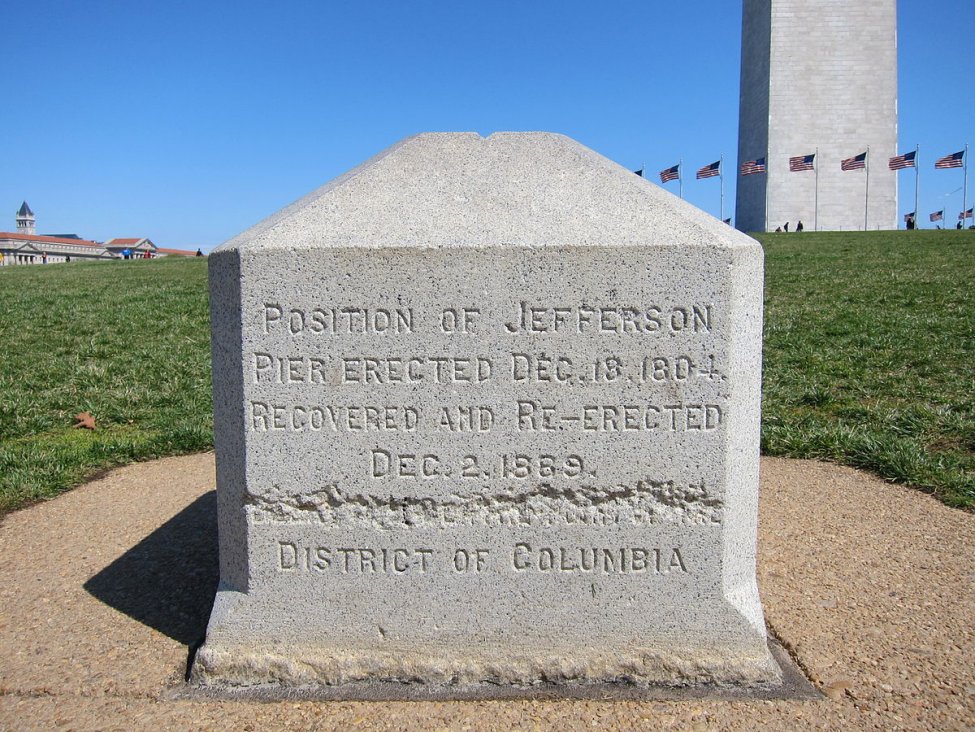
The Jefferson Pier
West side of Jefferson Pier with Washington Monument in background.jpg

POSITION OF JEFFERSON
PIER ERECTED DEC 18, 1804.
RECOVERED AND RE-ERECTED
DEC 2, 1889.
[fifth line chiseled out]
DISTRICT OF COLUMBIA

The chiseled-out fifth line reportedly once incorrectly stated: "BEING THE CENTRE POINT OF THE" It was lost the first time around 1872-1874 by the Army Corps of Engineers. Other sources say that the chiseled out line represents the Potomac river level.

In 1804, Jefferson requested a survey of a meridian through the President's house while living in the house when serving as the President of the United States. It is not known why Jefferson requested a survey of a new meridian after he had previously directed a survey of a different one while serving as Secretary of State eleven years earlier.

In accordance with Jefferson's request, Isaac Briggs used a transit and equal altitude instrument (see Theodolite) to survey a new meridian line extending south from the center of the President's House that intersected a line extending due west from the planned center of the Capitol building. On October 15, 1804, Nicholas King, Surveyor of the City of Washington, erected at the intersection "a small pier, covered by a flat free stone, on which the lines are drawn." This established the Washington Meridian (sometimes termed the "16th Street Meridian"), now at a longitude 77°2'11.56" (NAD 83) west of the Royal Observatory, Greenwich. The pier and stone were located at the point that L'Enfant's plan had identified as being the future site of George Washington's equestrian statue. A pier is a massive pillar capable of supporting a great weight. Most of the length of a surveying pier is buried vertically in the ground for stability. Free stone is fine grained stone soft enough to carve with a chisel, yet has no tendency to split in any preferential direction.
Due to errors either when the Jefferson Pier was initially surveyed or when it was replaced, its center is now 2.23 ft (0.680 m) south of the Capitol's centerline.

The 1804 stone marker replaced one of two wooden posts driven into the ground in 1793 at its site. The marker was originally located on the south bank of Tiber Creek, near the creek's confluence with the Potomac River. The area of the present National Mall west of the marker was under water until an engineering project that Peter Conover Hains directed from 1882 to 1891 created West Potomac Park. East of the marker, Tiber Creek was transformed into the Washington City Canal.

The stone marks the intersection of the latitude of the Capitol with the longitude of the White House. That intersection is marked on the top of the stone. It is three hundred feet from the Washington Monument, meaning that the L'Enfant plan does not match the actual lay out. Why? Maybe the Washington Monument was there before L'Enfant planned the city.


Sketches of the original


Bench Mark A: 12 feet tall x 3 feet wide at base - made of concrete.

“All the surveys we’ve done, going back to the early 1900s, have used it,” says Smith. Most recently, it was used in the aftermath of the 2011 Washington earthquake. Measurements over the past century have shown that the Washington Monument has sunk 6.2 cm into the marshy soil below, at an average rate of 0.5 mm per year.

The mini monument was placed in the 1880s as a part of a trans-continental leveling program!!!!!. The ground level here was much lower at that time, with large parts of the Washington Monument foundation still visible above ground (see fourth image above). The mini monument was above ground for a time, before being encased in a brick chimney and buried. Outside of surveying circles, it’s been largely forgotten.


cross section of mini monument.JPG geodetic survey.JPG Mini monument.JPG Capture2.JPG
Does this look like it was made of concrete? Mini Monument

???

Symbolism of placement
Capture.JPG


The Monument sits on a pedestal that is a in the center of a Circumspunct - the dot represents the sun or god and the circles around the dot the universe we live or the limit to which the sun illuminates. In the center of a Vesica Piscis, which also has a ton of meanings. Another obelisk that is on a circumpunct in a vesica picis:

vatican.jpg
The Vatican


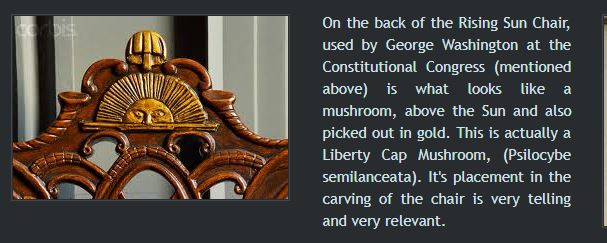
I found a website that talks about the Shadows of the Monument. It has a bunch of things in regards to the information I am posting. If you only check one link, make it this one. Here is something else from the site:

mushroom chair.JPG

LIBERTY CAP MUSHROOMS i.e. MAGIC MUSHROOMS!!!
The sun and the psychedelic musHroom = A VERY ILLUMINATED GEORGE :LOL:

???

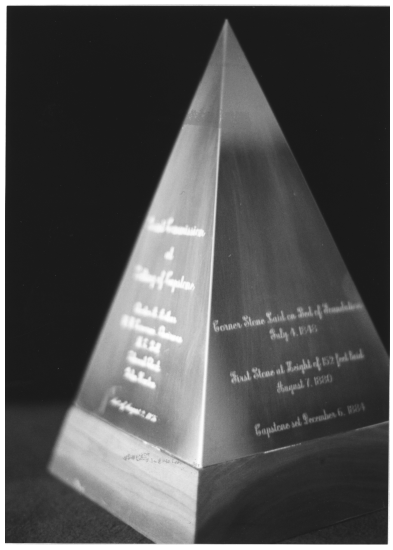
The Aluminum Capstone

In addition to KD's information: The overall lightning protection system had seemed quite adequate when designed in 1880. It consists of four hollow wrought-iron columns that stand in the well of the shaft. These act as supports for the elevator machinery and serve as a guide to the car. These columns are 15 cm in exterior diameter and slightly more than 1 cm thickness. The columns rest upon cast-iron shoes that are set in the large drum pit below the monument floor. The cast-iron shoes are connected to soft copper rods that, in turn, lead to the bottom of a water well below the masonry foundation. No disruptive discharge of electricity was experienced between 1880 and 1884.

Then it didn't. They made modifications and it started getting struck more.


So they added the collar with spikes to attract the lightening

Spiked collar.JPG


Here is the melting
Melted pyramidion.JPG

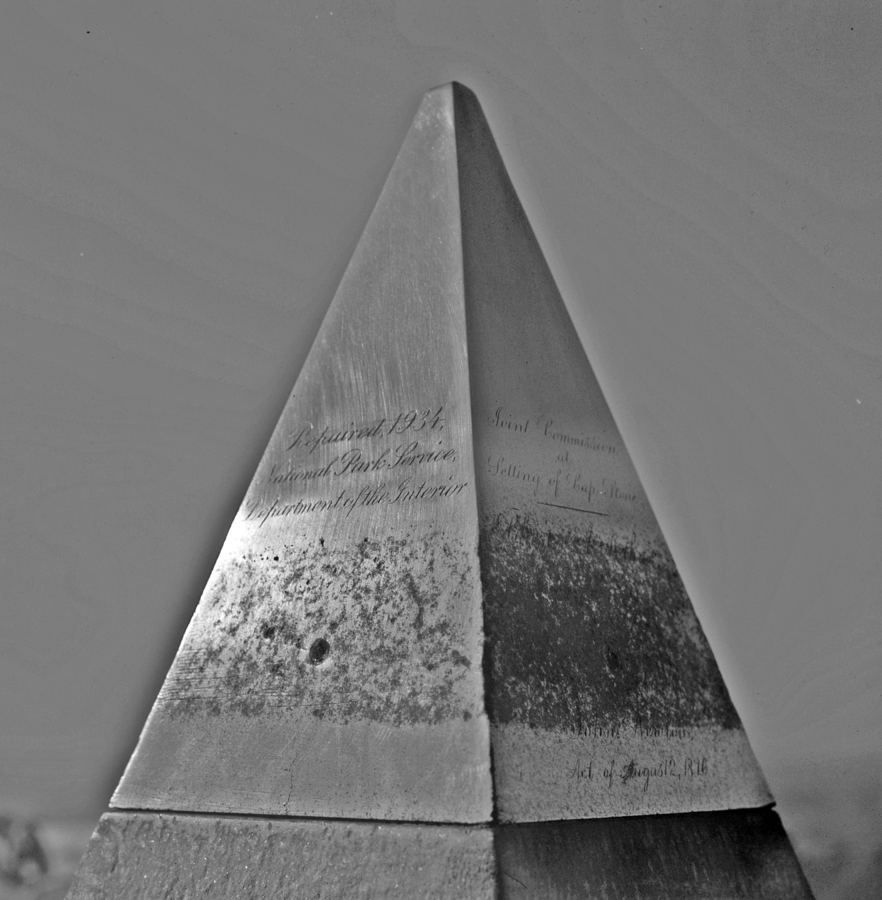
And the damage from the spike lightening rod collar made with copper bars, which has rubbed out some of the engravings. Interestingly, the engravings were done on site (Way easier than in the shop) and as you can see, the collar has worn off some of the engravings.

Replica
Replica.gif

Damaged Capstone
882px-Aluminum_apex_Repaired_1934.png


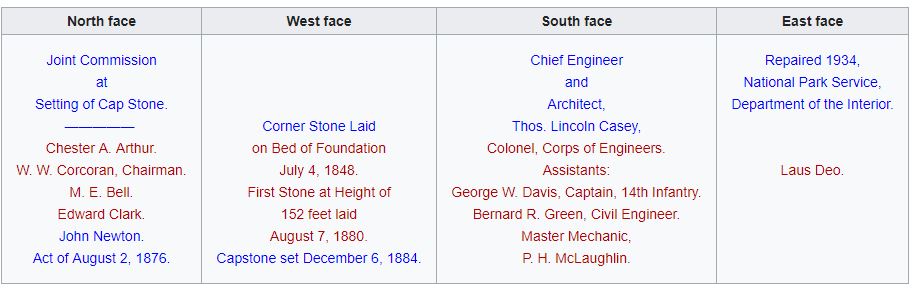
In the blue, what is still legible. In the red, their guess at what it says.

Capstone inscriptions Per Wiki.JPG
Laus Deos.JPG

Article on Aluminum Tip
Aluminum Cap
Monument and Lightening

???

EARTHQUAKE
How the monument looked with scaffolding in 2011 while fixing earthquake damage. It looks nothing like the scaffolding in the OP image. Also, notice how the majority of the damage is above the 125 feet of the stump. Some people say it is leaning after the earthquake.


Maybe it's because of this engineering marvel!

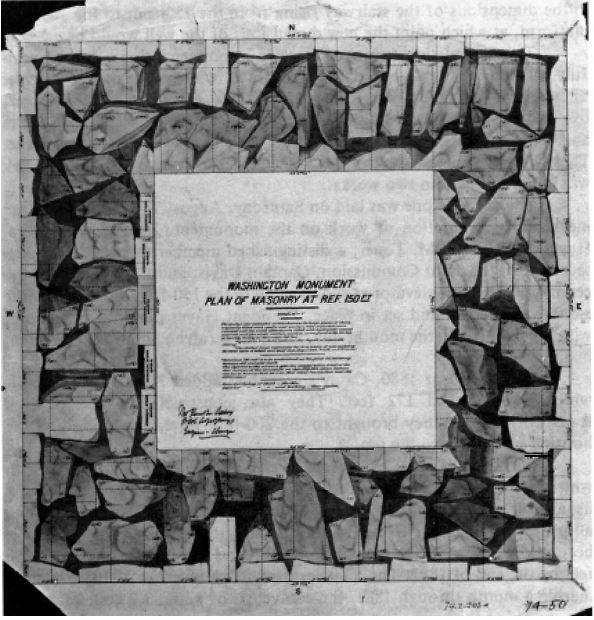
Cross section of rubble in shaft at 150 feet and typical of rubble below 150 feet.jpg
Or maybe because there is a building with in a building and not this loose rubble in the stump. Who knows for sure.

Earth Quake Article

???

Diagrams

Washington-Monument-1885.png Washington_Monument_foundation.png


???

The Memorial Stones
According to the National Park Service’s Mike Litterst, the steps of the Washington Monument were closed for walking up in 1971, and then closed altogether — up and down — in 1976.

There were occasional exceptions, such as special ranger-led tours that took visitors past the 190 carved memorial stones inside the shaft. (Those tours stopped after the 2011 earthquake; the Park Service is hoping they may eventually resume.)

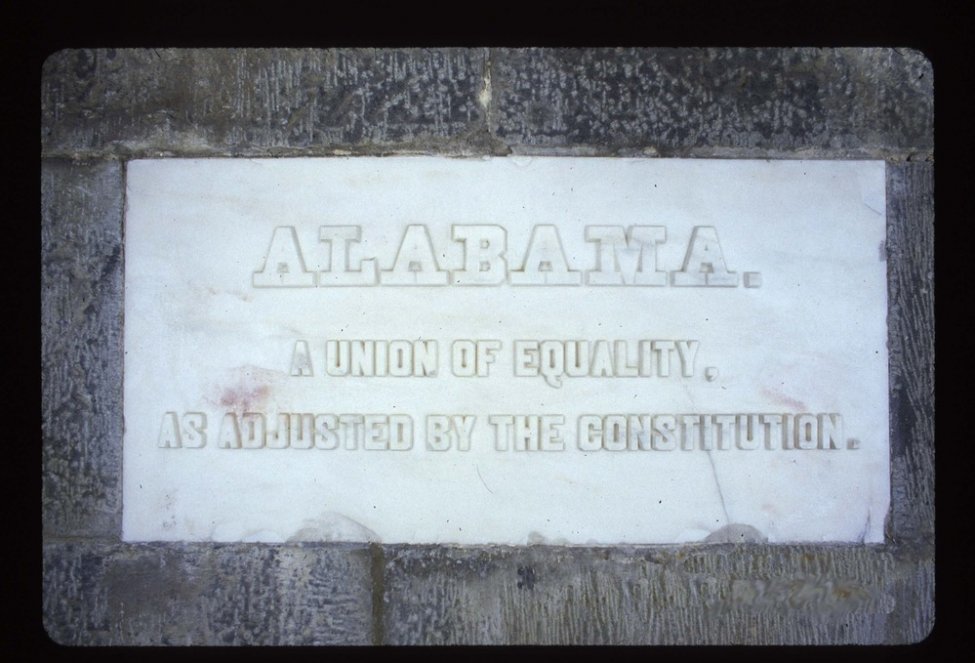
So you can't see them in person. I had to look hard to find the links below with images. Way more than this number were actually sent but they are lost. Some where found buried in the ground. And Alabama was the one that donated the first one. Then other states, countries, cities, societies and even some Native American tribes donated stones.

alabama adjusted.jpg


Journeymen of Stonecutters -- Looks like they are trying to reassemble. Why are there columns in ruin?

Association of Journeymen Stonecutters.jpg

And this one from the Oddfellows Grand Lodge of the United States:

216E77B4-1DD8-B71C-079DCA003EBDF773Original.jpg

The words: We command you to visit the sick, relieve the distressed, bury the dead, and educate the orphan. WHAT CATASTROPHE HAPPENED THAT THIS NEEDS TO BE POINTED OUT.

Buffalo school kids sent this one: The woman with the crazy head gear ?whipping? the kids and what is with that mountain behind them?

Public Schools Baltimore.jpg

Others I found interesting:


Memorial Stone Photos
Memorial Stones PDF
Alabama stone also the Know Nothings
No Stairs for You

Sorry if this went on forever. KD feel free to move if you think this is too long or off topic(y)

Plissken ?
 
Note: This post was recovered from the Sh.org archive.
Username: whitewave
Date: 2019-03-20 14:43:37
Reaction Score: 6
Googling for info for the alternate names of Norumbega mentioned in my earlier post, I found this reference. It's over 800 pages of download but the Norumbega info is on page 138. Also, I noticed a couple of the pages had been copied with a paper covering the text. Now why is that, I wonder?

This link also gives some of the earliest names of Norumbega by the French, the natives, and others as well as alternate names for the rivers that might yield more in your searches rather than just searching for "Norumbega". It's hard enough finding what little info there is on these old references to early America but when they change the names or it's called different names by different groups, searching becomes fruitless so having the alternate names, I thought, was a big help.

On about p. 265 of the second link it talks about the dispute between the Dutch and English over title to the new lands and the Dutch lost for some reason.

Both are interesting reads if you have the time.
 
Note: This post was recovered from the Sh.org archive.
Username: jd755
Date: 2019-05-21 09:52:56
Reaction Score: 2
From the undated (but the text seems to place it in the 1930's) book produced for Odhams called Wonders of the World

The Washington Monument is the greatest memorial shaft of the world. It is five hundred and fifty-five feet high and was thirty-seven years in building. The lower portion of the monument is built of New England granite, faced with crystal marble; the upper part of pure white marble.
The shaft was begun in 1848 it was finished in the year of the Nation's Centennial.
The keystone that binds the interior ribs of stone that support the marble facing of the pyramidal cap of the monument weighs nearly five tons. It is four feet six inches high and three feet six inches square at the top. The capstone, which is five feet two and a half inches in height and about three feet square at its base, was laid December 6, 1884. Its summit was crowned with a tip or point of aluminium, which never oxidises and is always bright.


A few things from that. What machinery today can lift a shaped five ton stone over five hundred feet into the air?
Why is the weight of the keystone mentioned but not the capstone sitting on top of it?
Why the precise, down to the half inch measurement for the height of the capstone and a guesstimate for the base?
A tale from the bullshit department it seems, to me.

Here is the colorised version of the image in the book. Checkout the size of the horse for scaling purposes.
bookimage.jpeg
 
Note: This post was recovered from the Sh.org archive.
Username: ISeenItFirst
Date: 2019-05-21 11:03:45
Reaction Score: 3
I'm more interested how they got aluminum that "never oxidizes." Aluminum always gets oxidized.

Let me also add that regular aluminum production wasn't really a thing in 1884. It was that very decade that industrial production of aluminum on anything approaching a usable scale occurred.
 
Note: This post was recovered from the Sh.org archive.
Username: jd755
Date: 2019-05-21 15:06:59
Reaction Score: 1
The Age of Aluminum: ALCOA | Pennsylvania Center for the Book

Sounds legit, not really!

In the early 1800s, scientists were finally able to prove its existence and produce a few droplets of pure metal, but even so, pure aluminum was more valuable than even gold or platinum. Applications of aluminum were limited to jewelry and other such luxury items: bars of aluminum were exhibited alongside the French crown jewels, and Emperor Napoleon III was said to have reserved aluminum dining sets for his most honored guests. In 1884, aluminum was used to cap the Washington Monument – at the time, the 100-ounce capstone was the single largest piece of cast aluminum ever created. It was not until the year 1886, when the first high-volume, low-cost smelting process for aluminum was discovered, that Alcoa and the age of aluminum was born.

And then there is all this.
A History of the Aluminum Cap of the Washington Monument
"On the 8th of June 1885, during a thunderstorm, a disruptive discharge was seen to pass between the summit of the pyramidion and the cloud. Upon examining the structure, a crack was discovered in the north face of the pyramidion just under the top stone. A small piece was forced outward 3/4 of an inch. It was forced back into place and bolted to the solid stone from which it had been torn."

Question is how did they see it and how could they repair it if it was on the outer face?
Oh how silly of me the scaffolding was still up.

In a sense it was fortuitous that the construction platform (Figure 3) on the pyramidion was still in place during the middle of 1885, having been left there to complete some finishing touches. It provided a means of assessing the lightning strike damage and also a scaffolding to install the additional lightning arrester hardware.

scaffolding.gif
 
Note: This post was recovered from the Sh.org archive.
Username: SonofaBush
Date: 2019-06-12 22:19:24
Reaction Score: 1
Ogilby, John, 1600-1676., Montanus, Arnoldus, 1625?-1683

Only date I found skimming quickly through the text was 1598.

Even according to Wakiliar, California meant Baja California Peninsula, so modern day California and even places like modern-day Nevada, and Utah, and parts of Arizona, New Mexico, Texas, Wyoming, and God knows what else could have been part of Tartary back then.
 
Tips
Tips
Please respect our Posting Rules.
Back
Top