SH Archive Obelisks of Axum: cargo cult or mockup city skyscrapers?

SH.org OP Username
KorbenDallas
SH.org OP Date
2020-06-24 14:57:47
SH.org Reaction Score
16
SH.org Reply Count
33

KD Archive

Not actually KorbenDallas
Active Member
Joined
Sep 22, 2020
Messages
4,691
Reaction score
1,500
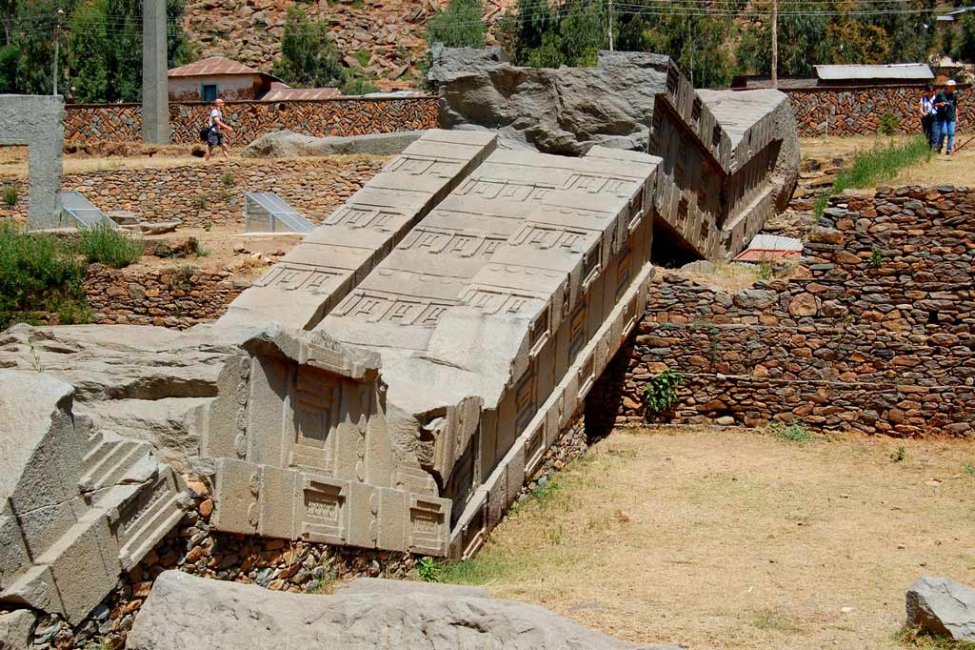
Per the PTB: The Obelisk of Axum is a 4th-century AD, 24-metre-tall (79-feet) obelisk, weighing 160 tonnes, in the city of Axum in Ethiopia. The obelisk ends in a semi-circular top part, which used to be enclosed by metal frames.
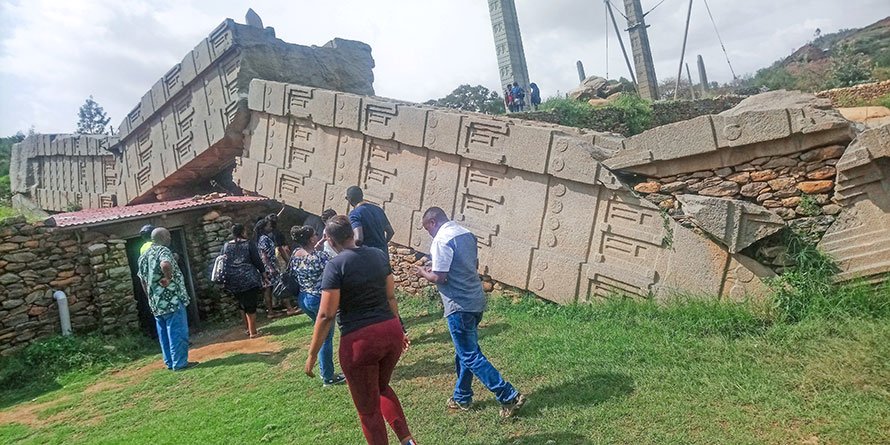
The Obelisk of Axum is intricately carved to represent a nine-story Axumite building. At the base are two false doors, carved to look like the wooden entryways into an Axumite home. The detail on these doors is incredible, even to the point of false locks being carved into them. The architectural illusion continues as we work up the monolith. Each 'story' of the building appears to have a frame, structural supports, and windows, all of which are only carved outlines. At the top is a rounded peak that once was enclosed in a metal frame. It was likely used to hold some sort of symbolic image or icon. Overall, this impressive structure gives the impression of a massive building, giving us a strong idea about what the architecture of Axum would have looked like.
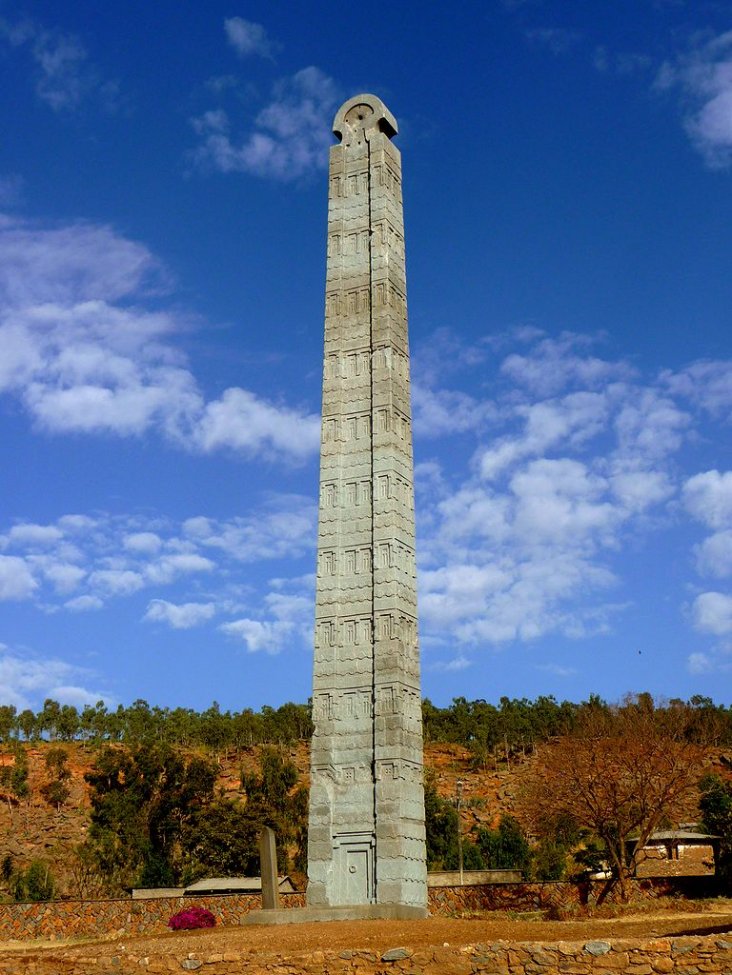
FA4C9DC1-5F9C-4A64-B2EC-98745F40DFF3.jpeg
The stelae were probably carved and erected during the 4th century CE by subjects of the Kingdom of Aksum, an ancient Ethiopian civilization.
  • Erection of stelae in Axum was a very old practice probably borrowed from the Kushitic kingdom of Meroe.
  • Their function is supposed to be that of "markers" for underground burial chambers.
  • The largest of the grave markers were for royal burial chambers and were decorated with multi-story false windows and false doors, while lesser nobility would have smaller, less decorated ones.
  • The last stele erected in Axum was probably the so-called King Ezana's Stele, in the 4th century CE.
Check this stuff out: At the end of 1935, following the Italian occupation, Italian soldiers found King Ezana's obelisk of Axum still standing. In 1937, it was taken as war booty and moved to Italy. The monolith stele was cut into five pieces and transported by truck along the tortuous route between Axum and the port of Massawa, taking five trips over a period of two months. It arrived via ship in Naples (on a ship called Adwa), on March 27, 1937. It was then transported to Rome, where it was reassembled and erected on Porta Capena square in front of the Ministry for Italian Africa and the Circus Maximus. It was officially unveiled on October 28, 1937 to commemorate the fifteenth anniversary of the March on Rome.

In a 1947 UN agreement, Italy agreed to return the stele to Ethiopia. Little action was taken to return the stele for more than 50 years, partly as a consequence of the considerable technical difficulties related to its transportation.

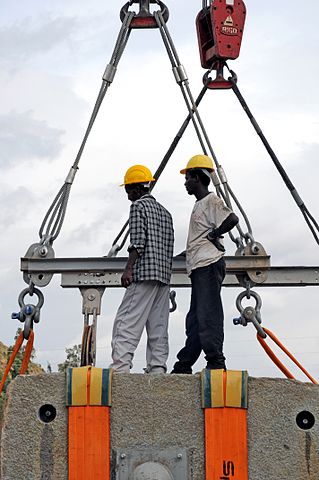
The first steps in dismantling the structure (in Italy) were taken in November 2003. The intent was to ship the stele back to Ethiopia in March 2004, but the repatriation project encountered a series of obstacles:
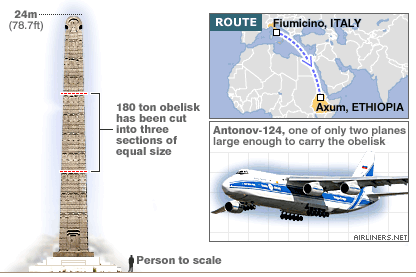
  • The runway at Axum Airport was considered too short for a cargo plane carrying even one of the thirds into which the stele had been cut.
  • The roads and bridges between Addis Ababa and Axum were thought to be not up to the task of road transport.
  • The access through the nearby Eritrean port of Massawa - which was how the stele originally left Africa - was impossible due to the strained state of relations between Eritrea and Ethiopia.
  • The runway at Axum airport was then upgraded specially to facilitate the return of the stele.
  • It was the largest and heaviest piece of air freight ever carried.​
B14584B9-C6B4-4ADC-9F50-83D9815BFD0F.gif
  • All pieces were transported back to Ethiopia in 2005.
  • By March 2007 the foundation had been poured for the re-erection of the stele near King Ezana's Stele, structurally consolidated in this occasion.
  • Reassembly began in June 2008, and the monument was re-erected in its original home and unveiled on 4 September 2008.
87DA3E76-D5E7-49F5-94F9-C0FF84AA2FFE.jpeg
3ECEE457-B1F2-40AB-A571-69247823AFB4.jpeg0AB24481-EE66-4E09-B788-C5B31BC12FB2.jpegE6799664-542A-444F-B465-65AA506FB436.jpeg13B2DA76-C292-4BA8-A625-E8A2450D1B15.jpeg
These transportation difficulties are not the main purpose of this thread, but I simply could not help it. So, how did those who barely progressed from a loincloth were able to make, transport and install these?
  • How did they even get this thing to Italy in 1937, and why to go through all the difficulties related to moving this monster?


KD: Here we have a few close ups to consider.

C3791624-B1A4-4CAD-9823-A13EAA9A51EF.jpeg2C7ADCEA-4335-4568-9F43-66364A50B431.jpeg50D0D81A-5E41-428C-A4C4-0F70FADACE8B.jpegBDD674FF-D62A-4CF6-AE23-379ED13BD17E.jpeg
I only have two versions of what these were made for. I do not believe in either one of my own versions, but what else could it be?
  • 1. We are witnessing some cargo cult products.
  • 2. These “obelisks” (and there are quite a few left) served as skyscraper models for some humongous city mockups.
And looking at the below image, I’m not even sure what these were made of.

DEE85D9D-0F9D-4AFF-9CD4-686B6E51EE50.jpeg

Wondering if the stuff is somehow related to what you can see in the video below.


You gotta love our pseudo-historians. They feed us this “obelisk” BS instead of saying:
  • We have no clue why Ethiopians were building nine story, 80 foot tall high rise building models 1,600 years ago in the 4th century AD.
Any opinions on all of this non-sense?
Note: This OP was recovered from the Sh.org archive.
Note: Archived Sh.org replies to this OP are included in this thread.
 
Note: This post was recovered from the Sh.org archive.
Username: Cemen
Date: 2020-06-24 19:40:29
Reaction Score: 7
Photos from a different angle. The voids were simply laid stone.

stely_aksuma_5.jpg

As for the versions, I am of the opinion that these are the remains of megaliths from some previous civilization.
 
Note: This post was recovered from the Sh.org archive.
Username: KorbenDallas
Date: 2020-06-24 19:52:08
Reaction Score: 5
I threw this together on my phone. It was hard to figure out on a smaller screen.
By the PTB definition:
  • A megalith is a large pre-historic stone that has been used to construct a structure or monument, either alone or together with other stones.
  • Megalith - Wikipedia
Giving these things a contemporary name meaning “a huge stone,” does not really explain what these “obelisks” are.

If these are monuments, then they were erected to commemorate what?

If these are not monuments, then what are they?

If this author below new what was depicted on this obelisk, he would have chosen a different explanation. Unless misleading and covering up was his goal, of course.

 
Note: This post was recovered from the Sh.org archive.
Username: Cemen
Date: 2020-06-24 22:15:24
Reaction Score: 5
The obelisk, in general, is also a large stone, and it can quite be attributed to megaliths, but that is not the point. I do not believe in primitive civilizations that built such structures with the help of historians so loved by copper saws and bronze chisels.

And what is it, for what purpose did it serve, who built it, we can only guess. This could be a beacon, a nautical sign. mast for any equipment, yes anything.

Electrical substation for example. :rolleyes:

9fb45d12c85a37b005fb19f3ae6ec081.jpg
 
Note: This post was recovered from the Sh.org archive.
Username: RTP now
Date: 2020-06-25 01:28:07
Reaction Score: 7
Ethiopia/Abyssinia is a place with lots of secrets and ties to the British monarchy. I came across a photo sometime ago of the current queen kneeling and kissing the feet of emperor Haile Selassie [Haile Selassie - Wikipedia, la enciclopedia libre]. There was also some recent political uproar between the two countries over the return of locks of hair held by the British of Emperor Tewodros II.

I have a feeling that Ethiopia are among the few countries whose monarchy somehow made it through to the modern era and they do indeed possess some deeper knowledge about the past. They made a deal with the devil (Britain) to avert the Italian invasion and part of the deal may be that they would collaborate in withholding deep knowledge and or tech from the past.

I’ll try to locate some of the photos if I have time.
With regard your question, it’s possible that the obelisk was never moved from Ethiopia to begin with but was already in Italy and “returning” it to Ethiopia is part of a ritual. If it was in fact moved, how the hell did they do it in 1937 and struggle to do it in our more advanced times?
 
Note: This post was recovered from the Sh.org archive.
Username: whitewave
Date: 2020-06-25 02:16:00
Reaction Score: 7
If you look at the lower left part of cemen's picture you can see what looks to be concrete rather than quarried stone. Would make more sense for it to be concrete since I imagine carving that semi circle on the top would have been a bother using stone. Pouring concrete in a mold would be easier.

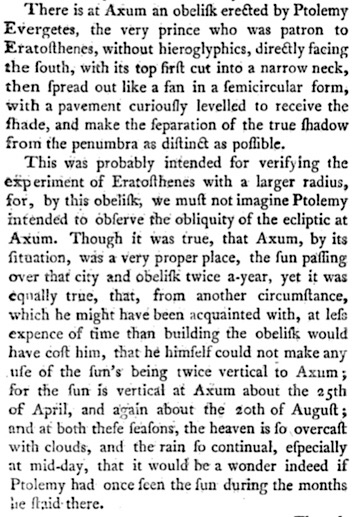
As far as it's intended use, the author of the article kd posted suggests it (or something like it) "could" have been used for astronomical purposes. The author doesn't seem to think Ptolemy DID use it for that purpose only that it might have been possible.
If similar obelisks were once used for stargazing or some other astronomical research, the author could feel comfortable suggesting such a possible use. Otherwise his readers would think him mad when "everyone knows" what obelisks are for. (We don't, but the people of the times surely would have).
 
Note: This post was recovered from the Sh.org archive.
Username: JWW427
Date: 2020-06-25 12:46:28
Reaction Score: 7
Like Napoleon's invasion of Egypt for antiquity treasures, Mousso did the same in 1935 in Ethiopia.
I think these invasions are partly about finding treasures of the deep past. Perhaps the subtle "energetic" properties of obelisks when
placed in city squares and the like are what's valuable. In that, I mean Earth grid Ley Line power, subtle energies known only to the elite secret society few.

A clue: In Tibet, the 8-sided star towers, just like the "power tower" Viking towers in Ireland, are said to increase crop yields.
When this Ethiopian obelisk was cut up, it may have lost some of its cohesive crystalline matrix, thus reducing its piezoelectric effectiveness.
Who knows what other functions it may have had? Astronomy and cosmology purposes a given in my book.
Multipurpose, geomantic, and harmonious technology.

Tibet tower:

Tibet tower.jpeg
 
Note: This post was recovered from the Sh.org archive.
Username: ThreeSocks
Date: 2020-06-25 13:11:51
Reaction Score: 2
Unless these people had tech we can't even imagine, some form of concrete is what I lean towards thinking. I'm on board with the mudfossil theory that WISE UP speaks of, like the churches, but I'm not sure most mudfossils could stand being chopped up and moved. The mainstream theory is that primitive people moved this as a solid object, but smart ol us can barely chop it into 5 pieces and move it. Once again, the only sure thing is that the penguins explanation can be ruled out.
 
Note: This post was recovered from the Sh.org archive.
Username: KorbenDallas
Date: 2020-06-25 13:31:19
Reaction Score: 2
May be it’s a stylized tech a la tree looking cell towers we have today, or whatever else. All I see is a strong resemblance to this. And for something allegedly being 1600-1700 years old, we have no real explanation for this resemblance.

EA836770-9752-4A06-9E34-B0F162FB97E3.jpeg
 
Note: This post was recovered from the Sh.org archive.
Username: Red Bird
Date: 2020-06-25 13:55:56
Reaction Score: 2
My first thought was this was a model for giants who built the megaliths and buildings.
However it could involve tech for sure.
This may not be as far fetched as it sounds as my Current thoughts say everything points to this ongoing architecture weirdness as being occultic involving building certain things, destroying them, and rebuilding. Along the lines of Order Out Of Chaos. Mystery Religions from at least Babylon to now. We are in the destroying phase, right now, it seems.
Any tech would seem magical, too.

See recent Babylon thread.
 
Note: This post was recovered from the Sh.org archive.
Username: WeeWarrior
Date: 2020-06-25 14:18:50
Reaction Score: 8
Thanks for the thread, KD! I've been puzzling over this scenario for years and had even started a blog about it in 2008 but never published because I couldn't quite decide what was going on with this stone being moved around in the first place! Looking forward to seeing what ideas the bright folks on this forum will have about this strange scenario.

I've gone back to my draft of the blog and pulled out some of the quotes I had collected regarding the project that I thought might add to the tableau. For some reason I haven't been able to post pics since the new code was installed, but I'll get over to the appropriate thread and get that figured out.

So...what caught my attention immediately about this fiasco was the date for the installation: September 11
The Ethiopian authorities plan to mark the end of their Ethiopian calendar year 2000 celebrations, held on 11 September 2008, by inaugurating the standing obelisk.

Just for fun, I checked for any suspicious events in Rome on that date that might serve as a cover for a ritualistic event related to this stone. What I found was the European Association for the Study of Diabetes meeting from Sept. 9-11 in the Masei Capitolin event center space called the Conservator's Apartment. Of course, it is a beautifully preserved Old World complex.

The Conservators' Apartment contains the original architectural nucleus of the building, decorated with splendid frescoes portraying the history of Rome. The ancient Capitoline bronzes on display here add to the noble atmosphere: the Capitoline She-wolf, Spinario and the Capitoline Brutus.

Naturally, this whole thing wouldn't be possible without the deep pockets of the crew at UNESCO, those sanctioned land grabbers who scoop up all these fascinating sites and put strict controls over who can see what.

The total budget for the project is USD$2,833,985, funded by the Italian Government who also financed the transportation of the obelisk and the related studies undertaken by UNESCO in collaboration with the Ethiopian authorities and experts. Lattanzi has begun mobilizing its staff and equipment, and shall start the works as of mid July. The works will take place in two segments throughout a period of 18 months. During the first segment, a foundation for the obelisk will be built as well as a temporary steel tower for lifting the separate parts of the obelisk. In the second phase, the steel structure will be put in place and the obelisk lifted and placed in position. Finally, the surface of the obelisk will be cleaned and restored, and the steel support structure dismantled and removed.

However, UNESCO is not too worried about excavating and studying all the underlying crypts that were buried under the parking lot.

"Geo-radar and electrotomographic prospection, the most advanced technologies for underground observation, revealed the existence of several vast funerary chambers under the site's parking ground which was built in 1963," it said.


Also ran across articles pushing the emotional aspect of this escapade from the Italian perspective.

The Italians were run out of Ethiopia at the end of World War II, but Rome still has the stele, which stands in the Piazza di Porta Capena, in front of a United Nations building that used to house Mussolini's Africa headquarters.

In the latest flare-up of the saga, Vittorio Sgarbi, Italy's deputy minister for cultural heritages, announced recently that he would resign if the obelisk were returned.

In remarks that prompted rage in Aksum, and in Ethiopia's capital, Addis Ababa, Mr. Sgarbi said last month that "Italy cannot give its consent for a monument well kept and restored to be taken to a war zone, and leave it there with the risk of having it destroyed." He was referring to the border war between Ethiopia and Eritrea, which for some years has given the Italians pause. Askum lies in Ethiopia's northern highlands, near Eritrea.

Mr. Sgarbi suggested instead that Italy send engineers to Ethiopia to repair some of Aksum's fallen obelisks.

The Ethiopians scoff at the notion that they cannot keep the obelisk safe. True, the biggest obelisk of them all did collapse long ago when it was being built. The obelisk now in Rome had also probably fallen over before the Italian soldiers arrived. But the people of Aksum say the obelisk is a treasure to them and ought to be returned.

Our border disputes are none of their business," said Fisseha Zibelo, the culture minister of Aksum. "We have been guarding the stelae for the last 3,000 years. We know how to take care of them. It's safe.


But for some reason the Italians gave in and Ethiopia got their stelea back at great expense and with an apology! Interesting that all this happened within one lifetime.

AKSUM, Ethiopia, Jan. 16 - Only a few old-timers, men with long beards and women hunched over low from a lifetime of toiling, remember the day that the Fascists trucked a giant granite obelisk away from Aksum.

Abebe Aemayehu was a boy of 12 in 1937, and he cannot forget the despair of the townspeople as Italian soldiers struggled to move the 200- ton monument. The first truck could not handle the load. A larger one was brought in. Mussolini's men, frustrated by the task, shooed away onlookers.

It was only some children who got a good glimpse as the obelisk, a revered symbol among Ethiopians that is more than 1,000 years old, began its long journey to Rome.

"I'll never forget that day," said Mr. Aemayehu, now a gray and wrinkled man of 76. "It will always be written in my heart."
Centuries ago, Aksum was the center of an ancient Ethiopian empire that extended across the Horn of Africa and beyond. Historians consider the empire among the greatest states of the ancient world, and Aksum was a center of trade, in ivory, animal skins and grain.

Though run-down and destitute today, the town is considered a holy place by Ethiopians because of its leading role in the growth of Coptic Christianity. And some reminders of Aksum's glory days still stand in the center of town - churches, palaces and intricately carved obelisks marking the site of holy burial grounds.

But where one majestic 78-feet- high obelisk once stood near the town center there is now only a deep depression
 
Note: This post was recovered from the Sh.org archive.
Username: Onijunbei
Date: 2020-07-04 17:52:01
Reaction Score: 1
their giant penises, commemorating giant penises, Phalic, Fertile, Egyptian type stuff
 
Note: This post was recovered from the Sh.org archive.
Username: Hipophoralcu
Date: 2020-07-04 18:24:22
Reaction Score: 3
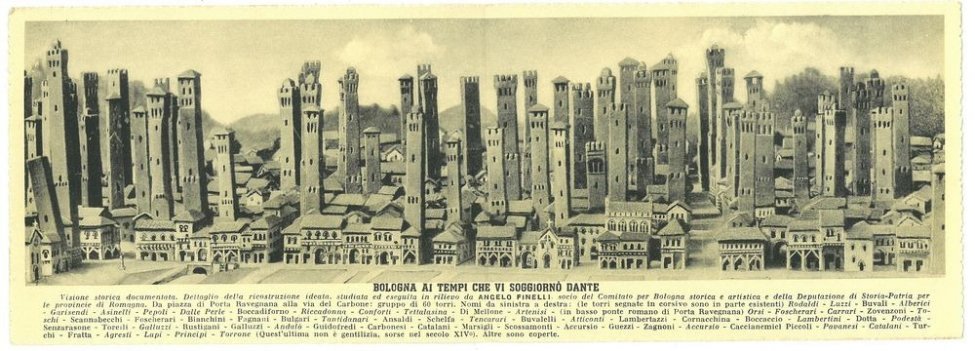
Reminds me of Bologna.towers-of-bologna-82.jpg
 
Note: This post was recovered from the Sh.org archive.
Username: Dielectric
Date: 2020-07-11 02:19:13
Reaction Score: 5
Hmm....there's all the obvious uses for towers of stone in the middle and dark ages. A stone tower is way safer to be inside of at night than a street level house or fort. So we have all those sorts of very conventional ways to see how these could be attractive forms to build.

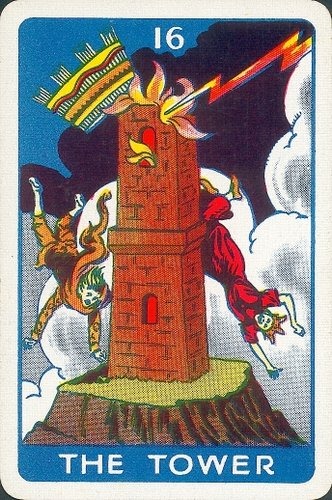
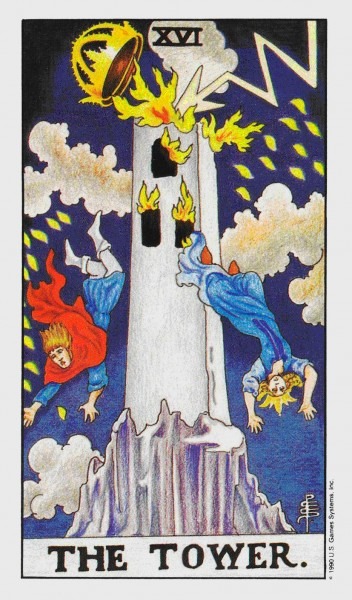
There's something here with towers in general. Towers are castles in Chess. Towers figure in Tarot. Windows and Water and Power ect.
Then there's the September 11th date, which must commemorates a remembrance, a date which appears to be connected symbolically to the collapse or destruction of towers, and the destruction of towers is symbolic of the destruction of a ruling body/system/authority. Why 2 towers survive in Bologna?

From Wikipedia.
Two Towers, Bologna - Wikipedia
" Architect Minoru Yamasaki is thought to have been inspired by the Towers when designing the World Trade Center during the 1960s"

"The Asinelli Tower was used by the scientists Giovanni Battista Riccioli (in 1640) and Giovanni Battista Guglielmini (in the following century) for experiments to study the motion of heavy bodies and the earth rotation."

" It was cited several times by Dante in the Divine Comedy and The Rime (a confirmation of his stay in Bologna),[1] and by Goethe in his Italian Journey. The Two Towers have also been the subject of an eponymous poem by Giosuè Carducci as part of the Barbarian Odes. Charles Dickens wrote about the towers in his Pictures from Italy. "

The Tower in Tarot

Thomson-Leng version of the Tower card
mmtarot-16.jpg

Rider-Waite-Smith tarot
r-w-tower-352x600.jpg

Tarot de Marseilles Trump
tdm-tower-g.jpg
 
Note: This post was recovered from the Sh.org archive.
Username: cazador
Date: 2020-07-20 03:52:51
Reaction Score: 1
Some thoughts
Why they didn't use the original 5 cuts when moving into the previous location?
Italians did a great job bonding the pieces together! They made 2 cuts without disturbing the older 4 cuts?
180/5=36ton each section. Wich Italian military hardware could have done this job? Not a Lancia 3, I think. A crane was needed? How foot soldiers loaded it on trucks?
Why waste military resources on it?
Crazy job for a stone pole!
 
Tips
Tips
Please respect our Posting Rules.
Back
Top