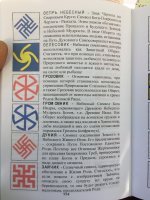
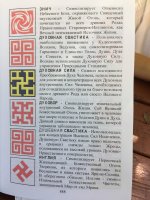
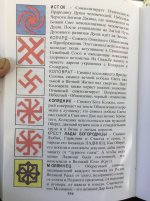
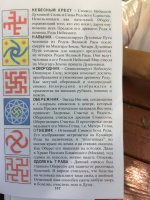
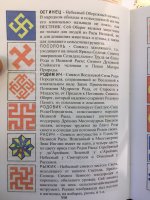
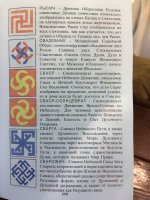
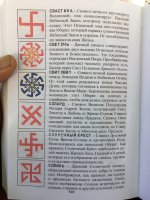
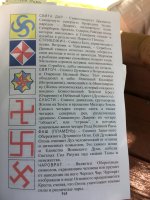
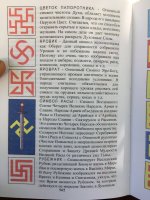
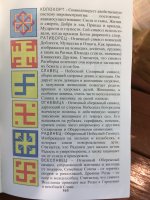
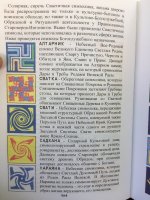
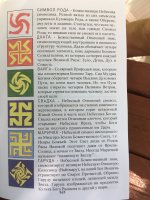
Old Russian History via Babushka

Prince Harry and Megan are about the only royals I know that are somewhat mixed. And he’s not even “royal” anymore.

I’m not aware of any historical examples of royals entertaining a mixed race wedding.

Some armour the tzar bought out of Arabia is not an example of anything more than people of different races trading w each other.

I have a Japanese car. It doesn’t prove I have a Japanese wife or that one would want me for a husband. Lol.

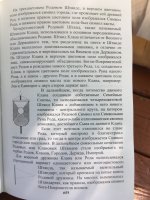
I have some more translated pages but missed a few in between. When I get them I’ll post some more non Nazi info.

Btw a good writer on many subjects is Georgy Sidorov. He also has a video on YouTube about an expedition to Very remote northern islands with ancient ruins.
 
"Some armour the tzar bought out of Arabia is not an example of anything more than people of different races trading w each other." Yhonk one minute, would a, let's say, catholic pope were a bouddhist or eve would he command it to tibetans ? Would a christian orthodox king wear on his forehead the Muslim profession of faith?
Good questions, uh ?

It seems that your perspective is particularly narrow: 1) you draw no conclusions from such extraordinary details (see Anatoly Fomenko for a much more in-depth analysis than your assertion. And see further); 2) you commit a serious anachronism by applying your ultra-materialistic 21st-century Western perspective to a non-European culture centred on religion centuries ago. You cannot fail to overlook the clues to a remarkable specificity of the ancient world. ‘Which one?’ you may ask.
 
Last edited:
"Some armour the tzar bought out of Arabia is not an example of anything more than people of different races trading w each other." Yhonk one minute, would a, let's say, catholic pope were a bouddhist or eve would he command it to tibetans ? Would a christian orthodox king wear on his forehead the Muslim profession of faith?
Good questions, uh ?

It seems that your perspective is particularly narrow: 1) you draw no conclusions from such extraordinary details (see Anatoly Fomenko for a much more in-depth analysis than your assertion. And see further); 2) you commit a serious anachronism by applying your ultra-materialistic 21st-century Western perspective to a non-European culture centred on religion centuries ago. You cannot fail to overlook the clues to a remarkable specificity of the ancient world. ‘Which one?’ you may ask.
My answer : "The one that makes the very orthodox Tsar of Russia wear on his forehead not just any verse from the Koran but the formula for conversion to the Muslim faith (other helmets, such as those of Ivan IV, Mikhail Fedorovich or Yaroslav II also feature verses from the Koran or other words issued from Islam on the temples or in other places) not only shows where the helmet was made, but also signals the religious and ethnic openness of the wearer. Yes, because at that time of prolonged and contrasting contact between Eurasian cultures, there was zero chance that the Tsar would be unaware that these words were the finest Kufic script, let alone their sacred meaning. Just as it would have been blasphemous for a Muslim to place this formula on the head of an “infidel” king!

Obviously, this escaped you. There is none so blind as those who will not see. But it is always time to open your eyes. A king's helmet is also a crown. These objects, which are very dear to Russia, tell the story of a time when these religions were not antagonistic, nor were the peoples who practised them; a time when, perhaps, it was possible to revere several religions at once — or at least to be the sovereign guarantor of several at once (as was the case with the Great Khan and those of the Golden Horde). It is not easy to reconcile this evidence with the narrow view of a patchwork of inbred races! You can now easily see (at least, I hope so) how inappropriate your example of ordering a car is, can't you?

I quote "The Helmet of Michael (Fedorovich)
Jericho Cap of Tsar Mikhail Fedorovich (Russian: ‘Ерихонская шапка царя Михаила Федоровича’) is yet another artefact attributed to Nevsky.
 
The helmet was crafted in 1621 by Nikita Davydov (Rus.) for Michael I, the king of Moscovia.
It was used as a parade attribute to Michael's dress.
After Muscovy was renamed the Russian Empire, the helmet was depicted on the coat of arms of the Russian Empire.
Nowadays, the helmet is stored in the Kremlin Armoury and treated as one of its most valued artefacts.

[…] It is worth mentioning that Arabic scriptures on the armoury of Muscovite, and later Russian, kings were not at all uncommon. For example, the helmet of Ivan IV the Terrible. Above the Cyrillic text, it also has an Arabic inscription that reads ‘Allah Muhammad’, […] The leaf-shaped device on Tsar Alexis' helmet actually contains the complete Muslim profession of faith (shahâda), ‘There is no god but God, Muhammad is the messenger of God’ (Lâ ilah ilâ Allâh, Muhammad rasûl Allâh). It is quite legible, starting at the bottom right and reading left, then up, roughly:

الله — Allâh

رسول — rasûl

محمد — Muḥammad

لا اله الا الله — Lâ ilah ilâ Allâh

Think about that and the implication in terms of ethnos."
 
Last edited:
1. Chronology of the emergence of Islam in the Golden Horde
Islamisation was not a single event, but a gradual process that took place over nearly a century, driven by the Mongol ruling elite.

Initial period (mid-13th century): Tolerance and pluralism

The founders of the Golden Horde, Batu and Berké, were the grandsons of Genghis Khan. They followed the precepts of the Yassa, the Mongolian legal code, which guaranteed remarkable religious freedom for the time.

The Mongolian elite mainly practised Tengrism (a shamanistic religion centred on the Eternal Blue Sky, Tengri).

In the 1250s, Khan Berké (r. 1257-1267) converted to Islam. This was the first documented conversion of a ruler of the Golden Horde. It was largely an individual decision and did not lead to the mass conversion of the population. Berké maintained alliances with the Muslim Mamluks of Egypt against the Mongols of Persia (Ilkhanate).

Acceleration under the reign of Möngke Temür (r. 1267-1280) and his successors: The policy of tolerance remained the norm. The wives of the khans, often Byzantine or Khwarezmian princesses, could be Christian or Muslim, illustrating the intermingling of cultures at court.
The turning point: Khan Özbeg (r. 1313-1341)

It was during his long reign that Islam became the official state religion of the Golden Horde.
 
Last edited:
Unlike his predecessors, Özbeg pursued a policy of active Islamisation. He favoured Muslims for key administrative positions and had mosques and madrasas built in major cities such as Sarai.

He encountered resistance from the traditionalist Mongol aristocracy (the ‘princes of the blood’) attached to Tengrism and ancestral customs. Özbeg violently repressed them to establish his authority and that of the new faith.

It was at this time that Arab travellers, such as Ibn Battuta, described the Golden Horde as a flourishing Muslim state.

Consolidation (after Özbeg)

After Özbeg, Islam was firmly established as the religion of the ruling dynasty and the urban elite. The process of converting nomadic and rural populations (both Turkic and Mongol) continued more slowly over several decades.
 
Last edited:
2. Religious Coexistence in the Empire
The Golden Horde was a multi-ethnic and multi-religious state. Coexistence was governed by the Mongol principle of pragmatism and utilitarian tolerance.

The main communities:

Muslims: The majority among the sedentary populations of the cities of the Volga (Bolghar, Sarai) and Khwarezm. Increasingly present in the army and administration.

Christians: Very numerous. Mainly Orthodox (Russians, Alans), but also Armenians and Catholics (Genoese and Venetian merchants from trading posts in Crimea such as Caffa).

Buddhists: Present, particularly among civil servants and merchants of Eastern origin.

Jews: Communities active in trade and crafts, in Crimea (the Krymchaks) and in the cities.

Shamanists (Tengrists): Still numerous among the nomadic tribes not yet Islamised.

The mode of cohabitation:

Autonomy of communities: Each religious community (millet) enjoyed a large degree of autonomy in managing its internal affairs (family law, justice) under the authority of its own religious leader.

Economic pragmatism: The khans protected merchants and craftsmen regardless of their religion, as they were essential to the empire's economy, which was based on control of the trade routes (Silk Road).

Status of the clergy: The various clergy (Orthodox, Muslim, etc.) were exempt from taxes in exchange for their prayers for the khan's prosperity. The Russian Orthodox Church, for example, enjoyed a period of favour that allowed it to grow rich and powerful.
 
Last edited:
2. Religious Coexistence in the Empire
The Golden Horde was a multi-ethnic and multi-religious state. Coexistence was governed by the Mongol principle of pragmatism and utilitarian tolerance.
3. Intermarriage: Prohibited or Common?
Intermarriage was extremely common and was a fundamental characteristic of the Golden Horde. The empire was, in essence, a melting pot.

At the top of the state: Khans regularly married foreign princesses to seal alliances: Byzantine (Christian) princesses, Central Asian (Muslim) princesses, etc. These unions produced an elite that was mixed, both culturally and genetically.

In the army and administration: The empire was based on a Mongol and Turkic ruling class that mixed with the local populations.

In cosmopolitan cities: Large cities such as Sarai were veritable melting pots where Mongols, Kipchak Turks, Russians, Circassians, Alans, Armenians, Genoese, etc. lived and married together.

Nothing was prohibitive; the identity of the Golden Horde was not ethnic or racial, but political: to be a loyal subject of the khan.

4. Legacies and consequences to the present day
The intermingling and Islamisation of the Golden Horde had profound and lasting consequences on the ethnic, cultural and political map of Eurasia.

Formation of modern Turkic-speaking peoples:

The Volga and Crimean Tatars are the direct descendants of the Golden Horde. They are the product of intermingling between the ruling Mongol populations, the Kipchak Turks (the majority in the steppe) and the earlier local populations (such as the Volga Bulgars).

The Kazakhs and Uzbeks also owe their ethnic formation to the fragmentation of the Golden Horde (the White Horde and the Ozbeg Horde are at the origin of these peoples). The name ‘Uzbek’ comes directly from Khan Özbeg.

The Nogays are descended from the Nogai Horde, a fragment of the Golden Horde, and bear the name of General Nogai.

Sunni Islam of the Hanafi rite became the majority religion of almost all these peoples and remains a central pillar of their identity to this day.

Cultural and genetic influences:

In Russia: Tatar-Mongol rule (the ‘Tatar Yoke’) lasted more than two centuries and had a profound impact on Muscovite Russia, in its administrative, fiscal and military (cavalry) systems and even in its vocabulary (hundreds of words of Turkish or Mongolian origin entered the Russian language).

Genetic heritage: Genetic studies show significant Asian (Mongolian) contributions in certain populations of the Volga and North Caucasus, evidence of centuries of intermingling.

Architecture and art: The synthesis of Islamic, Turkish, Mongolian and local influences produced a unique architectural style, visible in the remains of the mosques and mausoleums of Sarai and Bolghar.
 
« The inscription on Ivan the Terrible's helmet was deciphered by the Iranian consul

The Arabic inscription on the helmet of Russian Tsar Ivan the Terrible, exhibited in the Astrakhan Museum of Military Glory, has been deciphered by Iranian Consul General Seyed Golamrez Meyghani.

‘The consul claims that the inscription on the upper horizontal band of the tsar's helmet translates from a rare Arabic dialect as “Allah Muhammad”,’ said Elena Arutyunova, senior researcher at the museum. "These words may be an abbreviated version of the well-known expression “Allah is great, and Muhammad is his prophet”.

"We consider the Iranian consul's translation to be a version that certainly requires verification by linguists and orientalists. One explanation for why such an inscription could be on the helmet of an Orthodox Russian tsar is the assumption that the headdress was given to Ivan the Terrible's father by the Turkish sultan for his son. After all, the inscription on the second horizontal band of the helmet is already in Slavic: “Helmet of Prince Ivan Vasilyevich, Grand Duke, son of Vasily Ivanovich, Lord of All Russia, Autocrat,”" Arutyunova explained.

This world-class relic was brought to Russia from Sweden, from the Royal Armoury in Stockholm, especially for the 450th anniversary of the incorporation of Astrakhan into the Russian state by the strong hand of Ivan IV the Terrible. The exhibition, conceived by businessmen and patrons working in the Astrakhan region, as well as all the preceding preparations for its organisation, became an entire inter-state cultural project.

The helmet was previously exhibited in the Armoury Chamber of the Moscow Kremlin. "From 14 May, it was on display in Astrakhan, in the Museum of Military Glory. During this time, about 3,000 Astrakhan residents and visitors to our city viewed the tsarist relic,‘ said Arutyunova. ’On 14 June, the exhibition will close, and on 15 June, the relic will be sent back to Stockholm, Sweden, with all security measures in place," ITAR-TASS reports.

There are several versions of how Ivan the Terrible's helmet ended up in the collection of the Royal Armoury in Stockholm. It may have been captured in Moscow during the Time of Troubles in 1611-1612 and sent to King Sigismund in Warsaw along with other treasures. Then, in 1655, when Polish troops were defeated during the war with Sweden, it may have been taken from Warsaw by the Swedes as their own trophy. In 1663, the helmet was first mentioned in the inventory book of the Royal Armoury in Stockholm. »

So long for the no-physical-contact policy ! BTW see the Dubghail or Black Danes and come back again if you dare, with notion of strictly closed ethnic boundaries . Fortunately, our ancestors managed to avoid the defects caused by inbreeding (most of the time)! Don't you think ?
 
Last edited:
You win. By sheer volume of words!

The runic alphabet used in these books predates Christianity and Islam. These false religions are what swept away the old Yngling believers. Almost.

You have not provided an example of a royal or any other marriage of two people of a different race prior to 80 years ago. I’m sure there were some secret ones but highly frowned upon. It’s really not terribly important.

Btw I do agree with much of what Fomenko says. However he is talking about the atrocities of the false religions Thousands of years after the stories of the Ynglings.
The subject is ancient Stolen History. Not let’s identify every race in the Russias. Specifically these stories are from the Kievan Rus peoples histories.

The story goes that an ancient race of white people with blue, green, grey or brown eyes lived in a northern land that has been destroyed by a cataclysm that changed their climate. This caused them to move south into the lands of others that learned from them. The swastika is a great example. What these stories are saying is that it is a symbol of the first white people given to others. Now we think they belonged to the Hindus, Buddhists etc.

Please stop posting links to AI generated videos. Thanks.
 
The story goes that an ancient race of white people with blue, green, grey or brown eyes lived in a northern land that has been destroyed by a cataclysm that changed their climate. This caused them to move south into the lands of others that learned from them.
What you say is quite plausible. Many races came down each with different characteristics - including varying skin colouration. I believe this is depicted in the medicine wheel with red, black, yellow and white areas.
  • Red - Olmec, Aztec, Mayan (all copper colored)
  • Yellow - Asiatic, Mongol
  • Black - Nubian, Ethiopian, Dravidian, Aeta
  • White - Turkic?
 
Last edited:
Speaking about the swastika and the russian connection. There is one swastika form that represents the god Svarog.

"Svarog is a Slavic god who may be associated with fire and blacksmithing and who was once interpreted as a sky god on the basis of an etymology rejected by modern scholarship. He is mentioned in only one source, the Primary Chronicle, which is problematic in interpretation. He is presented there as the Slavic equivalent of the Greek god Hephaestus. The meaning of his name is associated with fire. He is the father of Dazhbog and Svarozhits... In earlier scholarship, the dominant view was that the root svar was borrowed from an Indo-Iranian language (e.g., from Sanskrit स्वर्, svar "radiance", "sky", "sun"), but this etymology is nowadays rejected due to phonetic difficulties."

?u=https%3A%2F%2Ftse3.mm.bing.net%2Fth%2Fid%2FOIP.jpg
iya-ermolaeva-70aeb58a-14c4-4196-be36-30ab3bfebd0d.jpg


"Page 104 of the Hypatian Chronicle according to the Ipatiev List of the first quarter of the XV century with the beginning of the euhemeristic myth of Svarog"
Hypatian_Codex_Page_104.png


Idol of Svarog on his pagan temple in Bitsevsky Park, Moscow
800px-Svarog%27s_shrine_in_Bitsa_Park_09.jpg


Next we have Svarozhits, a Slavic god of fire, son of Svarog. One of the few Pan-Slavic gods, he is most likely identical with Radegast or its regional variant; it is also but much less often identified with Dazhbog.
ost_img%2F2022%2F04%2F25%2F8%2F1650889487167844705.jpg
Kupala_2015_in_Krasotinka%2C_Kaluga_%285%29.jpg


I found this on shutterstock
-symbols-with-their-names-in-russian-and-797461366.jpg
 
They beleived in the dark side and were fanatically committed to promote their wrong ideology. Hence swastika, which was ever only known as a benevolent sign started to be perceived as an evil symbol.
It is proven fact that they did basically import / copy their concepts and ideas like eugenics, the Arian race, its supremacy and the like from others - name the British 'elites'.
Funnily, the moustache man wrote his "Mein Kampf" in 1924 (allegedly), when being in jail for insurrection. Being busy with internal struggles and hardships in Germany mostly caused by the treaty of Versailles imposed on them by the British and Americans, he knew very little about another struggling empire - Russia (or the fledgeling Soviet Union). But nonetheless, he named a whole chapter of 'his' book "Together with Great Britain against the Bolshevism".
Does that sound plausible ? Not to me.
And not to mention, in the late '20s he spend a whole year in the UK, allegedly visiting relatives. And while the Soros Wackopedia has removed all traces of his stay at the future enemy's country, they don't deny his British family branch - yet.

Long story short - nothing about the Nazis is organic.
It was a carefully prepared setup to bring the first world war to a specific conclusion, a "world government".
I don't believe for a second that they have choosen any of those symbols themselves.
And I think smearing and defaming actual ancient history is just on of their intended side effects,
 
View attachment 35284


They have plenty of hidden and stolen history to be uncovered.
At least according to official history, Rurik, the first regent of Russia, was a Varangian chieftain invited from Scandinavia (Sweden nowadays).
As the norsemen were present in substantial numbers at the time, the use of runes in documents thus seems normal to me.
On a related note, some close relations between the Russian and nordic languages are even present today.
 
9F546925-6F62-4D3D-B3DD-95FBC6B3D69F.jpeg
 

Attachments

  • AE343275-C47F-4C5F-9F23-8E9E7AC762CB.jpeg
    AE343275-C47F-4C5F-9F23-8E9E7AC762CB.jpeg
    1.7 MB · Views: 37
  • BA2DE9A2-E41A-40BF-8B63-3CE8ADF142BC.jpeg
    BA2DE9A2-E41A-40BF-8B63-3CE8ADF142BC.jpeg
    1.7 MB · Views: 38
  • A578D38B-D601-4C8C-9053-AD6B2EC542F8.jpeg
    A578D38B-D601-4C8C-9053-AD6B2EC542F8.jpeg
    2.7 MB · Views: 44
  • A8D8D378-F429-43D7-A05C-0E4195EDCE12.jpeg
    A8D8D378-F429-43D7-A05C-0E4195EDCE12.jpeg
    1.6 MB · Views: 36
  • 58059A32-EC5D-4EE9-93A4-1EE2162DAB92.jpeg
    58059A32-EC5D-4EE9-93A4-1EE2162DAB92.jpeg
    1.8 MB · Views: 42
  • A3ECD948-133F-4987-AAD3-F66464CC7DF2.jpeg
    A3ECD948-133F-4987-AAD3-F66464CC7DF2.jpeg
    1.8 MB · Views: 50
  • 529E13A5-CEEE-44AB-841A-40E4AC42B0A0.jpeg
    529E13A5-CEEE-44AB-841A-40E4AC42B0A0.jpeg
    1.8 MB · Views: 42
  • 870420D6-03C8-4240-BA87-2D6F96079D88.jpeg
    870420D6-03C8-4240-BA87-2D6F96079D88.jpeg
    1.6 MB · Views: 30
  • 192D49B9-E4C3-4D97-B52C-90EC23AA8BAF.jpeg
    192D49B9-E4C3-4D97-B52C-90EC23AA8BAF.jpeg
    1.7 MB · Views: 47
  • BC6F11C0-90A8-42E6-B29D-6B1F8C5F9BBF.jpeg
    BC6F11C0-90A8-42E6-B29D-6B1F8C5F9BBF.jpeg
    1.6 MB · Views: 43
  • FB5F95BF-6C29-4E97-B947-88DDE8665DC2.jpeg
    FB5F95BF-6C29-4E97-B947-88DDE8665DC2.jpeg
    1.9 MB · Views: 33
  • 79241CD6-EC2C-4BBB-8D0B-C35801526EBD.jpeg
    79241CD6-EC2C-4BBB-8D0B-C35801526EBD.jpeg
    1.8 MB · Views: 34
  • CE694AF6-2B97-4714-BCD4-AEF7EE8CBC87.jpeg
    CE694AF6-2B97-4714-BCD4-AEF7EE8CBC87.jpeg
    1.8 MB · Views: 49
  • 2409C1A3-03C1-430B-A4B1-A4683957A56B.jpeg
    2409C1A3-03C1-430B-A4B1-A4683957A56B.jpeg
    1.9 MB · Views: 50
  • 1FDF79A8-272E-4A29-A580-E06AD913040E.jpeg
    1FDF79A8-272E-4A29-A580-E06AD913040E.jpeg
    1.7 MB · Views: 34
  • B7E8C55F-4571-46DF-8AED-D98C7FDC87B0.jpeg
    B7E8C55F-4571-46DF-8AED-D98C7FDC87B0.jpeg
    1.6 MB · Views: 42
  • 893CEAB6-564B-40E3-B0F5-55DB4511D02C.jpeg
    893CEAB6-564B-40E3-B0F5-55DB4511D02C.jpeg
    1.6 MB · Views: 42
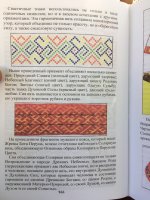
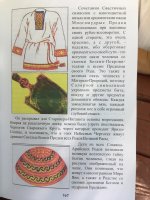
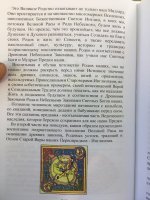
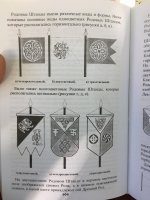
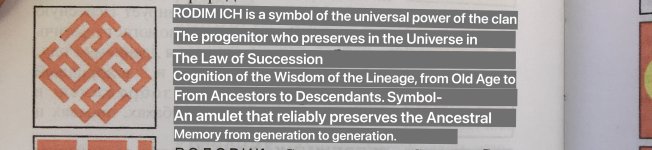
Im not a russian speaker and my translation apps are not working really well on this. So heres the list of all the symbols of the old faith. Ynglings

These predate christianity islam and judaism too.
 
Tips
Tips
Please respect our Posting Rules.
Back
Top