SH Archive Omaha Mud Flood: St. Mary Magdalene Church 1920 transformation

SH.org OP Username
KorbenDallas
SH.org OP Date
2018-09-06 07:49:10
SH.org Reaction Score
44
SH.org Reply Count
44
Note: This post was recovered from the Sh.org archive.
Username: kentucky
Date: 2018-09-10 17:21:12
Reaction Score: 1
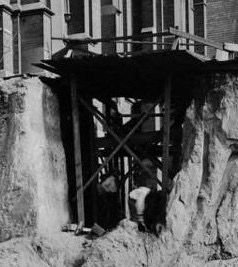
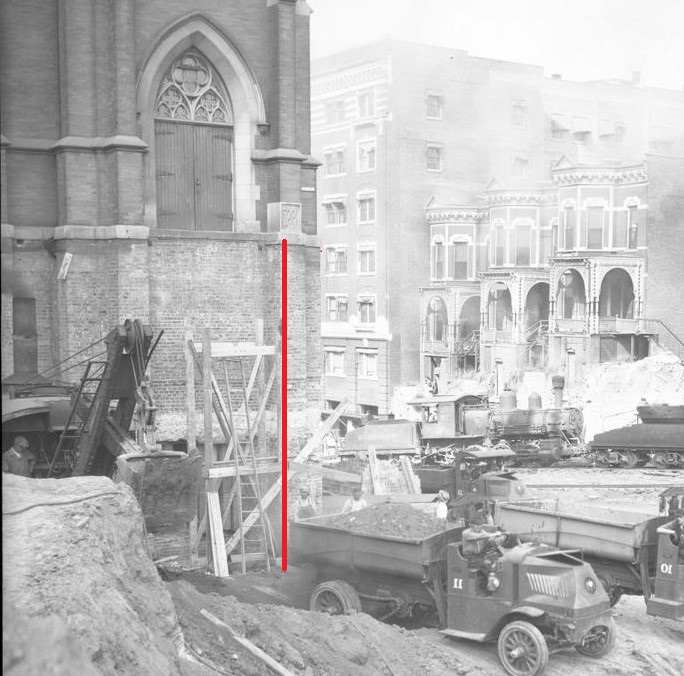
Thank you for your perspective, would you mind offering your thoughts on the windows at the bottom right and the supporting beams installed into them? I can only assume that that would not be standard ops for neither new construction nor for operations focused on securing the integrity of a building’s foundation.
 
Note: This post was recovered from the Sh.org archive.
Username: KorbenDallas
Date: 2018-09-10 17:28:17
Reaction Score: 1
I will respectfully disagree that this depth of a foundation is reasonable for this size of a building. This 20 foot wall is a threefold overkill. This is not a skyscraper after all.
 
Note: This post was recovered from the Sh.org archive.
Username: ISeenItFirst
Date: 2018-09-10 17:30:18
Reaction Score: 1
Don't need much more than a shovel on this project. Bricklayers need a hand trowel and some string, or a level.

I was looking at those supports inside the 'window' on the lower right as well.

They didn't honor the design aesthetic in these windows anyhow. The new windows did not have arch tops. However, the supports likely had to do with getting a lintel in there, which is in no way secondary to the structural integrity. Cutting in a window after the fact would be more difficult, and less structurally sound in the long run (and/or require more maintenance). Ever seen those cracks running up and away from window corners? That's a steel lintel that has rusted. Enclosed rusting steel can exert upwards of 10,000 psi. If you live in a brick house, please paint and caulk any steel lintel you have regularly. The rust will lift the entire wall.
 
Note: This post was recovered from the Sh.org archive.
Username: anotherlayer
Date: 2018-09-10 17:39:41
Reaction Score: 1
i have multiple steel lintels! this seems like sound advice that i never thought about...
 
Note: This post was recovered from the Sh.org archive.
Username: ISeenItFirst
Date: 2018-09-10 17:40:28
Reaction Score: 1
There is no way to say that definitively without much more information. If the ground is stable bedrock (we know it isnt), 1 inch is excessive. If it is silty clay, might not be deep enough. If it's loamy sand soil, it's probably about right.

Skyscrapers have foundations (when not built on shallow bedrock, ie manhattan) that can get well over 200 feet deep.

Also, 20 feet or so on the high side is immaterial. It is the low side that is the critical dimension. The high side will be whatever the grade change over the distance is, plus the low side foundation. You desribe a foundation depth by its most shallow point, for most considerations.

Those holes with beams in them likely have to do with the lowering of the main church floor to match the new ground level. They would have had to send the beam in through the hole, as the building is already built. Without seeing before and after floor plans, that's about as much as I can say.
Post automatically merged:

Direct to metal paint, like rustoleum. Followed by caulking. Something rated for exterior use. I like silicone, but an acrylic is probaby more recommended in this application, ymmv. If it's already started to crack, you can't really reverse the process, but you can slow it down until it stops, then patch the crack. Don't use mortar unless you know it's matched materially with the existing mortar, or you're asking for trouble. It's generally not structurally concerning at all, but it is one of my pet peeves and looks like he'll.
 
Note: This post was recovered from the Sh.org archive.
Username: kentucky
Date: 2018-09-10 17:58:52
Reaction Score: 1
Well, to be pedantic, since you are saying otherwise, there are two windows in size that are directly above the on the upper section of the building, as I had eluded to in my previous comment. And, to say unequivocally that that doesn’t meet the design aesthetic, especially merely because they are not arched seems a bit disingenuous. There are plenty of examples of buildings with arched windows only on the uppermost sections, to be sure.

Thank you nevertheless for your statements for the record. I will seek the perspective of some construction and architect peers and compare them to your account for my own edification.
 
Note: This post was recovered from the Sh.org archive.
Username: ISeenItFirst
Date: 2018-09-10 18:11:56
Reaction Score: 1
That holds to the basic design layout, but there is more to the aesthetic than just the layout. Primarily the style. Further, if you look at the finished product there are no windows in that location. They have what looks like an exhaust vent or a makeup/combustion air intake there, and some kind of rectangular panel above it, but nothing matching those "windows". Maybe they are to be additional beam pockets, or maybe something to do with a boiler or octopus system install. I don't know.

Just because examples of buildings having this or that feature can be found, does not mean they conform to a particular style. Mixing of styles happens all the time, and few buildings are of one style exclusively. At any rate, that these holes did not remain as windows, or anything else, is indicative that they were not done for any aesthetic reasons.
 
Note: This post was recovered from the Sh.org archive.
Username: kentucky
Date: 2018-09-10 18:27:03
Reaction Score: 1
Again, thank you for your input, but I find no interest in arguing what may or may not be construed as a design aesthetic. I will respectfully disagree that these windows could be ruled out as evidence of such.

And if you would please, I would sincerely appreciate being directed a photo that show that there are no finished windows there. I was looking for a post-work view of that location but could not ascertain them from any of Op's photos, and I feel that I carefully scrutinized each photo to pinpoint the location of where the windows would have been. Regardless, thank you in advance for your help there.

I would be indeed interested in seeing the final disposition of that area to see what evidence would present itself. To be sure, I don't feel that the lack of windows in that location would discount the notion, but rather may only bolster it.
 
Note: This post was recovered from the Sh.org archive.
Username: KorbenDallas
Date: 2018-09-10 18:31:19
Reaction Score: 1
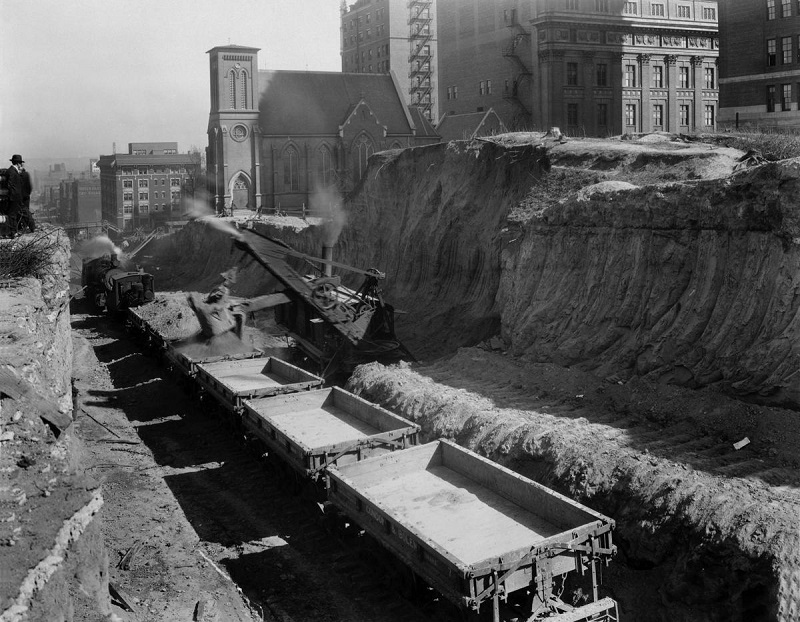
In picture #3 of the OP I can see, what I think are the original dug out window slots. Obviously, it can be argued either way, but to me they look like window slots, and not like recently added wall extensions.
——
Once again, apologies, but to me it sounds just like my history teacher’s explanation of the Pyramid building process. Chisels, sleds, etc, all the things which appear reasonable and doable. As far as I know it’s still the official version, egyptologists keep on finding proof for the method, and some people still believe this off version.

With this cathedral we have a huge building across the street, another several buildings to its right, and whatever else is on this hill. Lower puctures in the OP show some of those buildings. All of the surrounding buildings would have to suffer the same fate. The building across is twice taller than the cathedral. Would its foundation be 30-40 feet deep. The tiny building to the right would need a much smaller original foundation. And they do look like a portion was added or a portion was renovated.

All over sudden this entire operation sounds like a bit more than just dirt removal.

Yet the biggest achievement we get out of the historical article is the dirt removal. It’s like nobody is aware of anything else, otherwise where is the info?
 
Note: This post was recovered from the Sh.org archive.
Username: kentucky
Date: 2018-09-10 18:35:24
Reaction Score: 1
If you mean picture #4, I thought so too, but I found it to be on the wrong part of the building. If you did mean picture #3, i'd be curious to see what you're seeing, as I can't make it out.

But, to be sure, picture 4 does show window holes with support columns already in place, nevertheless. It's silly to have to argue, but plain holes with supports are easier to work with when window holes aren't needed just to be able to pass things through.
 
Note: This post was recovered from the Sh.org archive.
Username: ISeenItFirst
Date: 2018-09-10 18:40:28
Reaction Score: 0
Well I've never seen a pyramid built. I have seen buildings lifted and new foundations put on, and lots of brickwork.

The foundation depth is less dependant on the height of the building, and much more dependant on the geological conditions of the site.

Like I said, Manhattan skyscrapers have very shallow foundations, as they don't have to go far to hit bedrock. The Shanghai tower, if I am not getting my buildings mixed up, has foundation piers almost 300 feet deep. Clay type soil (among the worst for foundations).

It's about the soils ability to support the weight throughout the expected conditions (water, temp etc) with a margin of safety.

I don't know anything about the other buildings or the extent of the hill this church sat on. I'm just going on what I see.
 
Note: This post was recovered from the Sh.org archive.
Username: kentucky
Date: 2018-09-10 18:46:57
Reaction Score: 1
Ah, thank you for the screenshot. As you can see in picture 8, that is the scaffolding that is up one level and to the right of where the windows that I am referring to are located. Picture 3 still has them obstructed by uncleared land, if we were to assumed that they were already a part of an existing structure. Picture 8 shows it unobstructed.
 
Note: This post was recovered from the Sh.org archive.
Username: ISeenItFirst
Date: 2018-09-10 18:48:46
Reaction Score: 0
Looking closer, I do see a few things that don't make sense. I'll have to get to a computer and Mark up a couple photos to show what I mean.

There is plenty that doesn't add up about this, but for the most part the construction looks pretty legit.
Pics 10, 11, 12 show no windows in that location.
 
Note: This post was recovered from the Sh.org archive.
Username: kentucky
Date: 2018-09-10 19:29:02
Reaction Score: 0
Thank you for setting me straight. My mind was having trouble reconciling the location from those photos. At first, I could not figure out why I had such troubles and had initially assumed that I was looking at the wrong location, but now I see why.

Ironically, and directly counter to your assertion that "Cutting in a window after the fact would be more difficult, and less structurally sound in the long run (and/or require more maintenance)", there seems to now be aesthetically-congruent windows in the section above the area in question, that were not present beforehand.
Screen Shot 2018-09-10.png Screen Shot 2018-09-10 at 2.22.13 PM.png
 
Note: This post was recovered from the Sh.org archive.
Username: ISeenItFirst
Date: 2018-09-10 20:43:01
Reaction Score: 1
Yeah I mentioned those three holes. Look closer and you can see the end of the I beam that was installed in them. The beams were probably at least 50 feet long, and wouldn't fit through the door, so they had to open a hole and send them in through the wall. (Yep seen this done too)

The three holes become beam pockets once the holes are bricked up.

Incidentally, that's my best theory for the holes below, but I'm not very confident in that at all.
That rectangular spot is still there on the church today, not sure what the intent for it was.


I do see some pretty weird stuff here, but it's gonna take me a bit to figure it out, and mark up some photos to show what I mean. It might help to set this straight one way or the other, if I can figure it out.

Don't feel too bad, I been looking at stuff like this professionally for a long time, and figuring the orientation of these photos on this building is definitely tricky.
 
Note: This post was recovered from the Sh.org archive.
Username: kentucky
Date: 2018-09-10 21:00:07
Reaction Score: 0
The fact that there were 3 I beams there was already clear. I was referring to the two windows that are now there that weren't before. Thank you for your input, I'm gonna seek the perspective of others from here.
 
Note: This post was recovered from the Sh.org archive.
Username: ISeenItFirst
Date: 2018-09-10 21:20:44
Reaction Score: 0
You are correct on that one. That is weird. Can't have a beam pocket and a window in the same spot. Either beams are temporary, or windows are false, and I don't think the windows are false, but I never found a good pic of them, to be sure.

I did read that beams were added in to put the floor at its new lower height.

This ties in a little bit with some of the weirdness I am seeing here. I'll have to keep it in mind when I do a thorough looking through of the pics.
 
Note: This post was recovered from the Sh.org archive.
Username: sharonr
Date: 2018-09-12 05:14:46
Reaction Score: 2
I certainly agree with your assessment, except when you look at the grading of Omaha at that apparent time. The hills do not line up (literally) with the story. Not to toot my own horn, but what I posted originally is trying to say something about the grading in the roads compared to other buildings (or not) still there. It is hard to tell, but the "hills" in the story make no sense.

This:


Doesn't line up with:

 
Tips
Tips
Please respect our Posting Rules.
Back
Top