Angelovitz
New Member
- Joined
- Nov 15, 2023
- Messages
- 5
- Reaction score
- 22
Oscar Hammerstein I...
Was a 19 century Prussian Jewish immigrant, who came to the United States at around 17/18 years old in 1864. He grew quite a large tobbaco empire and fortune, also due to inventions & patents by himself.

There are many things interesting about the guy, but our main interest here is that he's held responsible for the financing and construction of 11 Opera Buildings (New York, London).
Let's have a look at the third Opera Building, for which he's held "accountable": The Manhattan Center (formerly known as the Manhattan Opera House).
Manhattan Center in front, and next to the right, the Wyndham New Yorker Hotel (Tesla death). Both buildings owned by the "Unification Church":

A short summary of the history, of the Manhattan Opera House:


Okay wait..:
Let's have a look at his ninth Opera House, the Metropolitan Opera House in Philadelphia:

A short summary of the history, of the Metropolitan Opera House in Philadelphia:
Let's have a look at his tenth Opera House, the London Opera House (Peacock Theater / Royalty Theater):

A short summary of the history, of the former London Opera House (Peacock Theater) in London:
Here a couple of other Opera Houses that he's connected with (some are also remarkable to say the least, for example the Olympia Theater), and I'll close of with the Harlem Opera House.
Lexington Avenue Opera House (Biltmore Theater, Loew's Lexington Theater). Opened in 1910, demolished in 1961:

Victoria Theater. Opened in 1899, and sold by Hammerstein in 1915. Demolished 19 years later:

Olympia Theater. Opened in 1895. Sold in 1898 by Hammerstein. Demolished in 1935 (looks almost like a palace, so nice):

Republic Theater (New Victory Theater). Built in 1900 and still in use:

Lew Fields Theater (Hackett Theater - Anco Cinema). Opened in 1904, demolished in 1997:

Until now I didn't want to touch upon the following speculative question:
I'm not disputing the fact that these Opera Houses, can be build in a fast and qualitive manner. But when I look at the Lew Fields Theater, I definitely right away got 17/18 century European vibes.
Especially since I've lived around them my whole life, seeing the Lew Theater is like watching a building in my own city (old VOC/WIC offices).
It would've fit perfectly in the canal district of Amsterdam for example (formerly the seat of the Dutch East/West India Companies, and governmental power), which brings me to the Harlem Opera House (opened in 1889, demolished in 1959):


If I was showed pictures of the Lew Field Theater, and the Harlem Opera House (and the building next to it) without knowing the history, asking me a question like:
I would've said that:
Here's an existing Dutch VOC/WIC building from 1700 in the Netherlands, eerie similar to the Harlem Opera House:


What's interesting is that on the location where the Harlem Opera House once stood (former commerce office & shops), now stands a Financial Center with a branch of the Bank of America (perhaps a subtle hint to the commercial past of the Harlem Opera House?)

But sadly the question of some of the Hammerstein Opera Houses being Old World Buildings, can only be resolved if one (independent) / a team under own authority can research such buildings.
Hopefully find original integral structural material from the building itself, that predates the construction period between 1889 - 1911. Stuff of that nature.
Until then, Oscar Hammerstein I stays an intruiging fellow as himself. Rise to riches, and downfall. Strange coincidences of money flows, real-estate (rights and transferal)..
What do you kind gentlemen & ladies think of the Hammerstein Opera Houses, or the flows of money in respect to real-estate in this story?
Have a great day!!!
Was a 19 century Prussian Jewish immigrant, who came to the United States at around 17/18 years old in 1864. He grew quite a large tobbaco empire and fortune, also due to inventions & patents by himself.
There are many things interesting about the guy, but our main interest here is that he's held responsible for the financing and construction of 11 Opera Buildings (New York, London).
Let's have a look at the third Opera Building, for which he's held "accountable": The Manhattan Center (formerly known as the Manhattan Opera House).
Manhattan Center in front, and next to the right, the Wyndham New Yorker Hotel (Tesla death). Both buildings owned by the "Unification Church":
A short summary of the history, of the Manhattan Opera House:
- Constructed in 1906, as Oscar Hammerstein I was meaning to compete with the Metropolitan Opera;
- The Metropolitan Opera offered 1.2 million Dollar in 1910, if Hammerstein would stop production at this place for the next ten years;
- Hammerstein accepted the offer, and his contracts go towards the Metropolitan;
- He sells the Manhattan Opera House in 1910 or 1911 (4-5 years after construction);
- The new owners from 1911 are the Shubert Brothers / family;
- A family, that's according to Wiki, responsible for the Broadway Entertainment district;
- In 1922, the Ancient Accepted Scottish Rite of Freemasonry takes ownership of the Manhattan Opera House;
- Later on it turns into an event center/venue;
- The Unificaton Church gets hold of the former Manhattan Opera House in 1976, for the sum of 3 million dollars;
Okay wait..:
- Hammerstein starts with his Opera Houses from 1889 till around 1911-ish;
- Goes bankrupt in between, but continues to build new Opera Houses, because he sells other assets/rights and such;
- Hammerstein sells the Manhattan Opera House not even 4-5 years, after it was constructed;
- After getting a nice bonus from the Metropolitan, and turning over contracts to them;
- Influential connections (entrepeneurs, industrials, politicians, moviestars etc.);
- The Shubert family sells (gifts.. who knows) the building 11 years later to the Freemasons;
- And so on, if we look at it from an angle of "Flow of Money in the Upper Echelon, and ownership / transferal of real-estate throughout the decades (or centuries), between friendly affiliated parties";
A short summary of the history, of the Metropolitan Opera House in Philadelphia:
- Design was ready in 1907;
- Built completely in 1908, being the largest theater of its kind in the world (!);
- Opening on 17 November 1908;
- Sold by Hammerstein I in 1910 to the Metropolitan Opera NY (the same who took over the contracts from the Manhattan Opera House);
- Sold in 1954 to a Church (not sure which organisation);
- Decline in the 1980-1990's;
- Saved from demolotion in 1996 when the Holy Ghost Church purchased it, and put in some pre-renovation;
- The Unification Church remarkably also in a similar fashion does that with the New Yorker Hotel (who also are the owners of the former Hammerstein Manhattan Opera House);
- Holy Ghost Church spend 5 million dollar between 1997-2013 on stabilizing the structure;
- In 2012 the Church opts for a development partnership with Blumenfeld, who buys the building for one dollar;
- The Church and Blumenfeld in 2017 reach a joint ownership agreement;
- A 45 million dollar renevation project starts between 2017 - 2018;
- New opening of the Philadelphia in 2018;
- That's a whole lot of millions spent on one single building (and also gained by income);
Let's have a look at his tenth Opera House, the London Opera House (Peacock Theater / Royalty Theater):
A short summary of the history, of the former London Opera House (Peacock Theater) in London:
- On the grounds of the current location, stood a theater from mid 17th century until 1809;
- Known / remaining records of theater plays up to 1663, at the site;
- What a coincidental (symboli / esoteric) historical mirror thing that 100 years later, a new theater opens on the same spot;
- London Opera House opened on 13 November 1911;
- Sold by Hammerstein in 1915;
- Renovated / adjusted to currently hold 999 seats;
- Dimension stage approx. 36x33 feet, or 10x11 meters;
- Aah... the numbers...
Lexington Avenue Opera House (Biltmore Theater, Loew's Lexington Theater). Opened in 1910, demolished in 1961:
Victoria Theater. Opened in 1899, and sold by Hammerstein in 1915. Demolished 19 years later:
Olympia Theater. Opened in 1895. Sold in 1898 by Hammerstein. Demolished in 1935 (looks almost like a palace, so nice):
Republic Theater (New Victory Theater). Built in 1900 and still in use:
Lew Fields Theater (Hackett Theater - Anco Cinema). Opened in 1904, demolished in 1997:
Until now I didn't want to touch upon the following speculative question:
"Are / were some (if not most) of the Hammerstein I Opera Houses, in actuality repurposed "Old World" buildings (even though they're ascribed to the Gilded Age style of construction)?"
I'm not disputing the fact that these Opera Houses, can be build in a fast and qualitive manner. But when I look at the Lew Fields Theater, I definitely right away got 17/18 century European vibes.
Especially since I've lived around them my whole life, seeing the Lew Theater is like watching a building in my own city (old VOC/WIC offices).
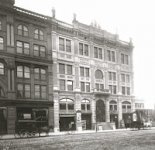
It would've fit perfectly in the canal district of Amsterdam for example (formerly the seat of the Dutch East/West India Companies, and governmental power), which brings me to the Harlem Opera House (opened in 1889, demolished in 1959):
* Wiki and * Other Source
If I was showed pictures of the Lew Field Theater, and the Harlem Opera House (and the building next to it) without knowing the history, asking me a question like:
"What do you think the origin, and use of these buildings was?"
I would've said that:
- These are Dutch in origin;
- Possibly from the 17/18th century;
- And used among others for the use of Commerce, Trade and Governance.
- That's what these last Opera Houses exude unto my, a Dutchie living in one of the former VOC cities;
What's interesting is that on the location where the Harlem Opera House once stood (former commerce office & shops), now stands a Financial Center with a branch of the Bank of America (perhaps a subtle hint to the commercial past of the Harlem Opera House?)
But sadly the question of some of the Hammerstein Opera Houses being Old World Buildings, can only be resolved if one (independent) / a team under own authority can research such buildings.
Hopefully find original integral structural material from the building itself, that predates the construction period between 1889 - 1911. Stuff of that nature.
Until then, Oscar Hammerstein I stays an intruiging fellow as himself. Rise to riches, and downfall. Strange coincidences of money flows, real-estate (rights and transferal)..
What do you kind gentlemen & ladies think of the Hammerstein Opera Houses, or the flows of money in respect to real-estate in this story?
Have a great day!!!