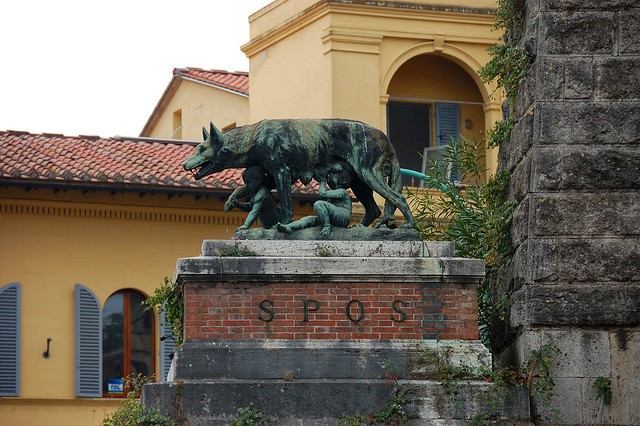
Old thread, but it may be worth adding that Sean Hross claims that the famous she-wolf is actually a hyena. Once you see it, you can't unsee it:
He claims that the hyena is a mafia symbol and was brought to Italy from Egypt/Babylon by the bad guys. Look at the way hyenas band together to kill lions. Individually the "honorable" male lion may be stronger, but collectively the (matriarchal) hyenas are invincible. Hyenas have no honor or loyalty among themselves, but paradoxically this only strengthens the pack. They let "nobler" animals do the dirty work of hunting, then come in and steal the kill. This is also what bankers do: let others break their backs doing productive labor, then steal the fruits through usury, leaving the idiots with nothing but their vain pride (pun intended). The hyena is therefore a symbol of a form of political organization in which the individual will always be at the mercy of the collective. Individual vice becomes collective power.
At age 2 or 3 a male leaves his natal clan and wanders off to beg acceptance into another clan. After vicious rejections, he eventually succeeds and reaps his reward: brutal harassment as the clan's nadir, one of the last in line for food and sex. This probation, which biologists call "endurance rivalry," is a test, Holekamp explains: "The guy who can stick it out the longest wins."
Compare to the earlier comment:
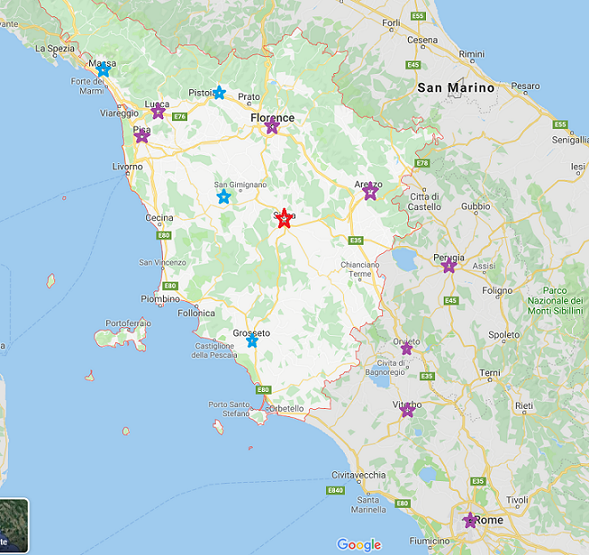
This reminds me of the Etruscan dodecapolis. The Etruscan league consisted of twelve cities, and according to the article from Wikipedia below, "had no fixed roster and if a city was removed it was immediately replaced by another" which means any city within reason could have belonged to the league. Could this depiction of 12+1 cities possibly represent the Etruscan dodecapolis? Twelve cities plus the capital?
Isn't this basically the same mafia system? Was Siena the matriarch hazing the would-be gang members? Hross claims the hyena's home today is Switzerland, the "pure democracy".
Next we have a mainstream article arguing the famous Roman statue is a thousand years more recent than claimed, and that the babies were added later:
Ancient Rome's she-wolf statue not so ancient?
Articles like this are amusing and instructive because they reveal the epistemological Achilles Heel of these would-be knowledge masters. The simple fact that multiple "experts" can disagree so wildly is in itself proof that their whole edifice is built on sand.
The following quotation from the article is of special interest:
Parisi Presicce, the Capitoline Museums director, said that in medieval times Rome's symbol was considered to be a lion. He said that weakened arguments that Lupa was made during that period.
Wow. On the contrary, this fact strengthens the argument. Did the Baal-worshiping Canaanite mafia roll into Etruria during the Renaissance, found Siena, then take over Rome and replace the old symbol, the proud and independent male lion, with his ancestral arch-enemy, a laughing female hyena, one who steals and suckles his children to boot, as a form of mockery? And then, to add insult to injury, fabricate an ancient history in which the hyena came before the lion? Is this "wolf" the face of the forgers of history?