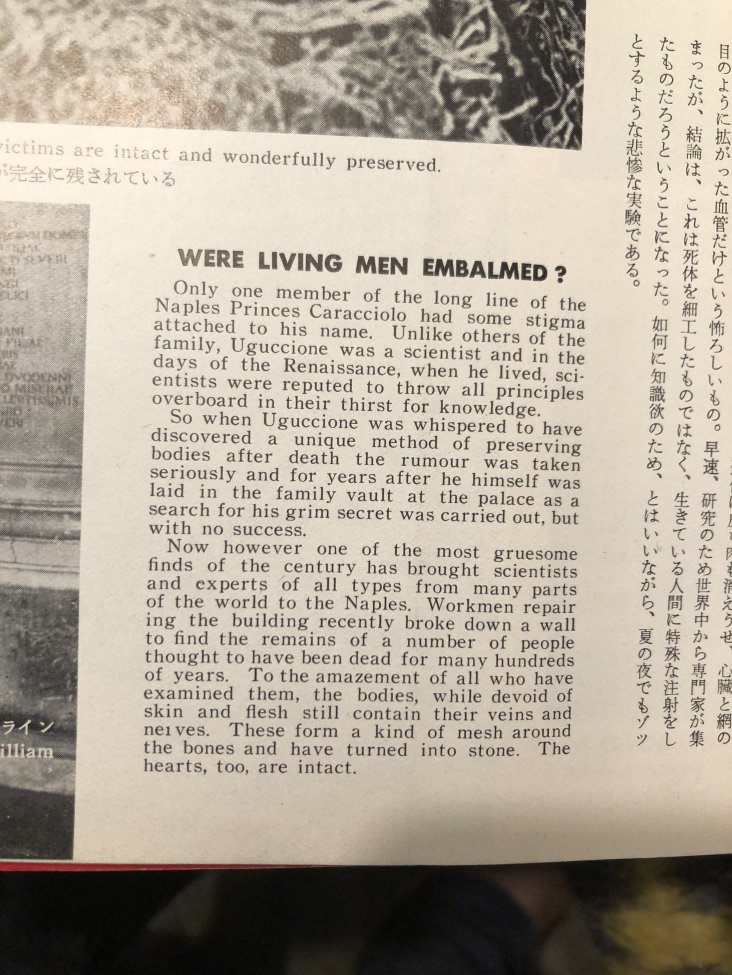
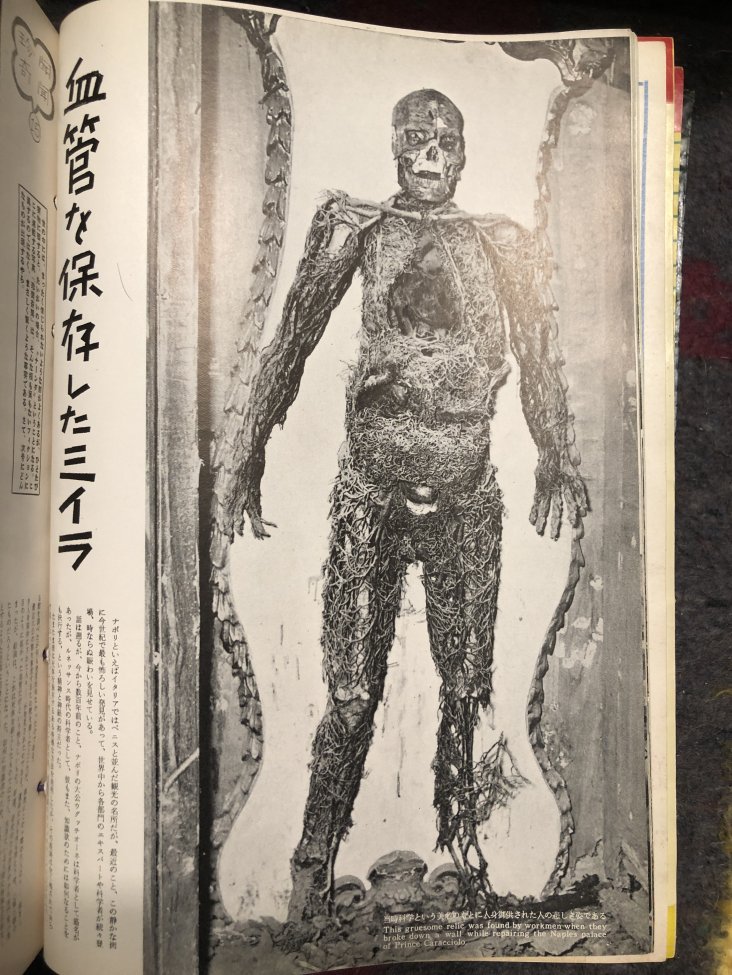
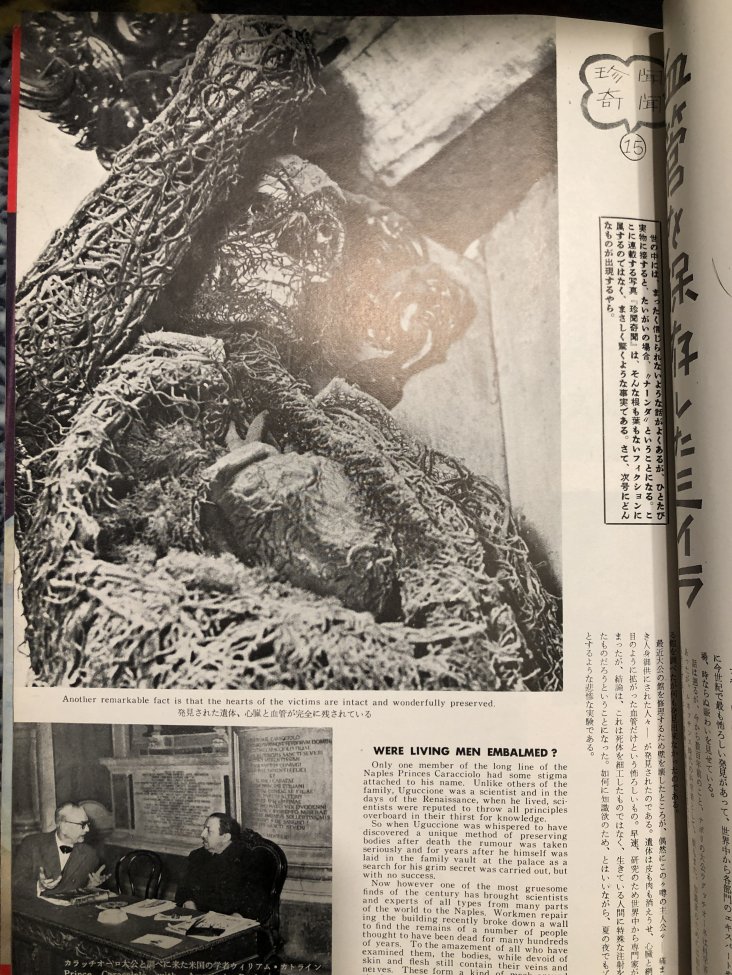
I have always thought the details of di Sangro's sculptures much too intricate and frangible to have been carved out with a chisel. What caught my attention in this discussion, however, were the photos of Francesco Queirolo's "anatomical machines." They remind me of a bizarre news item I encountered a couple of years ago in an old Japanese magazine ("Were living men embalmed?" from the June 1958 issue of International Cultural Pictorial). I had found the pictures accompanying the article so intriguing that I searched the Internet for further information on the subject. Incredibly, I found nothing at all. But chancing upon this discussion, I'm wondering if there's a connection between the embalmed bodies and the anatomical machines. Here's a picture of the magazine blurb and the accompanying photos:
wow stonified nerves and blood vessels Im pretty convinced that some few alchemists around this era discovered how to do this, I keep seeing these impossible art works always in conjunction with alchemy and the mention that the alchemist has no whatsoever qualms about experimenting on unwilling subjects . Frankenstein stuff.
Assuming the methodology of embalming a.k.a. mummy creation was known, the usage of the life pulmonary system to spread the conservative chemicals (poison) throughout the whole body is the next "logic" step. If you have psychopathic tendencies, I suspect.
Ohh- I'm starting to get the idea. Unfortunately. @HollyHoly this is sort of what you meant, right?
The fat/skin layers weren't permeated in this instance.
I wonder though- the stone eyelashes looked pretty thick- fine, but not as fine at the real thing. And the hair (in the cemetery statues) always looked less than authentic. How would the fabric or rope or wings be done, too? Would it not need - jeebus I can hardly believe I'm entertaining these thoughts- wouldn't a non-living thing need some way to push the poison/stoning agent through the cell structures? I guess they could soak it? That would make the hair less authentic-looking once it had stiffened. Effing mental.
It's always bothered me why so many famous statues noses have been damaged. After reading this thread, I'm now thinking it could very well be a 'superstition' type thing and they're giving the former person inside a chance to breathe again.
@codis yes very like Gunther Von Hagen in spirit but not in method. you do have to be a psychopath though
@ verity not a perfect process seems like it had steps or stages I think the hair is coated clothing dipped body embalamed some way and "frosted' almost forgot alchemy is obsessed with 'nano tech" apparently , if Im tracking correctly, if you get it right this stuff is some kind of nano tech with as all BS alchemy some multi stage process.
@ witchcraft, maybe to find the ones that are human from actual statues
Eureka! Yes of course- my sister went to this in England.
I couldn't bring myself to go, but maybe I was broke and that was my excuse, can't remember. I know it was a hefty price, probably more than I could afford back in London days. She said she felt sick at first but by the time they got to the other end of the display it seemed like some casual exhibition, no big deal...
walking past the corpse of a man posed as if he was running for the bus with his skin over his arm instead of his raincoat...
Still glad I didn't see it. Some things are perhaps not meant to be seen, and that sort of thing sure can't be unseen.
As for that 'stoned' sensation, I'm not a complete stranger to it, I was a teen once. One can't really move when blown out. It's a strange thing, the heaviness of the limbs.
Edit; as usual I can't let it stop just there.
The subject 'Écorché', french for 'flayed' is an anatomical art style brought about by Da Vinci and Renaissance art. There is an old torture technique similar to this. But I digress.
During the Renaissance in Italy, around the 1450 to 1600, the rebirth of classical Greek and Roman characteristics in art led to the studies of the human anatomy. The practice of dissecting the human body was banned for many centuries due to the belief that body and soul were inseparable. It wasn’t until the election of Pope Boniface VIII that the practice of dissection was once again allowed for observation.
Écorché by Paulus Pontius.
The study of anatomical figures became popular among the medical academies across Europe around the 17th and 18th century, especially when there was a lack of bodies available for dissections.
Medical students relied on these figures because they provided a good representation of what the anatomical model looks like. The écorché (flayed) figures were made to look like the skin was removed from the body, exposing the muscles and vessels of the model. Some figures were created to strip away the layers of muscles and reveal the skeleton of the model. Many of the life-size scale écorché figures were reproduced in a smaller scale out of bronze that could be easily distributed.
Écorché figures were commonly made out of many different materials: bronze, ivory, plaster, wax, or wood. By the late eighteenth and early nineteenth centuries, wax was the most popular use of material in creating écorché statues. The production of colored wax anatomies allowed for a variety of hues and tone that makes the models appear realistic
Plastic and wax. Not much in the difference visually.
The royal couple (must open, my son thought it was a photo of the real people) are made of the following;
Silicone, Wax, Silicone, Fiberglass, Resin
It's considered a 'silicon' statue.
2nd Edit; cooking in the kitchen gives one such time for reflection...
This plant was named after him; Sansevieria - Wikipedia
Other names for it; Sansevieria is a historically recognized genus of flowering plants, native to Africa, Madagascar and southern Asia now included in the genus Dracaena.
Common names for the 70 or so species formerly placed in the genus include mother-in-law's tongue, devil's tongue, jinn's tongue, bow string hemp, snake plant and snake tongue. In the APG III classification system, Dracaena is placed in the familyAsparagaceae, subfamily Nolinoideae (formerly the family Ruscaceae). It has also been placed in the former family Dracaenaceae.
So when one looks in to the genus, Dracaena it really does sound very familiar- dracula is the first sound that comes to mind. The genus of "succulents".
Blood out of nothing? Blood out of something/one me thinks.
Something I heard yesterday, in deference to my initial naivete on this subject in saying 'but fine artists wouldn't', in the languages German, Dutch, Swedish, Finnish and Norwegian, apparently the secondary term for 'blue-eyed' is 'naive.'
I'm not so sure of that, at least in some areas. Why then do we move from HD television to Ultra HD, or even the newest 8k? More realism, more detail. It isn't as if the old standard SD wasn't good enough to watch movies. After only a few seconds the logical mind still shuts off and goes into programming mode. Why the steady increase in realism?
Planned obsolescence, and other factors relating to money, I suppose. If there was a market for realistic anatomical artwork like there is for TV, we'd be seeing all sort of "innovation" in that field.
It's almost impossible to compare motives across eras especially when the motive for most anything these days is the pursuit of further wealth. I tend to think this wasn't always the case and it's hard to estimate the impact this could have on creative people. Maybe our great creative minds are all on producing season 3 of The Crown instead of inventing new ways to sculpt.
I'm not so sure of that, at least in some areas. Why then do we move from HD television to Ultra HD, or even the newest 8k? More realism, more detail. It isn't as if the old standard SD wasn't good enough to watch movies. After only a few seconds the logical mind still shuts off and goes into programming mode. Why the steady increase in realism?
Maybe ultra-realism pushes any given medium to its utmost limits of manipulation, maybe manipulation in a financial sense too, not just cultural. Fine oil paintings (or are they?) of photographic quality are still the gold standard of painting.
My boy tried a virtual reality mask on New Years Eve and said it was scary when some banditos just outside of his vision behind him told him to keep still and not to turn around. He was surrounded by other noisy children in reality but he was too scared to turn within that virtual reality.
TV is like this. A law was passed whereby military practice/tests were permitted to be filmed and then used in news broadcasts. Now we have a false flag operation on a global scale being sold as reality- straight out of that film Wag the Dog.
It's magic. It's not that the actual medium is magic per se, it's the Wizard of Oz, but the EFFECT it has creates an alternative reality. That is the magic.
It's not real unless someones perception of it is real, where it is manifested by the mind into reality proper. Propaganda. Magic.
Don't ask me why I spend time on FB- the place is mad. But there I was, scrolling through today and someone posted a collection of twitter posts about various reactions of the death of some Star Wars character. No idea who. The reactions were genuine, shocked, grieved, heart-broken. They cried in the cinema bathrooms, mourned, took pills to cope with the loss. One 32yr old woman was described anecdotally by an ex-best friend. She had a shrine set up in her home in love for the character- not even the actor but the character- and now hates Disney for ruining her life. So maybe the more realistic the detail, the more they can pluck those unwary heart-strings and mould reality to their whim.
And now for something similar you won't want to miss.
Professor C. Louis Kervran book: "Biological Trasmutations"
Free download from Rex Research. 192 Pages of fascinating facts. http://www.rexresearch.com/kervran/bioltransmtn.pdf





.jpg)


