We've talked about the idea of Resetters in America. These would be wealthy or connected men that would go West in advance of settlers and "develop" cities and towns for population. They were generally connected to politicians and given some kind of land grant, charter, directive or a (fixed) land lottery. Each individual or group of Resetters would be directed to a certain area that was suspected of being a mud buried city, like Omaha or Independence. Of course the politicians knew exactly where to assign Resetters to based on the reports from Lewis and Clark, Zebulon Pike, Father Pierre DeSmet, John C. Frèmont, Army officers and scouts, and countless fur trappers. The Resetters would go to their assigned locations and proceed to organize the digging out, rebuilding of some builings and tearing down of others, assigning buildings to government/church/fraternal organizations, then photographing the city for brochures to take over to Europe to recruit some residents, and finally assisting said new residents to reach the promised new home.
I would like to use this thread for all forum members to report on Resetters that they have run across during research. There are generally silly stories attached to the birth of each city to diffuse the fraudulent origins. In the past I would have seen these stories as cute or quirky facts that endured through time. But now the same stories cause alarms to go off in my head and I try to figure out the REAL story.
------------
The first Resetter I want to bring up is a man named Dr. Winthrop Foote. He has both Medical and Law degrees from Columbia University, was one of the first doctors in Indiana, is the father of the Indiana limestone industry, was a prosecuting attorney, county commissioner and county treasurer, has a unique grave that should be on Atlas Obscura -- but somehow isn't important enough to have a Wikipedia page! (This in itself points to him being an official Resetter, since he is somewhat hidden from history by not being easily searchable.)
I heard about him from Adventures With Roger, a Youtube channel about Southern Indiana. I like Roger's style and dedication to history, he just doesn't understand that he is researching a false narrative. Here's his three part video on Dr Winthrop Foote.
View: https://youtu.be/_pAxYIuQ0Ac?si=XJKu1ZlpQwGWIK-b
I will summarize the information in the videos for you. I have also fleshed out the information from these and other sources:
Title
Lawrence County Indiana - Community - Some History
(My comments and interpretations will be in italics.)
Winthrop Foote was born a younger child to a large, poorish family in Newtown, Connecticut, in 1787.
(That would be the same Newtown associated with Sandy Hook Elementary. Which also is where a lot of descendants of Puritans are concentrated, I learned while researching this thread. The Puritans are some of the original collaborators / Resetters. It makes so much more sense why Sandy Hook was able to take place as it did.)
Winthrop's older brother Ziba was brilliant and instilled a love of learning in Winthrop. Ziba obtained a four year degree at Yale in just one year of schooling and went west as a surveyor of newly opened lands.
(Ziba obviously was noticed by someone important in his local community. He came from a poor family, but went to Yale. He was fast-tracked through Yale and was immediately placed in training to be a surveyor. I see this as a smart but poor child who got groomed by a local Freemason to become a Resetter... I just took some time looking into Ziba specifically. His best friend growing up was David Sanford. He followed David to Yale and was becoming a surveyor because that's what David had chosen to do. I looked into the history of the Sanford family in Connecticut. They were part of the original Puritan settlers, that came over around 1630. These early settler families would have definitely known about and used any previously existing buildings, and would become, by default, the original Resetters of New England. The Sanfords became prominent citizens, leaders and business owners in New Haven, Milton and Newtown. I am certain that David Sanford was the scion of an original Resetter family, since his intended job was to survey newly opened land. His close friend Ziba was noticed for his intelligence and also moulded to serve as a Resetter in newly acquired lands. They may even have been lovers.)
Ziba ended up drowning in the Indiana wilderness and was buried there. (David had died in his arms from illness several weeks earlier.) Back in Newtown, Winthrop was crushed by this and vowed to get his brother's bones back and give them a proper burial. He got degrees from Columbia University to be a doctor and a lawyer. He chose doctor and headed out to the Indiana wilderness to offer his services to the settlers in Palestine, Indiana, at the end of 1818.
(When the golden child Ziba died, the Freemasons then groomed his brother Winthrop to replace him. They made sure he had two degrees, a doctor and a lawyer, so he could consolidate more power, authority and respect where he was assigned. He had his instructions to rebuild the area he was sent to and the knowledge and abilities to become the richest and most important man in the area. Indiana had just become a state in 1816 following the "New Purchase" of the area from native tribes. In the 1800's the Freemasons would have been in a constant state of grooming Resetters as each new chunk of land was taken from the natives and more areas opened up.)
Dr Winthrop Foote became well loved as a doctor in Palestine, Lawrence County, Indiana. He would swim across rivers and ride his horse up to 70 miles to see patients. He passed the Indiana bar exam in 1819 and became the local prosecuting attorney as well as continuing his medical practice. In 1820 he took a trip west and retrieved the bones of his brother Ziba to be re-interred in the Palestine cemetary. Around this same time he met his future wife, Cynthia, who was the sister-in-law of the founder of Palestine, a civil engineer named Robert Carlton. There's a story that in 1822 Dr. Foote plastered the Palestine courthouse all by himself, a large two-story building.
(He was willing to ride so far to see patients because he was exploring the surrounding area. I believe he was close to a very nice pre-existing town and had already started to rehabilitate it. The courthouse story sounds like he rehabbed a pre-existing building by himself where he was at in Palestine. Or, more likely, had slaves working on digging the courthouse out and help from Masons to fix the stone, then Foote just replastered the outside to make it look fresh and new. And of course his future bride is the sister of the town founder, Robert Carlton, who would have found remnants of at least that courthouse when he first got there. Carlton may have been an earlier Resetter and Freemason himself. And the marriage helped keep the secrets hidden.)
Everything went smoothly until a 'malaria epidemic' in Palestine, which was low lying near a river, and many people died. Dr. Foote traveled to consult with the two doctors that he had come to Indiana with originally, who were in Salem and Bloomington. They convinced Foote to move the town to higher ground to avoid disease.
(These two doctors would have been fellow Freemasons that were groomed concurrently with Foote to be Resetters. This in-person 'consultation' was his cover for receiving updated instructions from his superiors. He must have gotten enough restoration work done on the new town location he had discovered near Palestine. Now it was time to initiate the cover story of malaria. Many reset cities in the American Midwest and West mention malaria epidemics as part of their early history. Perhaps it is part of a set routine.)
Foote petitioned the state and on February 9, 1825, the Indiana legislature approved the full scale move of Palestine to a higher location several miles away. Townspeople would receive identical land plots in the new location without cost. This area became downtown Bedford, Indiana. Six businessmen donated the land. The residents dismantled their log cabins in Palestine to move to the new location, where they reassembled them. The two story courthouse (that Dr. Foote had refinished himself) was sold to Moses Fell, who dismantled it brick by brick to build new buildings in the new location.
(Dr. Foote was finally finished fixing up the entire city of Bedford that he had discovered and rehabbed enough for residents to move in. I think the poorer folks may have dismantled their log cabins and moved them to their new plots in Bedford. But I'm pretty sure that there were mud flood mansions available for Dr. Foote and the 'six businessmen.' And mud flood stone edifices for government buildings, churches, schools and Masonic halls. And they even have a cover story for the mud flood courthouse to be removed, since it was too big for Foote to have really built by himself.)
Here's some pictures of early buildings in Bedford, Indiana:


(These people really had a preference for castles with turrets, didn't they? And buried basements. Check out that jail! Did the guards patrol on top of the tower, ready to sink a crossbow shaft in the backs of escaping prisoners? It seems a little overdone for a small Indiana town...)
Here's the county courthouse:

(The courthouse reveals itself to be an undeniable mud flooded building in 1930 when it was finally dismantled to make room for a new courthouse.)


Sometime around 1824-1826, Dr. Foote visited New Harmony, Indiana, a utopian religious community that respected all gods.
(I'm not sure if he was looking for ideas to make Bedford a Utopian community. More likely he was there on a spy mission for the Freemasons. Or perhaps New Harmony hosted some big occult festival that Foote attended.)
At some point Foote had found a limestone quarry while out riding his horse around to see patients. Around 1830 he founded (found?) the Blue Hole Limestone Quarry and brought in a stonemason named Samuel Tobin from Kentucky to work it. Bedford grew quickly with the ready made population and easy access to limestone. It became known as "Stone City" and shipped limestone all over the world. Foote was known as the "Father of the Limestone Industry." Of course he was very wealthy.
One of the things he spent his money on was his tomb. He had Samuel Tobin carve a large limestone slab into a vault and had a coffin made wrapped with iron and compared to an Egyptian sarcophagus. He had his brother's bones dug up from the abandoned Palestine graveyard and re-re-interred them in this final location.
There ended up being some scandals at the end of his life, things really fell apart for him. A couples of his children died and he started drinking heavily. After close to 30 years of marriage his wife divorced him because he was an alcoholic and was sleeping with a much younger woman. His children ended up suing him for a portion of the estate, claiming he was being irresponsible with his money (his tomb was mentioned). Foote won the lawsuit, married the younger woman, died a few months later, and was buried in his grand tomb. With his brother Ziba next to him.
---------
Here is the grave of him and his brother Ziba. Looks very ritualistic and/or Masonic. It's near his Blue Hole limestone quarry in the woods. It's said it was one large slab that had fallen from a nearby cliff and was then worked into a vault by his stonecutter friend Tobin.
(What was special about this location? Was this stone a monolith that had fallen from an ancient ruined hilltop city? The very same city he had mined to ship around the world?)


----------
And this is the grave of his wife, Cynthia Foote, and most of his children in Bedford's Green Hill Cemetary. In a regular graveyard, not near Foote's hillside masoleum. Both Dr. and Mrs. Foote have the same marker on top, perhaps to channel energy up or down. Both obelisks originally had globes on the top, I don't know if they were stone or metal. Mrs. Foote was most likely a member of a female branch of the Freemasons.

Here's an article about the ceremony. The caretaker at this cemetary uses divining rods to find old unmarked graves. There are some pretty amazing carved limestone grave markers in this place. Because of all the stonemasons and limestone that were concentrated there.
The cemetery documents Bedford's past. But its historic limestone monuments are crumbling.
-----------
I have come to understand that there are so many Resetters we can't possibly name them all. Any man with money or connections was offered an opportunity to found a town.
Freemasons on East Coast got word from trappers, explorers, surveyors and military regarding the locations of mud flood cities and towns across the Midwest and West. The surveyors they sent out were trained in what to look for and probably were able to follow the buried railroad tracks and canals. We're able to see the straight lines today on satellite images like Google Earth, so why not then?
Freemason lodges in large, established cities would assign many of their members to become Resetters. The men would be willing, as they understood the riches and real estate that came with being a Resetter. The Masons would be recruited/assigned as investors in each new town, with expectations that they would move to the town and rehabilitate it - repair what they could, destroy what couldn't be repaired, and dig, dig, dig, until the new town looked believable. I think there were crews of Masons with slave labor that would travel to where they were assigned, including a small support system of cooks, launderesses and livestock. When a town was completed they would leave for the next assignment, just ahead of the advancing settlers.
Populating the newly rehabbed cities was done a few ways:
- Move nearby populations into the newly prepared town using disease or disaster (such as fire) taking place in the old town, like what happened when Palestine moved to Bedford.
- Recruit settlers from within America, generally done by newspaper advertisements or word of mouth within churches and social organizations.
- Recruiting in Europe seemed to be done individually by the Resetters. The Resetter or his agent would travel to Europe with pictures of their city. They might choose a country to recruit from that had similar geography or weather conditions to their city. Or they might choose a country based on thier own nationality. It was an important choice since they were about to become the leader of this new community they were forming. The recruiter would then shepherd the group onto a boat, across the ocean, through immigration, by train and wagon to the newly rehabbed city, and install the families into pre-existing homes and apartments. These strangers in a strange land would be happy for the fresh start and keep their questions to themselves about how the buildings got there.
--------
Enough for now. Please post regatding obvious Resetters. Thanks for reading.
I would like to use this thread for all forum members to report on Resetters that they have run across during research. There are generally silly stories attached to the birth of each city to diffuse the fraudulent origins. In the past I would have seen these stories as cute or quirky facts that endured through time. But now the same stories cause alarms to go off in my head and I try to figure out the REAL story.
------------
The first Resetter I want to bring up is a man named Dr. Winthrop Foote. He has both Medical and Law degrees from Columbia University, was one of the first doctors in Indiana, is the father of the Indiana limestone industry, was a prosecuting attorney, county commissioner and county treasurer, has a unique grave that should be on Atlas Obscura -- but somehow isn't important enough to have a Wikipedia page! (This in itself points to him being an official Resetter, since he is somewhat hidden from history by not being easily searchable.)
I heard about him from Adventures With Roger, a Youtube channel about Southern Indiana. I like Roger's style and dedication to history, he just doesn't understand that he is researching a false narrative. Here's his three part video on Dr Winthrop Foote.
View: https://youtu.be/_pAxYIuQ0Ac?si=XJKu1ZlpQwGWIK-b
I will summarize the information in the videos for you. I have also fleshed out the information from these and other sources:
Title
Lawrence County Indiana - Community - Some History
(My comments and interpretations will be in italics.)
Winthrop Foote was born a younger child to a large, poorish family in Newtown, Connecticut, in 1787.
(That would be the same Newtown associated with Sandy Hook Elementary. Which also is where a lot of descendants of Puritans are concentrated, I learned while researching this thread. The Puritans are some of the original collaborators / Resetters. It makes so much more sense why Sandy Hook was able to take place as it did.)
Winthrop's older brother Ziba was brilliant and instilled a love of learning in Winthrop. Ziba obtained a four year degree at Yale in just one year of schooling and went west as a surveyor of newly opened lands.
(Ziba obviously was noticed by someone important in his local community. He came from a poor family, but went to Yale. He was fast-tracked through Yale and was immediately placed in training to be a surveyor. I see this as a smart but poor child who got groomed by a local Freemason to become a Resetter... I just took some time looking into Ziba specifically. His best friend growing up was David Sanford. He followed David to Yale and was becoming a surveyor because that's what David had chosen to do. I looked into the history of the Sanford family in Connecticut. They were part of the original Puritan settlers, that came over around 1630. These early settler families would have definitely known about and used any previously existing buildings, and would become, by default, the original Resetters of New England. The Sanfords became prominent citizens, leaders and business owners in New Haven, Milton and Newtown. I am certain that David Sanford was the scion of an original Resetter family, since his intended job was to survey newly opened land. His close friend Ziba was noticed for his intelligence and also moulded to serve as a Resetter in newly acquired lands. They may even have been lovers.)
Ziba ended up drowning in the Indiana wilderness and was buried there. (David had died in his arms from illness several weeks earlier.) Back in Newtown, Winthrop was crushed by this and vowed to get his brother's bones back and give them a proper burial. He got degrees from Columbia University to be a doctor and a lawyer. He chose doctor and headed out to the Indiana wilderness to offer his services to the settlers in Palestine, Indiana, at the end of 1818.
(When the golden child Ziba died, the Freemasons then groomed his brother Winthrop to replace him. They made sure he had two degrees, a doctor and a lawyer, so he could consolidate more power, authority and respect where he was assigned. He had his instructions to rebuild the area he was sent to and the knowledge and abilities to become the richest and most important man in the area. Indiana had just become a state in 1816 following the "New Purchase" of the area from native tribes. In the 1800's the Freemasons would have been in a constant state of grooming Resetters as each new chunk of land was taken from the natives and more areas opened up.)
Dr Winthrop Foote became well loved as a doctor in Palestine, Lawrence County, Indiana. He would swim across rivers and ride his horse up to 70 miles to see patients. He passed the Indiana bar exam in 1819 and became the local prosecuting attorney as well as continuing his medical practice. In 1820 he took a trip west and retrieved the bones of his brother Ziba to be re-interred in the Palestine cemetary. Around this same time he met his future wife, Cynthia, who was the sister-in-law of the founder of Palestine, a civil engineer named Robert Carlton. There's a story that in 1822 Dr. Foote plastered the Palestine courthouse all by himself, a large two-story building.
(He was willing to ride so far to see patients because he was exploring the surrounding area. I believe he was close to a very nice pre-existing town and had already started to rehabilitate it. The courthouse story sounds like he rehabbed a pre-existing building by himself where he was at in Palestine. Or, more likely, had slaves working on digging the courthouse out and help from Masons to fix the stone, then Foote just replastered the outside to make it look fresh and new. And of course his future bride is the sister of the town founder, Robert Carlton, who would have found remnants of at least that courthouse when he first got there. Carlton may have been an earlier Resetter and Freemason himself. And the marriage helped keep the secrets hidden.)
Everything went smoothly until a 'malaria epidemic' in Palestine, which was low lying near a river, and many people died. Dr. Foote traveled to consult with the two doctors that he had come to Indiana with originally, who were in Salem and Bloomington. They convinced Foote to move the town to higher ground to avoid disease.
(These two doctors would have been fellow Freemasons that were groomed concurrently with Foote to be Resetters. This in-person 'consultation' was his cover for receiving updated instructions from his superiors. He must have gotten enough restoration work done on the new town location he had discovered near Palestine. Now it was time to initiate the cover story of malaria. Many reset cities in the American Midwest and West mention malaria epidemics as part of their early history. Perhaps it is part of a set routine.)
Foote petitioned the state and on February 9, 1825, the Indiana legislature approved the full scale move of Palestine to a higher location several miles away. Townspeople would receive identical land plots in the new location without cost. This area became downtown Bedford, Indiana. Six businessmen donated the land. The residents dismantled their log cabins in Palestine to move to the new location, where they reassembled them. The two story courthouse (that Dr. Foote had refinished himself) was sold to Moses Fell, who dismantled it brick by brick to build new buildings in the new location.
(Dr. Foote was finally finished fixing up the entire city of Bedford that he had discovered and rehabbed enough for residents to move in. I think the poorer folks may have dismantled their log cabins and moved them to their new plots in Bedford. But I'm pretty sure that there were mud flood mansions available for Dr. Foote and the 'six businessmen.' And mud flood stone edifices for government buildings, churches, schools and Masonic halls. And they even have a cover story for the mud flood courthouse to be removed, since it was too big for Foote to have really built by himself.)
Here's some pictures of early buildings in Bedford, Indiana:
(These people really had a preference for castles with turrets, didn't they? And buried basements. Check out that jail! Did the guards patrol on top of the tower, ready to sink a crossbow shaft in the backs of escaping prisoners? It seems a little overdone for a small Indiana town...)
Here's the county courthouse:
(The courthouse reveals itself to be an undeniable mud flooded building in 1930 when it was finally dismantled to make room for a new courthouse.)
Sometime around 1824-1826, Dr. Foote visited New Harmony, Indiana, a utopian religious community that respected all gods.
(I'm not sure if he was looking for ideas to make Bedford a Utopian community. More likely he was there on a spy mission for the Freemasons. Or perhaps New Harmony hosted some big occult festival that Foote attended.)
At some point Foote had found a limestone quarry while out riding his horse around to see patients. Around 1830 he founded (found?) the Blue Hole Limestone Quarry and brought in a stonemason named Samuel Tobin from Kentucky to work it. Bedford grew quickly with the ready made population and easy access to limestone. It became known as "Stone City" and shipped limestone all over the world. Foote was known as the "Father of the Limestone Industry." Of course he was very wealthy.
One of the things he spent his money on was his tomb. He had Samuel Tobin carve a large limestone slab into a vault and had a coffin made wrapped with iron and compared to an Egyptian sarcophagus. He had his brother's bones dug up from the abandoned Palestine graveyard and re-re-interred them in this final location.
There ended up being some scandals at the end of his life, things really fell apart for him. A couples of his children died and he started drinking heavily. After close to 30 years of marriage his wife divorced him because he was an alcoholic and was sleeping with a much younger woman. His children ended up suing him for a portion of the estate, claiming he was being irresponsible with his money (his tomb was mentioned). Foote won the lawsuit, married the younger woman, died a few months later, and was buried in his grand tomb. With his brother Ziba next to him.
---------
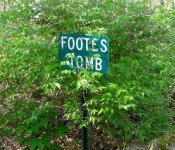
Here is the grave of him and his brother Ziba. Looks very ritualistic and/or Masonic. It's near his Blue Hole limestone quarry in the woods. It's said it was one large slab that had fallen from a nearby cliff and was then worked into a vault by his stonecutter friend Tobin.
(What was special about this location? Was this stone a monolith that had fallen from an ancient ruined hilltop city? The very same city he had mined to ship around the world?)
----------
And this is the grave of his wife, Cynthia Foote, and most of his children in Bedford's Green Hill Cemetary. In a regular graveyard, not near Foote's hillside masoleum. Both Dr. and Mrs. Foote have the same marker on top, perhaps to channel energy up or down. Both obelisks originally had globes on the top, I don't know if they were stone or metal. Mrs. Foote was most likely a member of a female branch of the Freemasons.
Here's an article about the ceremony. The caretaker at this cemetary uses divining rods to find old unmarked graves. There are some pretty amazing carved limestone grave markers in this place. Because of all the stonemasons and limestone that were concentrated there.
The cemetery documents Bedford's past. But its historic limestone monuments are crumbling.
-----------
I have come to understand that there are so many Resetters we can't possibly name them all. Any man with money or connections was offered an opportunity to found a town.
Freemasons on East Coast got word from trappers, explorers, surveyors and military regarding the locations of mud flood cities and towns across the Midwest and West. The surveyors they sent out were trained in what to look for and probably were able to follow the buried railroad tracks and canals. We're able to see the straight lines today on satellite images like Google Earth, so why not then?
Freemason lodges in large, established cities would assign many of their members to become Resetters. The men would be willing, as they understood the riches and real estate that came with being a Resetter. The Masons would be recruited/assigned as investors in each new town, with expectations that they would move to the town and rehabilitate it - repair what they could, destroy what couldn't be repaired, and dig, dig, dig, until the new town looked believable. I think there were crews of Masons with slave labor that would travel to where they were assigned, including a small support system of cooks, launderesses and livestock. When a town was completed they would leave for the next assignment, just ahead of the advancing settlers.
Populating the newly rehabbed cities was done a few ways:
- Move nearby populations into the newly prepared town using disease or disaster (such as fire) taking place in the old town, like what happened when Palestine moved to Bedford.
- Recruit settlers from within America, generally done by newspaper advertisements or word of mouth within churches and social organizations.
- Recruiting in Europe seemed to be done individually by the Resetters. The Resetter or his agent would travel to Europe with pictures of their city. They might choose a country to recruit from that had similar geography or weather conditions to their city. Or they might choose a country based on thier own nationality. It was an important choice since they were about to become the leader of this new community they were forming. The recruiter would then shepherd the group onto a boat, across the ocean, through immigration, by train and wagon to the newly rehabbed city, and install the families into pre-existing homes and apartments. These strangers in a strange land would be happy for the fresh start and keep their questions to themselves about how the buildings got there.
--------
Enough for now. Please post regatding obvious Resetters. Thanks for reading.