The Daily Fake

feralimal

Core Member
Active Member
Joined
Aug 31, 2020
Messages
1,140
Reaction score
2,176
On an almost daily basis I see a history related story in the news that seems suspicious to me. Mostly I can't actually be bothered to do a long dissection or investigation of whatever-it-is - there's only so much time. However, I think it would be useful to have a thread where we can dump a short snippet or link with a short commentary about why it seems suspicious. So this is that thread! I'm hoping that as-and-when I see one of these articles I'll find the time to make a short post to catch some of the potential historical fakery.
 
Last edited:
2023/08/28 - ‘Homer and His Iliad’ by Robin Lane Fox review | History Today

Historian Robin Lane Fox has written a book on Homer. The link is to a review of his book. It reads:

But according to Lane Fox he was not simply a poet. He may have been a charioteer – ‘I like to believe he drove a racing team himself’ – a hunter, even a ‘putative gardener’. In fact, as he sharpens into focus, this Homer increasingly becomes a mirror image of Lane Fox, himself a great horseman
.. who also writes a gardening column.

Lane Fox, an atheist, is the father of Martha Lane Fox and Henry Lane Fox. Martha is an entrepreneur and crossbench life peer who co-founded Lastminute.com. Henry is CEO of a website, The Browser.[22][23]

As gardening correspondent of the Financial Times, Lane Fox is an outspoken opponent of garden gnomes.[24]
from Robin Lane Fox - Wikipedia

Homer increasingly becomes a mirror image of Lane Fox
Remarkable.

This is supportive of the idea that historians are simply those who are licensed to write (themselves into) the record.
 
Last edited:
2023/08/28 - Algorithm for offsetting a latitude/longitude by some amount of meters

From the thread:
If your displacements aren't too great (less than a few kilometers) and you're not right at the poles, use the quick and dirty estimate that 111,111 meters (111.111 km) in the y direction is 1 degree (of latitude) and 111,111 * cos(latitude) meters in the x direction is 1 degree (of longitude).
and
Incidentally, these magic numbers of 111,111 are easy to remember by knowing some history: the French originally defined the meter so that 10^7 meters would be the distance along the Paris meridian from the equator to the north pole. Thus, 10^7 / 90 = 111,111.1 meters equals one degree of latitude to within the capabilities of French surveyors two centuries ago.

Amazingly it is the use of '111111' that is the best way to model offsets on a globe earth.
 
I hope this qualifies for this thread...

"A temenos (Greek: τέμενος; plural: τεμένη, temenē) is a piece of land cut off and assigned as an official domain, especially to kings and chiefs, or a piece of land marked off from common uses and dedicated to a god, such as a sanctuary, holy grove, or holy precinct." Source

In the news yesterday...

"What’s Brewing after Temenos Partners with MongoDB?
Temenos achieved high-performance benchmark results for its Banking Cloud platform on Microsoft Azure and MongoDB Atlas, simulating a large-scale client with multiple offerings on a single cloud instance." Source

It turns out that these days Tememos is...

"The Single, Integrated Temenos Platform - Temenos
Temenos was the first technology solution provider to provision a complete core banking system on the public cloud in 2011, and since then all of Temenos' software solutions have become cloud-native and cloud-agnostic." Source

So, now Tememos is a domain cut off from common use and assigned to the kings and chiefs of the god Finance as his holy sanctuary for money. However, it is "cloud-agnostic" and therefore seems not to be sure if it really exists or not.

This kind of misappropriation of ancient and historic terminology goes on all the time. I wonder if it's intended to bring with it some of the former glory and sanctity of the original meaning, or maybe it's just the usual inversion / reversal trick where everything spiritual is turned to base materialism.

Incidentally, "tenemos" is a Spanish word that means "we have" ...as in "we have all your money and personal data."
 
Peru: Priest of Pacopampa exhumed after 3,000 years

Project leader Yuji Seki told Reuters news agency that the large size of the tomb, nearly 2m (2.2 yards) in diameter and 1m deep, was "very peculiar," as was the position of the body lying face down with one half of his body extended and feet crossed.

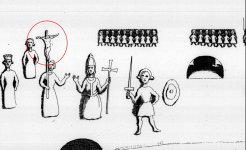
Perhaps a bit like the fella below, circled in red:

circled_basting_victim_left_side_grid_hanging.jpg
Image depicts Royston Cave wall carving, Royston, Hertfordshire.

About five miles south of Royston is Clothall.

From Clothall - Victoria County History:
The most notable of the scattered homesteads is Quickswood, which lies to the north-east of the church near the site of the former residence of the Earls of Salisbury.

The cock-pit may still be seen in a field to the north of the old house.

Sounds like they uncovered a cock-pit AKA koch-pit AKA cook-pit, complete with lunch formerly on a stick.

Accompanying photo shows rocks in with the skeleton. Perhaps those folks were boiling water with hot rocks. Or just roasting him over a dry hot rocks.
 
Last edited:
The world has become so utterly ridiculous, the news isn't the actual news anymore (although I always think it was set up to be a propaganda machine) a skewed slice of the truth sprinkled with some fear and anticipation for good measure.

This will be a good post to follow along with over the coming years, I am in the same boat as you @feralimal believing His Story to be changed almost daily with small reconciliations or deletions to ensure the "main story or plot" can be changed when needed.

Will be sure to chip in!
 
What Can Historical Clothing Reveal That Other Sources Cannot? | History Today

How historical clothing can tell us about the wearers.. and serve present day agendas!

There's lots of nonsense in this article, using 'fashion' to draw in atypical history interest, promote the V&A, Levi's, etc as well giving us all a further opportunity to reflect on the social justice issues of the present day.

Here are some quotes:
Are those clothes real? This question is often asked when looking at Tudor and Jacobean portraits...
I love the opening line of the article.

Yet surviving shirts and smocks divulge the secrets of their craft, including the finesse of their stitching compared to that of tailors; their careful use of the full loom width of linen and a ‘zero-waste’ approach to fabric
"zero-waste". Clothes used to be more sustainable and have far lower carbon emissions too, back then.

Written descriptions of 16th-century clothing are often brief, and children’s clothing, especially for the lower and middling sorts, is under-recorded. These scant references can be expanded by examining a surviving mitten and vest
Ok - I'll have to remember that, when I next hear about someone pulling a mitten out of a clay tablet or something..

Its study reveals the histories of those who have been continually placed outside the mainstream due to their race, culture, gender, class or sexuality, allowing us to get closer to the wearer.
I think I know what's coming...
Born around 1690, the 18th-century free Black Jamaican scholar Francis Williams is a complex figure. Among the only written traces of his extraordinary life that remain are stanzas from his Latin poetry, and a derisive chapter about him written by the slavery apologist Edward Long in The History of Jamaica: or, General Survey of the Ancient and Modern State of that Island (1774). Racist beliefs that African people are inferior, backward and barbaric can be traced back to the slave trade, colonialism and 18th-century slave owners such as Long. Long ridicules Williams, using him to legitimate the plantation slavery system on which his own wealth was secured. Long had spent 12 years in Jamaica but had never been to Africa. He was not a scientist, but his proclamations about Africans were taken as scientific fact.
White slave owner, who was not a scientist, ridicules "backward" slave.
The V&A is home to the only known portrait of Williams. Painted in 1745, he is depicted as a gentleman scholar, classically educated in such subjects as geography, arithmetic, music, astronomy and Latin. Williams stands in his study in front of his bookcase surrounded by the tools of learning. He is dressed in the fashions of the day: a powdered wig, an elegant navy-blue broadcloth coat with gold buttons, breeches, stockings and buckled shoes. Williams’ self-fashioning supports what we know of his biography and his desire to be part of the Enlightenment elite. He was educated partially in England, became a member of Lincoln’s Inn (a professional association for barristers) and attended Royal Society meetings. The painting, which some scholars believe is a self-portrait, refutes Long’s assertions, demonstrating the way in which history writing can be contradicted by the study of fashion.
But Williams (the slave) was classically educated, a member of Lincoln's Inn and went to the Royal Society (masonic institution). He even painted his own portrait!

That above seems a great example of a historical re-write. As Oisin (phd historian) told us, present day historians are busy writing history for subaltern voices:
There are certainly historians who are set in their ways, but I don’t think that as a discipline history is stagnant. Actually, it is a really exciting moment to be a historian right now. The amount of new work that is being done to recover what are called ‘subaltern voices’, the histories of people who have been traditionally excluded from historical narratives like women, LGBT+ people, people of colour, people in poverty, etc., means that the discipline is changing very rapidly and new vistas of opening up all the time. The reason I love being a historian is that every day I work with documents and objects that give me insights into the lives of people who have been systematically ignored, and whose stories I have the chance to bring to light.
from: SH Archive - Ask Pro | - Questions for History Professionals

Then we move into the Levi's promotional section:
Jeans are one of the world’s most popular items of clothing.
The other patched-up and cut-off pair from the 1880s have been worn threadbare by hard labour, with the wax splatters giving a clue to their owner toiling by candlelight. These trousers are clearly labelled Levi Strauss, along with an imprint that claims: ‘Made by White Labour’ – a bigoted boast to appeal to consumers after Congress passed the Chinese Exclusion Act of 1882. Both pairs bore witness to important moments in American history.

Then a little piece to explain that even in the past law and legislation helped us in our fight against racial injustice:
In the Spanish Empire, garments acted as an important way for subjects to define themselves in relation to their peers. By the 17th century, the Spanish Crown had instituted sumptuary laws – statutes that barred select groups from wearing certain clothing or using socially charged items – to create clear boundaries between different communities.
By the time Charles II wrote to Rivera, hundreds of Indigenous individuals and castas (people with mixed Spanish, Indigenous and African heritage) had sued for their right to wear the clothing and accessories withheld from them – and they won. In doing so, they used clothing to fight for their right to belong in Spanish society.
Its not that the entire structure is owned, as we can see that even kings have to bow before the law.. right?
 
Last edited:
By the time Charles II wrote to Rivera, hundreds of Indigenous individuals and castas (people with mixed Spanish, Indigenous and African heritage) had sued for their right to wear the clothing and accessories withheld from them – and they won. In doing so, they used clothing to fight for their right to belong in Spanish society.

I think that qualifies as one of the most ridiculous things I've ever heard.

Staying with the same region of the world, many may have noticed the increased media activity regarding UFO disclosure and reports of imminent invasion. Seems that now they have reclassified the whole UFO thing and are calling it UAP, Unidentified Anomalous Phenomena, whilst in Spanish it was always OVNI, but has recently changed to FANI by NASA ...who can always be relied upon for a load of old fanny, of course.

Coincidentally with this reclassification, something highly sinister has come to light that's been occurring in South America for quite some time now. This 'Unidentified Anomalous Phenomena' is being called 'Pelacaras', which means 'face-peelers' in English. The vast majority of mainstream media is promoting this as being an alien intervention, but the truth is much more disturbing.

In brief, and not wishing to steal any sensationalism points from usselo, the phenomena involves attacks upon isolated South Americans, mostly children or young adults and frequently in the Peruvian forests. They are paralysed by an intensely bright light then their skin and certain organs are removed and they are left with their stomachs split open and stuffed full of money (yes, you did read that right - money, cash.) There have been survivors who were rescued before the organ extractions could take place and they are now permanently blind.

Obviously this situation has given rise to local legends regarding mysterious creatures, similar to the Chupacabras episodes of the last century, but without the cash element. A typical eye-witness report goes as follows:

"I have shot one twice with no effect, but it arose and disappeared. His color is silver, his shoes are round in shape and with those they rise. They float a meter high and have a red light on the top from the heel. His head is long, his mask is long and his eyes are slightly yellowish. With that they see you well and they leave. They are experts at escaping." Source

The media in the Americas have had an orgasm with all of this and the alien invasion agenda is placed front and centre. However, as I said previously, all is not quite what it seems...

"In the Peruvian jungle, people are very afraid of these types of characters. This is the name [Pelacaras] given to foreigners, who they claim are organ traffickers, who kill people to make beauty items." (ibid)

The local authorities are apparently reluctant to believe that there is anything going on or to take any action whatsoever and the money left in the stomachs of the victims is obviously meant to discourage their relatives from pursuing the matter. The local communities have been forced to form their own vigilante groups in order to protect themselves.

These organ traffickers obviously have access to some highly advanced technology that sounds a bit like hoverboards, but aliens they are not. The rewards for the fruits of their ill-gotten gains must be phenomenal and the market for them an elite and secure one - sick b*stards. For me personally, this sums up the entire 'aliens from outer space' malarkey - when it's not paranormal it's always a cover for human abuse.
 
Lunik: Inside the CIA’s audacious plot to steal a Soviet satellite

Article strapline:
How a team of spies in Mexico got their hands on Russia's space secrets—and tried to change the course of the Cold War.
My strapline:
How piling up the fiction means makes it easy to tell what's real - its all lies. Cool story, bro.

Confession?
American newspapers suggested that the Luna was a hoax and called it, incorrectly, “Lunik,” like Sputnik.

Some of the nonsense, without even considering the incoherent narrative:
“President Eisenhower ... he is in a panic,” Scott said, according to Silveti’s Tercer Milenio interview. Eisenhower had spent $110 million—nearly a billion in today’s dollars—trying to launch his own Sputnik, but was losing patience: the CIA’s CORONA program was a secret embarrassment. Seven rockets had failed, misfired, or tumbled into the Pacific ocean without even reaching orbit: meanwhile a Soviet astronaut was already in training to walk on the moon. The Luna spacecraft contained the secrets to the Soviet’s success, and, Scott said, there was an opportunity on the horizon to steal them.
$110 million, the CIA’s CORONA program - I'm hearing an echo - same names, same numbers.

The boastful Soviets had sent their Luna rockets on a world tour. At one exhibition in New York, American spies had confirmed that a Luna on display was legit. The CIA plotted to kidnap the spacecraft, loot it, and put it back without the Soviets knowing. But they dared not tamper with it on American soil.

Then the CIA learned that on November 21 the Soviet exhibition was headed to the Auditorio Nacional in Mexico City. An intercepted shipping manifest described “models of astronomic apparatus.” The dimensions of the crate matched the Luna rocket: 17 feet long and 8 feet wide. Jackpot.
Space is a hoax, so what are Luna rockets? If the scenario were real, why would the Russians take the actual rocket on a world tour? Why do the CIA need to put the rocket back? Why can't they tamper with it on American soil? Wasn't it handy that the 'boastful Soviets' labelled their rocket as 'models of astronomic apparatus'? Etc.

Characterisation of Warren L. Dean:
The second man was Warren L. Dean, Winston Scott’s deputy chief of station. A tall and dashing martini man, Dean had joined the FBI and chased Nazis in Bolivia and Chile, before serving under Scott in London and then joining him in Mexico City. Dean watched workers load the cargo from the Soviet boat onto a train, and asked his colleague if they could somehow grab it during its journey to the auditorium.
Martini? Shaken, not stirred, right?
Dean stood half a foot taller than Silveti, and, while his Mexican counterpart was something of a party animal, the American enjoyed coaching his son’s little league team and doted on Happy, his family’s miniature dachshund, who was heavily pregnant.
'"Happy" the pregnant miniature daschund' sounds like the punchline of some inside joke that I don't get.

The "Dwayne Day, American space historian" (aka liar):
The Luna connected to the same type of rocket that powered the Soviet missiles pointed at the US. Dwayne Day, an American space historian, agrees that the Americans were more concerned with national defense than the race to the moon. The Luna contained “data that they could use to understand the Soviet rocket that launched it,” he says.

The plan:
Eventually, they settled on a plan. Silveti and his team of spies would need to hijack the truck carrying the spacecraft on the evening it left the exhibition. They would re-route it to a lumber yard owned by his brother-in-law, where CIA engineers would arrive in the dead of night to dismantle and inspect it. They would have to somehow return it to the Soviets by seven o’clock the next morning. Dean would carefully monitor Silveti, and Zambernardi would deliver the stolen secrets to the US.
But what about the KGB agents:
Meanwhile, the farewell party was underway at the hotel. According to Silveti, the Soviet soldiers “let loose with the American prostitutes, and with the drinks.” Zambernardi’s son Paul told me that his father bought LSD to “put a Mickey on them all.” With every shot of tequila, thoughts of shipping manifests and cargo evaporated.
who writes this stuff??

Anyway - if you enjoyed this brief taste of what appears to be a rejected James Bond screenplay, I encourage you to read the rest of the MIT article.
 
Last edited:
I came across this whilst searching for images to illustrate the next upcoming episode of The Dark Earth Chronicles. It involves Saint Columba, the BBC and Bayesian archaeology.

First some background info on St. Columba... which probably wasn’t his given name. In Gaelic it means ‘dove’ which is also the Latin meaning and that's weird because Gaelic is a ‘Celtic’ language while Latin is ‘Italic’… sorry ‘Italic’. His father was what they now call a semi-mythical figure who was one of the ancient High Kings of Ireland. His grandmother on his father’s side, was claimed to be Saxon, or at least Romano-British, which conforms to the 6th century that the official narrative stipulates for his existence. After a thoroughly monastic education or two or three, St. Columba left Ireland. Some say he was exiled, but most prefer to call it a 'pilgrimage', although where he was pilgriming to is never specified. There are tales of some form of conflict which gained him the reputation of being a ‘warrior saint’. He left in a wicker currach covered with leather accompanied by 12 apostles, no sorry, 12 ‘companions’. That must have been some currach to hold 13 people and all their possessions and supplies. Once again, we have the familair ‘One plus Twelve’ coven, which is the trademark of Christian manipulation.

St. Columba was bound for the Isle of Iona. Iona is currently a small island 2km from a much bigger island called Mull on the west coast of Scotland. It was here that St. Columba chose to make himself accessible to the people of Scotland for the purpose of converting them to Christianity. A more inaccessible place is hard to imagine. We must not forget though, that Iona may not have been an island back then if the 10th century cataclysm is taken into account, which might suggest that St. Colomba was actually around before 934AD. His lineage from a semi-mythical father certainly suggests that, more than most people, he should have had a strong ‘pagan’ inclination.

Of course there were ‘miracles’, one even includes an encounter with a ‘water beast’ on the banks of the river Ness. From that small island of Iona he supposedly converted the whole of Scotland and his monastery on Iona became the hub of an important network of monasteries. Today it is a site of pilgrimage.

OK, so back in July 2017 the BBC announced "Archaeologists say they have identified the remains of the cell of St Columba on the Scottish island of Iona."

The story goes that one Charles Thomas and his team were excavating on Iona back in 1957 in an attempt to find evidence for the existence of St. Columba...

"On Tòrr an Aba [a rocky hillock] the diggers found hazel charcoal, apparently the remains of a wattle hut.
The site had been deliberately covered with beach pebbles and there was a hole where a post - possibly a cross - had been placed. Were these the remains of Columba's cell? Charles Thomas thought so."


No other reason is given as to why he "thought so." And, of course, the hole in the beach pebbles was "possibly a cross" rather than a sign saying 'Beware! Buried Charcoal' or something.

"If only they could be accurately dated. But in 1957 that was impossible. The technique of radiocarbon dating was in its infancy then. [WS: So not in fact impossible] It measures the level of carbon 14, a radioactive isotope, to assess the age of a sample of organic material. But 60 years ago the process was expensive, required the destruction of a relatively large sample, and the dates it produced had a wide margin of error.

"So Charles Thomas did not write up his findings in an academic paper. Instead he carefully preserved the samples from the dig along with his notes. He took the remains with him from university to university. After he retired he stored them in his garage in Truro."


So these samples got dragged around the country for 55 years and finally carefully dumped in a garage, then suddenly...

"Prof Thomas was happy to hand them over for testing using radiocarbon techniques of an accuracy unimaginable six decades ago."

...an accuracy unimaginable, Oh! If only!

"The result? The remains of the hazel stakes date the hut between the years 540 and 650. Columba died in 597. Adrián Maldonado says it is 'within a standard deviation of the lifetime of St Columba', which he says is 'about the closest you can get to being certain that it is something that was standing when Columba was on Iona."

Well, of course! Was there ever any doubt, given the unimaginable accuracy of modern Bayesian Radiocarbon dating techniques? But it gets better...

"Historic Environment Scotland's Senior Archaeologist Richard Strachan is similarly enthusiastic. He said: 'It's fantastic, it absolutely nails it. There's no debate. We can actually prove this scientifically. This is real. This actually happened here."

Nails what exactly? What actually happened there? There were some twigs of hazel burnt to a crisp on the Isle of Iona between 540 and 650. That's all they have actually 'proven' - although given the involvement of Bayesian statistics in all radiocarbon dating these days it's hardly surprising. But we're not finished yet because now there's an enormous leap from 'some hazel twigs' to this...

"Dr Campbell says it is extremely rare to be able to associate any archaeological deposits with a figure from the past. He said: 'This being Columba, who is so important as a spiritual figure and as a person who founded this series of monasteries which cultivated that learning which spread throughout Europe, it's really important. It's really exciting to be able to touch some of the things that were associated with him."

Hang on a minute, surely they don't mean that the carbonised hazel twigs are actually the remains of Co,umba himself or maybe we missed the part where he wrote his name and passport number on them? Are they that crazy? And now he spread Christianity throughout Europe, not just Scotland!

"Sixty years on, some of Prof Thomas's fellow diggers on Iona are still alive. They were as sure as they could be that this was the saint's scriptorium, but lacked the backing of modern radiocarbon dating. Sadly Charles Thomas did not live to see his work vindicated. He died last year before the definitive date of his samples could be established. But Dr Maldonado [WS: Maldonaldo!? Is he an Italian/Scottish anagram of Macdonald I wonder?] is in no doubt about the significance of his legacy: 'What Charles Thomas and his team found - and couldn't prove until now - was that we've been walking on the early monastery this whole time."

Right, so we have some 55 year old bits of carbonised hazel that have now proven, beyond any doubt, that Saint Columba was actually real and alive in the 6th century, exactly when the mainstream official history has always told us and that he was on Iona, exactly where the mainstream official history has always told us he was, where he established an abbey that spread Christianity throughout Europe... well almost exactly like the mainstream official history has always told us he did.

Isn't it amazing what science can do these days? They can make a whole load more bullshit out of just the smallest amount of bullshit. Personally, I find it utterly insulting that these so-called academics think we are all stupid and gullible enough to believe their hyped-up, illogical, insane nonsense.
 
Stories are bad for your intelligence

This is someone doing something similar to this thread/site - a little deconstruction of someone called Bulstrode who wrote a story about how Jamaicans developed advances to ironworks that were then used in England. The problem is that there was very little evidence for the subaltern story that Bulstrode wrote. And how this indicative of the general malaise in history.

Bulstrode’s paper has made a big splash. It’s been hailed by her academic peers as a major breakthrough, and picked up by big media outlets including the Guardian, the New Scientist, and NPR. If you Google “Henry Cort”, it’s these reports which come up. Wikipedia has already incorporated it into Cort’s biography. Bulstrode’s paper fits the zeitgeist in historical studies - that the economic success of Britain and the West owes much more to the exploitation of black ingenuity and ideas than mainstream historians have hitherto allowed for.
If the story Bulstrode tells sounds incredible, that’s because it is. Right after Bulstrode’s paper made the headlines, Anton Howes, the proprietor of an excellent Substack on the history of innovation, noted the almost total lack of evidence for the paper’s central claims. Last week, he returned to it in a piece sparked by a new paper from Oliver Jelf which examines Bulstrode’s paper in detail and provides the most thorough debunking of it imaginable.
The discipline, or a sub-set of it, has become helplessly in thrall to one of the archetypal narrative forms: Good vs Evil. Naturally, the academics are on the side of the Good.
Anton Howes argues that, like the field of psychology has done in recent years, history must confront its own “replication crisis”. Errors are allowed to survive and spread throughout the corpus for decades.
All academic subjects have a replication crisis, imo - and, perhaps, the seeds of all these crises were in place from the very beginning.
 
Last edited:
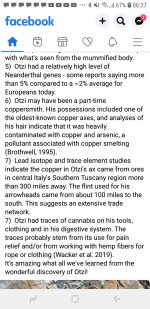
Screenshot_20230825-062737.jpgScreenshot_20230825-062753.jpg
This one is kinda obvious for the reasons listed in the post itself, i've always been suspicious about this Otzi, especially since it was said that food was found sort of intact on his stomach.....

Edit: he was either a wreck or in shape, but sometimes the bullshitometer don't give a damn
 

Attachments

  • Screenshot_20230825-062737.jpg
    Screenshot_20230825-062737.jpg
    424 KB · Views: 232
Unfinished lion’s head spout found in Selinunte – The History Blog

This article is a good example of how unwarranted guesswork results in a story that isn't really supported by the evidence.

The claim as I see it, is that a large ornate piece of marble is presumed to be designed as a spout, and it's size indicates that it was for a larger as yet unknown temple. Additionally the marble is presumed to be imported from a Greek island.

Unfinished lion's head simen, 5th century B.C. Selinunt project Ruhr University Bochum, Marc Klauss/Leah Schiebel.Excavations at the ancient Greek colony of Selinunte in Sicily have unearthed a rare marble lion’s head sima, a decorated spout meant to drain water from the roof of an ancient temple. It dates to the 5th century B.C.
Almost two feet high, the figure is larger than usual for this type of architectural feature. It is also unfinished. The water outlet is not yet installed. The back of the mane and the top decoration is also incomplete.
“The newly found Sima from Selinunte cannot be compared to any of these temples and is therefore part of a tenth temple with such a marble roof,” concludes Jon Albers. The researchers cannot yet decide whether the object was once intended for the well-known Temple E in Selinunte or for another monumental temple that is still unknown today.

The problem for me is that the idea of a tenth temple seems a massive overreach, on the basis of a large ornate spout, when it's not even clear it is a spout!
 
Last edited:
2,000-year-old child’s shoe found in salt mine – The History Blog

Written descriptions of 16th-century clothing are often brief, and children’s clothing, especially for the lower and middling sorts, is under-recorded. These scant references can be expanded by examining a surviving mitten and vest

Ok - I'll have to remember that, when I next hear about someone pulling a mitten out of a clay tablet or something..

I did remember! The child's item of clothing was a shoe and came out of a salt mine:
Archaeologists with the German Mining Museum Bochum have unearthed a child’s leather shoe that is more than 2,000 years old and in excellent condition. It is complete to an exceptional degree, even preserving a section of the flax laces and showing how the shoe was originally tied. The design of the shoe dates it to around the 2nd century B.C.
Leather-child-shoe.jpg
2,000 years old

51VGsjqyZwL.jpg
sponsored by Adidas?
 
Last edited:
https://www.npr.org/2023/09/01/1197...tatue-seized-cleveland-museum-marcus-aurelius

I say "alleged," because how did they decide it was him, when the statue has no head?? 😆 Any statue that is dug up out of the dirt or found in a ruined building is just some random person unless it is clearly marked with an inscription...and even those can be faked. All of the statues in museums are given labels and we're expected to believe it, when there is literally no way to tell who they were meant to represent. I'm sure the Turkish officials have their own story about who this is supposed to be, with just as little proof to back it up. The fakery is getting comical at this point.
 
Historical Objects: The Bees of Childeric I

bees.png
Are they even bees though?

A page turner:
Over 1,500 years old, these bees appear unassuming, and yet their history provides a compelling and dramatic story.
The 27th May 1653 likely started as any other for mason Adrien Quinquin. A man working on a construction site in Tournai, modern-day Belgium, he was several feet under the ground swinging his pickaxe when he hit something unusual. A glint of gold shimmered up at him. After gathering the attention of nearby people, the rest of Quinquin’s hole was dug up. Inside was a real treasure trove: human bones, hundreds of silver coins, a highly decorated sword and scabbard, and many more gold items including buckles, rings and brooches. Key for us, there were also 300 little bees made from gold. The excitement was palpable.

News of such an amazing find quickly spread to the highest levels; soon Archduke Leopold William, who was Governor of the then Spanish-ruled region, caught word of the treasure and he wanted it. No one could say no to the brother of the Holy Roman Emperor, and so the hoard was sent to the Archduke in Brussels. Now, Leopold was a refined man who was a renowned patron of the arts. He didn’t just want the treasure as a status symbol – he was genuinely fascinated by the find. And so he recruited an unusual ally: his physician.

Whilst a medical doctor may not seem like the standard choice, Jean-Jacques Chifflet was also a historian.
300? Exactly 300?

Chifflet took pains to identify the items from the hoard, and he also managed to identify the owner of the objects: a 5th-century Frankish king called Childeric I. Whilst Chifflet did end up misidentifying some of the pieces, his approach in his research and recording the outcomes is now often considered the first scientific archaeological publication. The key to identifying Childeric came from a ring which had a depiction of a long-haired, clean-shaven man holding a spear and wearing Roman-style clothes. Around the edge of the portrait were the words “Childirici Regis”. This made the find even more exciting, as Chifflet identified this Childeric as the father of King Clovis I, the first ruler to unite all of the Frankish tribes under one leader and thus considered the creator of the French monarchy.
Leopold treasured the collection until his death in 1662, upon which it was bequeathed to his nephew, another Leopold. This Leopold was Leopold I, King of Hungary, Croatia and Bohemia, and he had become Holy Roman Emperor after the death of his father. He prized his uncle’s collection and had replicas made of the items in Childeric’s hoard. Despite his care for the collection, sometimes politics came above the arts, and in 1664 Leopold had been in a difficult spot. The Ottoman Empire were encroaching on his Hungarian kingdom, and King Louis XIV of France had provided military aid to repel the invaders. To show his gratitude, in 1665 Leopold gifted the Childeric hoard to the French king, believing it a grand gesture to return it to Childeric’s descendent.
After the French Revolution, when many items related to the monarchy were destroyed, Childeric’s Hoard was kept alongside the objects it was stored with to form a collection within the Imperial Library, which later became the Bibliothèque nationale de France.

Whilst King Louis had not appreciated the value of the hoard, a subsequent French leader was to define himself by it. In 1804, a man named Napoleon Bonaparte declared himself Emperor of France.
The shape bore a resemblance to the fleur-de-lis (indeed, Chifflet had suggested in his monograph that the bees may have been the originator of the fleur) whilst connecting to the earliest days of France as a country, and a time where Imperial Rome still held sway.

From this time, the bee became not only the emblem of the French Empire, but the personal representation of Napoleon himself. His coronation robes were scattered with gilt wire bees, and they also appeared on the robes and slippers of his wife’s coronation outfit.
But on one fateful night – 5th November 1831 – that was to change. A group of thieves broke in to the library and stole over 2,000 golden treasures from within, including the entirety of Childeric’s hoard. Although a huge police manhunt was launched and a group of suspects were arrested, much of the treasures had been lost forever. The thieves eventually revealed that they had melted down most of the golden treasure into ingots for easier use, and the pieces that were heavily laden with jewels (like the bees) were thrown into the River Seine. The police recovered 20 ingots of gold from the thieves’ hideout, and following information from the confessions, managed to dredge the river where the items had been dumped and found 8 bags filled with 1,500 of the stolen items. When the weight of the recovered bags and the ingots were combined, it was judged that the entirety of the stolen treasure had been located.
350 years ago, an amazing treasure was found in a small city. Despite the grandeur of the contents, it was a collection of tiny gold bees which made history. Though just two remain today, they tell a tale of the fall of a great empire, the rise of a new dynasty, the slow change of culture, the way powerful people will appropriate history for their own uses, and of human greed. These beautiful bees have seen plenty of history and been part of it themselves, and I think they are absolutely wonderful.
Fantastic.

I want to draw attention to one bit of the story:
The thieves eventually revealed that they had melted down most of the golden treasure into ingots for easier use, and the pieces that were heavily laden with jewels (like the bees) were thrown into the River Seine. The police recovered 20 ingots of gold from the thieves’ hideout, and following information from the confessions, managed to dredge the river where the items had been dumped and found 8 bags filled with 1,500 of the stolen items. When the weight of the recovered bags and the ingots were combined, it was judged that the entirety of the stolen treasure had been located.

But now there are only 2 bees.

So, there is an inconsistency - its can't be that the thieves threw the jewel laden bees in the river AND the entirety was recovered if there are now only 2 bees where there were 300 previously.
 
Last edited:
Signs of the Zodiac: The Dendera Dating Controversy | History Today

zodiac.png
Spot any distractions? Did you even realise there was a zodiac being displayed?

How ancient was ancient Egypt? How old is the world?

Hungry for power, in 1798 Napoleon sailed off across the Mediterranean, backed by a contingent of 50,000 military men and 151 scholarly volunteers. Napoleon’s critics denounced this mission as an expensive, ill-judged attempt to compete with British global expansion by colonising part of northern Africa. But for those in the academic contingent, his initiative represented a thrilling opportunity. Pursued by Horatio Nelson’s British fleet, they spent 30 days on the emperor’s ship before disembarking in Alexandria.

I'll point to some excellent logistical breakdown from @Jd755 here:
Fact and fiction as sources.

The Zodiac was initially discovered by the artist Dominique-Vivant Denon, who had spotted the massive disc embedded in the ceiling of a ruined temple near Thebes (Luxor). Getting inside required squirming through a tiny window and dropping down into the dark, smelly interior littered with rotting and mummified corpses. By the flickering light of flaming torches, Denon and the men who followed him gazed in amazement at the walls decorated with colourful carvings. They were particularly awed by the ceiling of a small roof chapel, which carried an elaborate sculpted circle supported by goddesses and mythical creatures. Denon made a drawing on the spot, but more accurate renditions were later created by two young engineers who spent several weeks systematically measuring and copying the entire ceiling on a scale of one to five. When they ran out of pencils, they melted down lead bullets, using reeds to cast suitable drawing utensils.
who is Denon?
Dominique Vivant, Baron Denon (4 January 1747 – 27 April 1825) was a French artist, writer, diplomat, author, and archaeologist.[1] Denon was a diplomat for France under Louis XV and Louis XVI.[1] He was appointed as the first Director of the Louvre museum by Napoleon after the Egyptian campaign of 1798–1801, and is commemorated in the Denon Wing of the modern museum and in the Dominique-Vivant Denon Research Center.[2] His two-volume Voyage dans la basse et la haute Egypte ("Journey in Lower and Upper Egypt"), 1802, was foundational for modern Egyptology.

Vivant Denon was born in Givry, near Chalon-sur-Saône[3] to a family called "de Non", of the "petite noblesse" or gentry, and until the French Revolution signed himself as "le chevalier de Non".[4] Like many of the nobility, he revised his surname at the Revolution to lose the "nobiliary particle" "de". He seems to have consistently avoided using his baptised first name "Dominique", preferring his middle name "Vivant", and so is usually known as "Vivant Denon". He was created "Baron Denon" by Napoleon in August 1812, at the age of 65.
Vivant Denon - Wikipedia

The chevalier of "no"? Vivant means someone who enjoys the good life btw - a 'bon vivant'.

Strangely, as I read "artist, writer, diplomat, author, and archaeologist", I also read "faker". My lying eyes playing tricks on me again, I guess...

Denon’s two-volume illustrated book of his Egyptian discoveries proved a bestseller across Europe, and obsession with Egypt escalated. As collectors vied to retrieve additional antiquities, they benefited from the Egyptian government’s policy of attracting foreign money by encouraging visitors to tour the country and remove transportable objects for display in prestigious museums and private collections.

French enthusiasts were especially keen on seizing the Zodiac, which is still the only circular representation of Egyptian astronomy to have been unearthed. Eventually, an excavation team entered the site in 1821 and blasted the disc out of the ceiling. Virtually the only French protest was expressed anonymously by a philologist called Jean-François Champollion, later celebrated for cracking the Rosetta Stone. Professing himself delighted that the Zodiac would be on show next to the Seine rather than the Thames, he asked rhetorically ‘Should we, in France, follow the example of Lord Elgin? Certainly not.’ He thought the Zodiac should have been left near the Nile.
For the rest of his life, what happened next remained a closely guarded secret between Champollion and his elder brother. As he gazed at the remaining inscriptions, he realised that all the cartouches were empty – and that included the one supposedly carrying the crucial word autocrator. Champollion had unwittingly been putting forward false arguments that strengthened the position of his opponents.

It remains unclear whether the perpetrators of this error simply made a mistake or intentionally faked the evidence. Even so, Champollion has since been vindicated: the Zodiac is now believed to have been created in the first century bc during the reign of Cleopatra VII, just before Egypt was absorbed into the Roman Empire. Champollion had been right – but for the wrong reasons.

In summary the story seems to be some nonsense about dating the age of the zodiac, but that there was faked evidence, confusion, politics - who knows. There's an interesting angle in there, probably about how Denon faked history. Certainly, little about the evidence that is presented seems straightforward - its like was written badly by AI.
 
Last edited:
China's ancient water pipe networks show they were a communal effort with no evidence of a centralized state authority

pipes.jpg
Evidence of anarchy

A system of ancient ceramic water pipes, the oldest ever unearthed in China, shows that neolithic people were capable of complex engineering feats without the need for a centralized state authority, finds a new study by University College London researchers.
Is it just me, or is there a minor MSM promotion of anarchist ideas at the present?

Meet Javier Milei, the front-runner to be Argentina’s next president

In a study published in Nature Water, the archaeological team describe a network of ceramic water pipes and drainage ditches at the Chinese walled site of Pingliangtai dating back 4,000 years to a time known as the Longshan period. The network shows cooperation among the community to build and maintain the drainage system, though no evidence of a centralized power or authority.
My god - how did people manage 400 years ago, without a "centralised power or authority"? 🙀

And what kind of evidence of a "centralised power or authority" are they expecting to see. from 4000 years ago? Are they hoping for a paper record?!?

Dr. Yijie Zhuang (UCL Institute of Archaeology), senior and corresponding author on the paper, said, "The discovery of this ceramic water pipe network is remarkable because the people of Pingliangtai were able to build and maintain this advanced water management system with stone age tools and without the organization of a central power structure. This system would have required a significant level of community-wide planning and coordination, and it was all done communally."
communally
But, despite the apparent lack of a centralized authority, the town's population came together and undertook the careful coordination needed to produce the ceramic pipes, plan their layout, install and maintain them, a project which likely took a great deal of effort from much of the community.
the town's population came together, coordination, community... hmm - quite a communitarian agenda being worked in, it seems.

While other ancient societies with advanced water systems tended to have a stronger, more centralized governance, or even despotism, Pingliangtai demonstrates that was not always needed, and more egalitarian and communal societies were capable of these kinds of engineering feats as well.
egalitarian and communal societies were capable of these kinds of engineering feats

Co-author Dr. Hai Zhang of Peking University said, "Pingliangtai is an extraordinary site. The network of water pipes shows an advanced understanding of engineering and hydrology that was previously only thought possible in more hierarchical societies."
Neuro-linguistic programming, requires repetition of the message, so that you get the message, otherwise the message might not be received - and an undelivered message would be a sad state for a message to end up in, right?

Managing these deluges was important to prevent floodwaters from overwhelming the region's communities. To help mitigate the excessive rainwater during the rainy seasons, the people of Pingliangtai built and operated a two-tier drainage system that was unlike any other seen at the time. They built simple but coordinated lines of drainage ditches that ran parallel to their rows of houses in order to divert water from the residential area to a series of ceramic water pipes that carried the water into the surrounding moat, and away from the village.
Its almost as if they had climate change too!

Researchers cannot say specifically how the people of Pingliangtai organized and divided the labor among themselves to build and maintain this type of infrastructure. This kind of communal coordination would also have been necessary to build the earthen walls and moat surrounding the village as well.
 
4,000-year-old arrow shaft found in melting ice – The History Blog

Hafted-end.jpg
4000 year old hafted arrow shaft or a bit of wood?

The arrow was broken at both ends making it challenging to date. Initially, archaeologists thought it was from the Iron Age like other arrows found there, but when conservators removed the glacial silt, they exposed the hafted end where the arrowhead was embedded. The dimensions and shape indicated the arrowhead was a flint projectile and therefore dated to the Stone Age.
When they say 'broken at both ends', they mean that the arrow head was not there, not that the wood was broken. The hafted shaft was fine.. ok? It sure is a shame that historians struggle to explain a story stating the facts plainly - but then, that also leaves a bit of wiggle room..

Likely, Pilø said, the arrow ended up in the ice while hunters were pursuing reindeer, which gathered near ice and snow on hot days to avoid botflies.

“The ancient hunters knew this and would have hunted the reindeer en route to and on the ice patch,” said Pilø in an email. “Sometimes, when an arrow missed its target, it burrowed itself deep into the snow and was lost. Sad for the hunter but a bull’s eye for archaeology!
They know so much! There were botflies, reindeer, hunting parties, one fellow slipped on the ice to the amusement of his colleagues and much mirth was had by all! They even sung a song about it, I bet. Its surely only a matter of time until we get some Viking melodies!

A bull’s eye for archaeology!
 
Last edited:
4,000-year-old arrow shaft found in melting ice – The History Blog

4000 year old hafted arrow shaft or a bit of wood?


When they say 'broken at both ends', they mean that the arrow head was not there, not that the wood was broken. The hafted shaft was fine.. ok? It sure is a shame that historians struggle to explain a story stating the facts plainly - but then, that also leaves a bit of wiggle room..


They know so much! There were botflies, reindeer, hunting parties, one fellow slipped on the ice to the amusement of his colleagues and much mirth was had by all! They even sung a song about it, I bet. Its surely only a matter of time until we get some Viking melodies!

A bull’s eye for archaeology!

Wow my garden is full of those ..... Must be an ancient battleground.
 
Tips
Tips
Please respect our Posting Rules.
Back
Top