The Daily Fake

But now there are only 2 bees.

So, there is an inconsistency - its can't be that the thieves threw the jewel laden bees in the river AND the entirety was recovered if there are now only 2 bees where there were 300 previously.

"Two bees or not two bees, that is the question."

Also, surely the melting down process wouldn't harm the jewels, which could easily have been fished out of the molten gold? It all seems to bee very fishy...
_________________________________________________________________________________________________________

Please Note: What follows may be considered controversial. It's not my intention to cause controversy or offense, but I refuse to be intimidated into silence for the sake of 'political correctness' gone mad.

I was looking for images in Wikimedia Commons for 'Cheddar Man.' I would invite readers to see the results for themselves: Search media - Wikimedia Commons

Cheddar Man was discovered in Gough's Cave, Cheddar Gorge, Somerset, England in 1903. His skeletal remains are claimed to be between 9,000 and 10,000 years old. In February of 2018, following analysis of Cheddar Man's ancient DNA, the media was full of headlines such as "Early Briton from 10,000 years ago had dark skin and blue eyes." Very shortly after there was a documentary program broadcast on the UK's Channel 4 during which Afua Hirsch, of Ghanian and Jewish descent (a former barrister turned journalist,) made some extraordinary claims. They were also published in National Geographic:

"We do not have a sense of being an immigrant nation even though that is essentially what we are, and I think this is very useful in reminding people that we are an immigrant nation, everybody came here from somewhere and actually they’re saying that only 10% of the current British population is descended from Cheddar Man. So most British people are more recent immigrants than him and I think that that is really helpful in changing our narrative about what immigration means — there would be no British population if it weren’t for immigration and it’s hard to understand that you could be so hostile to immigration as an intrinsic principle, I think there are people in Britain who feel like that, if you understand that everyone’s ancestors were immigrants at some point. To see Cheddar Man with his dark skin it definitely provoked quite an emotional response in me, and I think that’s the power of this. It’s one thing to know that there were black people here thousands of years ago and to know that White people weren’t always White. We know there were Africans here before there were English people here, for example, and so through that that gives you a sense of the idea that there’s this indigenous British person who is White and essentially British is a fiction, it’s a narrative that was created over time, it’s not based on scientific facts so this is another feature of that really." (Afua Hirsch)

cheddarman.png
Cheddar Man's 2018 'makeover' Source

Later it became apparent that the team behind the DNA analysis actually had a range of complexions to choose between because there is no specific gene for light skin, or at least one has yet to be identified. For unknown reasons the very darkest complexion was chosen by some of the researchers. The media pounced upon this and in their typical frenzied manner began referring to the earliest Britons as having been "Black."

'As Carles Lalueza-Fox has suggested, “… we cannot know the exact shade …” of the skin colour of Mesolithic Europeans, and while we might reasonably suppose that it was in some cases darker than is normal for modern Europeans, we should not assume that it was as dark as that of the darkest sub-Saharan Africans...

'...What Carles Lalueza-Fox also tells us is that other than with regard to colouration, the genome of Mesolithic Europeans is, “otherwise clearly northern European”, and this brings us to the crux of the matter, that even though our Mesolithic ancestors may have had darker colouration than we have on average today, and may have even been as darkly coloured as the darkest sub-Saharan Africans, they were not Negroes, they were in every other respect indistinguishable from people we would recognise as Northern Europeans today.' Source


In fact a 1997 DNA study has shown that the DNA of Cheddar Man has survived intact in the same local area. 9,000-Year-Old Cheddar Man Has Living Descendant Still Living in The Same Area. However, back to the 2018 study...

"Researchers including Susan Walsh at Indiana University–Purdue University Indianapolis read Cheddar Man’s DNA. Walsh had helped develop a model that attempts to predict someone’s eye, hair and skin pigmentation solely from their DNA, and the team applied this model to Cheddar Man...

...Walsh stresses that the study doesn’t conclusively demonstrate Cheddar Man had dark to black skin. We cannot place such confidence in the DNA analysis, she says. For one thing, Cheddar Man’s DNA has degraded over the last 10,000 years....

“...It’s not a simple statement of ‘this person was dark-skinned’,” says Walsh. “It is his most probable profile, based on current research....

"...In fact, we are not ready to predict the skin colour of prehistoric people just from their genes, says Brenna Henn at Stony Brook University, New York. That’s because the genetics of skin pigmentation turn out to be more complex than thought."
Source

So basically then this whole 2017-2018 DNA analysis was totally misrepresented, not only by the media, but even by certain members within the research team itself. In spite of the debunking, any search on the internet will still bring up the fake news headlines from 2018 as the most popular results. Furthermore, the current results results from Wikimedia Commons for "Cheddar Man" bring up many images of random black people and when those links are examined it is not possible to find any mention of Cheddar Man, or even Cheddar Cheese, on those pages.

As I said, I have no desire to stir up any controversy, but I feel it's important to demonstrate just how science, history and archaeology are still being used as political weapons - probably more so today than ever before.
 
Last edited by a moderator:
"Two bees or not two bees, that is the question."

Also, surely the melting down process wouldn't harm the jewels, which could easily have been fished out of the molten gold? It all seems to bee very fishy...
_________________________________________________________________________________________________________

Please Note: What follows may be considered controversial. It's not my intention to cause controversy or offense, but I refuse to be intimidated into silence for the sake of 'political correctness' gone mad.

I was looking for images in Wikimedia Commons for 'Cheddar Man.' I would invite readers to see the results for themselves: Search media - Wikimedia Commons

Cheddar Man was discovered in Gough's Cave, Cheddar Gorge, Somerset, England in 1903. His skeletal remains are claimed to be between 9,000 and 10,000 years old. In February of 2018, following analysis of Cheddar Man's ancient DNA, the media was full of headlines such as "Early Briton from 10,000 years ago had dark skin and blue eyes." Very shortly after there was a documentary program broadcast on the UK's Channel 4 during which Afua Hirsch, of Ghanian and Jewish descent (a former barrister turned journalist,) made some extraordinary claims. They were also published in National Geographic:

"We do not have a sense of being an immigrant nation even though that is essentially what we are, and I think this is very useful in reminding people that we are an immigrant nation, everybody came here from somewhere and actually they’re saying that only 10% of the current British population is descended from Cheddar Man. So most British people are more recent immigrants than him and I think that that is really helpful in changing our narrative about what immigration means — there would be no British population if it weren’t for immigration and it’s hard to understand that you could be so hostile to immigration as an intrinsic principle, I think there are people in Britain who feel like that, if you understand that everyone’s ancestors were immigrants at some point. To see Cheddar Man with his dark skin it definitely provoked quite an emotional response in me, and I think that’s the power of this. It’s one thing to know that there were black people here thousands of years ago and to know that White people weren’t always White. We know there were Africans here before there were English people here, for example, and so through that that gives you a sense of the idea that there’s this indigenous British person who is White and essentially British is a fiction, it’s a narrative that was created over time, it’s not based on scientific facts so this is another feature of that really." (Afua Hirsch)

Cheddar Man's 2018 'makeover' Source

Later it became apparent that the team behind the DNA analysis actually had a range of complexions to choose between because there is no specific gene for light skin, or at least one has yet to be identified. For unknown reasons the very darkest complexion was chosen by some of the researchers. The media pounced upon this and in their typical frenzied manner began referring to the earliest Britons as having been "Black."

'As Carles Lalueza-Fox has suggested, “… we cannot know the exact shade …” of the skin colour of Mesolithic Europeans, and while we might reasonably suppose that it was in some cases darker than is normal for modern Europeans, we should not assume that it was as dark as that of the darkest sub-Saharan Africans...

'...What Carles Lalueza-Fox also tells us is that other than with regard to colouration, the genome of Mesolithic Europeans is, “otherwise clearly northern European”, and this brings us to the crux of the matter, that even though our Mesolithic ancestors may have had darker colouration than we have on average today, and may have even been as darkly coloured as the darkest sub-Saharan Africans, they were not Negroes, they were in every other respect indistinguishable from people we would recognise as Northern Europeans today.' Source


In fact a 1997 DNA study has shown that the DNA of Cheddar Man has survived intact in the same local area. 9,000-Year-Old Cheddar Man Has Living Descendant Still Living in The Same Area. However, back to the 2018 study...

"Researchers including Susan Walsh at Indiana University–Purdue University Indianapolis read Cheddar Man’s DNA. Walsh had helped develop a model that attempts to predict someone’s eye, hair and skin pigmentation solely from their DNA, and the team applied this model to Cheddar Man...

...Walsh stresses that the study doesn’t conclusively demonstrate Cheddar Man had dark to black skin. We cannot place such confidence in the DNA analysis, she says. For one thing, Cheddar Man’s DNA has degraded over the last 10,000 years....

“...It’s not a simple statement of ‘this person was dark-skinned’,” says Walsh. “It is his most probable profile, based on current research....

"...In fact, we are not ready to predict the skin colour of prehistoric people just from their genes, says Brenna Henn at Stony Brook University, New York. That’s because the genetics of skin pigmentation turn out to be more complex than thought."
Source

So basically then this whole 2017-2018 DNA analysis was totally misrepresented, not only by the media, but even by certain members within the research team itself. In spite of the debunking, any search on the internet will still bring up the fake news headlines from 2018 as the most popular results. Furthermore, the current results results from Wikimedia Commons for "Cheddar Man" bring up many images of random black people and when those links are examined it is not possible to find any mention of Cheddar Man, or even Cheddar Cheese, on those pages.

As I said, I have no desire to stir up any controversy, but I feel it's important to demonstrate just how science, history and archaeology are still being used as political weapons - probably more so today than ever before.
History, as far as I can make out, is what's expedient in service of agendas. It's purpose is to conjure some sort of 'timelessness spell craft' on people, where history is invoked like it's ye olde magic from the source. If we think it was 'ever thus', we will act differently to when we think something has been sprung upon us.

I think Orwell was into something when, in 1984, he stated:
Who controls the past controls the future: who controls the present controls the past.
 
in their typical frenzied manner began referring to the earliest Britons as having been "Black."
They do this absolutely everywhere. I'll have to dig for the infographic I saw about it. They even do it in East Asia, and even when the hair is red (as with Peruvian mummies).

One of the funny, rebel infographics I saw shows a modern, I believe, Chechen man, 50% Yamnaya (Indo-European Aryan, essentially), and shows a modern Icelandic man, also 50% Yamnaya. Both of the men look very stereotypically what we call white. Then it shows a man from India, who is approximately 10% Yamnaya.

Guess what the official reconstruction of what the 100% full-blooded Yamnaya people looked like? Why, it turns out the prehistoric Yamnaya look like any dude grabbed off of the streets of New Delhi! Of course!

And it always works in that one direction.

Oh, and don't get me started on the "AI can tell the race of skeletons and no one knows how!" Even though I know my education was largely misinformation, I have an undergrad degree in anthropology and my goofy ass could easily tell you the race and sex of an intact skeleton. Braincase size statistics are available to anyone who wants to look.
 
We found this short funny and couldn't believe how bad the old world photoshop was. The link to the source of the photo is in the shorts video description. What do you guys think about this old photo manipulation and why do you think they did it?


View: https://www.youtube.com/shorts/t2calXBAa0c

That would be a good thread idea if it hasn't already been done. Bad old photo fakery. I know of a handful of Civil War ones, Soviet Union ones, and a famous Nazi one where they added a woman with exposed breasts supposedly being tortured (but the original photo was later unearthed and she was added in later)
 
We found this short funny and couldn't believe how bad the old world photoshop was. The link to the source of the photo is in the shorts video description. What do you guys think about this old photo manipulation and why do you think they did it?


View: https://www.youtube.com/shorts/t2calXBAa0c

Everything to do with photography or imagery has had a strand of fakery running through it from the beginning, I reckon. I have a thread on how this is admitted wrt to digital photography here:
1984 NYT article on "contemporary photojournalism" admits all?

From the referenced article about digital photography, we read:
The computer is at the heart of a revolution in image making. It is now possible not only to make almost seamless composites of existing photographs and to alter images in such a way that the changes may not be detected, but - using mathematics instead of a camera - it is possible to create images that are nearly photographic in their realism.

Its such a blasé admission - altering the image is a feature not a bug.
 
Simulating History with ChatGPT

I'm posting to note that ChatGPT is already being used to train historians, and being intergrated into the process.
What follows are some thoughts about what I believe to be a novel use of LLMs: using them to simulate interactive historical settings as part of a university assignment. The results of these early trials are why I am personally much more excited about generative AI than many of my colleagues — though I also concede that in the short term, cheating will be a major problem.

Meet the historian of the future:
As illuminating as the simulations can be, the real benefit of the assignment is in what follows. First, students will print out and annotate the transcript of their simulation (which runs for twenty “turns,” or conversational beats) and carefully read through it with red pens to spot potential factual errors. They will then conduct their own research to correct those errors. They’ll then write their findings up as bullet points and feed this back into ChatGPT in a new, individualized and hopefully improved version of the prompt that they develop themselves. This doesn’t just teach them historical research and fact-checking — it also helps them develop skills for working directly with generative AI that I suspect will be valuable in future job markets.
As in many other academic fields, the hope work AI is that historians can skip the grunt work, and take a higher level QC role - preventing stuff that sounds like total nonsense from seeing the light of day. Yes, AI will be writing the history of the future, but there will be a human prompting the AI in the first place probably 20+ times and then filtering the history "product" before going live. The author suspected that these are the skills that will be valuable in future. I think he's right!

PS At the end of the article some links are posted. I was surprised to see Childiric's bees, which I already covered here:
The Daily Fake
 
Last edited:
https://www.ips-planetarium.org/page/a_jacobsen2001

Tycho Brahe killed by Mercury!

This famous Danish astronomer died in Prague on the 24th of October 1601, eleven days after he had attended a banquet at the Bohemian count of Rosenberg. Tycho was too courteous to obey the calls of nature during the hour-long dinner and finally his bladder burst, which led to his death. Or so the story goes. But is this the real cause of Tychoºs death? Is it at all possible to die from a burst bladder? Or are there more likely explanations of his death?
Johannes Kepler recounts in Tychoºs observation log that during the banquet with plenty of food and drink, Tycho Brahe didnºt want to empty his bladder and would wait until he got home; however he was unable to do so. After five sleepless nights he produced bloody urine, suffering great pain. Then followed more insomnia, fever and delirium. On the 24th October he passed away peacefully after hours of delirium exclaiming: ÑHave I not lived in vain!æ.
All three sources point to the fact that Tycho suffered prostatic hypertrophy (enlargement of the prostate gland) or another disorder of the urinary system followed by uremia. However, at that time it was known how to insert a catheter and relieve the pain that way and Tycho was rather young (54 years) to suffer from prostatic hypertrophy. Why wasnºt that done? Could there be other explanations of his death?

After Tycho Braheºs death, rumors arose that he had been victim of a poisoning case, and since the symptoms are in accordance with heavy metal poisoning and poisoning by certain plants this possibility must be taken seriously into consideration. The motive for poisoning could be both political and religious since neither the catholic council nor the nobility were pleased with the influence this protestant had gained on the weak emperor Rudolf II in Prague.
Ok - so the question is was it a natural death or poisoning. We have accounts from Kepler and forensic evidence:
The first medical-legal investigation was made possible in 1991 when a small box (at a Danish flag ceremony on Tycho Braheºs grave in the Teyn Church in Prague) was handed over to the newly appointed Danish ambassador in the Czech Republic by the director of the Czech National Museum as a gift to the Danish government. The box contained a piece of shroud and some beard remnants. A small note explained that these items originated from the opening of Tychoºs grave in 1901 on the third centenary of his death, where the city authorities of Prague wanted to restore the sepulchral monument, and at the same time they investigated the rumour that Tychoºs corpse had been removed in 1620 when the Catholics took power in Bohemia.
He died in 1601, the corpse was moved in 1620, they opened his grave in 1901, and some beard remnants given in 1991. What answers do forensic analysis reveal?
In Tycho Braheºs beard a relatively high amount of lead compared to the present population was found, so it can not be excluded that Tycho died from lead-poisoning. But more likely, the lead content could be caused by the historical fact that lead frequently was used in kitchen ware, water pipes and as a wine-sweetener. Also environmental influences such as lead in the coffin may have given a high concentration of lead in the beard.

The concentration of arsenic was not found to be high enough to have caused the death of Tycho Brahe.

However, the beard contained a much higher concentration of mercury than normal. Taken in consideration with the description of his illness, uremia, shortly before his death, this corresponds with symptoms of poisoning by mercury.
and
In 1996 it was possible to carry out another analysis using the PIXE-method (Particle Induced X-ray Emission) by J. Pallon at Fysiska Institutionen at Lund University, Sweden., this time on hair from Tycho with the root preserved. The result was that the mercury was not from an outside source but actually had been digested.

Using the growth rate of hair it was concluded that Tycho was poisoned by mercury one day before his death.
These forensic investigations show Tycho Brahe died of mercury poisoning. Even though it cannot be excluded, it is not likely that Tycho was murdered, but most likely he conducted his own death by using his own mercury-rich medicines the day before his death. This was done to help cure his disorder of the urinary system (prostatic hypertrophy or less likely bladder stones, since no stones were to be found in the coffin). It was not a burst bladder caused by his courteousness, but mercury in his own medicines that led to the uremia of which he died.

This story reminds of the story that Uranus smells of farts - its like it was created to fit the punchline.
 
Last edited:
Wow my garden is full of those ..... Must be an ancient battleground.
For some reason, I couldn't stop laughing after reading your snarky response... Thank You!
We found this short funny and couldn't believe how bad the old world photoshop was. The link to the source of the photo is in the shorts video description. What do you guys think about this old photo manipulation and why do you think they did it?


View: https://www.youtube.com/shorts/t2calXBAa0c

Perhaps the photo-shopper was drunk and/or high the day he put this shit show together and then, upon a review of that day's work, the photo-shopper's handlers saw it and they laughed and laughed and commented amongst themselves how "Ole boy really did a doozy on this one!" and went to knee-slapping and hee-hawing like crazy. Then, one of them opined "Why Boys, we oughtta just go ahead and put it out there for the ignorant-assed masses! They'll never know the difference! Hee-haw!" and The Boys all agreed, and it was done... all mockery and duping delight style.
 
Last edited:
Found your sentence there very misleading - using that capital M.

I looked forward to reading how Brahe was killed by either the Roman god Mercury , or possibly the planet Mercury by some fantastic means. I ruled out death by Freddy Mercury - time eras all wrong.

This book - Heavenly Intrigue by Mr & Mrs guilder - gives much insight into the dastardly deed if your interested.
 
Found your sentence there very misleading - using that capital M.

I looked forward to reading how Brahe was killed by either the Roman god Mercury , or possibly the planet Mercury by some fantastic means. I ruled out death by Freddy Mercury - time eras all wrong.

This book - Heavenly Intrigue by Mr & Mrs guilder - gives much insight into the dastardly deed if your interested.
It refers to the metal, but I capitalised it intentionally as it draws out the word play that is the punchline.

Personally I don't believe it is that likely that much of the story is plausible - that the beard hair is his, that it can last 400 years, while being moved on multiple occassions, that it can be analysed, that they can deduce that he had poisoned himself the day before, etc.

Like I said, I think its one of those stories that is intended to fit around the punchline (hence my capitalisation) - like uranus smells of farts, or masks are good for respiratory health. It seems that lots of stories have this sort of humorous side.

As I said at the beginning of this thread - this thread is just somewhere where one can review the articles that are presented in their own right - it is a media deconstruction. I think there is value in this alone. Of course I understand the value in deeper research, but deeper research is not this thread.

However if something presented here acts as a launchpad for further investigation, perhaps members of this site create a related thread, I'd certainly read it! If that happens, please link back here so we can follow the deeper trails too.
 
Last edited:
It refers to the metal, but I capitalised it intentionally as it draws out the word play that is the punchline.

Personally I don't believe it is that likely that much of the story is plausible - that the beard hair is his, that it can last 400 years, while being moved on multiple occassions, that it can be analysed, that they can deduce that he had poisoned himself the day before, etc.

Like I said, I think its one of those stories that is intended to fit around the punchline (hence my capitalisation) - like uranus smells of farts, or masks are good for respiratory health. It seems that lots of stories have this sort of humorous side.

As I said at the beginning of this thread - this thread is just somewhere where one can review the articles that are presented in their own right - it is a media deconstruction. I think there is value in this alone. Of course I understand the value in deeper research, but deeper research is not this thread.

However if something presented here acts as a launchpad for further investigation, perhaps members of this site create a related thread, I'd certainly read it! If that happens, please link back here so we can follow the deeper trails too.
i did think you were referring to the metal . It got me thinking though, just changing a lower case letter to a capital can give a totally different meaning to a word.

How hard it must be to preserve the original meaning of words translated over the centuries or even decades which was my point sort of . I'm always flying off at tangents. I'll shut up now
 
i did think you were referring to the metal . It got me thinking though, just changing a lower case letter to a capital can give a totally different meaning to a word.

How hard it must be to preserve the original meaning of words translated over the centuries or even decades which was my point sort of . I'm always flying off at tangents. I'll shut up now
No worries, don't shut up :)

But this leads me to a tangent... I don't know if you know crrroooww787877, but he got very excited at the fact that Marie Curie sounds like Mercury. Obviously Mercury is a god, also known as Hermes. At this point perhaps you can see that we may be stepping into occult explanations of our reality - Hermes/Mercury is the messenger of the gods, a mediator (like the media and history are) as well as being famous for his staff - the caduceus with 2 snakes, which also represents commerce and medicine. I've only a little time for this sort of stuff (it is not my concern) but I would agree that whatever the case the 'Hermes/Mercury mythology' does seem to be ingrained into the culture of this reality. I'm not sure the figure of Mercury is one I admire, frankly - it seems to be associated with the worst of this world.

So, what does it mean to say "Tycho Brahe killed by Mercury"? Can this be read as an occult, astro-theological phrase? Perhaps Tycho was going against the agenda of those who steer our cultural reality. Perhaps this is more significant that I intended, in a religious, occult sense.

At this point, I'll reference an alternative cosmology that I know about:
Tychos.space

As I understand it, this uses Tycho Brahe's understanding and observations to constitute an alternative explanation of how the planets, stars, etc work. This stands in contrast to the Copernican explanation - I see there is a chapter that it titled: "Chapter 7: The Copernican model is geometrically impossibile"

Chapter 7: The Copernican model is geometrically impossibile – Nextra

Playing fast and loose with words only - I can't help but wonder whether the tychos.space site is a sort of resurrection of Tychos, even though his idea was purported to have been killed by Mercury.
 
Last edited:
Water worker finds two 2,500-year-old gold torcs – The History Blog
and:
https://edition.cnn.com/style/article/spain-asturias-gold-necklaces-scli-intl/index.html

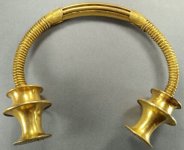
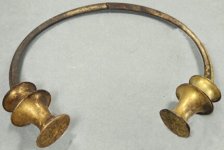
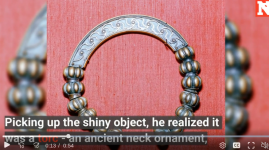
Someone working for the water company found 2 gold necklaces in Cavandi, Asturias, northern Spain, estimated to be 2500 years old.

On thehistoryblog:
Sergio Narciandi was tracing the route of an outage when he saw a shiny object on a slope next to the road. At first he assumed it was a random piece of metal from a goat farm or agricultural equipment in the area, but the brightness of the metal gave him pause. When he took a closer look, he realized it looked a lot like a torc, and a gold one at that.
He knew it needed to be reported to authorities, but he had to hunt around for a while to identify the appropriate authority, so he dialed the mayor, whom he knows personally, and the mayor told him he could deposit at city hall until the cultural patrimony officials took over. Finally Narciandi called his uncle, an archaeologist, and the uncle connected him to the director of the Archaeological Museum of Asturias.

After this round-robin of calls, archaeologists made it to the find site that very afternoon. The confirmed the object was a gold torc, then found six fragments of a second torc on the same hillside. The fragments formed a complete second gold torc. Both torcs were then swiftly transported to the museum’s laboratory for conservation.
- so that same day archeologists turned up and found the second necklace before whisking them away.

These images are shown:
Torc-1-430x351.jpgTorc-2-430x289.jpg

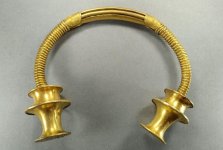
On cnn:
Sergio Marciandi was working in Cavandi, Asturias, on August 29 when he spotted a gold necklace among some rocks.
In this case, the site is intact, giving archaeologists a much better idea of their context, he added.

This images are shown:
230913155811-01-asturias-spain-gold-necklaces.jpg

So - the story is some chap found two 2500-year-old gold necklaces, by the road, on a intact site. In one report the site is a slope by the road, in another one of the necklaces in among some rocks.

Can it be that 1 or 2 gold necklaces are out in the open for 2500 years. Can this really be called an 'intact site'?

If this is a case of information getting lost in translation - is this information not worse than useless? To see more about this I searched online - this was the next link:

MSN

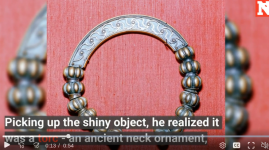
This image is shown:
AA1gAY3t.jpeg

The video has this image:
Screenshot from 2023-09-15 10-29-45.png

The video displays all sorts of nonsense - presumably stock footage.

The MSN article says:
Archaeologists from the Archaeological Museum of Asturias were notified, who took a closer look at the strange discovery and called in experts from institutions in northern Spain.

"This discovery is very important because, for the first time, we know the exact origin of two of these valuable objects, the maximum symbol of prestige for pre-Roman communities, and the context in which they were deposited.

"Its will allow us to solve many enigmas about which we were missing data," investigators into the find told El Pais. "It is a window that has been opened to a part of the history hitherto hidden from the Iron Age."

"Its will allow us to solve many enigmas about which we were missing data".... well, I don't know about that. How well is that data going to be relayed to people? Will we see 4 different types of necklace? Are we really meant to accept that any of us might find ancient gold necklaces on the rocks?

Ángel Villa, an expert at the Archaeological Museum of Asturias told El Pais that the torcs will be valuable in bringing archaeologists "closer to the knowledge of this era."

"In both pieces, all the techniques of antiquity used by a goldsmith of extraordinary skill are concentrated: casting, filigree, graining and welding, combined with aesthetic and geometric motifs and styles, which now allows us to delve deeper into the aspects such as the dispersal of other pieces of which we were not sure of their real origin," Villa said.

Strangely, there were no other archaeological artifacts found around the same area.
"Fundamental analytical work begins now. The pieces may be intended to represent an accumulation of community wealth, not that of an individual. We do not know. Not even if they were for men or women," Villa told the news outlet.

María Antonia Pedregal Montes, director of the museum, concluded: "A multidisciplinary team will be created, the most advanced in knowledge of the Iron Age, with experts from various national institutions. The best."

I get that there is a news wire, and that news is pumped out as a product. I also get that museum directors have to promote their museum, etc. But is it possible that this is all that is going on? Is the coherence of the story of a purported historical find irrelevant? Surely the truth, relayed in good faith will be coherent. Are we to be given incoherent narratives, throw our hands up in the air and accept whatever is being stated? Apparently so.

So - the story is incoherent for the following reasons, imo:
Is it a slope, some rocks, a rocky slope, something else?
Which 2 necklaces?
Why 2500 years?
How can the site be intact AND for 2500 years no one saw these, even though they are by the side of the road (or slope)?
And why are there are no other artifacts in the area?
 
Last edited:
Liquid Bewitchment: Gin Drinking in England, 1700–1850

01-DP825288-edit.jpeg

Not so fake?

I enjoyed looking at the works of cartoonists such as Hogarth in this article. Despite the fact that cartoons are a vivid conjuring of imagery directly from the mind of the cartoonist, I have some time for what these 200+ year-old cartoonists have to say.

Perhaps this is because the style is so idiosyncratic and stylised that it is not readily faked, and perhaps because the bias is clear (this is the cartoonist making popular art for the day).

The world these cartoons describe is not one I recognise in the present - even accounting for the excessive nature of cartoons. However, that supports the idea that the past is not really knowable to us in a meaningful way - the daily reality, the commonly understood context that these cartoons (and the people reading them) operate within, has changed - people today no longer have access to that understanding. We may as well be aliens looking at creatures on another planet. To illustrate the gap - barely anyone even drinks gin nowadays, and even then it would have to be with fizzy tonic water - no one drinks it straight, in a rush to reach oblivion - as often seems to be the case in the cartoons. Also noteworthy, is that drinking was open to all - men, women, even children. It seems that despite the lack of schooling, etc opportunities (to get blind drunk) were pretty equitable.
 
Last edited:
Also noteworthy, is that drinking was open to all - men, women, even children. It seems that despite the lack of schooling, etc opportunities (to get blind drunk) were pretty equitable.
I remember reading about the gin mania in school. Upon reflection, the only way it makes sense to me is that this must have been the first time that this population experienced hard alcohol. But that's just speculation after seeing Dreamtime's gruit beer thread. The picture is basically what happened to some American Indian tribes after being exposed to hard liquor for the first time.

science, history and archaeology are still being used as political weapons

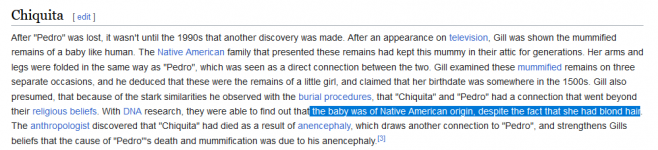
And speaking of American Indians, I found a fake for the thread in the Wikipedia article for the San Pedro Mountain mummy (a mummified baby with anencephaly). There is a second anencephaly baby mummy named Chiquita. Chiquita had blonde hair, but, um... She's American Indian! She just is, okay???

You know. One of those naturally blonde American Indians. Don't ask questions.

San Pedro Mountains Mummy - Wikipedia
 

Attachments

  • chiquita.png
    chiquita.png
    30 KB · Views: 97
No worries, don't shut up :)

But this leads me to a tangent... I don't know if you know crrroooww787877, but he got very excited at the fact that Marie Curie sounds like Mercury. Obviously Mercury is a god, also known as Hermes. At this point perhaps you can see that we may be stepping into occult explanations of our reality - Hermes/Mercury is the messenger of the gods, a mediator (like the media and history are) as well as being famous for his staff - the caduceus with 2 snakes, which also represents commerce and medicine. I've only a little time for this sort of stuff (it is not my concern) but I would agree that whatever the case the 'Hermes/Mercury mythology' does seem to be ingrained into the culture of this reality. I'm not sure the figure of Mercury is one I admire, frankly - it seems to be associated with the worst of this world.

So, what does it mean to say "Tycho Brahe killed by Mercury"? Can this be read as an occult, astro-theological phrase? Perhaps Tycho was going against the agenda of those who steer our cultural reality. Perhaps this is more significant that I intended, in a religious, occult sense.

At this point, I'll reference an alternative cosmology that I know about:
Tychos.space

As I understand it, this uses Tycho Brahe's understanding and observations to constitute an alternative explanation of how the planets, stars, etc work. This stands in contrast to the Copernican explanation - I see there is a chapter that it titled: "Chapter 7: The Copernican model is geometrically impossibile"

Chapter 7: The Copernican model is geometrically impossibile – Nextra

Playing fast and loose with words only - I can't help but wonder whether the tychos.space site is a sort of resurrection of Tychos, even though his idea was purported to have been killed by Mercury.
Apologies for the belated reply .

Do tangents ever converge? Here are more . Kepler stole Brahe's work after his death by Mercury. Was ordered by the authorities to return Brahe's works to his rightful heirs. He duly did return all apart from Tycho's data on Mars . Apparently this data is now held in the Vatican Vaults. Always a mystery to me as to why that is and why that particular planet.

Happy to see someone else has come across Simon Shacks new ideas about the Tycho Brahe's geocentric model. Totally demolishes the
Heliocentric model.

Also provides a very good reason as to why the Martian data is hidden. I do like the the new Tychonic model resurrected and further developed by Simon and colleagues.

I've not really looked at the crow78777 stuff. Seems to Aleister Crowley liber 777 to me.
 
And speaking of American Indians, I found a fake for the thread in the Wikipedia article for the San Pedro Mountain mummy (a mummified baby with anencephaly). There is a second anencephaly baby mummy named Chiquita. Chiquita had blonde hair, but, um... She's American Indian! She just is, okay???

You know. One of those naturally blonde American Indians. Don't ask questions.

I wrote an article about the Mandan Indians some time ago:

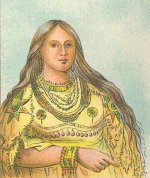
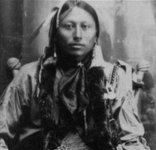
'In the early 1700’s, French explorers encountered the Mandan tribe in the region of the Missouri River (present-day North and South Dakota.) They possessed rather fair skin, red or blonde hair and blue or grey eyes. The women in particular [were] reportedly to be indistinguishable from white people.

In 1804 Lewis and Clark described them as “half-white,” as well as peaceful, civilized, courteous, and polite. They also reported how frequent small pox epidemics and attacks by neighboring tribes had depleted their numbers. "In 1838 the tribe was hit by a devastating smallpox epidemic, and although this was a specter they had been haunted by for centuries, this time it was absolutely catastrophic, wiping them out at such a rate that after only a few months there were only an estimated 30 to 140 of them left. With the Mandan teetering on the edge of extinction, enemy tribes swept in and took them as slaves, after which they were assimilated and absorbed.” By the Borg perhaps?

Here we have the usual smallpox excuse once again, except this time even though it was something “they had been haunted by for centuries, it was absolutely catastrophic, wiping them out.” So, they hadn’t developed a natural immunity to the disease over the previous centuries then? The handful who managed to survive were quickly snaffled up as slaves. "Play it again, Sam."'

Since I wrote that it seems information about the Mandan - specifically their fair complexion - has become rarer than hen's teeth on the internet. In fact the original information came from this site The Mysterious Tribe of Blue-Eyed Native Americans which is now 'Access Denied' unless you sign up.

I don't know if you know crrroooww787877, but he got very excited at the fact that Marie Curie sounds like Mercury. Obviously Mercury is a god, also known as Hermes. At this point perhaps you can see that we may be stepping into occult explanations of our reality - Hermes/Mercury is the messenger of the gods, a mediator (like the media and history are) as well as being famous for his staff - the caduceus with 2 snakes, which also represents commerce and medicine. I've only a little time for this sort of stuff (it is not my concern) but I would agree that whatever the case the 'Hermes/Mercury mythology' does seem to be ingrained into the culture of this reality.

This is very interesting. In his book 'The Dwellings of the Philosophers', Fulcanelli discusses this kind of hidden language of symbolism as being a method of conveying Alchemical knowledge. Mercury was also known as 'Quicksilver' and featured prominently in Alchemy. I forget the word he used to describe the particular devices, but it's an old word that now has a slightly different meaning and isn't used much these days anyway. They are compositions of visual and verbal puns and double-entendres. His book was originally written in French, making some of the examples difficult to follow, but 'Marie Curie' would definitely qualify. I must admit, although I was fascinated by it all, I didn't have time to "complete the course," but I will do one day.

Anyway, it's highly probable that old Tycho was an Alchemist and the tale of his death by Mercury was one of those secret Alchemical allegories. Perhaps it showed where he went wrong in the quest for his Alchemical transformation? Maybe a bashful bladder is really a code for something else? (I will resist the temptation to make distasteful jokes about not taking the p***.)

Fulcanelli's revelation could open up a whole new method of interpreting otherwise ridiculous historical narratives.
 
Since I wrote that it seems information about the Mandan - specifically their fair complexion - has become rarer than hen's teeth on the internet. In fact the original information came from this site The Mysterious Tribe of Blue-Eyed Native Americans which is now 'Access Denied' unless you sign up.
The Mysterious Tribe of Blue-Eyed Native Americans | Mysterious Universe

The Mysterious Tribe of Blue-Eyed Native Americans​

History holds many oddities that we may never fully understand, either through incomplete documentation, disinterest at the time, or simply a big question mark that hangs over all. Among these are mysterious tribes of people that have been encountered and confronted in all corners of the globe, often vanishing before we really understand them and leaving us perplexed at just who they were or where their origins lie. One such tribe was a mysterious group of Native Americans who appeared to explorers as something quite European in nature, although their ways and beginnings have always been cloaked in shadows. Known mostly from historical accounts, their origins remain murky, their lineage uncertain, and they are a historical curiosity we may never fully understand.
During the era of early European contact, the native peoples of North America held many curiosities for explorers and settlers coming to this new, wild land. These tribes were numerous, and displayed rich variety between different cultures, as well as myriad languages, customs, and traditions that inspired awe, wonder, curiosity, bafflement, and even fear in the European adventurers who bravely delved into this uncharted new world and tried to tame it. Yet as fascinating as these new peoples were, perhaps the most interesting was an alleged tribe of natives who were said to look decidedly Caucasian in nature.
The first reports of what would come to be known as the Mandan tribe began to trickle out from French explorers in the region of the Missouri River in present-day North and South Dakota in the early 1700s. These natives were said to have rather fair skin and to have red or blonde hair and blue or grey eyes, and indeed especially the women were purportedly so Nordic in appearance that if it were not for their clothing they were said to be nearly indistinguishable from whites. In 1738, the French Canadian trader Sieur de la Verendrye made the first official outside contact with the Mandan and described them as living in 9 villages at a tributary of the Missouri river called the Heart River, and noted that they also exhibited customs that were decidedly more European than the neighboring tribes.
176732-004-29A6CB64.jpg
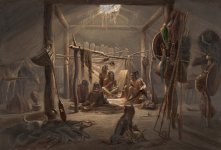
A Mandan chief’s lodge
By 1784 the word had gotten out on this mysterious tribe of blue-eyed Indians, and they were featured in the media, with the August 24, 1784 edition of the Pennsylvania Packet and Daily Advertiser proclaiming that a new tribe of white people had been discovered and that they were “acquainted with the principles of the Christian religion” and “extremely courteous and civilized.” Perhaps one of the more famous of the explorers to come across the Mandan was none other than Lewis and Clark, who visited the tribe in 1804 and described them as “half-white,” as well as peaceful, civilized, courteous, and polite. They also noted that the tribe’s numbers had dwindled significantly due to the frequent small pox epidemics that terrorized them, as well as attacks against them by neighboring tribes, namely the Assiniboine, Lakota, Arikara and the Sioux.
Of course this all led to intense speculation as to what the origins were of this bizarre tribe, and one of the earliest ideas put forward was that they were the descendants of pre-Columbian explorers to the New World. For instance there were many legends from various regions of the present day United States of Welsh speaking natives, perhaps descended from Welsh settlers coming to these shore in the 12th century, in particular a Prince Madoc, who along with his followers was said to have emigrated to America from Wales in about 1170.
One Welsh explorer by the name of John Evans became so convinced that this was the case with the Mandan that he launched an expedition up the Missouri river in 1796 to search for them and prove that their language was derived from Welsh and contained Welsh vocabulary. Evans would trek up the river in the winter of 1796 and he could find no evidence whatsoever of the Welsh influence he had been so sure he would find, forcing him to concede that this was not where the Mandan origins lay. Indeed, he became extremely skeptical that there were any of these legendary “Welsh Indians” at all, saying in a letter to a Dr. Samuel Jones:
Thus having explored and charted the Missurie for 1,800 miles and by my Communications with the Indians this side of the Pacific Ocean from 35 to 49 degrees of Latitude, I am able to inform you that there is no such People as the Welsh Indians.
f3745efe53ebc8d814abecaf2f8b6e9a.jpg
Mandan tribespeople
Another explorer who believed that the Mandan had European roots, perhaps even Welsh, was the frontiersman and pictorial historian George Catlin, who spent several months with the tribe in North Dakota, living amongst and drawing and painting them in 1832. One of the things that first struck him about these mysterious people was just how European they looked, describing that many of them were nearly white and had light hair and blue eyes, and he also noticed that they had more advanced techniques for manufacturing goods and dwellings, customs, traditions, town layouts, and language vastly different from neighboring tribes. Caitlin would say of the Mandan:
They are a very interesting and pleasing people in their personal appearance and manners, differing in many respects, both in looks and customs, from all the other tribes I have seen. So forcibly have I been struck with the peculiar ease and elegance of these people, together with their diversity of complexions, the various colours of their hair and eyes; the singularity of their language, and their peculiar and unaccountable customs, that I am fully convinced that they have sprung from some other origin than that of the other North American Tribes, or that they are an amalgam of natives with some civilized race.
Even some of the legends of the Mandan people themselves expressly mentioned that they had been descended from a strange white man who had appeared to them aboard a canoe in ancient times after an enormous flood had wiped out everything in sight. They claimed that this stranger had taught them about medicine and had influenced their religion, which oddly featured many of the same beats as Christianity, such as a great flood, a virgin birth, and a child born who could work magical miracles, among others. This was noticed by other later expeditions as well, such as an 1833-34 expedition led by German naturalist A.P. Maximilian, who felt that the similarities between Christianity and the Mandan religion were too close to be mere coincidence. Caitlin would write of this:
It would seem that these people must have had some proximity to some part of the civilized world; or that missionaries or others have been formerly among them, inculcating the Christian religion and the Mosaic account of the Flood.
blond-blue-eyed-indian.jpg
A drawing of a Mandan tribeswoman by George Catlin
Another idea on the Mandan origins is that they came from pre-Columbian visitations by Viking explorers. The first official European to ever officially make contact with the Mandan tribe, Sieur de la Verendrye, claimed that at the time he had found a strange runestone with Nordic inscriptions on a riverside near the village. The stone was allegedly sent to France to be studied but it is unclear what happened to the “Verendrye Runestone” after that, and indeed it is uncertain if it ever really existed at all. Unless the stone ever turns up again it remains just as mysterious as the Mandan.
The idea of Vikings in the New World before the days of Columbus has been talked about for some time, with one prevalent and somewhat controversial theory having to do with Eric Thorwaldsson, also more famously known as “The Red,” who established two colonies on the coast of Greenland in 986. The story goes that Eric The Red then abandoned these outposts when the wild, rugged land proved to be too cold and forbidding, and made his way to North America along with the colonists. The theory then claims that the King of Norway is then said to have sent an expedition to the New World to find out what had happened to them, and that this expedition made their way up the rivers to end up in the Dakotas and other areas, after which they became stranded and then assimilated into the native tribes, giving them their Nordic genes.
However, there is very little evidence to prove that Vikings ever actually reached North America. The Verendrye Runestone vanished without a trace and then there is the hotly debated Kensington Runestone, which was a giant slab covered in runes allegedly found by Swedish immigrant Olof Ohman in Minnesota in 1898. In this case the inscriptions claimed that the runes had been created by 14th century Scandinavian explorers, and although the authenticity of the runestone is still debated it has mostly been classified as a hoax by the scientific community.
ef128cb79a2ecda1fd23cc7fb565692e.jpg
Mandan tribeswoman
Regardless of where the Mandan really came from the fact is that we will probably never know for sure. In 1838 the tribe was hit by a devastating smallpox epidemic, and although this was a specter they had been haunted by for centuries, this time it was absolutely catastrophic, wiping them out at such a rate that after only a few months there were only an estimated 30 to 140 of them left. With the Mandan teetering on the edge of extinction, enemy tribes swept in and took them as slaves, after which they were assimilated and absorbed.
Consequent intermarriage and interbreeding meant that any unique genetic heritage they may have had was quickly erased, and the last known full-blooded Mandan was a Mattie Grinnell, who died in 1971. Since there are no more full-blooded Mandan left and only an estimated 8 speakers of its language left today, it is difficult to get a grip on their heritage, even with our advanced DNA testing techniques, and their origins and history will likely forever remain shrouded in mystery, leaving us to merely speculate and debate on it.
It is somewhat sad that this tribe disappeared before we were ever able to really comprehend who they were. All we are left with is the tales and accounts from explorers, but other than that their legacy has evaporated into the tides of history. They are a vanished people who sowed bafflement and wonder, but ultimately left numerous questions swirling about them, doomed to a limbo of superstition, speculation, and rumor. Who were these people? Why did they look and act so differently, and what was the meaning behind their strange ways? To the alien explorers just starting to penetrate this wilderness at the time they may have seemed to be baffling anomalies, and interestingly they still are.
 
Last edited:
These images are shown:
View attachment 29791View attachment 29790

This images are shown:
View attachment 29789

This image is shown:
View attachment 29792

The video has this image:
View attachment 29793

The video displays all sorts of nonsense - presumably stock footage.
Do you have a link to the video that included this image? I didn't seen it when I checked the links (though that may be because I don't follow urges to upgrade my browser).

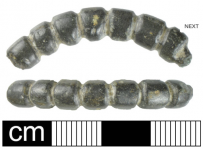
bobbly-ended_torque.png

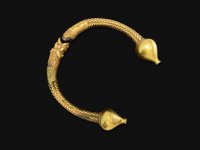
Its ends remind me of UK Portable Antiquities Scheme finds like this:

These struck me as particularly odd. When you know women like I do, you know they don't like bobbly bracelets.

To be more nuanced about it, women that have a taste for bobby bracelets can't afford that much metal. Women that can afford that much metal prefer more delicate bracelets.

Another untypical-of-bracelets attribute of these 'bracelets' is that so many of them are chords. About 90-100 degrees of arc perhaps? So your image of 'bobbly arcs' forming the ends of the 'shiny object' image makes me wonder if the items I've been puzzling over were component parts of torcs.

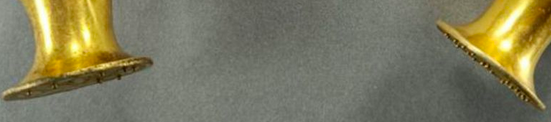
Your first couple of torc images appear to be terminated with the 1920s style phone earpieces made of gold. Phone-like objects called 'torcs'. Hmmmm. A phonetic cargo cult perhaps.

At a guess, these are remnants that the human archaeologists among us are cargo culting. I suspect there were originally organic component parts to these items too but the organic parts have been eaten or rotted away.

If torcs were devices for, say, transmitting talk then perhaps there were devices for listening to talk. Earrings of some sort perhaps. Or the 26 or so bronze 'spoons' that have been found in the UK. The ones that have really short handles, tend to come in pairs, where one has a cross with a tiny circle engraved in it and the other has a hole near its rim. Again, with some important organic parts missing.

The ends of the recently found torcs are interesting:

ends_of_asturias_torque_1.png
A very inconsistent pattern of tiny spikes on the flat ends.

starry_end_1.jpg starry_end_2.jpg
Star engravings with apparently one tiny nodule in the centre of the flat ends.

The last two may be easier to see on the original image.

Many of the PAS database's non-bobbly 'bracelets' have the same arc and other common characteristics. Some of the pieces look like electrical terminal or connector straps fabricated by a culture that wasn't doing 'electronics' but was doing 'electricity'. Others remind me of the manual switch connectors I used to see on old variable resistor sets at school.

That PAS database is a cargo cultist's paradise.

Great thread. Keep it up!
 
Last edited:
Tips
Tips
Please respect our Posting Rules.
Back
Top