

Have to lol at this...
As Alexandra Witze reports for Nature, these are the first images taken with the National Science Foundation’s Daniel K. Inouye Solar Telescope, which sits atop Haleakala, a dormant volcano in Hawai‘i. The Inouye Solar Telescope is the most powerful solar telescope in the world, and according to the National Science Foundation (NSF), its images show the sun in “unprecedented” detail.
The celestial body looks like a bubbling expanse of golden kernels, which in fact represent plasma that covers the sun. (Interesting term...represent...)
The kernels—or “cell-like structures,” as the NSF puts it—are each about the size of Texas. Hot solar plasma rises up in the center of the cells and then cools, sinking down from the surface—“a process known as convection,” the NSF notes.
The sun is a constant swirl of violent activity, burning around 5 million tons of hydrogen fuel every second. That energy radiates into space, and the movement of the sun’s plasma “twists and tangles” solar magnetic fields, according to the NSF.
(Love how they tell us what to believe)
From 93 million miles away, we can’t see all this motion, but we sometimes feel its effects. For instance, coronal mass ejections from the sun shoot charged particles into space that can collide with the Earth’s atmosphere and disrupt satellites, telecommunications and navigation systems, and power grids. In 2017, a solar flare caused blackouts across a wide geographic area, including the Caribbean—where, in an unfortunate coincidence, Hurricane Irma was raging and emergency radio communications were knocked out.
Here's the amazing image below....
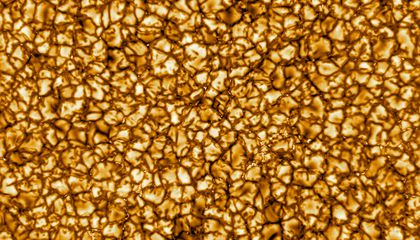
The Daniel K. Inouye Solar Telescope has produced the highest resolution image of the sun's surface ever taken. In this picture, taken at 789 nanometers (nm), we can see features as small as 30km (18 miles) in size for the first time ever. The image shows a pattern of turbulent, “boiling” gas that covers the entire sun. (NSO/AURA/NSF)
So, no image of the earth from space, but here we have a macro close up of the sun, 93 million miles away, from some mountain top on earth...

Source
As Alexandra Witze reports for Nature, these are the first images taken with the National Science Foundation’s Daniel K. Inouye Solar Telescope, which sits atop Haleakala, a dormant volcano in Hawai‘i. The Inouye Solar Telescope is the most powerful solar telescope in the world, and according to the National Science Foundation (NSF), its images show the sun in “unprecedented” detail.
The celestial body looks like a bubbling expanse of golden kernels, which in fact represent plasma that covers the sun. (Interesting term...represent...)
The kernels—or “cell-like structures,” as the NSF puts it—are each about the size of Texas. Hot solar plasma rises up in the center of the cells and then cools, sinking down from the surface—“a process known as convection,” the NSF notes.
The sun is a constant swirl of violent activity, burning around 5 million tons of hydrogen fuel every second. That energy radiates into space, and the movement of the sun’s plasma “twists and tangles” solar magnetic fields, according to the NSF.
(Love how they tell us what to believe)
From 93 million miles away, we can’t see all this motion, but we sometimes feel its effects. For instance, coronal mass ejections from the sun shoot charged particles into space that can collide with the Earth’s atmosphere and disrupt satellites, telecommunications and navigation systems, and power grids. In 2017, a solar flare caused blackouts across a wide geographic area, including the Caribbean—where, in an unfortunate coincidence, Hurricane Irma was raging and emergency radio communications were knocked out.
Here's the amazing image below....
The Daniel K. Inouye Solar Telescope has produced the highest resolution image of the sun's surface ever taken. In this picture, taken at 789 nanometers (nm), we can see features as small as 30km (18 miles) in size for the first time ever. The image shows a pattern of turbulent, “boiling” gas that covers the entire sun. (NSO/AURA/NSF)
So, no image of the earth from space, but here we have a macro close up of the sun, 93 million miles away, from some mountain top on earth...
Source
Note: This OP was recovered from the Sh.org archive.
Note: Archived Sh.org replies to this OP are included in this thread.


