
F
Felix Noille
Guest
This post is part six in a series that follows a long chain of events within which The City of London features significantly, as does the number 6. It is hoped that by studying this chain of events, various patterns can be identified that may give clues to support alternative theories of ‘history’. Also, the arrogance and vanity of the perpetrators of these events may reveal more detail than was intended. It may also be possible to recognise these same patterns and details in our more recent history which may add weight to the validity of any assumptions and theories that suggest themselves. This chain of events represents just one tiny thread in the spider’s web, but hopefully it reaches further in towards the centre.
It’s also possible that this entire chain of events never happened, but we have to work with what we’ve got.
Please note:
Invasion of the Orange Puppet.
[Continued from part 5] James II and the Jesuits used the Declaration of Indulgence to replace Anglican officials with Catholic ones which, of course, led to a confrontation that did James no favours at all.
In June 1688 James Francis Edward Stuart was born. He was supposedly the son of King James II and his second wife, Mary of Modena. He immediately squashed Bill the Orange’s wife Mary’s position as next in line for the crown. It seemed that Bill was a seedless Orange, having no children of his own. Many found this birth far too convenient and believed it was a fraud.
After much secret communication between Bill the Orange and “several leading English politicians”, he was ‘invited to intervene’ in the affairs of England. On November 5th, 1688, William Prince of Orange, King of the Netherlands, puppet of the Jewish bankers, invaded England. 5th November… that date again – this is what’s really being celebrated annually on Bonfire Night by an unwitting UK population.
The English people weren’t particularly pleased to see him, having had enough of political instability and religious squabbling so Bill the Orange kept a low profile. He ‘recommended’ that James dismissed all of the newly appointed Catholic officials and implemented a policy of “toleration for all forms of worship accompanied by religious tests for public office.” The Jesuits would have none of that, surprise, surprise and James was unable to concede to the further demand that he “should deny the legitimacy of the infant prince” his son.
Rather than appealing to English patriotism in the face of a foreign threat, James prevaricated and his actions were seen as cowardice. Various English gentry began declaring their allegiance to Bill ten days after his arrival, even though he was, to all intents and purposes, there “not to claim the crown, but to secure a free parliament and a constitutional government.” ...yeah right.
“When it was decided that the [James’] forces, which were assembled at Salisbury, should fall back to cover London instead of taking the offensive, John Churchill and the Duke of Grafton went over to William; they were followed immediately by George of Denmark, the husband of the Princess Anne, and then by Anne herself.” Source
John Churchill is worthy of closer scrutiny:
Source: “Pawns in the Game”, William Guy Carr.
“It is interesting to note that John Churchill, 1650-1722, became the leading military figure during this period of English history. Because of his military genius, and his services to Britain, he was created the first Duke of Marlborough... In 1701 the Duke of Marlborough was made Commander-in-chief of the armed forces of Holland. No less an authority than the Jewish Encyclopedia records the fact that for his many services The Duke of Marlborough received not less than £6,000 a year from the Dutch Jewish banker, Solomon Medina.
“The duke is the direct ancestor of Sir Winston Churchill, the Prime Minister of England today... i.e. 1954 — Churchill is self-acknowledged as having been the foremost Zionist of this era. He is the man most responsible for influencing the United Nations to create the State of Israel.”
One wonders how many other influential Englishmen were on the same payroll.
King James II fled to France, but got caught by some fishermen who, instead of throwing him back, had him returned to London “where, in the curiously oscillating state of public opinion, his return was received with bonfires, bell-ringing, and general acclamation.” However, the elation of the people counted for nothing and James’ flight had persuaded the vast majority of his supporters to desert him. Therefore, another flight was called for as it would be much easier to declare an abdication than if Bill the Orange physically removed him. “It was now William's object to frighten James into a repetition of the performance, and to take care that this time his escape should be unhindered. Some display of coercion was all that was needed to give effect to William's design. On December 22 James fled for the second time, to be hospitably received by the king of France, who established him in the palace of St Germain.” Source
England was left with no king, no parliament and no council that could claim authority. By a sheer stroke of luck, Bill the Orange was hanging about down on the coast with nothing better to do. He gathered an assembly which excluded anyone who had served under James II, but included anyone who had served under Charles II as they were less likely to be Catholics. He also included fifty members of the corporation of The City of London. This assembly decided to create a free Convention whereby “the boroughs elected their representatives under the old charters which had been cancelled in the last years of Charles II.” In the meantime Bill the Orange was to take care of everything.
What the Convention tried to achieve was to declare that by fleeing James had abdicated and left the throne vacant. Furthermore, that it was against ‘public policy’ that the throne should be occupied by a Catholic Prince – James’ new offspring. A battle ensued whereby one faction declared that the throne was not vacant as there was a clear line of succession and the other declared that a monarch was to be elected. “According to the strict law of hereditary succession, if the infant prince were excluded, Mary [Bill's wife] stood first, Anne [Mary's sister] and her children next, and after them William.”
Bill’s wife, Mary said she would only rule if it was jointly with her husband. Princess Ann said it would be in the ‘public interest’ for Bill to take the crown. Bill said “that he did not claim the throne for himself, but that he had no intention of remaining in England in any capacity except that of king. If the crown were offered him he would accept it; if it were not he would return to Holland.” So who was he claiming it for if not himself? He also demanded that he should rule absolutely even after Mary’s death.
The Glorious Revolution and the New Order
In 1689 William III of Orange and Mary II, were proclaimed King and Queen of England by the Bishop of London, not the Archbishop of Canterbury as was usual, because he was otherwise engaged in refusing to recognise James II’s abdication.
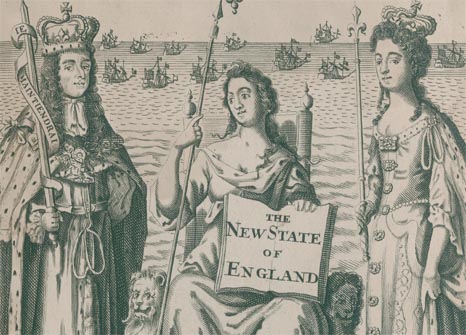
The House of Commons had made Bill accept another Bill - the Bill of Rights - before the coronation. This was “one of the most important constitutional documents in English history.” (Source). The Bill of Rights enforced limits on the powers of the monarch and set out the rights of Parliament. It effectively negated the supposedly age old ‘divine right of kings’ and shifted power from the monarchy (and to a certain extent the Church) to Parliament… or rather those who controlled Parliament. Apparently Bill the Orange wasn’t keen on the Bill of Rights, but signed it anyway due to the delicacy of his position as he didn’t want to upset the apple-cart… or the orange-cart either.
Bill was pre-programmed to make war, as much war as possible. The French were his favourite choice of enemy, but the predominantly Catholic Irish got more than their fair share too, especially when James II attempted a come-back tour there supported by the French. When Bill the Orange went to Ireland with troops and supplies, the French curiously made no attempt whatsoever to engage him during his passage. Once Bill and his troops were safe in Ireland, the French navy inflicted a disastrous defeat on the combined English and Dutch squadrons off Beachy Head, far away on the south-eastern coast of England, but it had no effect at all on hostilities in Catholic Ireland. Furthermore, England was left virtually undefended, all the troops being in Ireland and therefore ripe for the plucking as far as the French were concerned, but no – nothing happened.
When Ireland eventually capitulated, terms were agreed between Bill the Orange’s representative, Ginckel, a Dutch General and the defeated Irish. These terms were betrayed soon after and overturned by the British Parliament using its newly gained powers under the Bill of Rights. What resulted was a persecution of the Irish Catholics that was so severe it would guarantee division, confrontation, hatred and violence for hundreds of years to follow.
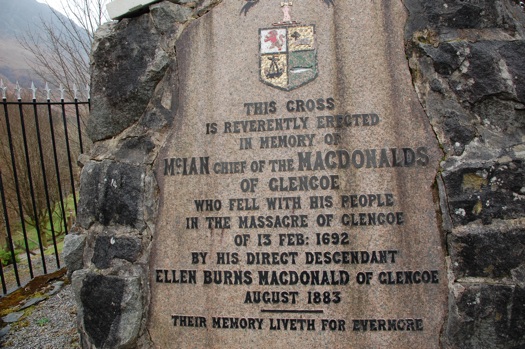
The ‘Glorious Revolution’ in Scotland was much more complicated. Scotland had its own constitution which was very different to that of England. It’s far too complicated to go into details, but the general tone of the whole affair is best summed up by its outcome and the despicable massacre of Glencoe. There had been armed resistance to the Glorious Revolution in Scotland that turned out badly for certain Jacobite Scottish clans. After their defeat, William offered a pardon dependant upon an oath of allegiance, but the taking of this oath had a time limit. The chief of the Macdonald clan went to swear on the last day, but curiously there was no one available at Fort William who could accept his oath. He was forced to go to Edinburgh to make it, which he did one week later, but they refused to take it out of time and reported him to London as a recalcitrant.
John Dalrymple, one of William's principal advisers with regard to Scottish affairs, procured from the king an order that "this set of thieves" should be "extirpated." “To carry out the order a party of soldiers was sent to Glencoe, whose commander was connected by marriage with the chief's family. Their hostile intentions were carefully concealed; they were received and entertained hospitably by the clan for a fortnight. Then in the night they rose upon their entertainers and massacred them, though some few of the intended victims succeeded in making their escape.” Source
“Bowing to public opinion, William dismissed those responsible for the massacre, though they still remained in his favour; in the words of the historian John Dalberg-Acton, "one became a colonel, another a knight, a third a peer, and a fourth an earl." Source
“The inadequacy of the penalties inflicted after the whole story of the crime was revealed left a rankling sentiment of bitterness in Scotland against the system which kept the king of Scotland at a distance from the realm and out of touch with the Scottish people… The memory of the massacre of Glencoe remained among the Scottish people as one of the incentives to Jacobitism and to the popular dislike at least of any closer connection with England.” Source
Another investment made in hatred with future dividends in divide and rule ensuring that the British Isles would never truly be a united kingdom.
“Post-revolution society was based much less on the rule of social leaders voluntarily leading in public service and on private philanthropy than on a rule of law made by the elite for the elite and upon the professionalism of government.” Source
The title ‘The Glorious Revolution’ seems like overkill really. There was nothing glorious about it whatsoever as far as the people of the British Isles were concerned. It’s like that other epithet ‘The Great’. ‘The Great War’ for example - that’s the one that sickens me the most. However, I think it’s obvious who the Great and the Glorious consider themselves to be.
Meanwhile, Bank in the City...
Source: “Pawns in the Game”, William Guy Carr:
“All the wars and rebellions fought from 1640 to 1689 were fomented by the International money-lenders for the purpose of putting themselves in position to control British politics and economy. Their first objective was to obtain permission to institute a Bank of England and consolidate and secure the debts Britain owed them for loans made to her to fight the wars they instigated. History shows how they completed their plans.
“In the final analysis, none of the countries and people involved in the wars and revolutions obtained any lasting benefits. No permanent or satisfactory solution was reached regarding the political, economic, and religious issues involved. The only people to benefit were the small group of money-lenders who financed the wars and revolutions, and their friends and agents, who supplied the armies, the ships, and the munitions.”
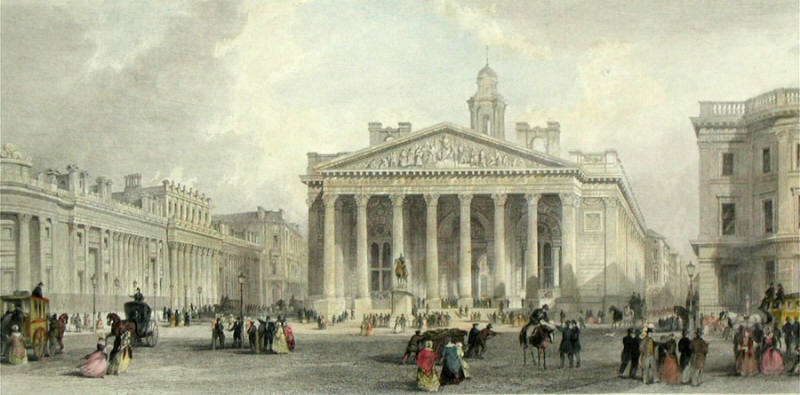
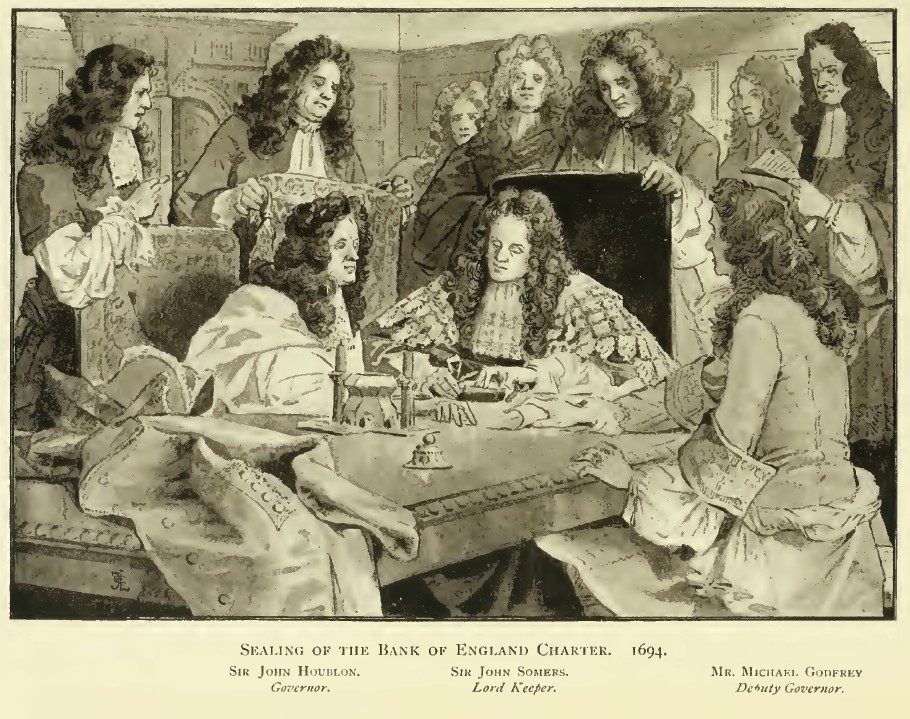
“William's decision to grant the Royal Charter in 1694 to the Bank of England, a private institution owned by bankers, is his most relevant economic legacy. It laid the financial foundation of the English take-over of the central role of the Dutch Republic and Bank of Amsterdam in global commerce in the 18th century.” Source
Source: “Pawns in the Game”, William Guy Carr:
“It is important to remember that no sooner was the Dutch General sitting upon the throne of England than he persuaded the British Treasury to borrow £1,250,000 from the Jewish bankers who had put him there. The school book history informs our children that the negotiations were conducted by Sir John Houblen and Mr. William Patterson on behalf of the British Government with money-lenders whose identity remained secret. Search of historical documents reveals that in order to maintain complete secrecy the negotiations regarding the terms of the loan were carried on in a church… The international money-lenders agreed to accommodate the British Treasury to the extent of £1,250,000 providing they could dictate their own terms and conditions. This was agreed to. The terms were in part :
“Thus, for the sum of £1,250,000, King William of Orange sold the people of England into economic bondage. The Jewish money-lenders gained their ambitions. They had usurped the power to issue and control the currency of the nation. And, having secured that power, they cared not who made the laws.
“As far as England is concerned, in only four years, 1694 to 1698, the national debt was increased from one to sixteen million pounds sterling. This debt accumulated because of wars… The events leading up to the French Revolution show how between 1698 and 1815 the National Debt of Britain was increased to £885,000,000. By 1945 the British National Debt had reached the astronomical figure of £22,503,532,372, and for the years 1945-46 the carrying charges alone amounted to £445,446,241.”
Today it’s £2,295,734,500,000 and rising at the rate of rate of £5,170 per second.
Finally in 1694 the City of London was just about rebuilt after the Great Fire of 1666. Maybe that should be reborn. All that was required now was to place it firmly under new management.
[To be continued… 666 in the City: Conclusion & Modus Operandi]
It’s also possible that this entire chain of events never happened, but we have to work with what we’ve got.
Please note:
- The dates and names have probably been changed or invented to protect the guilty.
- Also, the Divide and Rule/Conquer principle works both ways when the protagonists divide themselves into apparently opposing factions.
Invasion of the Orange Puppet.
[Continued from part 5] James II and the Jesuits used the Declaration of Indulgence to replace Anglican officials with Catholic ones which, of course, led to a confrontation that did James no favours at all.
In June 1688 James Francis Edward Stuart was born. He was supposedly the son of King James II and his second wife, Mary of Modena. He immediately squashed Bill the Orange’s wife Mary’s position as next in line for the crown. It seemed that Bill was a seedless Orange, having no children of his own. Many found this birth far too convenient and believed it was a fraud.
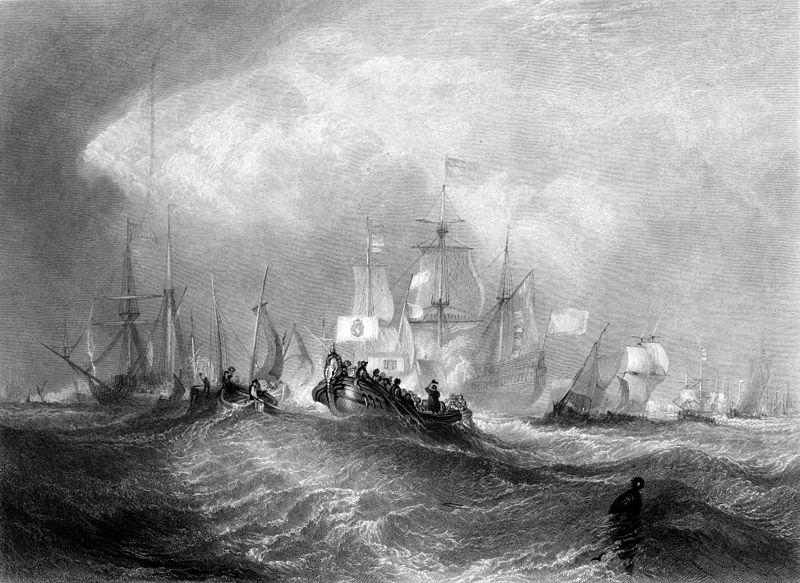
After much secret communication between Bill the Orange and “several leading English politicians”, he was ‘invited to intervene’ in the affairs of England. On November 5th, 1688, William Prince of Orange, King of the Netherlands, puppet of the Jewish bankers, invaded England. 5th November… that date again – this is what’s really being celebrated annually on Bonfire Night by an unwitting UK population.
The English people weren’t particularly pleased to see him, having had enough of political instability and religious squabbling so Bill the Orange kept a low profile. He ‘recommended’ that James dismissed all of the newly appointed Catholic officials and implemented a policy of “toleration for all forms of worship accompanied by religious tests for public office.” The Jesuits would have none of that, surprise, surprise and James was unable to concede to the further demand that he “should deny the legitimacy of the infant prince” his son.
Rather than appealing to English patriotism in the face of a foreign threat, James prevaricated and his actions were seen as cowardice. Various English gentry began declaring their allegiance to Bill ten days after his arrival, even though he was, to all intents and purposes, there “not to claim the crown, but to secure a free parliament and a constitutional government.” ...yeah right.
“When it was decided that the [James’] forces, which were assembled at Salisbury, should fall back to cover London instead of taking the offensive, John Churchill and the Duke of Grafton went over to William; they were followed immediately by George of Denmark, the husband of the Princess Anne, and then by Anne herself.” Source
John Churchill is worthy of closer scrutiny:
Source: “Pawns in the Game”, William Guy Carr.
“It is interesting to note that John Churchill, 1650-1722, became the leading military figure during this period of English history. Because of his military genius, and his services to Britain, he was created the first Duke of Marlborough... In 1701 the Duke of Marlborough was made Commander-in-chief of the armed forces of Holland. No less an authority than the Jewish Encyclopedia records the fact that for his many services The Duke of Marlborough received not less than £6,000 a year from the Dutch Jewish banker, Solomon Medina.
“The duke is the direct ancestor of Sir Winston Churchill, the Prime Minister of England today... i.e. 1954 — Churchill is self-acknowledged as having been the foremost Zionist of this era. He is the man most responsible for influencing the United Nations to create the State of Israel.”
One wonders how many other influential Englishmen were on the same payroll.
King James II fled to France, but got caught by some fishermen who, instead of throwing him back, had him returned to London “where, in the curiously oscillating state of public opinion, his return was received with bonfires, bell-ringing, and general acclamation.” However, the elation of the people counted for nothing and James’ flight had persuaded the vast majority of his supporters to desert him. Therefore, another flight was called for as it would be much easier to declare an abdication than if Bill the Orange physically removed him. “It was now William's object to frighten James into a repetition of the performance, and to take care that this time his escape should be unhindered. Some display of coercion was all that was needed to give effect to William's design. On December 22 James fled for the second time, to be hospitably received by the king of France, who established him in the palace of St Germain.” Source
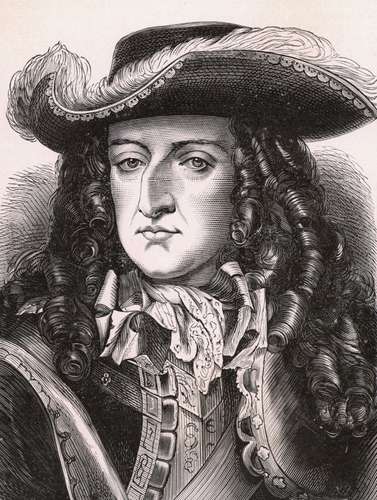
England was left with no king, no parliament and no council that could claim authority. By a sheer stroke of luck, Bill the Orange was hanging about down on the coast with nothing better to do. He gathered an assembly which excluded anyone who had served under James II, but included anyone who had served under Charles II as they were less likely to be Catholics. He also included fifty members of the corporation of The City of London. This assembly decided to create a free Convention whereby “the boroughs elected their representatives under the old charters which had been cancelled in the last years of Charles II.” In the meantime Bill the Orange was to take care of everything.
What the Convention tried to achieve was to declare that by fleeing James had abdicated and left the throne vacant. Furthermore, that it was against ‘public policy’ that the throne should be occupied by a Catholic Prince – James’ new offspring. A battle ensued whereby one faction declared that the throne was not vacant as there was a clear line of succession and the other declared that a monarch was to be elected. “According to the strict law of hereditary succession, if the infant prince were excluded, Mary [Bill's wife] stood first, Anne [Mary's sister] and her children next, and after them William.”
Bill’s wife, Mary said she would only rule if it was jointly with her husband. Princess Ann said it would be in the ‘public interest’ for Bill to take the crown. Bill said “that he did not claim the throne for himself, but that he had no intention of remaining in England in any capacity except that of king. If the crown were offered him he would accept it; if it were not he would return to Holland.” So who was he claiming it for if not himself? He also demanded that he should rule absolutely even after Mary’s death.
The Glorious Revolution and the New Order
In 1689 William III of Orange and Mary II, were proclaimed King and Queen of England by the Bishop of London, not the Archbishop of Canterbury as was usual, because he was otherwise engaged in refusing to recognise James II’s abdication.
The House of Commons had made Bill accept another Bill - the Bill of Rights - before the coronation. This was “one of the most important constitutional documents in English history.” (Source). The Bill of Rights enforced limits on the powers of the monarch and set out the rights of Parliament. It effectively negated the supposedly age old ‘divine right of kings’ and shifted power from the monarchy (and to a certain extent the Church) to Parliament… or rather those who controlled Parliament. Apparently Bill the Orange wasn’t keen on the Bill of Rights, but signed it anyway due to the delicacy of his position as he didn’t want to upset the apple-cart… or the orange-cart either.
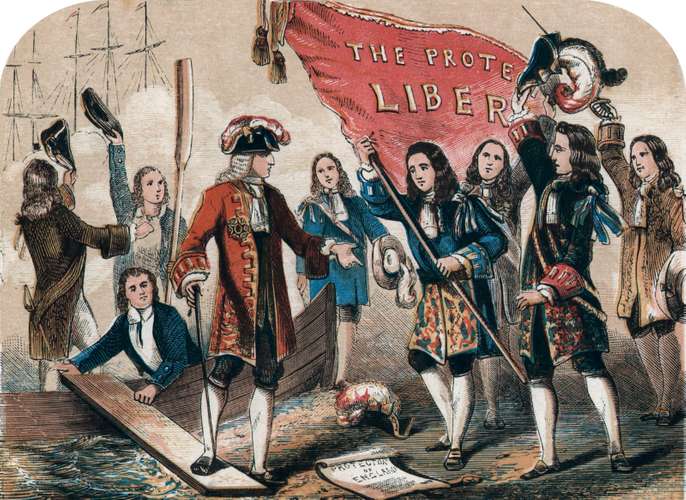
Bill was pre-programmed to make war, as much war as possible. The French were his favourite choice of enemy, but the predominantly Catholic Irish got more than their fair share too, especially when James II attempted a come-back tour there supported by the French. When Bill the Orange went to Ireland with troops and supplies, the French curiously made no attempt whatsoever to engage him during his passage. Once Bill and his troops were safe in Ireland, the French navy inflicted a disastrous defeat on the combined English and Dutch squadrons off Beachy Head, far away on the south-eastern coast of England, but it had no effect at all on hostilities in Catholic Ireland. Furthermore, England was left virtually undefended, all the troops being in Ireland and therefore ripe for the plucking as far as the French were concerned, but no – nothing happened.
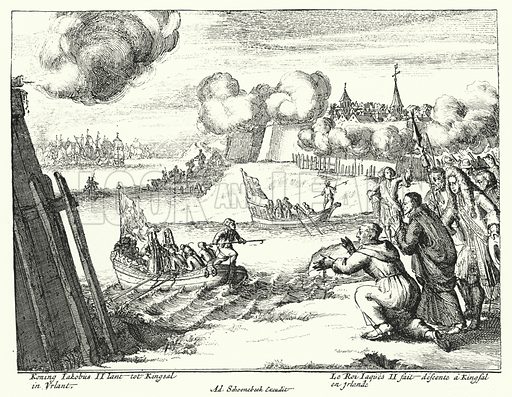
When Ireland eventually capitulated, terms were agreed between Bill the Orange’s representative, Ginckel, a Dutch General and the defeated Irish. These terms were betrayed soon after and overturned by the British Parliament using its newly gained powers under the Bill of Rights. What resulted was a persecution of the Irish Catholics that was so severe it would guarantee division, confrontation, hatred and violence for hundreds of years to follow.
The ‘Glorious Revolution’ in Scotland was much more complicated. Scotland had its own constitution which was very different to that of England. It’s far too complicated to go into details, but the general tone of the whole affair is best summed up by its outcome and the despicable massacre of Glencoe. There had been armed resistance to the Glorious Revolution in Scotland that turned out badly for certain Jacobite Scottish clans. After their defeat, William offered a pardon dependant upon an oath of allegiance, but the taking of this oath had a time limit. The chief of the Macdonald clan went to swear on the last day, but curiously there was no one available at Fort William who could accept his oath. He was forced to go to Edinburgh to make it, which he did one week later, but they refused to take it out of time and reported him to London as a recalcitrant.
John Dalrymple, one of William's principal advisers with regard to Scottish affairs, procured from the king an order that "this set of thieves" should be "extirpated." “To carry out the order a party of soldiers was sent to Glencoe, whose commander was connected by marriage with the chief's family. Their hostile intentions were carefully concealed; they were received and entertained hospitably by the clan for a fortnight. Then in the night they rose upon their entertainers and massacred them, though some few of the intended victims succeeded in making their escape.” Source
“Bowing to public opinion, William dismissed those responsible for the massacre, though they still remained in his favour; in the words of the historian John Dalberg-Acton, "one became a colonel, another a knight, a third a peer, and a fourth an earl." Source
“The inadequacy of the penalties inflicted after the whole story of the crime was revealed left a rankling sentiment of bitterness in Scotland against the system which kept the king of Scotland at a distance from the realm and out of touch with the Scottish people… The memory of the massacre of Glencoe remained among the Scottish people as one of the incentives to Jacobitism and to the popular dislike at least of any closer connection with England.” Source
Another investment made in hatred with future dividends in divide and rule ensuring that the British Isles would never truly be a united kingdom.
“Post-revolution society was based much less on the rule of social leaders voluntarily leading in public service and on private philanthropy than on a rule of law made by the elite for the elite and upon the professionalism of government.” Source
The title ‘The Glorious Revolution’ seems like overkill really. There was nothing glorious about it whatsoever as far as the people of the British Isles were concerned. It’s like that other epithet ‘The Great’. ‘The Great War’ for example - that’s the one that sickens me the most. However, I think it’s obvious who the Great and the Glorious consider themselves to be.
Meanwhile, Bank in the City...
Source: “Pawns in the Game”, William Guy Carr:
“All the wars and rebellions fought from 1640 to 1689 were fomented by the International money-lenders for the purpose of putting themselves in position to control British politics and economy. Their first objective was to obtain permission to institute a Bank of England and consolidate and secure the debts Britain owed them for loans made to her to fight the wars they instigated. History shows how they completed their plans.
“In the final analysis, none of the countries and people involved in the wars and revolutions obtained any lasting benefits. No permanent or satisfactory solution was reached regarding the political, economic, and religious issues involved. The only people to benefit were the small group of money-lenders who financed the wars and revolutions, and their friends and agents, who supplied the armies, the ships, and the munitions.”
“William's decision to grant the Royal Charter in 1694 to the Bank of England, a private institution owned by bankers, is his most relevant economic legacy. It laid the financial foundation of the English take-over of the central role of the Dutch Republic and Bank of Amsterdam in global commerce in the 18th century.” Source
Source: “Pawns in the Game”, William Guy Carr:
“It is important to remember that no sooner was the Dutch General sitting upon the throne of England than he persuaded the British Treasury to borrow £1,250,000 from the Jewish bankers who had put him there. The school book history informs our children that the negotiations were conducted by Sir John Houblen and Mr. William Patterson on behalf of the British Government with money-lenders whose identity remained secret. Search of historical documents reveals that in order to maintain complete secrecy the negotiations regarding the terms of the loan were carried on in a church… The international money-lenders agreed to accommodate the British Treasury to the extent of £1,250,000 providing they could dictate their own terms and conditions. This was agreed to. The terms were in part :
- That the names of those who made the loan remain secret; and that they be granted a Charter to establish a Bank of England. (The identity of the men who control the Bank of England still remains a secret. The Macmillan Committee appointed in 1929 to throw light on the subject failed completely. Mr. Montague Norman, the official Head of he Bank of England was most evasive and non-committal in any answer he made to the committee. For further particulars read — Facts about the Bank of England by A.N. Field, p. 4.)
- That the directors of the Bank of England be granted the legal right to establish the Gold Standard for currency by which —
- They could make loans to the value of £10 for every £1 value of gold they had on deposit in their vaults.
- That they be permitted to consolidate the national debt; and secure payment of amounts due as principal and interest by direct taxation of the people.
“Thus, for the sum of £1,250,000, King William of Orange sold the people of England into economic bondage. The Jewish money-lenders gained their ambitions. They had usurped the power to issue and control the currency of the nation. And, having secured that power, they cared not who made the laws.
“As far as England is concerned, in only four years, 1694 to 1698, the national debt was increased from one to sixteen million pounds sterling. This debt accumulated because of wars… The events leading up to the French Revolution show how between 1698 and 1815 the National Debt of Britain was increased to £885,000,000. By 1945 the British National Debt had reached the astronomical figure of £22,503,532,372, and for the years 1945-46 the carrying charges alone amounted to £445,446,241.”
Today it’s £2,295,734,500,000 and rising at the rate of rate of £5,170 per second.
Finally in 1694 the City of London was just about rebuilt after the Great Fire of 1666. Maybe that should be reborn. All that was required now was to place it firmly under new management.
[To be continued… 666 in the City: Conclusion & Modus Operandi]
Note: This OP was recovered from the Sh.org archive.


