The Stourhead Massacre of true English Nobility in1902

Artemisian

Core Member
Active Member
Joined
Aug 22, 2022
Messages
116
Reaction score
250
My theory so far: the recent history of the British Isles has been hijacked, and disaggregated so that the invaders' destruction is blamed on various other parties, including the indigenous population. The relentless, brutal attacks on man, beast, and building, and internal subterfuge, blackmail and bribery have proved successful, and the natives are now captured in the invaders' web of privileges and rights, to be dispensed and withdrawn on a whim. Britain's ancient history has been largely obliterated or consigned to mythology.

Questions remain: what happened to the true nobility and House of Wessex?

Alfred's Tower
I became fascinated by Alfred’s Tower (51°06′53″N, 2°21′54″W) when I came across a statue of King Alfred, otherwise known as Alfred the Great, a third of the way up on its north-eastern face. Another post has more details on the possible relationship between King Edward VII, King Alfred and Queen Elizabeth.

This beautiful triangular tower is massively solid, yet elegant, almost chateau-like with its pointed west turret. An impressive 48m/160ft tall - that’s 18-20 floors high! - it is set in a commanding position at the end of a long, high ridge in Wiltshire, looking west over Somerset and Dorset. It is not a well-known monument, and seems to have been largely forgotten, which in itself is strange. It is an iconic structure.

1756664368314.png
1756664582850.png

The site is managed by the suspect National Trust, a charitable organisation that manages a lot of British heritage sites. It acknowledges that King Alfred the Great’s army was once here, and I suspect that his son King Edward was familiar with the place:

1756664667595.png

It seems that the National Trust would prefer it if you got in your car, drove down to their box office, cafe and shop, and spent your two and a half hours there.

1756664731931.png

Viewed from a distance, it is striking, but the trees don’t allow you to appreciate the scale of it. Not that I would like the trees to be chopped down, but I’m just saying that If They wanted to, They would have.

Below is the map provided by the National Trust. It wasn’t until a few days later that I looked at the place names closely, and, to be honest, they turned my stomach, and I’m glad I didn’t notice when I was visiting.

1756664790102.png


Six Wells Bottom & St. Peter’s Pump
The centre of the map has areas called Lynch Wood, Sunny Hanging and Shady Hanging. There is also Hilcombe Hanging, by Alfred’s Tower, and White Sheet Hill is about three miles to the east.

1756664957035.png

This is Six Wells Bottom, looking along the top red/blue path on the map above, from left to right. Shady Hanging is to the left, with Sunny Hanging to the right of the gentle valley. From the corresponding angle of the sun, we can surmise that the hangings took place in summer.

1756665009533.png

Despite being called Six Wells Bottom, there are no longer any discernible wells except for this rather hideous mess, with an old world cherry on the top. It is at the other end of the valley, just visible a kilometre away in the middle of the photo above. This is St Peter’s Pump:

1756665044480.png

The name St. Peter gives a clear Catholic connection. The pump’s story is that it was made in 1474 and placed near to St Peter's Church in Bristol, a port city 35 miles away, where it was originally dedicated to St. Agnes or St Edith. It was removed in 1766, and placed here two years later, by Henry Hoare, on a grotto base over one of the springs that form the source of the River Stour. It certainly is not functioning - it’s hard to see how it would function - and the shoddy, scruffy walls are not in keeping with the smart, old buildings around.

Perhaps the name references St. Peter’s Pence? Peter’s Pence is the name given to donations or payments made directly to the Holy See of the Catholic Church, a practice which arose first in England, and was/is basically a tax. The pillaging of Wessex’s nobility would certainly swell the coffers of the victors, pumping considerable wealth into their currency. Maybe it even seals the well where the bodies were thrown, like a gruesome trophy photograph taken by a murderous psychopath of his victim’s secret burial place.

It is either coincidence or confirmation that the Hoares, professed owners of Stourhead Park since the early 1700’s, are the founding family of C. Hoare & Co., the oldest private bank in England, which is still thriving today, primarily serving high-net-worth families and individuals.

Okay, all this is circumstantial evidence - we need something more.

Stourhead House Inscription
Stourhead House, as the name implies, lies at the head of the River Stour, which rises in Six Wells Bottom. It is rather plain as stately homes go, but in a secure location on the same high ridge as Alfred’s Tower, with a fresh water supply that can be controlled and protected from poisoning.

1756665163933.png

However, at the rear of the building that I found something … chilling.

The back of the house is quite nice, with a wall-edged ha-ha, maybe once a moat, about fifty metres from the house, and a view along the ridge to a 100ft/ 32m tall stone obelisk. Following the ridge beyond the obelisk takes you round to Alfred’s Tower.

1756665344845.png

1756665370782.png

On the central pediment of the house, there is a Latin inscription, under a double-headed eagle; both associated with the Holy Roman Empire, and distinctly non-native.

1756665426271.png
Although it is difficult to make out some of the text, due to the angle of the photograph, it is possible to make out:

VASTATAS A.D. 1902 RESTAURAVIT ——AD1903
or
LAID TO WASTE 1902 RESTORED 1903​

Say What ???????


Finally, I would like to add that this is a novel theory, to my knowledge, just in case the Watchers have been persuaded by the Parasitic Ruling Class that We, the people, are fine with having our noble ancestors slaughtered, and replaced with evil personified. Attempts appear to have been made to allow for both “hidden in plain sight” with clues still on display, and simultaneously “plausible deniability “. I live in hope for retribution for their sins, and I hope you got that, Watchers!
 
My theory so far: the recent history of the British Isles has been hijacked, and disaggregated so that the invaders' destruction is blamed on various other parties, including the indigenous population. The relentless, brutal attacks on man, beast, and building, and internal subterfuge, blackmail and bribery have proved successful, and the natives are now captured in the invaders' web of privileges and rights, to be dispensed and withdrawn on a whim. Britain's ancient history has been largely obliterated or consigned to mythology.

Questions remain: what happened to the true nobility and House of Wessex?

It's possible that Cromwell was involved. He was responsible for destroying around 97% of Britain's artwork -
No one can be sure of the exact figure, but it is estimated that the destruction started and legalised by Cromwell amounted to 97% of the English art then in existence. Statues were hacked down. Frescoes were smashed to bits. Mosaics were pulverized. Illuminated manuscripts were shredded. Wooden carvings were burned. Precious metalwork was melted down. Shrines were reduced to rubble.

Stourhead House
On the central pediment of the house, there is a Latin inscription, under a double-headed eagle; both associated with the Holy Roman Empire, and distinctly non-native.
I found this described as being inside Stourhead House: "Gold coloured container in the shape of double headed eagle".

1756908538234.png
 
Last edited:
My theory so far: the recent history of the British Isles has been hijacked, and disaggregated so that the invaders' destruction is blamed on various other parties, including the indigenous population.
...
Britain's ancient history has been largely obliterated or consigned to mythology.
I allude to what sort of conflict this might have been in this post and a bit more directly in this one.
Here is the list of some of the dark-skinned Irish/Scottish/English rebels that Cromwell sent to North America, around the time he destroyed 97%+ of British artwork.

Questions remain: what happened to the true nobility and House of Wessex?
Perhaps clues to your question can be found by looking for artwork which contains elements that are least represented. Since Cromwell destroyed an estimated 97% (or more) of English art, the remaining 1-3% might stand out as somewhat irregular or unusual.
Statues were hacked down. Frescoes were smashed to bits. Mosaics were pulverized. Illuminated manuscripts were shredded. Wooden carvings were burned. Precious metalwork was melted down. Shrines were reduced to rubble.
Potentially flags, emblems and crests could prove insightful.

Here are some examples from England; although there are many more examples from across Europe.

1757022331738.png

Stained glass in a window, St James the Apostle Church, Somerton, Oxfordshire. Features one window with a single Black figure with Eastern Crown flanking the Juxon arms impaled with Walrond, and in another two escutcheons with Juxon’s arms (four faces) and a crowned Black head on a crest above the helm.

1757021860215.png
1757022114127.png

Sketch of coat of arms of William Juxon, Archbishop of Canterbury, in the window of Gray’s Inn; from a series of arms in the windows of the Inns of Court; illustration to Dugdale, ‘Origines Juridiciales’ (London, first published 1666). Source: Etching ©The Trustees of the British Museum.

1757022350920.png

Stonework coat of arms at Fulham Palace. Dated 1636, it shows Juxon’s arms impaled with the two swords of the Bishop of London.

1757023022680.png
1757023034092.png


1757025134616.png
image.png

This plate dates to c1815, beautifully decorated with Sir John Hullock family crest to the central part of the plate.
Sir John Hullock (1767-1829) was Judge and Baron of the Exchequer and resided at Thorngate House, Barnard Castle, Durham.

1757032363189.png

“James Bartholomew Radclyffe, 4th Earl of Newburgh and titular 6th Earl of Derwentwater (23 August 1725-2 January 1787) was a British nobleman, Earl of Newburgh in the Peerage of Scotland and titular Earl of Derwentwater in the Peerage of England. During the Jacobite rising of 1745,Radclyffe was captured with his father but soon released. His father was beheaded on 8 December 1746” (Wikipedia, 2019)
 
Last edited:
For me, the jury’s still out about Oliver Cromwell (1599-1658). He may have been a local actor, or a rival invading force that fought the royals for Papist approval, and nothing to do with the natives. He may have been a real character, who is now used as a convenient placeholder to attribute many destructive actions to, while being a cautionary tale of what happens when the people reject their “divine-right rulers”. An interesting man who deserves further investigation.

Muslim incursions into British waters were common, with Cornishman Thomas Pellow (1704-1745) being among the thousands of British Christian slaves held in Morocco, for example. There is nothing stopping the Saracens from coming ashore. There was also the Irish Fright, a mass panic in 1688 about a bloodthirsty Catholic advance right across England and may have more substance than is today reported.

In addition, Britain has suffered catastrophic “natural” disasters:
  • A tsunami hit south-west England in 1607 (details in another post)
  • A Chronicle of London lists earthquakes: 1232, 1268, 1274, 1343, & 1381 (5.8 magnitude); and floods: 1279, 1412 (three times in the Thames), 1448, and great winds: 1220 (with fiery dragons), 1224 (destroyed church steeples & turrets, and up-ended trees), 1232, 1249, 1364 (more church steeples lost) - I think the dates are much more recent, and another post notes that the events have much in common with the fairytale of the Romans
  • A letter from Worcestershire in 1598 details: Sliding of grounds, removing of highways, mighty floods by great abundance of rain, fearful lightnings and thunders, great fire from heaven, sudden earthquakes, strange and deformed children born, great dearth of corn, mighty plagues and pestilence, death of many good and godly benefactors, as the late lord Mayor for instance, and an outbreak of gangrene in a 10-mile radius of Worcester
  • two 5.8 magnitude earthquake in Dover - in 1381 (as above), and in 1580.
Britain has been battered, as well as beaten, into submission. I noted the similarities between the Chronicle of London and the Roman invasion in another post, and I now wonder if the Vikings, the Heathen Army, and the Civil War are all simply a re-telling of the same series of campaigns.

With the British Isles being islands, all invaders must necessarily be “Sea-People”, arriving from the sea, rather than crossing a land border. And connected to this, is the concept of “Maritime Law”, the system written in legalese, a Latin-based language that has wormed its way into English, and succeeded in usurping the natives’ Common Law: In the beginning, the Word was good, and men were honourable in their agreements, with no need to write anything down to hide the dirty clauses hidden in the piffle.

I completely agree that clues may be found in Art, and also Literature. Despite best efforts to destroy the incriminating evidence, some unusual examples remain.

The turbulent 200 years leading up to the Great War were times of brutal opportunism, and may have, at times, looked like this nightmarish painting, attributed to Pieter Bruegel the Elder around 1562, and held the Museo del Prado in Madrid since 1827. It is commonly referred to as The Triumph of Death, but it could just as well be called “Maritime Law comes Ashore”.

The Triumph of Death.jpeg


Bottom left is a bearded man wearing a suit of armour and a crown (a "king"), who is attended by skeletons, one of whom is also wearing a gold crown, and gold chains, while guarding barrels full of gold and silver, and other treasures. In front of them, a skeleton wearing a cardinal scarlet galero, traditionally made of skins, who is holding up an apparently unconscious man clothed in Papal red, and with the same red hat.

There is a huge amount going on in this painting, but I would like to draw your attention to the character bottom right, who is pouring water on the land right next to an interrupted game of backgammon He has skeletal legs, but has a man's head and jacket - a nondescript traitor, of which there must have been many.

Activity is focused on herding the innocent, backgammon-playing humans, by beating and the very real and present threat of immediate death, into a black box with a blood red roof, topped by a drumming skeleton. This painting may have been painted in northern Europe (although there is no record of Pieter Bruegel the Elder's birth...), but it could easily have been the same picture in England just a couple of hundred miles away across the English Channel.

A completely different example is Thomas Hardy (1840-1928), the Dorset poet and author, who is credited with creating the "semi-fictional region" of Wessex, comprising Dorset, Wiltshire, Somerset, Devon, Hampshire and some of Berkshire !! He was highly critical of much in Victorian society, especially on the declining status of rural people, and appears to have been an observer of the troubles caused by the invaders' actions. Readers may be familiar with his tragic tale Tess of the D'Urbevilles, where country girl Tess is seduced by the new French landed gentry, and then discarded, pregnant and suicidal.

Hardy's dry wit in The Levelled Churchyard (1880-1) records how churchyards were being deliberately disturbed, and re-organised, with memorials to good folk being re-attributed to the wicked. Churchmen are colluding if not promoting this "renovation", which supports Papist backing of the destruction of Wessex:
The Levelled Churchyard

O passenger, pray list and catch
Our sighs and piteous groans,
Half stifled in this jumbled patch
Of wrenched memorial stones!

"We late-lamented, resting here,
Are mixed to human jam,
And each to each exclaims in fear,
'I know not which I am!'

"The wicked people have annexed
The verses on the good;
A roaring drunkard sports the text
Teetotal Tommy should!

"Where we are huddled none can trace,
And if our names remain,
They pave some path or porch or place
Where we have never lain!

"There's not a modest maiden elf
But dreads the final Trumpet,
Lest half of her should rise herself,
And half some local strumpet!

"From restorations of Thy fane,
From smoothings of Thy sward,
From zealous Churchmen's pick and plane
Deliver us O Lord! Amen!"
 
Stourton Lodge

This little building, on the ridge above Six Wells Bottom between the obelisk and the tower, and lined up with the obelisk and back of Stourton House, proved hard to identify. It does not appear on the National Trust map - I have marked its location.

Stourhead Lodge.jpeg
Stourhead Lodge sidejpeg.jpeg
NT Stourhead & Alfred's Tower MAP w: Lodge.jpeg


There is no reference to it in either National Trust guide from 1968, or 2014 - both are mostly full of fluff about the family of Hoares said to have lived in Stourhead House for 200 years, founders of the bank C. Hoare & Co.

Stourhead NT 1968 front.jpeg
Stourhead NT 2014 front.jpeg


And then I found this incredible postcard from 1906, just four years after the pediment’s declaration of the “laying to waste” of Stourhead House.

Stourhead Lodge pc postmark 1906.jpeg


This lovely crenelated arch has been completely destroyed, and a footpath now runs where the high wall once stood. This was the main entrance way into the estate just 120 years ago (although it could have been as little as 70 years ago, with calendar manipulation), yet now it is has been relegated to a nondescript grass track.

The pitched roof on the Lodge has been removed, allowing for the installation of some “history” over the front porch. There is now a triangular pediment with two coats of arms, in the same style as the existing masonry, presumably with the aim of making it appear contemporary.

Stourhead Lodge coat of arms.jpeg


On the left, there are three leaping horses, while the one on the right looks very much like a double-headed eagle.

The message on the reverse of the postcard is intriguing.

Stouhead Lodge pc reverse.jpeg


It says: Just one more for your collection. Hope you will like it. There is not many here to get. Yours with love, M. S.

The postcard is postmarked as sent from Bourton, Dorset, a couple of miles from Stourhead, on 5 July ’06. It was published locally by Goodfellow, in the town of Wincanton, another four miles away. The message sounds as if such postcards are already becoming rare.

Historic England has listed the building as Terrace Lodge, saying that it was built in 1785 for Richard Colt Hoare. It is single storey, with a rear courtyard, although the interior was not accessible at time of survey (October 1986) - how hard can it be for Historic England and the National Trust to arrange entry for a survey? Forty years on, and we are still waiting…

Sadly, the recipient’s address also appears to have been demolished, as I haven’t been able to find a Stoldenhurst Road in Bournemouth, or anywhere for that matter.

Stourhead’s Fire Story
The “laying to waste” of Stourhead House is explained away by the National Trust guide (2014) with a fire story:

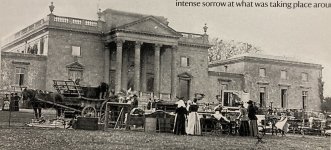
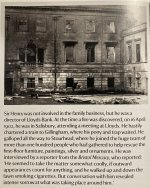
Sir Henry [Hoare] was not involved in the family business, but he was a director of Lloyds Bank. At the time a fire was discovered on 16 April 1902, he was in Salisbury [45 miles away], attending a meeting at Lloyds. He hastily chartered a train to Gillingham, where his pony and trap waited. He galloped all the way to Stourhead [6 miles], where he joined the huge team of more than one hundred people who had gathered to help rescue the first-floor furniture, paintings, silver and ornaments. He was interviewed by a reporter from the Bristol Mercury, who reported: ‘He seemed to take the matter coolly, if outward appearances count for anything, and he walked up and down the lawn smoking cigarettes. But conversation revealed intense sorrow at what was taking place around him’.

Stourhead Fire extract NT 2014.jpeg
Stourhead NT 2014 1902 Fire Sale.jpeg


In 2002, a series of events was organised to mark, or celebrate?, the centenary of the fire. The BBC relates the evening of the fire in such breathy tones, that it seems as if the BBC sent the reporter that night, and not the Bristol Mercury. Their version of the picture above really makes it seem like they are enjoying the chance to relive fond memories.

Stourhead BBC fire pic.png


On the 16th of April 1902, a great fire broke out in a South Wiltshire mansion. The fire raged all night. It swept through the main core of the building, gutting it. The roof and windows were destroyed. By the following morning, smoke still rose from the remains. The great house had been reduced to a blackened and smouldering shell.

The fire was discovered by the housemaid and under housemaid as they went upstairs to resume duties after breakfast. One of the front bedrooms was filled with smoke from a fire in the chimney flue. The fire rapidly took hold, ripping through the upper floors.

Staff at the house, unable to stop the fire’s progress, turned their attend to rescuing the family’s precious collection of furniture, books and works of art. The family had amassed, over 175 years, a vast collection of works by great masters such as Poussin and Sir Joshua Reynolds.

As the fire raged, the great rescue effort began. Teams of people, over 100 strong, passed furniture and paintings through the windows of the burning house on to the lawn. Local villagers, seeing smoke, made their way to the house and joined in.

A horse drawn fire engine, hand pumps and hose carts arrived from Mere, Zeals and Frome. The firemen fought the blaze with water from the lake.

The family helped, too. Lady Alda, wrapped up in coat and hat, can be seen cataloguing the rescued items she treasured.

“The fire constitutes an important part of the history of the house,” said Beccy Speight, the National Trust’s Property Manager at Stourhead. “The fire gutted the centre of the house but left the library and picture gallery unscathed. Sir Henry Hoare insisted that the house be rebuilt in replica, and it was, being completed in 1907.


It is a simple story of a banking tycoon’s house burning down suddenly, and for no apparent reason. He and his wife are so upset, it is all they can do to walk around smoking ciggies, and cataloguing their “precious things” - that other people are risking their lives for, entering the raging inferno to pass a Poussin out of the window. Afterwards, all the Hoare of the house has to do is stamp his foot, and Ta Da! the house is back, as if the fire never happened.

The photograph of the Fire Sale on the front lawn is variously captioned: (National Trust 2014) Servants on the lawn after the fire, while the BBC prefers Lady Alda and staff catalogued the salvaged items on the lawn. FFS, who “catalogues” their own stuff? This must be for auction.

And here are the fire fighters, who came to stand around in their splendid helmets while the fire raged, cool and invisible, behind them. Or did they get cleaned up, and come back again? Or are these the hangers, and hangers on?

Stourhead BBC fire fighters.png
 

Attachments

  • Stourhead Fire extract NT 2014.jpeg
    Stourhead Fire extract NT 2014.jpeg
    3.1 MB · Views: 60
  • Stourhead NT 2014 1902 Fire Sale.jpeg
    Stourhead NT 2014 1902 Fire Sale.jpeg
    2.6 MB · Views: 68
My theory so far: the recent history of the British Isles has been hijacked, and disaggregated so that the invaders' destruction is blamed on various other parties, including the indigenous population. The relentless, brutal attacks on man, beast, and building, and internal subterfuge, blackmail and bribery have proved successful, and the natives are now captured in the invaders' web of privileges and rights, to be dispensed and withdrawn on a whim. Britain's ancient history has been largely obliterated or consigned to mythology.

Questions remain: what happened to the true nobility and House of Wessex?

Alfred's Tower
I became fascinated by Alfred’s Tower (51°06′53″N, 2°21′54″W) when I came across a statue of King Alfred, otherwise known as Alfred the Great, a third of the way up on its north-eastern face. Another post has more details on the possible relationship between King Edward VII, King Alfred and Queen Elizabeth.

This beautiful triangular tower is massively solid, yet elegant, almost chateau-like with its pointed west turret. An impressive 48m/160ft tall - that’s 18-20 floors high! - it is set in a commanding position at the end of a long, high ridge in Wiltshire, looking west over Somerset and Dorset. It is not a well-known monument, and seems to have been largely forgotten, which in itself is strange. It is an iconic structure.

View attachment 34991 View attachment 34993
The site is managed by the suspect National Trust, a charitable organisation that manages a lot of British heritage sites. It acknowledges that King Alfred the Great’s army was once here, and I suspect that his son King Edward was familiar with the place:

View attachment 34994
It seems that the National Trust would prefer it if you got in your car, drove down to their box office, cafe and shop, and spent your two and a half hours there.

View attachment 34995
Viewed from a distance, it is striking, but the trees don’t allow you to appreciate the scale of it. Not that I would like the trees to be chopped down, but I’m just saying that If They wanted to, They would have.

Below is the map provided by the National Trust. It wasn’t until a few days later that I looked at the place names closely, and, to be honest, they turned my stomach, and I’m glad I didn’t notice when I was visiting.

View attachment 34996

Six Wells Bottom & St. Peter’s Pump
The centre of the map has areas called Lynch Wood, Sunny Hanging and Shady Hanging. There is also Hilcombe Hanging, by Alfred’s Tower, and White Sheet Hill is about three miles to the east.

View attachment 34997
This is Six Wells Bottom, looking along the top red/blue path on the map above, from left to right. Shady Hanging is to the left, with Sunny Hanging to the right of the gentle valley. From the corresponding angle of the sun, we can surmise that the hangings took place in summer.

View attachment 34998
Despite being called Six Wells Bottom, there are no longer any discernible wells except for this rather hideous mess, with an old world cherry on the top. It is at the other end of the valley, just visible a kilometre away in the middle of the photo above. This is St Peter’s Pump:

View attachment 34999
The name St. Peter gives a clear Catholic connection. The pump’s story is that it was made in 1474 and placed near to St Peter's Church in Bristol, a port city 35 miles away, where it was originally dedicated to St. Agnes or St Edith. It was removed in 1766, and placed here two years later, by Henry Hoare, on a grotto base over one of the springs that form the source of the River Stour. It certainly is not functioning - it’s hard to see how it would function - and the shoddy, scruffy walls are not in keeping with the smart, old buildings around.

Perhaps the name references St. Peter’s Pence? Peter’s Pence is the name given to donations or payments made directly to the Holy See of the Catholic Church, a practice which arose first in England, and was/is basically a tax. The pillaging of Wessex’s nobility would certainly swell the coffers of the victors, pumping considerable wealth into their currency. Maybe it even seals the well where the bodies were thrown, like a gruesome trophy photograph taken by a murderous psychopath of his victim’s secret burial place.

It is either coincidence or confirmation that the Hoares, professed owners of Stourhead Park since the early 1700’s, are the founding family of C. Hoare & Co., the oldest private bank in England, which is still thriving today, primarily serving high-net-worth families and individuals.

Okay, all this is circumstantial evidence - we need something more.

Stourhead House Inscription
Stourhead House, as the name implies, lies at the head of the River Stour, which rises in Six Wells Bottom. It is rather plain as stately homes go, but in a secure location on the same high ridge as Alfred’s Tower, with a fresh water supply that can be controlled and protected from poisoning.

View attachment 35000
However, at the rear of the building that I found something … chilling.

The back of the house is quite nice, with a wall-edged ha-ha, maybe once a moat, about fifty metres from the house, and a view along the ridge to a 100ft/ 32m tall stone obelisk. Following the ridge beyond the obelisk takes you round to Alfred’s Tower.

View attachment 35001
View attachment 35002
On the central pediment of the house, there is a Latin inscription, under a double-headed eagle; both associated with the Holy Roman Empire, and distinctly non-native.

View attachment 35003Although it is difficult to make out some of the text, due to the angle of the photograph, it is possible to make out:

VASTATAS A.D. 1902 RESTAURAVIT ——AD1903
or
LAID TO WASTE 1902 RESTORED 1903​

Say What ???????


Finally, I would like to add that this is a novel theory, to my knowledge, just in case the Watchers have been persuaded by the Parasitic Ruling Class that We, the people, are fine with having our noble ancestors slaughtered, and replaced with evil personified. Attempts appear to have been made to allow for both “hidden in plain sight” with clues still on display, and simultaneously “plausible deniability “. I live in hope for retribution for their sins, and I hope you got that, Watchers!
This thread gets more interesting by the minute.

My first impression of the tower image you posted was of it's resemblance to a battery along the lines of
tower of nevyansk.
My curiosity encouraged me to see if I could find more pictures, particularly of the inside.
Screenshot_20251221-103346_1.png


Screenshot_20251221-101938_1.png


Screenshot_20251221-101656_1.png


Images source

My thinking of it possibly being an old world power source, made me look for a water source nearby.
Sure enough, there's a water course nearby that looks like it originates in a spring not far from the tower
Screenshot_20251221-103828_1.png


Screenshot_20251221-104035_1.png

But suddenly I'm down a rabbit hole after visiting the above link.
The italics are mine below. "Times of great power, 33 images" Really?!
Truth and culprits hidden in plain sight perhaps?
Ultimately, the structure was merely a folly. These were monuments erected by the elite during great times of power. While they primarily served as displays of wealth, these 33 images of King Alfred's Tower confirm that its architectural beauty continues to outweigh its exorbitant cost.
Fortunately for the National Trust, a non-profit that funds heritage projects named Viridor Credits awarded the Stourhead Estate nearly $1 million in 2014 to restore its grounds and the tower itself.
We all know the nefarious projects many NGO's get involved with,so I decided to look into Viridor Credits quickly. First I followed this link Viridor credits
Viridor Credits Environmental Company is an independent, not-for-profit organisation which provides funding for community, heritage and biodiversity projects around England and Scotland through the Landfill Communities Fund and Scottish Landfill Communities Fund
They use Landfill funds for their project financing?!
OK never mind, keep on your trail Oracle.

I followed the link in the above qoute to look at their actual website,and
... I really have no words at this point!
Screenshot_20251221-111920_1.png

Best Online Casinos 2025 – UK Casino Sites
Their Logo alone can say much to those with eyes to see, let alone casino's ( more funding).

I have to stop there as I am going out shortly, but so many strange things relating to that tower, might be a rabbit hole worth following for anyone with the time.

Great thread and presentation @Artemisian,
Much food for thought.
 

Attachments

  • Screenshot_20251221-102008.png
    Screenshot_20251221-102008.png
    912.9 KB · Views: 54
Last edited:
Since Cromwell destroyed an estimated 97% (or more) of English art, the remaining 1-3% might stand out as somewhat irregular or unusual
As an aside, Cromwell is known in Ireland to this day for ( reputedly) saying " To Hell or to Connaught " when he transplanted the catholic natives of northern Ireland to the western province of Connaught in Ireland which is largely bogland blasted by Atlantic weather. Does this make North America Hell?
Sure seems that way to many Americans I'm sure in current times.
 
Their Logo alone can say much to those with eyes to see, let alone casino's ( more funding).
Its defunct. The company and their webite vanished in 2022 it seems.
Viridor Credits Environmental Company is an independent, not-for-profit organisation which provides funding for community, heritage and biodiversity projects around the UK through the Landfill Communities Fund and Scottish Landfill Communities Fund.

Viridor Credits was set up to administer Viridor's Contributions to the Landfill Communities Fund. It is, however, a wholly independent company, separate from Viridor's operations.
Here is the company which set up the environmental company which gave funding to the folly.
Viridor | UK's Recycling, Resource & Waste Management Company
 
At first I thought the tower was triangular as a clever optical trick of giving the appearance from a distance of being a square tower with the actual triangular shape becoming evident when the viewer gets closer but the shape makes much more sense when this information came to light.
Originally the tower stood on the borders of three counties: Wiltshire, Somerset and Dorset.
A few pictures from King Alfred's Tower (Stourhead) - Wiltshire
 
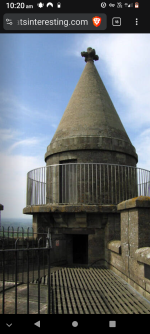
The link for the source of Oracle's interior images of the tower is to an article on Allthatsinteresting.com, titled "Inside King Alfred's Tower, A Stunning Folly That's Stood in Southern England Since the 18th Century", published 17/08/2021. It relates that Henry Hoare II shared his architectural vision with his daughter in a letter sent in 1764:
"I have one more scheme which will crown or top it all... To erect a Tower on Kingsettle Hill... I intend to build it on the plan of St Mark's Tower at Venice, 100 foot to the room which the staircase will lead to and four arches to look out in the four sides to the prospect all around."

The flaw in this story is staggeringly obvious - did anyone miss it? Perhaps it was made up by someone who succumbed to the same optical illusion mentioned by JD755 above?

Below is the four-sided St Mark Bell Tower in Venice. Why didn't Hoare fire the renowned Palladian architect Henry Flitcroft, who failed spectacularly to understand the brief? Did Hoare never visit the site and notice?

saint-mark-campanile-bell-tower-venice-italy-01.jpeg


Maybe Flitcroft had an agreement with the brick maker, and they cunningly built the side facing the approaching path first, and succeeded in whisking Hoare away whenever he strolled up, before he became too interested in work going on behind. With more than a million bricks apparently required in total, there would be a tasty reason to file the receipts for another third of a million bricks. Or maybe the whole story is toot?

But perhaps also a clue? St Mark's Tower apparently collapsed in on itself on the morning of 14 July 1902, just three months after the wasting of Stourhead. Only a cat died, and all rubble was miraculously held back from damaging the Basilica by a single stone, named the "opinion stone". That same evening, the town council decided to rebuild it in the same place, starting in April 1903 (the year of Stourhead's restoration according to the stone carving on its pediment). Those years again, mixed with nonsensical details.

The article also refers to another poem by Thomas Hardy, the Dorset poet credited with creating the region Wessex. "The Channel Firing" was published on 1 May 1914, three months before the start of the First World War, and reflects on the "gunnery practice" out at sea in the English Channel, from the perspective of the recently dead and buried.

Channel Firing

That night your great guns, unawares,
Shook all our coffins as we lay,
And broke the chancel window-squares,
We thought it was the Judgement-day

And sat upright. While drearisome
Arose the howl of wakened hounds:
The mouse let fall the altar-crumb,
The worms drew back into the mounds,

The glebe cow drooled. Till God called, “No;
It's gunnery practice out at sea
Just as before you went below;
The world is as it used to be:

"All nations striving strong to make
Red war yet redder. Mad as hatters
They do no more for Christés sake
Than you who are helpless in such matters.

"That this is not the judgment-hour
For some of them's a blessed thing,
For if it were they'd have to scour
Hell’s floor for so much threatening…

"Ha, ha. It will be warmer when
I blow the trumpet (if indeed
I ever do; for you are men,
And rest eternal sorely need).”

So down we lay again. ‘I wonder,
Will the world ever saner be,’
Said one, ‘than when He sent us under
In our indifferent century!’

And many a skeleton shook his head.
‘Instead of preaching forty year,’
My neighbour Parson Thirdly said,
‘I wish I had stuck to pipes and beer.’

Again the guns disturbed the hour,
Roaring their readiness to avenge,
As far inland as Stourton Tower,
And Camelot, and starlit Stonehenge.

It does not seem that the looming war is any different to the recent years, with "all nations striving strong to make red war yet redder". The gunnery practice has been going on "just as before [the dead] went below" in this "indifferent century". The noise can be heard "as far inland as Stourton Tower [attributed to be Alfred's Tower] And Camelot, and starlit Stonehenge". His poem supports the notion of the Great War against the Heathen Army starting decades earlier, and being a relentless onslaught which filled up the graveyards.

Stonehenge is widely known on Salisbury Plain, but Camelot, described by Hardy as if it were an existent place, listed between two other existent places, has been confined to myth and legend. Interestingly, Camelot, home of the legendary King Arthur, is often placed as Tintagel in Cornwall, but this would not fit the inland location described by Thomas Hardy.
 
Last edited:
This is the area of south-west Wiltshire in the John Speed map of c.1610/i610. Stourhead is noted as Sturton.

Of particular interest is The Beacon Hill to the East, with a tall, possibly obelisk-style structure. This structure no longer exists, and the hill is now named White Sheet Hill.
823.jpg
 
Tips
Tips
Please respect our Posting Rules.
Back
Top