

I lifted this from Historical Freethinker and I wanted you guys to enjoy. It reads well, even though Google Translated.
Unsolved secrets of the pillar of Alexandria
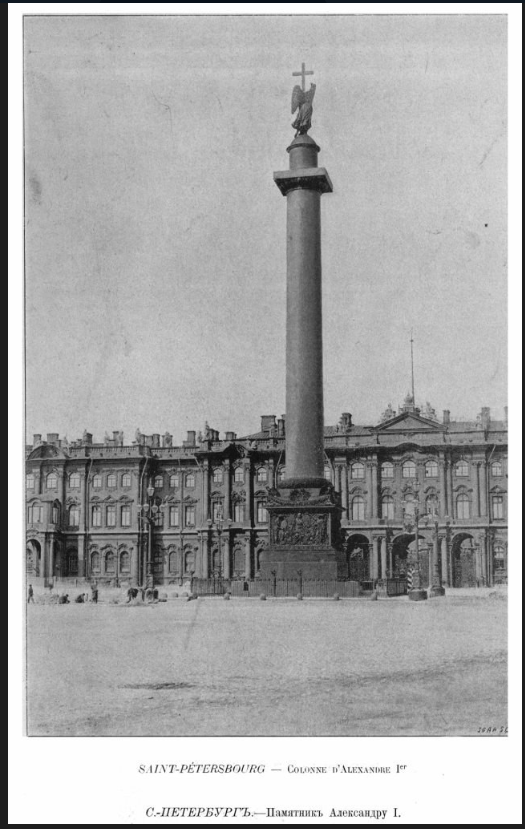
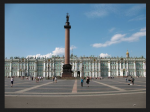
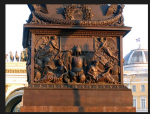
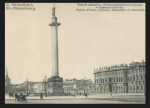
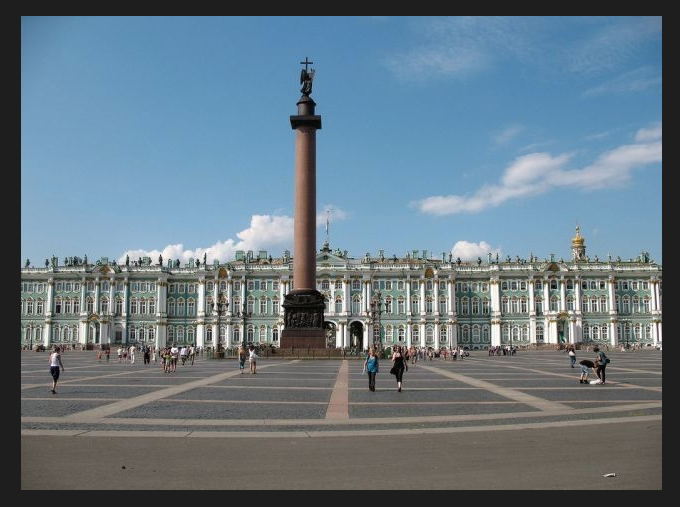
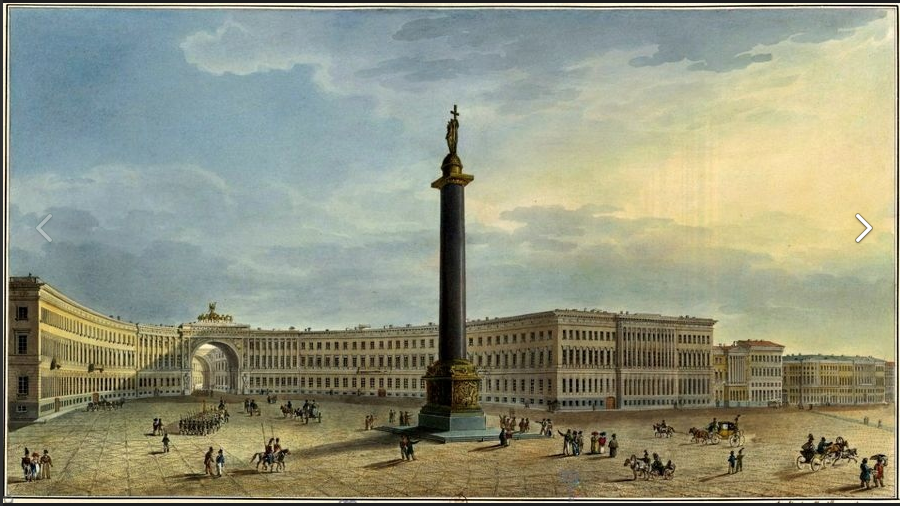
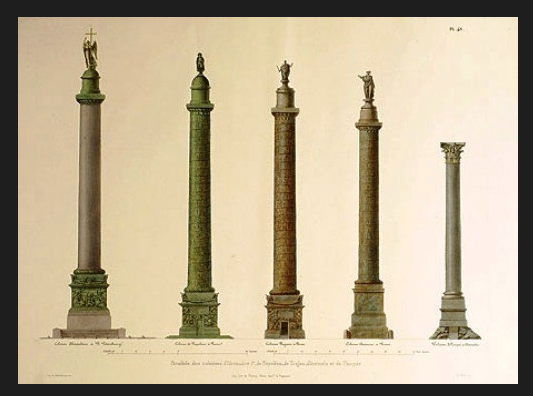
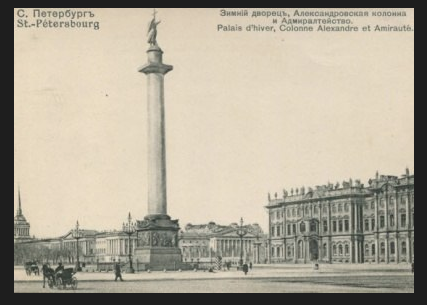
Alexander Column in the Empire style, also known as the Alexandrian Pillar (according to the poem by AS Pushkin's "Monument"), was erected and ceremonially opened (September 30) on September 11, 1834 in the center of the Palace Square of St. Petersburg by the decree of Emperor Nicholas I in memory of the victory of his elder brother Alexander I over Napoleon. The column, designed by the architect Auguste Montferrand, was to compete with the Vendome column, set in Paris in honor of Napoleon's victories. The total height of the Alexander Column is 47.5 meters.
It is said that the Countess Tolstoy always ordered the coachman to go round Palace Square by the side - she was afraid that the Alexander Column, which was not fixed in any way and was held in place only by the force of its gravity, would fall right on her. Some Petersburg residents feared the same. Therefore, the architect Auguste Montferran every evening demonstratively walking his favorite dog around his masterpiece. Gradually, the fears subsided. And now the Alexander Column is one of the brightest and most recognizable sights of the Northern Capital. But a lot of mysteries are connected with it.
"The eye of these people is extremely accurate"
According to the official version, the Alexander Column in the center of the Palace Square of St. Petersburg was erected in 1834 by the architect Auguste Montferrand by the decree of Emperor Nicholas I in memory of the victory of his elder brother Alexander I over Napoleon. At the same time, the tsar certainly wanted the monument to be higher than the Vendôme Column in Paris, exalting the French emperor. And this wish was fulfilled, although not without difficulty.
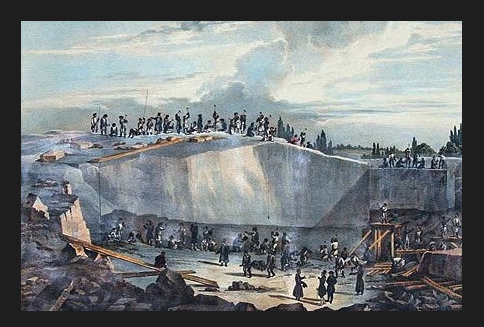
A suitable granite rock from which the stem of the column was woven was found in Finland, in the Püterlak quarry. Masters-masons S. V. Kolodkin and V. A. Yakovlev examined it and came to the conclusion that the stone is good. From the rock sawed off in some way a bar weighing about 1600 tons, managed with the help of levers and gates to move this boulder from its place and knock it over on a bed of spruce lapnik, softening the blow to the ground and reducing the risk of splitting the stone. And then manually, by eye, they cut off everything that was superfluous, cut and polished - and a perfectly smooth cylinder with a diameter of 3.5 meters at the base and 3.15 meters at the top, a height of 25.6 meters and a weight of 600 tons turned out.
How did they do it? After all, modern stone masters are almost unanimous in claiming that even nowadays, having perfect machines and precise measuring tools, it is practically impossible to perform such work in such a high-quality and accurate manner. And the peasants have managed! But, first, they worked for at least three years. Secondly, they used the technique of Samson Ksenofontovich Sukhanova, a legendary person, whose team created almost all the granite wonders of the Northern Capital: huge balls on the arrow of the Vasilyevsky Island, columns of the Kazan Cathedral, and the famous Tsar's Bath, now vegetating in the ruins of the Babolovsky Palace in Tsarskoye Selo ... One foreign traveler wrote about the work of Sukhanov's artel: "They, these peasants in simple ragged sheepskin coats, did not have to resort to various measuring instruments; looking inquiringly at the plan or model he indicated, they accurately and gracefully copied them. The eye measure of these people is extremely accurate. " Unfortunately, the secrets of this technique were subsequently forgotten, as was the name of the most ingenious master who ended his days in poverty.
In St. Petersburg, the column, as well as the huge stones for the foundation, the largest of which weighed more than 400 tons, were delivered by water. For this purpose a ship was designed by the ship's engineer Colonel Konstantin Andreevich Glazyrin. For loading works a special breakwater was built. It should be noted that this experience was already in the hands of Russian masters: in fact, it was in this way that the famous Thunderstone was delivered - a pedestal for the Bronze Horseman. Therefore, without special incidents, a barque with a column, towed by two steamships, reached Kronstadt, and then to St. Petersburg.
The column was raised ... the deceased
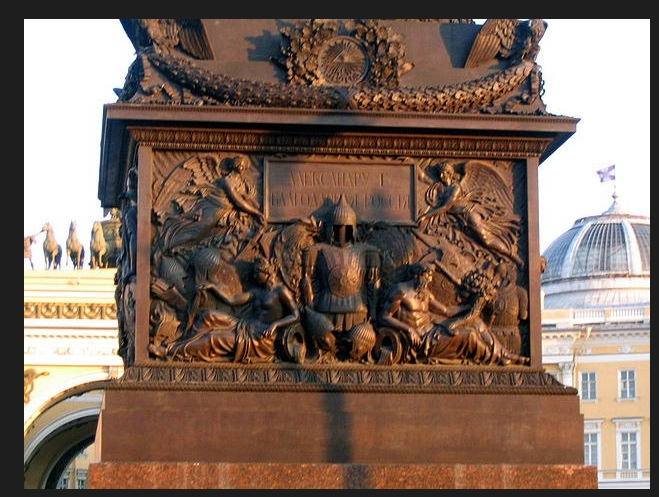
Under the foundation of the column, 1250 six-meter pine piles were slaughtered. Then the bottom of the foundation pit was filled with water, and the piles were cut to the level of the water mirror, which made the site perfectly horizontal. And only then it planted a 400-ton block of the basement.
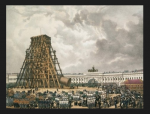
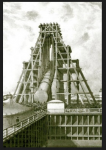
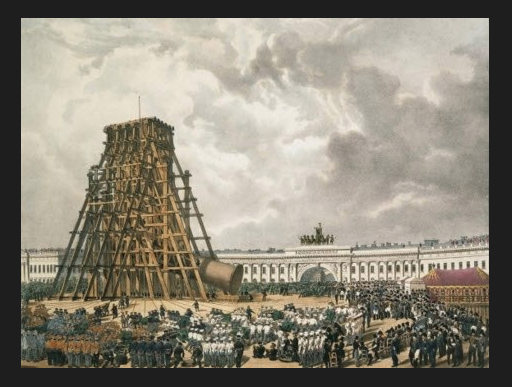
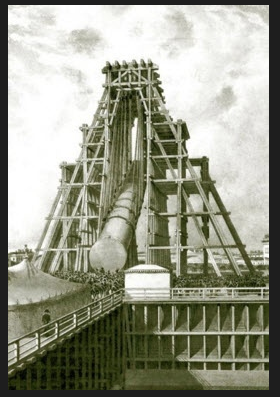
This method was allegedly proposed by the architect and engineer Augustine Augustinovich Betancourt. He also designed the original device for lifting the column on a pedestal. It included 47-meter-high scaffolding, 60 cableways (a winch with a drum mounted on a vertical shaft) and a block system. The installation of the column involved 2000 soldiers and 400 workers. This entire operation was completed in 1 hour 45 minutes. And, according to some sources, he supervised the work of Betancourt himself. But here there is one snag: the column took a vertical position in 1832, and Augustine Augustinovich ... died in 1824-m.
Of course, the deceased could not manage the construction site. Probably, a mistake has crept into the historical documents. Most likely, builders only used the talents of a talented engineer, applied by him, for example, in the construction of St. Isaac's Cathedral. Nevertheless, this mistake is one of the "holes" in the official version of the construction of the Alexander Column.
The trunk of the ruins of the temple
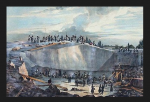
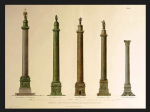
The second perceptible "hole" was made by an innocent figure. It depicts the Alexander Column in the woods, and the signature under it says: D'aperes nature r. le P-le Grigoire Gagarine. Priutino, se 4 juine 1833. That is, translated from French: "From nature Prince Grigory Gagarin. It is written in Priyutino. This June 4, 1833 ». So, in the figure the trunk of the column seems to grow out of some kind of capital structure, similar to the church, partially dismantled. Some historians are trying to prove that this, they say, is a temporary extension that the builders used in the next two years after the installation of the column. After all, it continued its final decoration: fine-tuning, polishing, the construction of capitals, the installation of an angel figure, the decoration of the pedestal, the installation of metal elements, etc. All this time it was necessary to store somewhere a tool, shelter the builders from the weather. One would agree with this point of view, if not for the thickness of the walls, which is clearly excessive for the timepiece. It can also be assumed that the artist, paying tribute to romanticism, ennobled an unprepossessing structure, giving it the appearance of ancient ruins. But if it really is the remains of an ancient temple?
Angel is a woman?
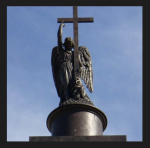
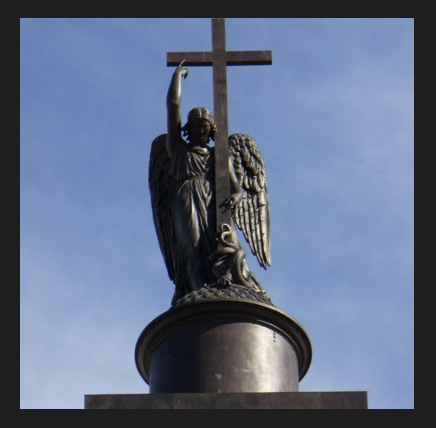
Many questions are raised by the figure of an angel with a cross made by the sculptor Boris Ivanovich Orlovsky. Historians unanimously affirm that the face of an angel is given the features of Emperor Alexander I. Therefore, the column is called Alexandrovskaya. Although it is easy to see that there is not even an approximate similarity between the angel and the emperor (it is enough to look at the portraits of the latter), most researchers do not try to challenge the generally accepted point of view. However, the profile of the statue is very Greek. And if you look at the figure? Chest, hips, smooth curves of the body - everything says that before us is a woman, not a man. By the way, there is a version that St. Petersburg poet Elisabeth Kulman served as a model for the sculpture. This would explain the characteristics of the figure of the angel, but her face is also not too similar to the well-known sculptural portrait of the poetess.
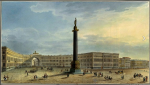
There is another version: the column is crowned with a statue of an ancient goddess, only slightly "perfected" for the sake of a monarch person, - a figure is given in the hands of a four-pointed Latin cross, whose base the angel tramples the snake, which symbolizes victory over the "antichrist" Napoleon. But, most likely, Orlovsky sculptured the original sculpture. It can be assumed that the column is much older than it is considered. Known are the drawings of the Palace Square, made before 1830. And what? The column stands, and the angel is in place, only without the cross, and the snake is not visible. And if it really is a statue of a goddess, who has come down to us from a civilization much older than Greek and even Egyptian?
Unsolved secrets of the pillar of Alexandria
Alexander Column in the Empire style, also known as the Alexandrian Pillar (according to the poem by AS Pushkin's "Monument"), was erected and ceremonially opened (September 30) on September 11, 1834 in the center of the Palace Square of St. Petersburg by the decree of Emperor Nicholas I in memory of the victory of his elder brother Alexander I over Napoleon. The column, designed by the architect Auguste Montferrand, was to compete with the Vendome column, set in Paris in honor of Napoleon's victories. The total height of the Alexander Column is 47.5 meters.
It is said that the Countess Tolstoy always ordered the coachman to go round Palace Square by the side - she was afraid that the Alexander Column, which was not fixed in any way and was held in place only by the force of its gravity, would fall right on her. Some Petersburg residents feared the same. Therefore, the architect Auguste Montferran every evening demonstratively walking his favorite dog around his masterpiece. Gradually, the fears subsided. And now the Alexander Column is one of the brightest and most recognizable sights of the Northern Capital. But a lot of mysteries are connected with it.
"The eye of these people is extremely accurate"
According to the official version, the Alexander Column in the center of the Palace Square of St. Petersburg was erected in 1834 by the architect Auguste Montferrand by the decree of Emperor Nicholas I in memory of the victory of his elder brother Alexander I over Napoleon. At the same time, the tsar certainly wanted the monument to be higher than the Vendôme Column in Paris, exalting the French emperor. And this wish was fulfilled, although not without difficulty.
A suitable granite rock from which the stem of the column was woven was found in Finland, in the Püterlak quarry. Masters-masons S. V. Kolodkin and V. A. Yakovlev examined it and came to the conclusion that the stone is good. From the rock sawed off in some way a bar weighing about 1600 tons, managed with the help of levers and gates to move this boulder from its place and knock it over on a bed of spruce lapnik, softening the blow to the ground and reducing the risk of splitting the stone. And then manually, by eye, they cut off everything that was superfluous, cut and polished - and a perfectly smooth cylinder with a diameter of 3.5 meters at the base and 3.15 meters at the top, a height of 25.6 meters and a weight of 600 tons turned out.
How did they do it? After all, modern stone masters are almost unanimous in claiming that even nowadays, having perfect machines and precise measuring tools, it is practically impossible to perform such work in such a high-quality and accurate manner. And the peasants have managed! But, first, they worked for at least three years. Secondly, they used the technique of Samson Ksenofontovich Sukhanova, a legendary person, whose team created almost all the granite wonders of the Northern Capital: huge balls on the arrow of the Vasilyevsky Island, columns of the Kazan Cathedral, and the famous Tsar's Bath, now vegetating in the ruins of the Babolovsky Palace in Tsarskoye Selo ... One foreign traveler wrote about the work of Sukhanov's artel: "They, these peasants in simple ragged sheepskin coats, did not have to resort to various measuring instruments; looking inquiringly at the plan or model he indicated, they accurately and gracefully copied them. The eye measure of these people is extremely accurate. " Unfortunately, the secrets of this technique were subsequently forgotten, as was the name of the most ingenious master who ended his days in poverty.
In St. Petersburg, the column, as well as the huge stones for the foundation, the largest of which weighed more than 400 tons, were delivered by water. For this purpose a ship was designed by the ship's engineer Colonel Konstantin Andreevich Glazyrin. For loading works a special breakwater was built. It should be noted that this experience was already in the hands of Russian masters: in fact, it was in this way that the famous Thunderstone was delivered - a pedestal for the Bronze Horseman. Therefore, without special incidents, a barque with a column, towed by two steamships, reached Kronstadt, and then to St. Petersburg.
The column was raised ... the deceased
Under the foundation of the column, 1250 six-meter pine piles were slaughtered. Then the bottom of the foundation pit was filled with water, and the piles were cut to the level of the water mirror, which made the site perfectly horizontal. And only then it planted a 400-ton block of the basement.
This method was allegedly proposed by the architect and engineer Augustine Augustinovich Betancourt. He also designed the original device for lifting the column on a pedestal. It included 47-meter-high scaffolding, 60 cableways (a winch with a drum mounted on a vertical shaft) and a block system. The installation of the column involved 2000 soldiers and 400 workers. This entire operation was completed in 1 hour 45 minutes. And, according to some sources, he supervised the work of Betancourt himself. But here there is one snag: the column took a vertical position in 1832, and Augustine Augustinovich ... died in 1824-m.
Of course, the deceased could not manage the construction site. Probably, a mistake has crept into the historical documents. Most likely, builders only used the talents of a talented engineer, applied by him, for example, in the construction of St. Isaac's Cathedral. Nevertheless, this mistake is one of the "holes" in the official version of the construction of the Alexander Column.
The trunk of the ruins of the temple
The second perceptible "hole" was made by an innocent figure. It depicts the Alexander Column in the woods, and the signature under it says: D'aperes nature r. le P-le Grigoire Gagarine. Priutino, se 4 juine 1833. That is, translated from French: "From nature Prince Grigory Gagarin. It is written in Priyutino. This June 4, 1833 ». So, in the figure the trunk of the column seems to grow out of some kind of capital structure, similar to the church, partially dismantled. Some historians are trying to prove that this, they say, is a temporary extension that the builders used in the next two years after the installation of the column. After all, it continued its final decoration: fine-tuning, polishing, the construction of capitals, the installation of an angel figure, the decoration of the pedestal, the installation of metal elements, etc. All this time it was necessary to store somewhere a tool, shelter the builders from the weather. One would agree with this point of view, if not for the thickness of the walls, which is clearly excessive for the timepiece. It can also be assumed that the artist, paying tribute to romanticism, ennobled an unprepossessing structure, giving it the appearance of ancient ruins. But if it really is the remains of an ancient temple?
Angel is a woman?
Many questions are raised by the figure of an angel with a cross made by the sculptor Boris Ivanovich Orlovsky. Historians unanimously affirm that the face of an angel is given the features of Emperor Alexander I. Therefore, the column is called Alexandrovskaya. Although it is easy to see that there is not even an approximate similarity between the angel and the emperor (it is enough to look at the portraits of the latter), most researchers do not try to challenge the generally accepted point of view. However, the profile of the statue is very Greek. And if you look at the figure? Chest, hips, smooth curves of the body - everything says that before us is a woman, not a man. By the way, there is a version that St. Petersburg poet Elisabeth Kulman served as a model for the sculpture. This would explain the characteristics of the figure of the angel, but her face is also not too similar to the well-known sculptural portrait of the poetess.
There is another version: the column is crowned with a statue of an ancient goddess, only slightly "perfected" for the sake of a monarch person, - a figure is given in the hands of a four-pointed Latin cross, whose base the angel tramples the snake, which symbolizes victory over the "antichrist" Napoleon. But, most likely, Orlovsky sculptured the original sculpture. It can be assumed that the column is much older than it is considered. Known are the drawings of the Palace Square, made before 1830. And what? The column stands, and the angel is in place, only without the cross, and the snake is not visible. And if it really is a statue of a goddess, who has come down to us from a civilization much older than Greek and even Egyptian?
Note: This OP was recovered from the KeeperOfTheKnowledge archive.


