Was the temple of King Salomo in Spain, Part 03

Had to split up the post to fit.

The Order of Saint Lazarus of Jerusalem is an important clue to the true identity of the lepers. They supposedly began in Jerusalem during the Crusades to take care of lepers in hospitals.

This statement alone raises a couple questions that we have explored on the forum. Mainly, "What were the Crusades?" and "Where is Jerusalem?"

The Crusades appear to be some kind of reset that happened in France and Iberia. We are told it was a war started by the (mostly French) Christians to remove the (mostly Muslim) Saracens from Jerusalem. This would have been a couple hundred years before the Roman Catholics swept in and forced their new paradigm on Europe.

As a result of the Crusades wars, several Orders of Knights were created. Saint Lazarus, the Hospitaliers, the Templars and others. Lazarus and the Hospitaliers were both founded to provide hospitality and accommodations to 'sick' people. See farther down for more thoughts on that. The Templars, officially known as the Poor Fellow-Soldiers of Christ and of the Temple of Solomon, were charged with protecting Solomon's Temple and the pilgrims traveling to and from Jerusalem. So, based on what we've learned in other threads, they would be guarding the Temple in Iberia where the gold mines were and also guarding Montemartre in Paris, and the roads between the two places.

I'm pretty convinced now that Paris is the Biblical Jerusalem. This fits in well with the stated history of the Knights of Lazarus. After their supposed origin in Jerusalem of the Middle East they open 'hospitals' or Commanderies in
Jerusalem and Acre. Acre and Jerusalem were near each other and Acre was considered a stronghold for the Knights Templar.

I was able to find a reference on French Wikipedia to the ancient city of Acre, which was absorbed into Saint-Laurent-de-Condel in 1790. It is close enough to Paris to be realistic as the site of ancient Acre.

Acre (Calvados) — Wikipédia

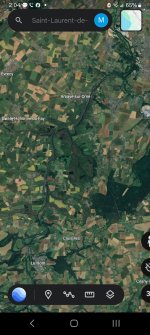
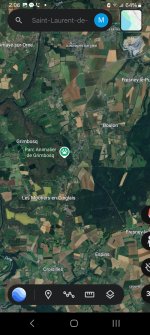
I went on Google Earth to check it out and it looks like ancient Acre was a Star City or Star Fort City a long time ago. I believe that the center of the Star City is now hidden in the forest to the west of Saint-Laurent-de-Condel.

The purple dot is Saint-Laurent-de-Condel. The ancient Acre Star City would be in the forest. You may ask why this is important. It shows that this small village in rural France was once a great city and could have been the Acre of the Bible.


1000002980.jpg

1000002974.jpg

1000002982.jpg


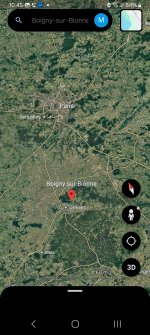
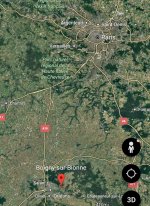
Same thing with Boigny, their headquarters after after the fall of Jerusalem and Acre. Small now, but was once an important location.You can even see a triangular pond still intact near the center. Orleans is nearby, so there may be some star overlap from there.

1000002994.jpg

1000002995.jpg


1000003004.jpg


After the Crusades the Knights of Lazarus opened hospitals or Commanderies in Southern Italy, Hungary, Switzerland, France and England. They also had a presence in Cyprus and Sicily after being forced from Acre by the Muslims. Eventually settled in Boigny, France, as their headquarters, in a chateau gifted to them by the king of France. Their secondary headquarters were in Italy. These locations are European and Mediterranean, not Middle Eastern. I feel that this supports their origin taking place in France, with Paris as Jerusalem.

The historical narrative has them spending centuries in France and Italy. They were pressured by kings and popes to dissolve or merge with other orders. Usually to try and take the land or wealth of the Order. Eventually they succumbed and merged in 1572 in Italy with the Order of Saint Maurice, becoming the Order of Saints Maurice and Lazarus. Saint Maurice is the Roman general who was Christian and refused to massacre a Christian town. He is the black skinned knight whose name is used to identify every image of a black man in the Middle Ages. In France they merged to become the Order of Our Lady of Mount Carmel and Saint Lazarus of Jerusalem United (now defunct). The Order of Our Lady of Mount Carmel had been formed in 1608 by Henry VI, with a mission to "exalt and increase the Holy Roman Church, extinguish heresies, suppress heretics, and other things." No mention of leprosy for the Carmel Knights.

-----------

Today there are a several different variations of modern day Knights of Lazarus, each one with their own website and own European nobility in charge.

• orderofsaintlazarususa.org
• st-lazarus.us
• saintlazarus.org
• saint-lazare.org

This international branch claims to be a continuation of Capetian princes. On their website, they are proud to appoint their 50th Grand Master, HRH Prince Sixte-Henry de Parme-Bourbon, and even more excited that they finally got to set up a Commanderie "back" in Jerusalem where they started.

OSLJ: Installation in Jerusalem


This is the Boigny Commanderie, which had been gifted to them by the French king back in the 1100's to be their headquarters in France. Far from the Middle East where Jerusalem and Acre were said to be...

Site de la Grande Commanderie de Boigny de l'Ordre Militaire et Hospitalier de Saint Lazare de Jerusalem


This branch is headquartered in Malta, their leader is Don Francisco de Borbon of the Dutchy of Seville family.

The Military and Hospitaller Order of Saint Lazarus of Jerusalem


This one is the one officially sanctioned by the Pope, the Order of Saints Maurice and Lazarus. It's managed by the House of Savoy, (the ex-Italian royal family currently having some succession problems), and based in Switzerland. Prince Emanuele Filiberto, Duke of Savoy, Prince of Venice, is the current Grand Master and Supreme Head of the Order.

THE DYNASTIC ORDERS – Ordini Dinastici della Real Casa di Savoia


The defunct Order of Our Lady of Mount Carmel and Saint Lazarus of Jerusalem United had obtained it's Grand Masters from the French royal family.


These Knightly Orders were all tools of the Elite, managed by the Elite, to enforce what the Elite wanted done.


To be continued on next post...
 

Attachments

  • 1000002994.jpg
    1000002994.jpg
    486.5 KB · Views: 55
  • 1000002996.jpg
    1000002996.jpg
    1.6 MB · Views: 44
  • 1000002974.jpg
    1000002974.jpg
    1.2 MB · Views: 39
  • 1000002975.jpg
    1000002975.jpg
    1.3 MB · Views: 47
Continued from previous post...


I can think of two three strong possibilities for the role the Order of Saint Lazarus filled.

1.) The original Order of Saint Lazarus was dedicated to helping 'lepers' by opening up hospitals to give them care and a place to live apart from other people, so as not to 'infect' them. I think they may have served as a hotel for this certain segment of society. Perhaps even long term housing. They had many Commanderies/hospitals in many countries.

The buildings known as leperariums may have been elite hotels. These lepers had rights and wealth, but supposedly had to be kept apart. Really? More likely they wanted to be kept apart and given their privacy. And maybe they were "untouchables" on purpose to keep the dirty riff raff from touching them and possibly getting them sick.

The sanitariums in the United States are huge and self contained. Many have their own farm, orchard, dairy, power plant, and railroad line spur. If the leperariums in Europe were the same kind of setup, they could be very nice places to live. And very safe, with knights protecting you.

OR

2.) The Knights of Lazarus were the jailers of the lepers/heretics. They may have been created to round up the heretics that weren't okay with the new history and put them in residential buildings with bars for reprogramming or imprisonment.

Many people on the forum believe something similar happened in Europe and North America because of a reset around 1840. The people willing to go along with the new history all joined secret societies to learn the correct new history. The people NOT willing to go along with it got put into sanitariums until they submitted or until they died. The leftover children were sent out on Orphan Trains or placed in reset-friendly homes to be raised with the new history.
This scenario fits in with the stated goals of the Order of Our Lady of Mount Carmel and Saint Lazarus of Jerusalem United, to extinguish heresies and suppress heretics.


OR I just thought of another scenario, a blend of the first two.

3.) Earlier, the Saint Lazarine knights HAD been protecting a sub-class of people that were kept apart and protected. These people were gone after a while, as evidenced by the empty Commanderies that the Kings and Popes were trying to get their hands on with the merger pressures. These 'lepers' may have died, moved away to the Americas, or just changed status.

Then comes the time of the mergers and the change in mission statements. Now they are supposed to suppress heretics. Do they then imprison the same group of people that they had previously been protecting?

@Frostychud said

After the Catholic coup, France was still full of multiple remnant populations more or less loyal to the old Eastern Empire (rewritten as the "Roman Empire"), which had allowed for a variety of different forms of worship as long as taxes were paid. Cretins, Cagots, Gypsies, lepers, Jews, and Cathars were all more or less lumped together as heretics to be combated.

- Over time, most of these groups were absorbed into the Catholic majority, with the hard core of those who refused eventually banding together under the rubric "Jew". Judaism as we know it emerges as a reaction-formation against Catholicism. Barzilay: In southern Europe during the Black Death in 1348...the charges were first directed against paupers, vagabonds, and mendicants, and only later transferred to Jews. Is this because "Jew" only emerged afterwards as a catch-all designation whose organizing principle was hatred of the Church?


Was the traveling Merchant class the original 'lepers'? They were to be kept apart from regular people - is this to protect their gold and trade goods? They needed large buildings to stay in for short and long stays - were the lepersariums actually warehouses to store their goods? They were pale skinned and covered up their exposed skin - traveling merchants would cover themselves for protection from the elements, and would become more fair-skinned due to that. And merchants could really use a group of knights to protect them from being robbed. The Knightly Orders were basically a protection racket, so the Kings could profit from the work of the Merchant class.

Then later the Catholic Church took over and the mission for the Knightly Orders changed to getting rid of everyone who wasn't part of the Catholic Church. The 'non-believers' were persecuted and pushed out. The lepersariums became sanitarium prisons. The Knightly Orders became prison guards and enforcers.


Which scenario do you all think is more accurate? Any supporting evidence for one scenario over another?
 
Starfire, excellent contribution. It feels like we're zeroing in on the target.

I'm too busy at the moment to riff on your ideas with the thoroughness they deserve, but I want to add a few things.

Paris as Jerusalem -- definitely, or at least one of the Jerusalems. Paris was supposedly the biggest city in Europe in the 16th century. If the events of antiquity are copies of 15th-16th century European history, then Paris must be "hiding" under another name, considering how important it was. Most of the early illuminated picture Bibles are French. The amazing cathedrals of Reims, Amiens (my favorite), Chartres, Rouen, and Beauvais are all clustered around Paris. Some connection between Christ and France is being hidden here.

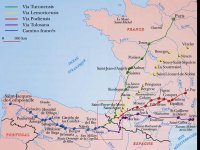
Stjacquescompostelle.png


This is the map of the St. Jacques de Compostelle network of "pilgrimage paths" leading to Santiago de Compostela in Spain, where I believe the Biblical Jacob is buried. I've twice visited the beautiful town of Vézelay, which is one of the four traditional trail heads. Believe it or not, there is an occult/esoteric bookshop next to the Catholic bookstore right there by the church. The woman behind the counter in the first store was a very attractive light-skinned black woman whose presence and dress reminded me of a New Orleans voodoo priestess. The Vézelay church, like many others in France, is double-coded with esoteric symbolism. It's only superficially Christian. Georges Bataille even lived there (!).

la-basilique-sainte-marie-madeleine-de-vezelay.jpg


So, were these paths originally the trade routes you bring up? Were these churches the sites where the followers of Jacob (Jews) stored their wares and practiced their religion? The religion of Jacob, that is, not the religion of Esau/Jesus. Remember also that the sntu-Catholic French revolutionaries were called "Jacobins". The idea of millions of regular people walking across Europe on vague voluntary "pilgrimages" lasting months strikes me as fantastical. Was the "mass pilgrimage" story a later invention to cover up the true commercial/imperial history of these routes and the people who used them? "Just wacky medieval Forrest Gumps, nothing to see here! The Middle Ages were so weird!" Starfire, your suggestion that lepers were the original protected custodians of these routes makes perfect sense. The peasants would definitely fear/hate these people. I can imagine them lording over the local helots from their protected stone leprosaria, and then later locking themselves in to hide out when the political tides turned against them. Was the Black Plague a campaign of biological warfare waged from the castles on peasants rebelling against economic exploitation in the name of the Parisian debt reformer Jesus? There must have been a long transitional period between the rule of "Jacob" and the rule of "Jesus" during which different orders displaced each other. I can imagine the different Jacobite orders only superficially converting to Christianity, but continuing to practice the old religion in secret in "their" churches like Vézelay. Was the cathedral of Compostela another of "Solomon's Temples"?

St. Bernard de Clairvaux supposedly mustered the second Crusade from Vézelay in "1146". Suddenly I'm having another idea. Were the four main pilgrimage routes (starting from Paris, Vézelay, Le Puy, and Arles) the four paths taken by the crusading knights towards the Temple of Jacob in Spain, "liberating" every town along the way from the local "Jacobite" franchise in the name of Jesus? Doesn't it make sense that the French-led Crusades would be land campaigns starting from France to take control of trade routes originating in Jewish/Muslim/Jacobin/"Old Church" Spain and operated by, essentially, a pirate mafia? Hasn't it been shown that logistically (horses, soldiers, ships, food, etc.), the Crusades against Jerusalem in Israel were an absurd impossibility? Was a truce eventually concluded by the belligerents, one that rewrote Jacob as "St. James", made him a Christian, sent a phantom copy thousands of years into the Old Testament past, and banished the events of the Crusades to the Middle East? Again, thinking out loud...if the Crusades had to be sent to the Middle East of the "11th century" to whitewash the misdeeds of the Spanish church before Christ, well, Christ would also have to be sent across the sea to the fictional Jerusalem. Otherwise the story loses its coherence.

Are today's pilgrims literally following the paths taken by the Crusaders and converging on Spain?
 
Last edited:
No surprise that there is a knightly Order of Santiago created to protect pilgrims on the road to Santiago de Compostela and to defend against Moorish invaders. The members of this had to be Catholic and it was under the power of the King of Spain. Can anyone say protection racket?

Before now I did not know about Santiago de Compostela. So I looked at a bunch of medieval pilgrimage maps and read up on it. It seems that Compostela was the main destination before Rome showed up as an option. Must have been something pretty special there to have four ways to get there. More later on that. Only one main path to Rome, though, the Via Francigena leading from Canterbury, England, to Rome.

1000003009.png


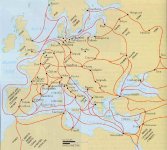
On this next map most pilgrim trails don't even go to Rome. There are trails from as far away as Denmark and Poland that head straight for Spain. Only after you get to Spain is there an option to head east towards Rome. The route from Hungary doesn't go straight to Rome either, you have to go to the heel of the boot or halfway down the Cote d'Azure before the turnoff for Rome occurs.

1000003014.jpg


This next map seems to be later, once the focus moved to Jerusalem.

The path from Ireland and England then through France is the only one with a straight shot to Rome (then on to the Middle East if desired). It's the Via Francigena extended out to Ireland and the Middle East.

This is a little bit contradictory. It makes sense that the Irish would want to go on a pilgrimage to Rome because they are pretty famously Catholic. But England was pretty famously NOT Catholic, completely separating from Rome with the Anglican Chuch of England. At times it was illegal to be Catholic in England, some people were killed. (And at times Jews were illegal, whatever that meant at the moment.) So the Irish would not have wanted to travel through England. They would have taken the water route out of Ireland that bypassed England and joined the Via Francigena in France.

The Via Francigena as a pilgrimage route going from England to Rome is weird because of the Anglican thing I mentioned above. It must have really been a mercantile route between Britain and Rome historically, prior to the Catholic thing. Then the Catholics co-oped it and called it a pilgrimage route to make Rome more important. This designation of religious pilgrimage route may have also made the route taxable, as I go into further down.

It's odd that there are no routes represented in western France on this map, since France was supposed to be so Catholic that they massacred the Hugenot Protestants. I guess all those western routes went to Compostela, so had to be left off this particular map that is focused on Jerusalem in the Middle East.

The route that does include Santiago de Compostela goes straight to Venice, then takes the water route to Jerusalem. No more offshoot pilgrim routes coming from France to Compostela are shown. Now the route represents eastward travel, the only route all the pious Spanish Catholics would have taken for pilgrimage to Rome or Jerusalem. And no famous Spanish seaports are marked to represent a water route to Jerusalem. They had plenty of boats, but a lot more interest in going to Venice than Jerusalem.

Venice appears to be the main crossroads and destination of this map. Was Saint Marks Cathedral also a destination for Jacobean pilgrims? Is it double-coded like Vezelay Cathedral?

1000003023.jpg


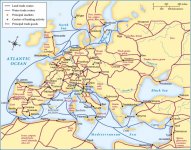
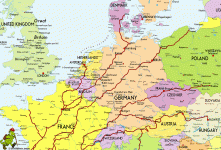
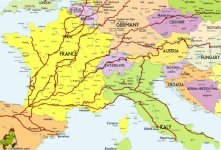
These pilgrimage routes (Crusader paths?) are in addition to the main trade routes. The main trade routes were probably patrolled by the king's troops or knights of the local lord. The Knightly Orders would have patrolled the pilgrimage routes on behalf of the king. And taxed on behalf of the king. I think this was a slimy work-around by the king to make money. I'm guessing that only the local lord had previously been able to tax merchants and travelers in exchange for protection. Then, the invention of the Knightly Orders gave the king this privilege as well. Perhaps because it was "religious" instead of mercantile. The king would be able to tax because the religion was called a "state religion".

Here are maps of the main Roman roads and trade routes.

1000003013.png


1000003011.png


1000003022.png


------------

Looking at the idea of the Crusades as a military action between France and Spain to eradicate some group of people. Frostychud suggested
Were the four main pilgrimage routes (starting from Paris, Vézelay, Le Puy, and Arles) the four paths taken by the crusading knights towards the Temple of Jacob in Spain, "liberating" every town along the way from the local "Jacobite" franchise in the name of Jesus?

Here's a map illustrating the four paths from France into Spain and west to Compostela. The Crusaders would have taken Saint Jacob the Patriarch's grave and converted it into Saint James the Apostle's grave. The Crusaders would also have gone south to Granada and Solomon's First Temple. Probably passing through Toledo near the silver mines.

1000003008.jpg


1000003021.jpg


I'm still absorbing the Marfull /Tamansky research, and how to reconcile it with the historical narrative I grew up with. Any thoughts on the timing of this military action? And how it fits in with the infamous 1492 date?

-----------

I found something to support the idea that Santiago de Compostela was a temple to Jacob the Patriarch that got changed to be a church of Saint Jamesthe Apostle. The Cathedral has a special door, called the Holy Door, that can only be used during a Jacobean Holy Year, described below.

From Wikipedia:
A Jacobean Holy Year (Galician: Ano Santo Xacobeo), also known as the Compostela Holy Year, is a Catholic celebration that takes place in the Spanish city of Santiago de Compostela, Galicia. It occurs in the years in which 25 July, the Feast of Saint James, falls on a Sunday. This occurs with a regular cadence of (6, 5, 6, 11) years, so that fourteen Jacobean Holy Years are celebrated every century (except when the last year of a century is not a leap year, resulting in a lapse of 7 or 12 years).

1000003018.jpg

1000003019.jpg


I checked for a Saint Day/ Holy Day for Jacob. The Catholic Church doesn't have him listed on their Saint Day calendar, they don't consider him a Saint. The Lutherans celebrate Saint Jacob's Day on February 5 each year, commemorating him as a Patriarch. So the Roman Catholics try to obscure him and change his name. And the Christian Protestants recognize and celebrate Jacob. That's a clue for sure.

When I searched Wiki for "Saint Jacob" it gave me a listing for "James the Great."

I asked AI what Santiago meant and it told me this:
Santiago is a masculine Spanish name that translates to "Saint James." It originates from the Hebrew name "Ya'akov," which means "supplanter." The name evolved through Latin as "Sanctus Iacobus" before becoming "Santiago" in Spanish.

Hmmm. Even my pigeon Spanish translates Sanctus Iacobus as Saint Jacob. How do they keep translating it as James?
 

Attachments

  • 1000003023.jpg
    1000003023.jpg
    349.1 KB · Views: 32
  • 1000003010.jpg
    1000003010.jpg
    73.4 KB · Views: 34
  • 1000003021.jpg
    1000003021.jpg
    197.5 KB · Views: 39
  • 1000003017.gif
    1000003017.gif
    246.1 KB · Views: 50
  • 1000003016.jpg
    1000003016.jpg
    195.8 KB · Views: 31
  • 1000003008.jpg
    1000003008.jpg
    193.9 KB · Views: 38
I have a synchronicity happening with a building I mentioned earlier as part of this mega thread, specifically the Different History of Rome thread. The building is the Church of San-Pierre et Montmartre. I had suggested it could possibly be the Second Temple, or rebuilt on the site of the Second Temple.

Post in thread 'The different history of the Roman Empire' The different history of the Roman Empire

San-Pierre et Montmartre presented itself to me as an overlooked, but important location. It is considered to be the oldest parish church in Paris and one of the oldest active churches in the world.

Then I ran into San-Pierre two more times in (what I thought were) unrelated inquiries. When looking into the origin of the Jesuits, or Society of Jesus, and when looking into the Order of Saint Lazarus of Jerusalem.


1000002141.png


------------

I heard a group of Jesuit priests referred to as Lazarites. Turns out that those sneaky Spanish Conversos who proceeded to run intelligence operations on the world had their origin at my little San-Pierre et Montmartre. Or at least spread the rumor that they did.

From Stinkypedia:
The other church on the hill, Saint Pierre de Montmartre, built in 1147, was the church of the prestigious Montmartre Abbey. On 15 August 1534, Saint Ignatius of Loyola, Saint Francis Xavier and five other companions bound themselves by vows in the Martyrium of Saint Denis, 11 Rue Yvonne Le Tac, the first step in the creation of the Jesuits.

Supposedly the Jesuits end up being associated with the church and called Lazarites. Even though they may have been blocks away from San-Pierre et Montmartre when they took their Oaths (I go into this below.) Also, the newly merged Military and Hospitalier Order of Our Lady of Mount Carmel and Saint Lazarus of Jerusalem United didn't occupy the Church of San-Pierre et Montmartre until after they were formed in 1608. So it wasn't called a Lazarite church until 74 years AFTER the Jesuits took their Oath of Montmartre. Where does their moniker Lazarites come from, really?

------------

Here is some history I dug up on the San-Pierre area.

Archeologists and priests claim it is a common practice for one church to be built on the ruins of another church or temple, which had also been built on the ruins of some other previous altar or holy site.

It is said the first holy site where San-Pierre stands was a Temple to Mars, possibly founded in the third century by Saint Denis. This would be before his beautification, of course, he started as a Roman named Dionysus. Then Dionysus found Jesus and became Denis, and was sent from Rome to become the first Bishop of Paris. He and two friends were beheaded for this on the hill directly below where San-Pierre et Montmartre now stands. Then Denis' headless body proceeded to pick up his head and keep preaching the Gospel as he walked for six miles. He finally finished dying and collapsed, after stating that the same location was where he wanted to be buried. That location is where the Basilica of Saint Denis was built, in the neighborhood now known as St Denis.

1000002150.jpg


Back at Montmartre, a Merovingian church was built on the ruins of the Temple of Mars. The Martyrium of San Denis was built at the location of his beheading to commemorate his death. It's not clear to me whether these were actually two different buildings.

Then the Benedictine Montmarte Abbey was built, which absorbed the Martyrium of San Denis into it's Lower Abbey / Crypt. The Upper Abbey connected to the ruined Merovingian church which was rebuilt into San-Pierre et Montmartre. This would be the same Crypt where Ignatius de Loyola and his six companions may have made their Oath of Montmartre and started the Society of Jesus, called Jesuits.

Saint-Pierre de Montmartre
Dating from the mid-fifth century arose here, on the site of a temple of Mars, the first Merovingian church. Sold, in ruins, to Louis VI in 1133, it was rebuilt for the Benedictine abbey founded by Queen Adelaide of Savoy, and solemnly consecrated by Pope III Eugena III Easter Monday 1147. This is one of the oldest religious buildings in Paris, which dates essentially from the twelfth century, with some reused Gallo-Roman. Closed to worship during the Revolution, it received in 1794, above the disused Ladies Choir, a tower designed to support the Chappe optical telegraph in service until 1844. In very poor condition in the nineteenth century, it narrowly escaped demolition, and has had a radical restoration from 1900.


1000002144.jpg


The Legend of Saint Denis
During the Merovingian era, an oral tradition attributes the evangelization of the Paris region to the first bishop and missionary sent by Pope Clement: a martyr for his faith, Saint Denis is said to have died beheaded in 273, along with the priest Rustique and the archdeacon Eleutherius, less than four leagues from the city. His
memory was still so honored in 475 that Saint Genevieve easily persuaded the people to erect a basilica over his tomb, where miracles abounded; the blind and the paralytic were healed, and those possessed by the devil came to be exorcised. In 840, Abbot Hilduin recounted the legend of cephalophoria, which was destined for extraordinary success: without ceasing to preach, the saint is said to have picked up his severed head in order to carry it to the fountain.


1000002143.jpg


The Crypt of San Denis and the place that Jesuits historically name as where they originated ends up being located a couple of blocks away from San-Pierre et Montmartre. During the 1600s there was a crypt discovered with three sets of bones near San-Pierre and the Church decided they belonged to San Denis and his companions. The new Martyrium of Saint Denis was built there, and that's where the pilgrims and tourists go now. It's not completely clear whether the Jesuits took their Oaths of Montmartre in this newer Martyrium of Saint Denis or the original Martyrium below San-Pierre et Montmartre.

1000002151.jpg


The true location of the Martyrium of San Denis has been quietly obscured. Is this because the real location does indeed have power? Maybe the Jesuits still do Oath ceremonies in the original location and they are trying to keep tourists away. And two places claim to have Saint Denis buried there, the Basilica and the Crypt (above).

Then the Upper and Lower Abbeys and San-Pierre were damaged during the French Revolution. It was in bad enough shape it was almost torn down, before being rebuilt into what we see today.

1000002153.jpg


San-Pierre was rebuilt in the same spot and includes parts of the original building.

Either the Abbey was extremely large or there has been some deception regarding the locations in this story. The historical marker for the abbey ends up blocks the other way, at the only part of the abbey still standing, the vineyard. Bet that wine is expensive! La Goutte d'Or or 'drop of gold' is slang for wine in the neighborhood. It's interesting that the modern day Place du Tertre was supposedly part of the Abbey. And the Martyrium of Saint Denis that was supposed to be part of the lower Abbey is blocks away.

1000002157.jpg


The next post goes deeper into Lazarites.
 
Continuation of San-Pierre post.

In looking into the Church of San-Pierre et Montmartre, I ran into a lot of uses of Lazarus in medieval France.

We know about the Order of Saint Lazarus of Jerusalem or Knights of Lazarus from earlier in this thread. As the 'lepers' disappeared, the power of the Order of Saint Lazarus of Jerusalem declined. They were split into an Italian branch and a French branch, each of which were required to merge with other Holy Orders to continue. In Italy they became the Order of Saints Maurice and Lazarus in 1572. The French merger happened in 1608 and they became known as the Royal Military and Hospitalier Order of Our Lady of Mount Carmel and Saint Lazarus of Jerusalem United. As a result of the merger the Lazarites had to move out of the place they were at and move into San-Pierre et Montmartre and the Montmartre Abbey. So San-Pierre became known as the Lazarite Church. They had commanderies in several cities, some of which they lost to the king and some they stayed in and made room for the new knights of the merged Order.

I discovered that in the beginning of the Order these knights had to be lepers themselves to join. I didn't specifically see a reference to whether the hospital caregivers had to be lepers, but I guess they would get 'infected' while giving care. As time passed and there were fewer lepers, only the Grand Master of the Order was required to be a leper. The priests and caregivers would run the churches and hospitals/leprosariums and the knights would patrol pilgrim routes in the so-called Holy Land and Europe.

Let's re-interpret this with leper meaning Merchant Class and hospital meaning hotel/motel/Holiday Inn. In the beginning this was a tight-knit closed community that didn't allow any outsiders in, you had to be part of the Merchant Class to get in and obtain a semi-permanent apartment where you could stay unmolested while you were in town and also store your trade goods until the optimal time for sale. They had no fear that their items would be stolen while travelling the trade routes on the way to their next storage apartment/hospital room, since each hospital and trade route was protected by armed knights of the Order of Saint Lazarus of Jerusalem.

As time passed, non-lepers could join the Order. I believe this meant they could stay at the hospital or leprosarium. I suppose rich people wanted the guarded apartments, and the luxury of armed guards during travel. For a cost, of course. The leprosariums were always outside of town and would be avoided by the townspeople so they wouldn't get sick. It would be extremely easy for the Merchants to come and go from the hospital/hostel without being observed. And for wealthy travelers to avoid getting robbed in town.

Then the king took over the Order and forced a merger in order to steal some or all of their property and wealth. Probably the non-Merchants/rich people must have told the king about the vast wealth held by these Merchants. He took their stuff, but couldn't kill them. It would have collapsed most trade routes in France and surrounding counties.

(At least they didn't get burned at the stake like the Knights Templar did when the Philip IV wanted the Templar land and wealth in 1307. He was fine with taking the money AND killing them. He must have had some other bankers set up to take over, back then. Honestly, I am skeptical that the burning the Templars at the stake situation even happened, now that I'm familiar with stolen history and it was supposed to have happened during the added thousand years. Earlier in this thread the Templars were suggested as a created middleman between the West and the East, so they were more likely eradicated in a takeover war.)

-----------

The next Lazarus association is Enclos Saint-Lazare, also known as the Priory of San Lazare in Paris, which started as a chapel for lepers in the ninth century, then grew into a hospital and mission for lepers. How is there need for yet another leprosarium? Were there that many people walking around with their skin falling off? Or does leper mean Merchant?

Here's the French Wiki entry on Saint-Lazare in Paris.

Enclos Saint-Lazare — Wikipédia

And from VincentWiki:

The property seems to have dated back to the 6th Century. In Vincent's time it consisted of the Priory and other buildings, farm and orchards, and was under the administration of the Canons of St Victor until handed over to the Congregation of the Mission in 1632. As well as being a Priory for the Canons, the property had housed a Leprosarium, a Lunatic Asylum, and the Court of Justice for the area.

Pretty important and self sustaining complex. Became one of the largest land holdings in the Paris area. I'm a little surprised they had a Court of Justice there. Is this because they WERE the law for the area?

In 1110, King Louis the Fat authorized an ongoing Market fair to exist here. This is a significant money making business for Saint-Lazare and the King. The goods to sell would have to be available, and the people to buy them would have to have access to the location. Why is a market allowed here if there are so many infected people, including the staff and security? It only makes sense if there was not actually a contagious illness, just a building full of Merchants and merchandise, near an established trade route.

Here's a French source I found, not able to auto-translate because it is scanned, but I'm getting better at reading French all the time. The author is very thorough, citing medieval references, listing out timelines of relevant dates, adding footnotes if indicated, and pointing out inconsistencies between the stories. I suggest this journal series as a source for French research. It's the forged history narrative, of course, but the author digs into multiple sources he had available in 1876.

https://gallica.bnf.fr/ark:/12148/bpt6k63057479/f158

This source discusses how the Order of Saint Lazarus of Jerusalem IS NOT affiliated with Saint Lazare of Paris. The author lays out the four different arguments for and against it, then proceeds to quote his sources and settle the argument. It sounds like the Order of Saint Lazarus tried to claim the enclosure as their own a couple times, but failed. Saint Lazare in Paris had roots in Paris before the Order of Saint Lazarus of Jerusalem claimed to have been founded in Jerusalem. The Canons Regular of Saint Augustine (or possibly the Canons of Saint Victor practicing under Augustine rule), were the Order that ran the Priory.

The following picture is the crest over the door of Saint-Lazare and is captioned as "The Crest of Old St Lazare, showing Jesus raising Lazarus from the dead." Which is contradictory, since the Lazarus raised from the dead was not the same person as Lazarus the leper. More on this later.

1000002154.jpg


In 1530, the king gets a law passed closing down the leprosarium and taking all the land and possessions held by San-Lazare of Paris. The Augustines were left in control of the Priory. That Market fair was still running and had even expanded during the 420 years it had been open for commerce! No wonder the king wanted to take it over.

This next step gets even more confusing with the whole Lazarite thing. The followers of St Vincent de Paul, known as the Congregation of the Mission, are given the old Priory of St Lazare in 1632 to use as their mother church. Of course they become known as Lazarites as well!!!

In case you are wondering, the Augustines didn't get kicked out. They were able to stay in the Priory with de Paul's Mission until they moved on.

Here is that complex getting sacked during the Revolution. See that Lazarus crest over the door?

1000002148.jpg


It then becomes a women's prison. (I don't know if the Court of Justice made it through the riots, but that would have been convenient for filling the prison.) Then is destroyed later when Paris is growing. Here it is as leftover rubble. You can see the Church of San-Pierre et Montmartre on the hill in the background, with the communication antenna stuck to the tower.

1000002147.jpg


-------------

So what's up with so many Lazarites?

Is this a purposeful obfuscation? Were one of these groups of priests doing something they shouldn't be doing? So they had to be able to pass the blame onto some other group with the same name?

OR

Was Saint Lazarus such an important person that everyone wanted to be associated with him? There are actually three historical figures named Saint Lazarus. Saint Lazarus of Jerusalem was the leper who inspired all the leprosariums. Saint Lazarus of Bethany is the one who was resurrected by Jesus, and later moved to France with his sisters Mary and Martha and became Bishop of Marseilles. The third was Saint Lazarus Zographos, an artist monk who defended sacred images in Constantinople, I don't think he is relevant to our mystery.

Some sources combine the first two, saying Lazarus had died because he was a leper and then Jesus resurrected him. AI suggested that Lazarus was Simon and he had purposely contracted leprosy so that Jesus could heal him and thereby fulfill a requirement to be the Messiah, and that it was Simon Lazarus who had been resurrected. Another factor is that the Hebrew phrase for leper is similar to the word lazarus, so any leper may have been called lazarus.

OR

Was San-Pierre et Montmarte so important that everyone wanted to be associated with the location? There is a tiny cemetery nestled next to San-Pierre et Montmartre called Calvary Cemetery. It is only open one day a year on All Saints Day, November 1st. Could this be the Calvary where Jesus died (whenever that was)? It would explain why this little church is so special.
 
Starfire, your research deserves a better response on the part of myself as well as others. Let me just add that officially, the cemetery of Saint-Pierre de Montmartre that is only open one day a year is also the oldest surviving cemetery in Paris, dating from 1688. Which is in itself absurd. Nothing older than 1688? I have a lot to add, but no time and everything is a bit disorganized in my notes.
Screenshot_20251025_174355.jpg
 
Starfire, your research deserves a better response on the part of myself as well as others. Let me just add that officially, the cemetery of Saint-Pierre de Montmartre that is only open one day a year is also the oldest surviving cemetery in Paris, dating from 1688. Which is in itself absurd. Nothing older than 1688? I have a lot to add, but no time and everything is a bit disorganized in my notes.
View attachment 35300
@Frostychud
So Toussaint, All Saints Day, is Saturday. Usually you are in Germany by the weekend, but if you stay in France, please visit the Calvary Cemetery on the only day it's open!

It will be open to honor the dead on Toussaint, perhaps you can gather information for Stolen History. This location has known connections to Saint Denys, the Merovingians, the Jesuits, the Knights of Saint Lazarus, and the French Revolution. And unknown connections to the site of the Second Temple, the palace of King Solomon, and where Jesus was crucified.

Perhaps you have a friend you have been able to share Stolen History ideas with. Or maybe a friend who is fascinated with cemeteries or is very religious. Could this person be convinced to go there and photograph the tombs? I feel that there are clues there that take eyes like ours to see. It could be names, dates, epitaths, or just an abandoned slab of stone that receives high honors.

I want to see everything they keep hidden behind this gate and wall, not just what you can see though the holes in the gate. The image on the gate really supports the idea that Jesus was crucified here.

1000003110.jpg

1000003111.jpg


Edited to remove personal information.
 
Last edited:
I've been reading through the excellent French-language chronological revisionist site, Theognosis, and I thought I would share a few of the author's ideas about the Temple of Jerusalem.

Theognosis

First of all, the style is difficult in the same way that Andreu Marfull's work is difficult. The author, Didier Lacapelle, has a strong grasp of university history, and does not stint when it comes to names and dates. He is extremely thorough, so much so that it is very easy to lose your way. He has read all of the important authors in the field of chronological revisionism, so his speculation is highly informed. Like Marfull, he doesn't often pause to present the big picture, so the only way to get it is by reading enough of his texts that you begin to see patterns. His topic of predilection is religious history.

For Lacapelle, the Temple of Jerusalem is above all Heavenly Jerusalem. It is the night sky with all the stars, which represent human souls. Heavenly Jerusalem is the place where souls come from and the place to which they return after death if the proper initiatic journey has been observed.

The Roman Empire, on the other hand, is the human empire. It is the material world. The Roman Empire destroying the Temple of Jerusalem is nothing but a metaphor for the material world engulfing the spiritual world. Gnosis involves "rebuilding the temple within".

(Interestingly, books like Robert Temple's "New Science of Heaven" suggest that we are indeed plasma intelligences trapped in matter and that our "home" is a giant plasma cloud in space. It's of course possible that the initiate Temple is just pulling the wool over our eyes.)

For Lacapelle, if I understand correctly, the original world religion was some version of the Orphic or Mithraic Mysteries. This was the religion of the original Horde or global empire. Through initiation, you purified yourself in preparation for your return to "Jerusalem". Many of the other place names we find in the Bible as well as other ancient texts were never real cities but metaphors for stages on the initiatic journey. There were variations of this cult all around the known world. Some practiced bull sacrifice. Others had different rites. But the idea was more or less the same everywhere. Mithra, Osiris, Moses, Jesus, Orpheus, Mohammed, Buddha, etc. were all just local variations on the same esoteric ideal.

According to Lacapelle, there came a point where the concept of the Messiah, which until then had been a purely spiritual one (the purified man), trickled down to the exploited slave classes, who took the stories literally. They began to clamor for their own "messiah", but a REAL one, a person who would end economic exploitation. They didn't give a damn about some esoteric Messiah. They were poor and hungry and wanted a political leader to free them from bondage.

(Interestingly, we see this recapitulated in the movement from Hegel to Marx. For Hegel, the dialectic was primarily spiritual, and for Marx, the dialectic was primarily material.)

In response to the general rebellion, the decision was made (by the Flavian Emperors of Rome) to attempt to pacify the rioting masses by creating an exoteric version of their mystery religion and "infecting" the plebs with it. This took place in the 16th and 17th centuries. Lacapelle seems to think that the character of Julius Caesar was based on a real political agitator who had caused trouble for the empire and become a hero in the eyes of the "Jews" (at this point the word just meant "slaves"). Caesar's rebellion forced the Empire to move its seat from Constantinople to Rome, where the Flavian Emperors neutered their hated rival Caesar into Jesus Christ, incorporating elements of their own autobiographies into the story (Atwill) and launched their completely literalized version of what until then had been a more or less universal mystery cult. The logic went something like: "Rather than fight the inevitable political revolt, let's get ahead of it by giving the slaves a dumbed-down, literalized, exoteric version of our mystery religion, complete with actual cities and temples they can point to, as well as a completely fabricated history, in order to take the fight out of them."

Mithra would be rewritten as a political reformer and real historical character named "Jesus". The slave classes were told that they had once been Jews, but now they were saved through Jesus. This was a lie: they had never been "Jews" because "Jews" never existed. The whole Old Testament story was originally nothing but an astrotheological initiation script with Moses being a lunar avatar and the twelve tribes of Israel being the twelve houses of the Zodiac. The story was rewritten and repackaged as straight history. "You were once slaves, but now you have been saved through Jesus. Pay taxes, go to church, and keep harvesting those crops. Stop that rebellious Old Testament behavior. Remember, it led to God breaking the covenant with your ancestors, the Jews, and cursing them. Your messiah already came and saved you inwardly. Go back to work." Ironically, some of the slaves smelled the con and responded with something like, "Well, okay, if we were Jews, then I guess we will go back to being Jews". When in fact they had never been anything but slaves. Judaism as we know it was nothing but an unintended by-product of Catholicism

This started an ideological/religious arms race in which other groups created their own similar exoteric religions (different flavors of Christianity, Islam, Judaism, Buddhism, Hinduism) to pull off the same clever trick. This is when the original world religion, which was just a spiritual practice (probably a quite hypocritical one, considering how its adherents had no qualms exploiting the entire world), split into all the separate religions we know today. This is also the moment the original world empire (Fomenko's "Horde", Pustogarov's "Mercurians", Grishin and Melamed's "Jewish Empire") split into pieces, with each breakaway faction claiming legitimate filiation from the One True Religion. And of course they all built their own Jerusalems, Constantinoples (= eternal cities), Babylons, Romes, etc.

Thinking about it, this offers a neat explanation for the practice of pilgrimage, where people go on literal journeys to different holy sites. This must have been a corruption of what was once an entirely inward process. Not only that, pilgrimages are a great way to get people to spend a lot of money that can be siphoned up by the priests (look how much money Saudi Arabia gets from Muslims doing the Hajj). We've all seen these young Mormons proselytizing two by two around the world. What I only recently learned, however, is that they take out loans from Mormon institutions to pay for their two-year tours of duty, loans which must be repaid at interest! That's a serious hook to put in a teenager.

How much money did the Church make loaning money to pilgrims, money which of course went straight back into their coffers via the church-run inns along the path?
 
Last edited:
- The events of the 14th century are a phantom copy of events of the 16th century, thrown back in time by the Catholic Church as part of their new chronology.

- After the Catholic coup, France was still full of multiple remnant populations more or less loyal to the old Eastern Empire (rewritten as the "Roman Empire"), which had allowed for a variety of different forms of worship as long as taxes were paid. Cretins, Cagots, Gypsies, lepers, Jews, and Cathars were all more or less lumped together as heretics to be combated.

- Over time, most of these groups were absorbed into the Catholic majority, with the hard core of those who refused eventually banding together under the rubric "Jew". Judaism as we know it emerges as a reaction-formation against Catholicism. Barzilay: In southern Europe during the Black Death in 1348...the charges were first directed against paupers, vagabonds, and mendicants, and only later transferred to Jews. Is this because "Jew" only emerged afterwards as a catch-all designation whose organizing principle was hatred of the Church?

It is always gratifying to me when I see that more experienced and knowledgeable researchers than I arrive at similar conclusions.

From the Facebook page of French Recentist Anthelme Arviere:

Establishing judicial power, then sacralizing Judaism to forget and assimilate the remaining minorities.
One of the historical realities to understand is the introduction and, above all, the application of judicial power in our region (1540) during the 16th and 17th centuries, which, as you can imagine, occurred in a very turbulent manner. The term "judiciable" gradually disappeared from the French language, leading people to believe that justice is "for everyone" and part of the natural order, which is far from the truth. Your ancestors fought to reject this.
(See Michel Foucault on this subject, La redéfinition du judiciable).
The development of this judicial power took place around "synods," which resulted in decisions initially concerning fundamental elements. During these early meetings, efforts were made to establish a common calendar, which led to the Protestant Revolt (PRO TEST). The Protestants rejected a numerical calendar, preferring to rely on physical experience to define the beginning of their year. This was followed by the Catholic Church, which universalized this power and ultimately ostracized those who did not adhere to it. To integrate them under the yoke of justice, social engineering offered a "Jewish" counter-egregore (a religion) to bring these individuals together more easily.
Thus, the definition of a Jewish individual in the 17th and early 18th centuries is not the same as that of the 19th century to the present day.
Or maybe he even read what I wrote first, since his post appeared three months after mine, and elsewhere on the Facebook group someone linked to one of my posts on this site. I should invite him to post here.
 
Last edited:
Let's take a closer look at the information that King Solomon used the 72 demons to build a temple. In the Babylonian Talmud (Gitt. 68ab) it is explained that they were male and female demons. In Deuteronomy 27:5 we find a reference to the fact that when temples were built, it was not permissible to hew them with iron tools. The same traditions can be found among our Celtic ancestors, whose history is much older. There, during the construction of holy cities, thinggrounds, and dolmens, the use of iron tools was forbidden, otherwise they would be desecrated, see Exodus 20:25;

"25 But if you make me an altar of stones, you must not build them up as hewn ⟨stones⟩ for you would have swung your chisel over it and profaned it."

Also to be found 1 Kings 6:7
"7 And when the house was built, it was built of stones unhewn from the quarry, and hammer and chisel orany ⟨other⟩ iron instrument were not heard in the house when it was built."

Again, a reference to Europe. Even Stonehenge was built with unhewn stones, typical of Celtic megalithic structures. The ancient Celtic menhirs were also made of unhewn stones, as God created them. The Canaanites also built their temples in this way. In the architecture of the cult of Mithraic we find this method of construction as well. The temples of Bal were also made of unhewn stones. They had copied and copied.

Solomon mainly used the demon named Asmedai, also called Asmodeus. On the other hand, when the temple was completed, Asmedai tricked King Solomon into loosening his bonds. Asmedai then threw the king far out of the country and threw the king's ring into the sea. Asmedai sat down on the throne of Solomon and desired his wives. In a roundabout way as a beggar, King Solomon regained possession of his ring and necklace with the true name of God (Ecclesiastes 1:12). So, he was able to have Asmedai removed from the throne and bind.


Thank you for bringing these versus to my (our) attention. In the Meno, they don't know who sculpted the statues. Presuming these books were written within the last 1,000 years*, we see documented disclosures that our world is built on the refurbished old. Or that there were-- perhaps-- extra-dimensional beings (and certainly unknown tech) involved.

*The robot told me in passing-- as always very tricky-- that Aristotle was an "archive, committee or very patient man."
 
Last edited:
Tips
Tips
Please respect our Posting Rules.
Back
Top