

Archive
Old SH Archive
- Joined
- Sep 8, 2020
- Messages
- 17,737
- Reaction score
- 3,168
I always thought it was an ancient weapon. They were used in antediluvian times and then afterwards, when the knowledge was lost and there were only vague memories, the Vajra then became a ceremonial object. At least that is my take on them.
Here is a very in depth blog post from Ancient Origins.
Our knowledge of the vajra goes back to deep antiquity. Texts indicate that the vajra was not always a symbol of peace and tranquility but something very different. It first appears in ancient India where it was the primary weapon of the Vedic sky-god Indra, the king of the Devas. According the Hindu Puranas, the evil Asuras, Namuchi and Vritra removed all of the light and moisture from the earth. It made the land inhospitable to living beings. Indra battled the demon gods unsuccessfully and as a last resort called upon their supreme god Vishnu for help.
Now I describe the glorious deeds of Indra, who holds Vajra. He killed the serpent and made waters flow. He broke the hearts of mountains.
He killed the serpent, which was taking refuge in mountain. Tvashta made the Vajra for him. Like the cows making sounds, flowing waters reached the sea.
Mighty Indra chose Soma, and drank from three containers. Generous Indra held Vajra in his hand, and killed first born among the serpents.
- Rigveda 1.32
The vajra, when used, was thrown at one’s opponent. Nitin Kumar, in his article Ritual Implements in Tibetan Buddhism , tells us, “As a hurled weapon the indestructible thunderbolt blazed like a meteoric fireball across the heavens, in a maelstrom of thunder, fire and lightning.”
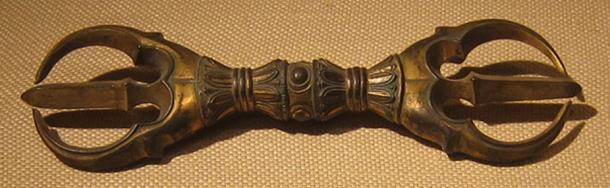
Figure 1. A traditional image of a vajra
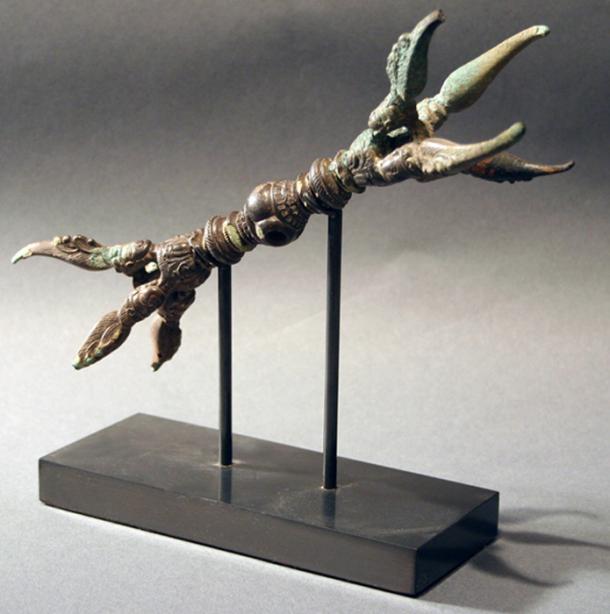
Figure 2. A vajra with open prongs
The symbol of thunder or a thunderbolt as a tool of destruction, for example, surfaces in many ancient civilizations. Mythology unfailingly associates lightning with a sky god, the god of thunder, who uses it as a weapon.
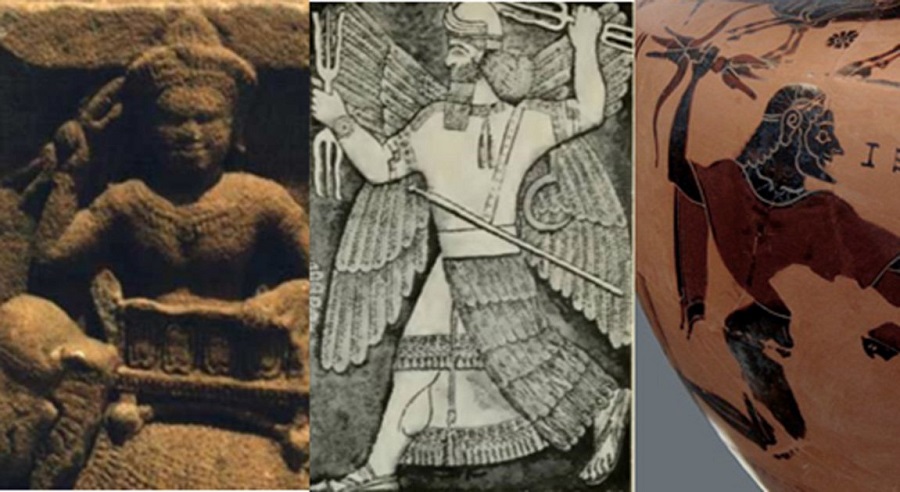
In the western world, the thunderbolt is most readily associated with the Greek sky god Zeus. With it, he defeated the Titans and took control of the Greek pantheon. Myth tells us, that Zeus freed the Cyclopes, the master builders, who were imprisoned in the depths of the underworld - Tartarus. In gratitude for their release, they gave him a marvelous weapon, the thunderbolt. In another story, Zeus used his formidable weapon to battle the largest and most fearsome creatures in all of Greek mythology, the hundred-headed serpent Typhon. Early images of Zeus depict show him holding a rod like thunderbolt, while others show this deadly weapon with its ends splayed into three prongs (Figure 3.).
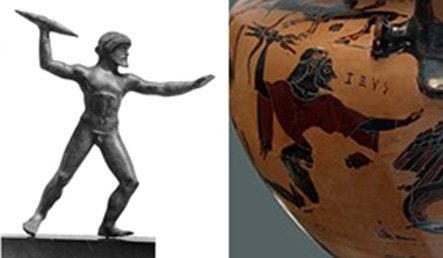
Figure 3. Left: Zeus is depicted with a rod-like thunderbolt.
Right: Zeus holds a thunderbolt with ends splayed into three prongs.
The gods agreed and provided Marduk with mighty weapons including a bow, a mace and a net to use in his battle against Tiamat. Images of this epic scene show Marduk holding a three tipped scepter in his hand (Figure 4.). Subsequent images clearly depict this same deadly three-pronged weapon (Figure 5.).
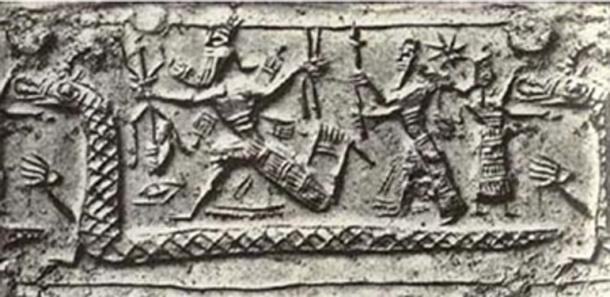
Figure 4. Marduk depicted with a three-tipped scepter
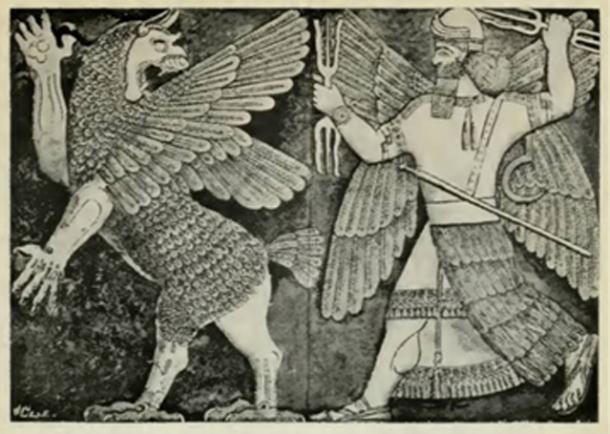
Figure 5. Marduk fighting Tiamat with the three-pronged weapon
They gave him the unrivalled weapon, the destroyer of the enemy [saying]:
"Go, cut off the life of Tiâmat.
"Let the wind carry her blood into the depth [under the earth]."
The gods, his fathers, issued the decree for the god Bel.
They set him on the road which leadeth to peace and adoration.
-Enuma Elish
The master builders, the dwarfs, in the depths of the earth, made Mjölnir. The Norse Skáldskaparmál, which can be found in the Snorri's Edda, describes Mjölnir as a hammer which would not fail. As a weapon, it could level mountains. It goes on to state that if aimed it at anything; it would never miss its target. It informs us that in addition to never missing its target, it would always find its way back to the hand of its owner.
Thor used his mighty hammer to battle his deadliest foe, the giant serpent Jörmungandr. In these tales, the Midgard Serpent, Jörmungandr is not killed. It would not be until near the end of the world in the apocalyptic battle of Ragnarök, that Thor would clash with Jörmungandr the final time.
It entered a man's body with a single wound, like a javelin, then opened into thirty barbs. Only by cutting away the flesh could it be taken from that man's body.” - Book of Leinster
The Chin-kang, deprived of their magical weapons, began to lose heart. To complete their discomfiture, Huang T'ien Hua brought to the attack a matchless magical weapon. This was a spike 7 1/2 inches long, enclosed in a silk sheath, and called 'Heart-piercer.' It projected so strong a ray of light that eyes were blinded by it. Huang T'ien Hua, hard pressed by Mo-li Ch'ing, drew the mysterious spike from its sheath, and hurled it at his adversary. It entered his neck, and with a deep groan the giant fell dead. - Myths & Legends of China – E. T. C. Werner
Finding myths, with similar storylines, and their corresponding images in relatively close geographic areas, while interesting, does not fully support the universality of the gods. When we uncover similar narratives and corresponding imagery, in remote regions of the world, this concept takes on a more serious tone. Myths of a vajra-like weapon are found all over the world. In Australia, the sky gods, the Wati Kutjara brothers, wield a magical boomerang, Wo-mur-rang or club. Boomerangs are known for their ability, once thrown, to return to their owner. Legend states that their father Kidili attempted to rape some of the first women. Throwing their wo-mur-rang, they castrated their father where he disappeared into a water hole.
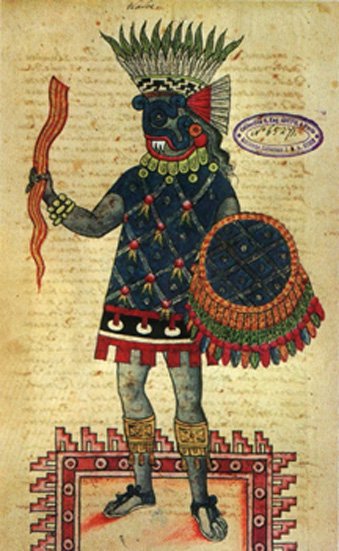
Figure 6. Aztec god Tlaloc depicted carrying a lightning axe
The thunder-producing weapon, the vajra, is only one example of the enormous number of commonalities found in myth, legend, culture and iconography around the world. Similarities exist throughout Greek, Sumerian, Norse, Aztec, Australian and American cosmology. These parallels include the gods, their lives and their amazing weapons. They also include the laws and customs that govern our lives - the very fabric of society.
Likewise, if tools like the vajra are genuine then we are forced to accept that the gods who wielded these weapons were factual individuals as well. This newfound knowledge would open the door to a revolutionary new understanding of who we are. It would challenge the basis of our society and could cause us to reevaluate not only our place in the universe, but everything we hold to be true.
All images courtesy of Dr Rita Louise
Here is a very in depth blog post from Ancient Origins.
The Vajra: An Ancient Weapon of War
The Vajra: An Ancient Weapon of War
The vajra is the most important ritual implement of Vajrayana Buddhism. In Sanskrit, the word vajra is defined as something hard or mighty, as in a diamond. It symbolizes an impenetrable, immovable and indestructible state of knowledge and enlightenment.Our knowledge of the vajra goes back to deep antiquity. Texts indicate that the vajra was not always a symbol of peace and tranquility but something very different. It first appears in ancient India where it was the primary weapon of the Vedic sky-god Indra, the king of the Devas. According the Hindu Puranas, the evil Asuras, Namuchi and Vritra removed all of the light and moisture from the earth. It made the land inhospitable to living beings. Indra battled the demon gods unsuccessfully and as a last resort called upon their supreme god Vishnu for help.
A weapon of the gods
Vishnu informed him that only a weapon that was neither solid nor liquid could kill Namuchi and Vritra. Vishnu had the divine carpenter Tvashta fashion Indra a marvelous weapon he could use to vanquish the dreadful Asuras. This new weapon, the vajra, emitted thunderbolts. With it, Indra annihilated Namuchi and Vritra and returned the much needed light and moisture back to the earth. The Rigveda describes this conflict thus.Now I describe the glorious deeds of Indra, who holds Vajra. He killed the serpent and made waters flow. He broke the hearts of mountains.
He killed the serpent, which was taking refuge in mountain. Tvashta made the Vajra for him. Like the cows making sounds, flowing waters reached the sea.
Mighty Indra chose Soma, and drank from three containers. Generous Indra held Vajra in his hand, and killed first born among the serpents.
- Rigveda 1.32
The vajra, when used, was thrown at one’s opponent. Nitin Kumar, in his article Ritual Implements in Tibetan Buddhism , tells us, “As a hurled weapon the indestructible thunderbolt blazed like a meteoric fireball across the heavens, in a maelstrom of thunder, fire and lightning.”
Figure 1. A traditional image of a vajra
From destructive weapon to peaceful scepter
Traditional images of the vajra (Figure 1.) depict it as a metal shaft with three, five or nine prongs that emanate from lotus blossoms on either end. Originally, according to the ancient Indian text the Rigveda, when Indra used his vajra it had open prongs (Figure 2.). Buddhist legend suggests that Shakyamuni, the Buddha himself, took the vajra from Indra and forced its prongs closed, thus transforming it from a destructive weapon into a peaceful scepter.
Figure 2. A vajra with open prongs
A lightning weapon across cultures
Scholars contend that there is no relationship between Indian, Greek, Australian, and Norse mythology, nor the cosmology of the Americas. They believe that each civilization conceived of their gods independently and that a deeper, older, universal tradition does not exist. If this were the case, then the foundation of these societies; their myths, traditions, beliefs and iconography should be unique to them, their location and their history. The tales of war, intrigue and conquest that come out of American history are vastly different from those of England, France, India and China. So too are the customs, traditions and the symbols that represent the nation. Yet when we look at a wide range of ancient and indigenous groups a pattern of commonality exists. Myths and symbols found in India readily appear in the oral and written descriptions of other cultures. They also appear in their artistic images. These representations seem to transcend time and location.The symbol of thunder or a thunderbolt as a tool of destruction, for example, surfaces in many ancient civilizations. Mythology unfailingly associates lightning with a sky god, the god of thunder, who uses it as a weapon.
In the western world, the thunderbolt is most readily associated with the Greek sky god Zeus. With it, he defeated the Titans and took control of the Greek pantheon. Myth tells us, that Zeus freed the Cyclopes, the master builders, who were imprisoned in the depths of the underworld - Tartarus. In gratitude for their release, they gave him a marvelous weapon, the thunderbolt. In another story, Zeus used his formidable weapon to battle the largest and most fearsome creatures in all of Greek mythology, the hundred-headed serpent Typhon. Early images of Zeus depict show him holding a rod like thunderbolt, while others show this deadly weapon with its ends splayed into three prongs (Figure 3.).
Figure 3. Left: Zeus is depicted with a rod-like thunderbolt.
Right: Zeus holds a thunderbolt with ends splayed into three prongs.
The vajra of the Sumerians
A vajra-like weapon also appears in Sumerian cosmology. Its use is recorded in the Babylonian Epic of Creation, the Enuma Elish. A battle between the sky god Marduk (Bel) and serpent Tiamat is detailed on the fourth tablet of this ancient document. The evil and powerful Tiamat, according to the Enuma Elish, was devising treacherous plans against Ea and the other reigning gods. The gods were afraid to invoke her evil wrath and search for a solution. Ea attempted to confront Tiamat, but instead of fighting, backed down. Marduk, his son, stepped forward and volunteered to fight the enraged serpent, on one condition… if he were successful, he would have dominion over the entire universe.The gods agreed and provided Marduk with mighty weapons including a bow, a mace and a net to use in his battle against Tiamat. Images of this epic scene show Marduk holding a three tipped scepter in his hand (Figure 4.). Subsequent images clearly depict this same deadly three-pronged weapon (Figure 5.).
Figure 4. Marduk depicted with a three-tipped scepter
Figure 5. Marduk fighting Tiamat with the three-pronged weapon
They gave him the unrivalled weapon, the destroyer of the enemy [saying]:
"Go, cut off the life of Tiâmat.
"Let the wind carry her blood into the depth [under the earth]."
The gods, his fathers, issued the decree for the god Bel.
They set him on the road which leadeth to peace and adoration.
-Enuma Elish
The vajra in Norse mythology
The Rigveda also offers an alternative description of the vajra. Some texts represent it as a notched metal club with thousands of prongs. We find this form of the vajra in numerous other cultures. The most well-known stories that portray the vajra in its club-like form come from Norse cosmology. They are associated with the sky god Thor. His mighty hammer Mjölnir was the most fearsome weapon in Norse mythology. Images of the thunder god Thor traditionally show him carrying his mighty hammer. Some texts describe Mjölnir as a hammer, while others refer to it as an ax or club.The master builders, the dwarfs, in the depths of the earth, made Mjölnir. The Norse Skáldskaparmál, which can be found in the Snorri's Edda, describes Mjölnir as a hammer which would not fail. As a weapon, it could level mountains. It goes on to state that if aimed it at anything; it would never miss its target. It informs us that in addition to never missing its target, it would always find its way back to the hand of its owner.
Thor used his mighty hammer to battle his deadliest foe, the giant serpent Jörmungandr. In these tales, the Midgard Serpent, Jörmungandr is not killed. It would not be until near the end of the world in the apocalyptic battle of Ragnarök, that Thor would clash with Jörmungandr the final time.
The Slavic vajra
In Slavic mythology, we learn of the evil serpent Veles who ascended from the underworld and stole something of value from the sky god Perun. Perun, using lightning bolts, would vanquish Veles back to his underground realm annually. His deadly axe, like Thor’s mighty hammer was used to subdue evil and overcome the iniquitous serpent Veles. It too would return to his hand after being thrown.Irish mythology has a vajra too
In Irish mythology, the magical weapon of the hero of Ulster Cúchulainn is the Gae Bolga or lightning spear. Cúchulainn fought and killed his childhood friend and foster brother, Ferdia with this magical weapon. The Gae Bolga is described as a dart or spear, which separates into multiple barbs when entering the body, causing fatal wounds. It was next to impossible to withdraw once it had impaled the body. The Irish Book of Leinster describes the devastating effects of the Gae Bolga as such:It entered a man's body with a single wound, like a javelin, then opened into thirty barbs. Only by cutting away the flesh could it be taken from that man's body.” - Book of Leinster
The Chinese vajra
In China, the legend of Hua-hu Tiao Devours Yang Chien describes a magical spike carried by Huang T'ien Hua which sounds remarkably similar to Indra’s vajra.The Chin-kang, deprived of their magical weapons, began to lose heart. To complete their discomfiture, Huang T'ien Hua brought to the attack a matchless magical weapon. This was a spike 7 1/2 inches long, enclosed in a silk sheath, and called 'Heart-piercer.' It projected so strong a ray of light that eyes were blinded by it. Huang T'ien Hua, hard pressed by Mo-li Ch'ing, drew the mysterious spike from its sheath, and hurled it at his adversary. It entered his neck, and with a deep groan the giant fell dead. - Myths & Legends of China – E. T. C. Werner
Finding myths, with similar storylines, and their corresponding images in relatively close geographic areas, while interesting, does not fully support the universality of the gods. When we uncover similar narratives and corresponding imagery, in remote regions of the world, this concept takes on a more serious tone. Myths of a vajra-like weapon are found all over the world. In Australia, the sky gods, the Wati Kutjara brothers, wield a magical boomerang, Wo-mur-rang or club. Boomerangs are known for their ability, once thrown, to return to their owner. Legend states that their father Kidili attempted to rape some of the first women. Throwing their wo-mur-rang, they castrated their father where he disappeared into a water hole.
The vajra in South American cultures
In the new world we encounter a similar deadly lightning weapon used by the sky gods. In the Aztec culture there is the god Huitzilopochtli. Huitzilopochtli, with his weapon Xiuhcoatl, “ the fire serpent ”, killed his sister Coyolxauhqui soon after he was born. The Mayan rain deity Chaac and the later Aztec Tlaloc are both depicted carrying their lightning axe (Figure 6.). Sometimes they are depicted holding snakes, which represent lightning bolts, which they would hurl from the mountaintops where they made their retreat. In Peru, we find the god Illapa who is described as a man wielding a club in his left hand and a sling in his right.
Figure 6. Aztec god Tlaloc depicted carrying a lightning axe
The thunderstone
A variation of the lightning motif is the concept of the thunderstone. It is believed that thunderstones fall from the sky when the gods are battling each other. This idea is widely held throughout Africa. The Yoruba of southwestern Nigera, for example, believe their axe carrying storm god Shange creates thunder and lightning and casts "thunderstones" down to earth. The elders of this culture would search wherever lightning struck for these magical stones.The thunder-producing weapon, the vajra, is only one example of the enormous number of commonalities found in myth, legend, culture and iconography around the world. Similarities exist throughout Greek, Sumerian, Norse, Aztec, Australian and American cosmology. These parallels include the gods, their lives and their amazing weapons. They also include the laws and customs that govern our lives - the very fabric of society.
Universality of symbolism
The universality of symbolism found around the world implies something else. Weapons, like the vajra, were not born from the imagination of man. They did not come into being as part of a cultures evolution. They were real. They were tangible. Someone somewhere in our remote past saw it and documented it. It is only through an actual encounter with a marvelous weapon that emitted thunder that a clear and specific portrayal of it could be made.Likewise, if tools like the vajra are genuine then we are forced to accept that the gods who wielded these weapons were factual individuals as well. This newfound knowledge would open the door to a revolutionary new understanding of who we are. It would challenge the basis of our society and could cause us to reevaluate not only our place in the universe, but everything we hold to be true.
All images courtesy of Dr Rita Louise
Note: This OP was recovered from the Wayback Archive.
Note: Archived Sh.org replies to this OP: Weapons of the Gods: Vajra, Dorje, etc...


