Lately I have been making crazy hypotheses based on the Korben Dallas threads and some of my reading.
I'll try to give you a little summary ...
John Ogilby in his book full of the sources of his time: 1671 although sources are not specified, but I suspect the volume of David Ingram mentions:
In the American city of Norumbega, live a people who speak the same language and observe the same customs with Mexicans.
In this corner there are also some Alavards, or Longobards, or Lombards, as they say.
Now KD in his Norumbega thread tells us what David Ingram said, which is the following ...
He reported a populous and prosperous land dotted with large settlements, divided into a multitude of what he calls kingdoms with kings ... The Norumbega language that sounds like "Latin" added a peculiar twist to this whole legend of history. This fact or speculation is obviously not
Now let's remember KD's thread from the "Newspaper about the country that the Spanish found in 1521, called Yucatán."
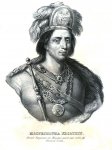
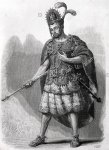
Here he told us about ... King Mathozoma who is the heart / of great Venice / and the most powerful king ... On the same lake there is a great city ... Christians call it great
Venice ... Why would Cortes put it that way?
Wasn't he himself a Christian?
Why would Christians / Spanish call it Great Venice unless it reminded them of Venice?
The conquerors generally named their territories after their countries of origin.
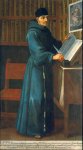
Bernardino de Sahagun
1529, he would leave for the recently conquered New Spain (Mexico). Where, curiously, he would teach Latin to the young Nahua, mainly those children of the pipiltin (nobles) who survived the indigenous nobility.
I find "Latin" curious, if we take into account the comparison with Norumbega.
But Bernardino from 1547 devoted himself almost totally to the construction of his historical-anthropological work. Work that would bring him not a few problems: General history of the things of New Spain.
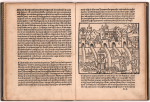
I put together about four volumes, of which only three remain today. And that by hell did not come to light until 1905 that Francisco del Paso y Troncoso published it, in the form of plates in Madrid and then in 1979.
Bernardino tells us how those who arrived before the Aztecs were the Chichimecas who later took another name: Toltecas which means: Master builder, practically these men taught all kinds of things such as astrology, about plants, construction, cultivation, obtaining precious stones, etc.
"And they were tall, with more body than those who now live, and because they were so tall they ran and jammed a lot, which is why they were called tlanquacemilhuique, which means they ran a whole day without resting."
John Ogilby in his book tells us how the Aztecs had to make their way to their promised land after countless wars more than anything and precisely with the Chichimecas that Bernardino de Sahagun spoke to us about.
What was known as New Mexico was in a way "old Mexico."
Because I have to tell you that Ogilby made the Tartars more likely to be the planters of "Native Americans" to the continent.
Which even reminds me of Fomenko's theories about Mexico as a so-called Moscow.
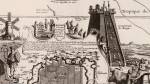
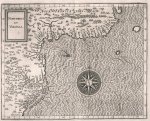
But looking at the two Ogilby engravings of the city of Old Mexico and New Mexico, I feel that the old one is on a smaller lagoon and the new one on a larger one or perhaps they were part of the mass as I will show below ...
https://www.davidrumsey.com/luna/se...List_No,Series_No;lc:RUMSEY~8~1&mi=15&trs=887https://www.davidrumsey.com/luna/se...List_No,Series_No;lc:RUMSEY~8~1&mi=64&trs=887Book:
https://www.gutenberg.org/files/59745/59745-h/59745-h.htm
In the book published by John Ogilby in collaboration with Montanus and others.
In the part where he describes us ...
The Kingdom of Mexico or New Spain.
Limits of New Spain. gives us descriptions of nearby cities such as: Cholula, Texcoco. Mexicaltzingo, Yztacpalapa, Cayocan and Quitlavaca.
The latter catches my attention for its description:
4. Quitlavaca, by the Spanish called Venezuela, (because it is, like Venice, surrounded by water and divided into several islands).
Perhaps you already noticed, the description reminded me of that little book: "Newspaper about the country that the Spanish found in 1521, called Yucatán."
Where they tell us about that city called "Great Venice".
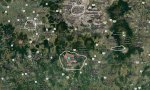
And since this city of Quitlavaca sounded so much like Cuernavaca to me, I decided to look for the location.
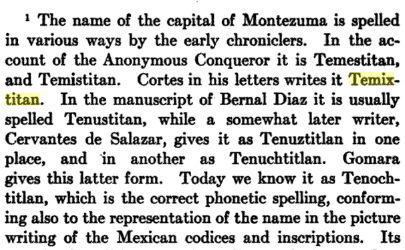
Interestingly, we have a region called Temixco.
Which sounds very familiar to me to Temix Titan, the old way they called Tenochtitlan.
The area also seems to be deep so perhaps in the past it was in a lagoon.
What do you think of all this?
I have a few other data saved but I also hope to hear from you.
Each of these threads are addictive.
I find it curious how David Ingran tells us about a place called Norumbega that is related to Mexicans, both in customs and language.
Which language? That language similar to "Latin"
What did Bernardino come to teach? Latin to the Aztecs, but if they already had a relationship with the Norumbega people who speak something similar to "Latin" it sounds interesting.
Now, the Aztecs were not the first but these Chichimecas.
What Bernardino tells us about the language of these Toltecs-Chichimecas:
"And these Toltec sayings were ladinos in the Mexican language, they were not barbarians, although they did not speak it as perfectly as it is now used."
For that same reason, Nahuatl was special among the Aztecs because it was the language of these Toltec-Chichimecas who arrived with a certain Quetzalcoatl, even the first Aztec Tlatoani was of Toltec origin, it is said, called Acamapichtli.
Another thing, if the people of Norumbega were, according to Ogilby, "Lombards."
What do we know in summary about the Lombards?
They were a Germanic people originally from northern Europe who settled in the Danube Valley and from there invaded Byzantine Italy in AD 568 under the leadership of Alboino. They established the Lombard Kingdom of Italy, which lasted until AD 774, when it was conquered by the Franks.
In the 7th century work Origo gentis Langobardorum (Origin of the Lombard people) he tells us:
It tells the story of a small tribe called the Winnili, they lived in southern Scandinavia, as good Scandinavians owed their name to Odin.
"Langobardo" comes from Langbarðr, a nickname for Odin.
The name 'langobardo' came from the length of their beards, from the Germanic words lang 'long' and bard 'beard'.
Tacitus, in his work Germanía (98 AD), describes the Lombards in the following way:
The langobards, on the other hand, are distinguished by their small number. Although surrounded by a host of more powerful tribes, they are secure, not by submitting, but by defying the dangers of war.
While in Pannonia, the Lombards were first affected by Christianity, but their conversion and Christianization was largely nominal and far from complete. During Wacho's reign, they were Catholics allied with the Byzantine Empire, but Alboino converted to Arianism as an ally of the Ostrogoths and invaded Italy. All these Christian conversions affected, for the most part, the aristocracy; common people sometimes remained pagan.
If Ogilby said that these Norumbega people are Lombard and speak something similar to Latin now it makes a little more sense and having a Germanic relationship, I am not surprised by the similarity of a Norumbega Name with Nuremberg.
Now it also reminds me of that legend of the seven cities of Civola, where the city of Quivira is ruled by a long-bearded king named Tartarrax.
Another thing, if the people of Norumbega were, according to Ogilby, "Lombards."
Yet another interesting thing, Ogilby says: The constitutions of the Tatars and Americans agree.
Tartars, without laws or legislators, who change places, both recognize the immortality of the soul, both as cannibals, eating and sacrificing human flesh. How famous was he among the ancients on the Altar of Diana in Taurica (Crimea).
Strabo relates, that ancient people consider an honorable Death to be cut into pieces, and their meat served in the Commons. Those who die of age, a natural death, are despised as criminals, and as punishment according to their demerits, they are left in the open fields, a prey of birds and beasts; some delight in that disgusting gorging on man meat, others, on the contrary, detest not only humans, but all kinds of meat.
I wonder who hated that barbarism and lived as vegetarians even in America?
Let's go back to Bernardino to answer that question, Quetzalcóatl, whose priest had the same name that they also called him Quetzalcóatl and he used to tell them many times that there was only one lord god, and that he wanted nothing more than snakes and butterflies to offer him and give him a sacrifice .
Many could not follow him and stayed and they are the ones who perhaps give testimony to the Aztecs of these Toltecas-Chichimecas and as the first Tlatoani Acamapichtli it would be said to be Tolteca.
Let's continue with more of Ogilby
The Tartars - A rude people in their religion, habits, and dwellings, and yet in all this Americans differ but very little. Lastly, how common is it among them to worship the devil?
In the Temples of Virginia there are still the horrible Images of the Demons Oka and Menetto.
Others in Virginia believe that there is a great and supreme Deity, who is eternal and forever. Tatars are also of the same type.
The stereotypes that in those times were said of the Tartars and the Scythians arise here and yet we have all these monstrous and incredible constructions everywhere, but could these wild nomads make them, who?
We already know many things about the Tartars in relation to Gengiskhan, that many were Mohammedans, Christians, there are many Jews inside as well, Tibetans and etc. That is why I do not understand these statements about them.
And since Ogilby made mention of sites with idols, an idol that was in Tenochtitlan catches my attention since it appears on various maps.
This colossus can be associated with different gods from other cultures, Neptune, a goddess Scythian perhaps.
Even this map shown in this thread made by the Cortes himself for Carlos V contains that statue.
Letters from Hernán Cortés, addressed to King Carlos V, would shape a book published in Latin, and printed in the city of Nuremberg. Four of the 11 copies included in the appendix a map apparently based on previous plans, made by the Mexica themselves, or on sketches drawn by Hernán Cortés himself.
Again, everywhere "Latin".
We could say the same about Braun and Hogenberg, Civitates Orbis Terrarum was an editorial project conceived as a complement to Abraham Ortelius' atlas of the world. Collection of panoramic views.
As I already told you: Ogilby tells how this region of Norumbega and Virginia observe the same customs as Mexicans.
Wiki says about it: it's a real sham ...
To represent a scene of religious practice in Virginia, Arnoldus Montanus in his work "America" of 1671.
The artist transformed the Mexican god into a great idol and placed it in a space based on a Mexican temple. The scene falsely depicted the natives of Virginia with a culture almost identical to that of Mexico.
Here wikipedia agrees with Ogilby on how in Virginia there were still centers for these idols
And in this engraving he led us to another OGILBY IN ITS REPRESENTATION OF HUITZILOPOCHTLI
Viztlipuztli was generally presented as a minor Image, called Tlaboc (TLALOC?)
Description of the Viztlipuztli image.
It was a wooden image like a man, sitting on a blue seat in a triumphant chair; at each end of which was placed a Staff with a Serpent's Head on it, from whose Forehead, which was painted blue, ran a Streak of the same color, crossing its Nose towards its Ears; on his head was a plume of feathers, the ends of which were covered with a golden varnish; his left Hand held a white Shield, in which five Feathers were glued, and on top a Laurel Bough; then the Shield put four Arrows, pretended to be sent from Heaven; in his right hand, a truncheon, full of blue stripes twisted like snakes; Behind his shoulders appeared Wings, not very different from those of a Bat, his large and round Eyes, and his Mouth extending from Ear to Ear, made him terrible to contemplate, also gaping and full of Teeth, which protruded from his Belly; on his chest were also two burning eyes, and under them a withered nose; their feet ended in claws, hung around with precious jewels, golden boxes and shields with colored feathers. The curtain behind which this idol sat did not open, except on a feast day.
I hope you noticed the people in turbans and the men in robes.
If the Norumbega people were Lombards who lived with the Byzantines for a long time, it would make people with robes and people with turbans more normal.
And about that grotesque colossus also curious things arise, that he was a man, sitting in a blue seat in a triumphant chair reminds me of a certain coat of arms in the past that corresponded to Alexander the Great.
About that face on his chest of a Lion perhaps, I would like to theorize that it was a shell with that figure of Leon, everything is interpreted in different ways.
Now if you ask about those bat wings.
Perhaps you have seen the Saint Petersburg rostra that contains a woman with bat wings, also these wings inspired by the Mayan monster Camatzotz with origin from a giant bat according to wikipedia.
According to Fomenko:
The name MEXICO or MESHIKO is a slight distortion of the name MOSOCH-MESHECH or MOSCOW.
Thus was also called the vast Tartary of MOSCOW.
The word MESHECH itself could have originated from sMESHAYU ('I will mix' - translated from Russian), sMESHEniye ('Mix, mixed' - translated from Russian), that is, a mixture of races.