Here's a few things to add to the equation which can be proven by empirical observation.
Light waves from the sun do not follow straight line as they travel through the atmosphere (or atmo'half'sphere if you prefer the dome). We assume that lightwaves are traveling in straight lines, but this is not true. The atmosphere if dense near the surface of earth an rare towards the top, which means there is a density gradient in the atmosphere and there is also a temperature gradient.
Temperature and density greatly affect a light wave's path and cause it to follow a curve.
-
Light waves propagate in straight-line paths as they travel in a homogeneous medium. The only homogenous media is "outer space".
- Light waves follow curved paths in a medium in which the refractive index changes. The atmosphere, due to it's ever changing temperature and density is never a homogeneous media.
Light *ALWAYS* follows a curved path through our non-homogeneous atmosphere. The reason specifically that waves follow curved paths in non-homogeneous media is because the left and the right side of the wave enter the media at different times. It's the same concept if you have a front wheel drive car, left and right wheel pulling the car forward. But if you increase the speed of the front left wheel, the car will start turning left. A light wave does the same thing when it enters a dense media. The Left side of the wave enters first, and starts to slow down- but the right side is still going fast. So the wave turns slightly.
It's a proven and measurable fact that all light waves follow curved paths, and there is no exception except for in a vacuum chamber or outer space (existence of the latter being debatable).
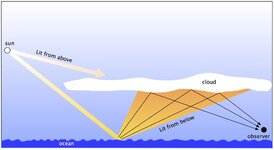
Just because light waves reach the bottom of clouds, have you traced back the path the light wave followed to ensure it didn't get there by following a curved path?
This curving of light waves causes many optical illusions such as Atmospheric Refraction which causes someone to think the sun hasn't set when it actually already has: (Assumed sun is still over the horizon, in reality it has already set)
Atmospheric Refraction can be broken down into 3 parts:
Astronomical Refraction: Light from a distant astronomical object (sun, moon, star) has followed a curved path through a potential 6,200 miles of atmosphere (Exosphere merges with solar winds ~6,200 miles). This causes an optical illusion that makes celestial objects appear higher in the sky than they physically are.
Terrestrial Refraction: Light from a distant mountain peak, ocean on the horizon, and all terrestrial objects appear elevated. Light waves traveling parallel to earth's surface also follow a curved path.
Horizonal Refraction (not accounted for by the scientific community): For the viewer who is outside (at high up in) the atmosphere, who is looking back to earth. How does the optical illusion caused by the curving of light waves affect the visible "earth from space"?
Here is a diagram I made to explain exactly how Astronomical Refraction works (viewer on surface of earth, looking at a celestial object):
And here is a diagram I made to explain how Horizonal Refraction works. Notice the obvious similarities. (viewer is outside/high up in the atmosphere and looking back at earth's surface):
That's correct, earth's 'curved surface' is optical illusion caused by atmospheric refraction.
But hang on, we're supposed to be talking about sun on the bottom of the clouds.
Here are the mathematical formulae for astronomical and terrestrial refraction, which I've calculated by hand, on paper. Please check my work any possible errors and realize that these are the accepted scientific formulae which any physicist can review for accuracy and it, of course, is assuming a sphere earth.
Astronomical Refraction:
AtmosphericRefraction.pdf
Terrestrial Refraction:
TerrestrialRefraction.pdf
Now you can see what happens on a sphere earth is that light waves, parallel to earth's surface, bend downwards. But this is only because of the geometric curvature of earth- a light wave "parallel" to earth's surface already has a radius of curvature of 3959 miles. But on a FLAT EARTH, a light wave parallel to earth's surface has no curvature, and is flat.
So then, does light travel slower or faster in dense media? Light slows down in dense media. And is the atmosphere more dense or more rare at the surface? It's more dense towards the surface.
A light wave, travelling parallel to earth's flat surface, constantly encountering "dense" media (think about the air as 1000 panes of glass all lined up) will constantly be slowed down. The speed of light, is
only in vacuum, and slows down when it enters a dense media such as air, water, or glass.
Light traveling through 1000 panes of glass will BEND when entering each sheet of glass, and it will also slow down each time. This is provable with empirical experimentation, so go try it before debating. It happens. And air is no different. For example: 1 meter of air, you could break it down into 1000 'microscopic' sheets of air. And when light enters each one, it will slightly slow down.
Light does not travel at "light speed", except in a vacuum. Light waves can and have been "stopped" by passing them through enough dense media.
So, do light waves following parallel to a flat earth bend up or down? They don't go straight, that's a fact.
-Ryan Zehm 55°N