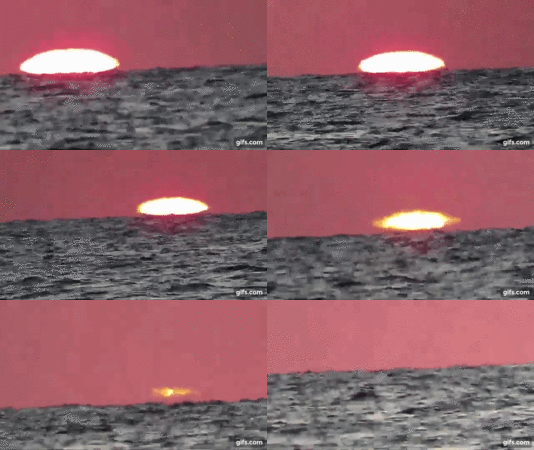
What actually happens when the sun sets?

This is what I observe. And I have spent a bit of time taking pictures and video of our sun disappearing.

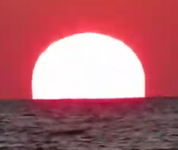
The problem is that most folks have locked in their brains that when the sun sets, they see something like this:
pnC51GY.png

In reality, the above is just a distorted and quite magnified mess that actually hides the sun "setting" or actually receding behind it, until ultimately it is gone.

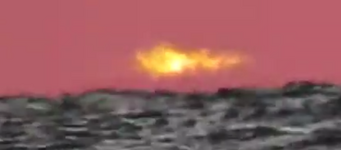
The brightest yellow circle in the center can be seen here, still behind what's left of the distorted, refracted light, still receding, and still above the horizon:
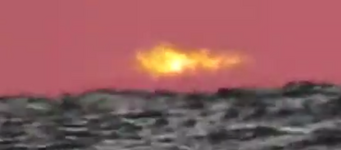
SZWQ1OJ.png

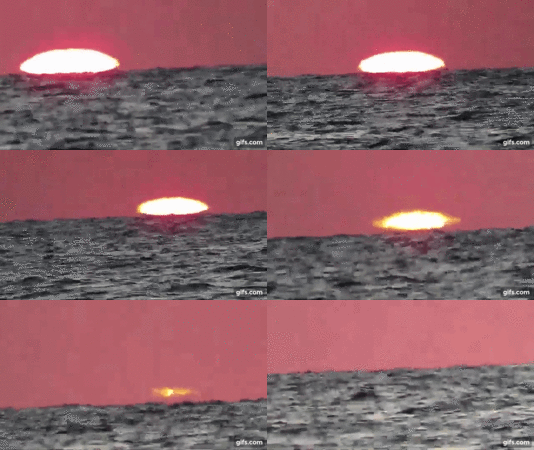
In real time it looks like this:
oZjgDN.gif

As far the op's suggestion that the sunset somehow debunks fe, please consider from a video I shot myself, that even when the crazy, distorted image from the sun begins to look like it is setting, a simple zoom can easily show that this is not the case.

Because the camera is able to resolve images at far greater distances, we are able to see how high in the sky the sun still actually is:

qQlXN3.gif
The above could never happen on a ball.

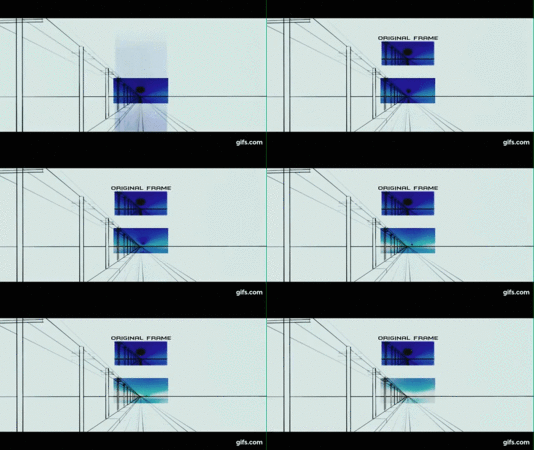
ALL parallel lines will converge at the same exact vanishing point because that is how our world works:
qQlWYy.gif


Hope that made sense.
 
This is what I observe. And I have spent a bit of time taking pictures and video of our sun disappearing.

The problem is that most folks have locked in their brains that when the sun sets, they see something like this:
View attachment 19725

In reality, the above is just a distorted and quite magnified mess that actually hides the sun "setting" or actually receding behind it, until ultimately it is gone.

The brightest yellow circle in the center can be seen here, still behind what's left of the distorted, refracted light, still receding, and still above the horizon:
View attachment 19726

In real time it looks like this:
View attachment 19727

As far the op's suggestion that the sunset somehow debunks fe, please consider from a video I shot myself, that even when the crazy, distorted image from the sun begins to look like it is setting, a simple zoom can easily show that this is not the case.

Because the camera is able to resolve images at far greater distances, we are able to see how high in the sky the sun still actually is:
View attachment 19728
The above could never happen on a ball.

ALL parallel lines will converge at the same exact vanishing point because that is how our world works:
View attachment 19729


Hope that made sense.
Im really confused at why we once again have these images.

The OP clearly said, he doesnt believe the globe earth model. He accepts that you can zoom in on a 'setting sun', and 'hey presto!' you can see the sun once again.

Vanishing points and convergence are all accepted explanations for this phenomena. There is no need for everyone to keep restating these points. They are accepted.

Seriously.... can we move on from optics with regards to vanishing points, please?
 
Last edited:
As far the op's suggestion that the sunset somehow debunks fe, please consider from a video I shot myself, tha
I've never suggested that fe is being debunked nor was it the purpose of the post. I'm closer to fe than any other model I've seen thus far but I honestly don't care what shape the earth. What is of interest to me is that the history of the world is largely a lie. That's how I found my way here. It follows that those who control history control academia so then science I'm similarly questioning.
 
The way our eyes and brain deliver the world they/we see means that in the imagery we see and capture in our devices makes it appears that the sun is dropping below the cloud base.
That has nothing to do with the cloud base appearing orange to our eyesd at sunset. The colouration of the clouds has everthing to do with the spectrum of light or waveband or frequency or whatever term fits with ones believes that strikes the cloud

In short it is a lighhting effect and instead of twineing on about earth shape can we instead trty and figure what causes the suns light to change the way it does from morning till night. There appears to be something staring us in the face but we cannot see it.
 
On to the matter of science and specifically, the sunset. Many may have seen the videos of flat-earthers stating the sun doesn't actually set but it just disappears behind the vanishing point and if you zoom in, you'll see the sun hasn't set at all. And they then proceed to show the footage of a sun that is setting, but is not actually setting, just moving away. It all seems very convincing. Until you look at images of clouds when the sun sets...
FTR, that is where, in the OP, my confusion stemmed from.
 
I know this is the moon and not the sun but it serves to illustrate what I am banging on about and this was taken half an hour ago on a compact camera with me bracing myself against a wall pointing the camera directly at the moon and barring cropping there is no software fiddling done to it.

You can just about make out the red tinge on the extreme right (the moons right the viewers left) the furthest part away from the source. It is an optical effect that only appears when there is the cloud between the moon and me that is thin enough to allow the moons light through.
It appears to me that the moons light is not focussed as the suns is hence it needs the cloud to reveal the presence of the red light at the edge of the visible light. The cloud in effect provides the lens if you will even though it is much closer to me than it is to the moon unlike the suns 'lens' or focussing apparatus/device whatever which is either very close to the source or is part and parcel of it.

The cloud is water droplets within the water vapour or so we are told. I have never been comfortable with this explanation quite honestly but that aside the droplets are acting as the lens mechanism because the light beyond the red ring becomes much lower and though the cloud remains lit it is now a murky whitey sort of grey as the moons light is nowhere near as bright as the suns is, if bright is the right word.

I feel it is the presence of the combination of lens on the sun and the light passing through water vapour which causes the red light to appear in our vision when it strikes the cloud or the hill or indeed the surface of water.

It is not a prism which splits all light like the rain bow does which may simply be a feature of the size of the liquid water droplets moving through the water vapour that surrounds them but it is seems incontrovertible to me that the sun is focussed by something or in and of itself.

red.jpg

Please do not expect me to provide science whatever the hell that it is or go along with all that scientists have said over my lifetime. I am simply looking at what I see with these mince pies that is a combined output with my brain to render the physical world around me and trying to make sense of what it is I am seeing occur that is all. It is not a theory its ideas being written down here and shared in the hopes of the decent discussion being allowed to carry on so we might collectively get some sort of handle on the sun.
 
I know this is the moon and not the sun but it serves to illustrate what I am banging on about and this was taken half an hour ago on a compact camera with me bracing myself against a wall pointing the camera directly at the moon and barring cropping there is no software fiddling done to it.

You can just about make out the red tinge on the extreme right (the moons right the viewers left) the furthest part away from the source. It is an optical effect that only appears when there is the cloud between the moon and me that is thin enough to allow the moons light through.
It appears to me that the moons light is not focussed as the suns is hence it needs the cloud to reveal the presence of the red light at the edge of the visible light. The cloud in effect provides the lens if you will even though it is much closer to me than it is to the moon unlike the suns 'lens' or focussing apparatus/device whatever which is either very close to the source or is part and parcel of it.

The cloud is water droplets within the water vapour or so we are told. I have never been comfortable with this explanation quite honestly but that aside the droplets are acting as the lens mechanism because the light beyond the red ring becomes much lower and though the cloud remains lit it is now a murky whitey sort of grey as the moons light is nowhere near as bright as the suns is, if bright is the right word.

I feel it is the presence of the combination of lens on the sun and the light passing through water vapour which causes the red light to appear in our vision when it strikes the cloud or the hill or indeed the surface of water.

It is not a prism which splits all light like the rain bow does which may simply be a feature of the size of the liquid water droplets moving through the water vapour that surrounds them but it is seems incontrovertible to me that the sun is focussed by something or in and of itself.


Please do not expect me to provide science whatever the hell that it is or go along with all that scientists have said over my lifetime. I am simply looking at what I see with these mince pies that is a combined output with my brain to render the physical world around me and trying to make sense of what it is I am seeing occur that is all. It is not a theory its ideas being written down here and shared in the hopes of the decent discussion being allowed to carry on so we might collectively get some sort of handle on the sun.
Thanks for the share. So looking at this image and your explanation, I have a few more questions but I think my view of what we are observing is starting to crystallize. Firstly, my takeaway from this and the other posts shared:

1) I think all the explanations around refraction, angles of light and the light splitting through the prism are definitely not what is being observed
2) Perhaps due to the "water vapor" or altitude or some other reason, the red wavelength seems to concentrate on the side of the clouds as observed most commonly, sometimes on hills but it's not something we observe anywhere and everywhere
3) if this is the case (big if), then light is either not what we have been told it is OR it does not behave the way we have been told it behaves. The example that springs to mind is we can observe the inside of lit room while in darkness yet the light traveling to our eyes in no way lights up our surroundings. Again, it seems as though it concentrates in our eyes due to some property of the eye or light, not simply the eye receiving the light beam/ray/wave otherwise I'd expect the surroundings to also receive it.

On to the questions:
4) Is your view that the moon gives off light or reflects it?
5) If it gives off light, is the light of the moon is different to that of the sun? The same effect is observed. Why?
6) If reflected, then we are saying the sun or some other distant light source is again responsible. How when the light source is not even visible?

Thanks for the input.
 
I have no idea what the moon is other than it definitely is not a three dimensional ball due to its changing shape and whatever it is that seems to cover it to create a crescent shape which itself is see through in daylight so the ring of light is still visible. Timeshifter has some superb picture of that on here somewhere.
That said it is either a light in and of itself or it is a window of some sort to a light behind it in a hole in wall with a light behind it so too speak. But that is all my speculation. It produces an unfocussed light which whilst it lands on the same living level as the suns light it does not have its intensity nor its spread. An enigma wrapped up in a conundrum is what I know it is!

The only differences I discern is the brightness or intensity is different and the suns light is focussed with a lens close to it it and the moons is not. The lighting effect of the red edge so do speak is not limited to the sun and moon it can be seen in torch light ans especially those night sun lights they hang off of helicopters so I reckon it has as much to do with the medium as in the water vapour as anything else.

I am with you completely in not trusting science to tell us anything of consequence about light. Every single time I have dived into sources of science or indeed historical academia it is a paper referencing a paper referencing a paper and then an opinion appears under the pile of papers if I get lucky. Most times its just papers about papers disappearing into time before computers existed.
 
I have been looking for toroidal light in so much as light in a toroidal shape and I cannot find any. Light always comes with a source. I say with quite deliberately as everything I come with light emanates from a source. With seemingly the luminaries and stars as possible exceptions but as they are all literally beyond reach I hope to use the sources within reach to come to some idea of how the beyond reach light sources work.

All I have been able to find is ball shaped light. It is not quite 360 as it does not illuminate its source.
A toroid shape is simply a ball shape squeezed about its middle so it is entirely possible that the ball light I am seeing is in reality a toroid not a ball but my eyes and brain cannot see it so present light as a ball.

Thing is I cannot figure out a way to determine the existence of the toroid. Light illuminates an area of water vapour that forms a lit three dimensional ball. We can easily ascertain this by walking round a candle on a pole in the dark.
The light is brightest nearest the source and fades into nothing furthest from the source no matter what direction we view it from.
If it were actually toroidal why do our eyes not show us the toroid?

I have been taught that light moves from point A its source to point B and illuminate anything at point B. Once it has illuminated point B it then scatters off from whatever point B is in a straight line relative the the angle the light first struck point B and then fades to nothing.
I have also been taught light has a wave length and it bounces in a wave form down a straight line so the straight part is merely a descriptor of travel not an actual thing.

Certainly a laser is the best example I could find of a light seeming to travel in straight lines but it is false as the laser is focussed light not a light and source. In short it is no different to a torch where a bulb creates a ball shape light and the lens construction delivers a beam of light.

Every time it takes a lens to turn the ball or toroid into a beam.

So on the back of that it follows that a light source without a lens is ball shaped around its source. Or am I barking?
The reality could be toroidal but I cannot fathom how light from a single source can be made to reveal its toroidal reality.
So in a ball of light from a source what is the light actually doing?
Does it actually go anywhere at all?
Is it in fact omnidirectional only limited by the source in the same way a dimmer is used to control the light from a bulb between a minimum and a maximum amount?
We never see a firefly whose back end is noticeably brighter than the others around it for example and all the matches in a box burn with the same amount of light present.
Is what we perceive as light simply a reaction of the water vapour or in the case of deep sea creatures liquid water?
 
I actually had a ball/sphere shape in mind the whole time. Toroid was a bad use of terminology on my part. I've been watching too much Ewaranon and the like. 🤦‍♂️

If light behaves in that manner, I would expect its area of influence to be spherical.
 
Last edited:
Aah. Would explain why the toroid is not manifesting!
I wonder. A torch bulb lit but without its lens in the dark in line with my eyes would reveal a fading circle of light from centre to edge.
Putting the lens on reveals a brighter circle of light so it must be that the lens is somehow able to take the ball and shine it back into itself and at the same time increase both distance it illuminates and brightness?
Or am I 'off beam ' there?

Edit to add
In the lensless torch example we could walk to either side of the torch and see a circle of light, it doesn'distort at all but with the lens on walking to to side would reveal a triangle shape or beam of light wider at its extremity than it is at its source.

Lift the torch above my head and thus we create the same light pattern/shape the suns light has?
 
Last edited by a moderator:
what is the light actually doing?
Does it actually go anywhere at all?
This is where I'm at. I've been looking at shadows, hoping that this would provide clarity and perhaps there is a simple explanation for what I'm about to share but it seemed odd. So, in the lounge area I have a tv and wall-mounted light behind it to its right. Then on the opposite wall there are wall-mounted lights close to each corner of the wall. As I was sitting last night I noticed a shadow cast by the tv from the light to my left and I thought," Ok, I suppose the light on the tv's side probably
can't illuminate that wall so there is a difference in luminosity or light intensity, thus the shadow." Then I realized, there are 2 lights facing the tv, and they are the same lights, same height, same bulbs, same everything. Yet a shadow is cast by the one light and the other light, which is shining directly on the shadow area, doesn't light it up, the shadow remains seemingly unaffected. That's when I thought I might not actually understand what shadows are either because I just figured shadows happen when the path of light is blocked, i.e. no/low light. How then is there a shadow when a light source identical to the light source casting the shadow is shining directly on the shadow area?

Coming back to the clouds at sunset. Clouds are illuminated from above and below, we've established this. Clouds also cast a shadow, this is known. Increased air density (i.e. high levels of humidity or water vapor in the air) should result in increased light refraction/bend according to the numerous drawings that have been shared ( :) ) which, I would expect, result in some discernible difference between what is observed in coastal regions and what is observed inland. I've lived by the coast and inland and I've never noticed a difference but this could just be because I wasn't paying attention to these things back then.
Now as for the sunset.....I don't think light moving in straight lines explains the underside lighting effect. If we assume this is simply a colour effect, caused by red spectrum light being observed, which it could be then it partially explains it but I feel it's more than colour. There's a luminosity which is akin to focusing light on an object. So what I'm thinking is what if light moves in some weird form, and perhaps toroidal is the wrong word but the shape is important. So what I imagine is something like this:

1644918772085.png

As this field of light interacts with the atmosphere, the outer edges of the field concentrates energy/polarity/something and this causes the red spectrum to be observed in the clouds and sky. This is probably the explanation that makes the most sense to me even though it opens up a lot of other questions and cannot explain the mechanism of how this works. Pure speculation basically.

Edit: Also, just thinking about shadows again, perhaps this is why when the sun is directly above us, our shadow is at it's smallest, as we are least affected by the field.
 
@User1
The picture you have supplied is more what I had in mind when I initially said toroid, as this one is roughly spherical. But, many other images describe it as a donut.

I feel though the effects are simply to those of gravity, magnetism etc. Each has a sphere of influence. I'm not convinced about light rays and beams etc.

It feels more as though light has a sphere of influence which causes a reaction in nearby objects, which then vibrate on a frequency or in a way that our eyes can perceive.

I'm wondering if its better to classify this as a quality or even a dimension. But then what else can be classified in this way? Density? Colour? Sound? Flavour? Texture?

One thing I still dont understand though - how do you explain the phenomena that sometimes a person can immediately tell when you are looking at them? So much so that they immediately turn and look you right in the eye, without hesitation. It's almost as if eyes are a transmitter as well as a receiver. Some connection is being formed.
 
I've said frequently on here the eyes are both camera and projector that is why working out their geometry and the way it distorts reality is important to figuring things out.

Apologies user I have just noticed your post above.
I have never noticed your TV example before so will see if I can replicate it this evening.

As for the toroid picture and vibrations frequencies beams and the myriad of words we are given to try and explain things.
Toroid's do not manifest in my vision only drawings of toroid's. Magnets with iron filings on a piece of paper reveal the existence of a toroidal shape but that shape is not stable as the filings will all be pushed towards the ends of the magnet with ease.
That light does not move in the way we are told it does seems beyond doubt. In truth I doubt it moves anywhere. I am coming to the probability light source does something to the water vapour, as you may be able to tell from these comments.

Are there any examples of a movement or vbibration of something that can give off a light?
I know that on some level a candle or match burning is a movement in the reduction of the source material but that material is not vibrating as it will sit happily for years and years without burning or giving off light.
 
Last edited by a moderator:
It's actually pretty interesting that the image of a toroid supplied there, actually contains the spectrum of light..... No idea if thats meant to be just artistic license, but it's very much a coincidence for this conversation.
 
I'm wondering if its better to classify this as a quality or even a dimension.

This is what I suggested early on in the thread. It appears as though the sun is setting to the naked eye. If you zoom in, it appears as though the sun is just moving away. I don't think it's either. To link in with your question
how do you explain the phenomena that sometimes a person can immediately tell when you are looking at them?

And what KD is saying
the eyes are both camera and projector

I'm inclined to think the sun sets but not in the way we imagine. It doesn't go down below the earth, nor does it move away. These observations are us interacting with the quality/dimension/trait of light. The moment we look or observe it, we influence it (not in the sense that we can change our destiny kind of influence). We are basically doing a kind of sonar with our eyes and the light bounces back after we "ping" the environment.

So what does this mean? The sun and possibly light may exist outside our dimension but interact with it and moves in manner outside our understanding of physics. It also ties in with what KD speculates about the moon. It may be a window for some other light source. A window into another place, which is here but not here, strange as that sounds. In the Islamic tradition it is taught angels are made of light and jinn are made of smokeless fire - some think this may refer to energy. These beings observe us from a place wherefrom we can't observe them and they do directly interact with our world.

I'm not sure how much further we can go with this but just want to express thanks to everyone who participated in the discussion. In the absence of anything which refutes what has been said, I feel I'm a bit closer to understanding what is happening, if only by understanding what is not happening. Still lots up for debate so hoping there's more we can get out of this.

Peace
It's actually pretty interesting that the image of a toroid supplied there, actually contains the spectrum of light..... No idea if thats meant to be just artistic license, but it's very much a coincidence for this conversation.
As though it was sent.....
Are there any examples of a movement or vbibration of something that can give off a light?
Example that comes to mind is a glow-stick. If memory serves correctly, you just shake it then the chemicals activate. Not sure if this i the kind of vibration you have in mind but it's all I can think of right now.
 
Last edited:
Here is an image of a cone jelly and its lights. Seemed perfect to add it in here.
biolum-1.jpg

I feel the sun is part and parcel of what we call reality. I base this on how it appears as a perfect circle within my field of vision wherever I am in relation to it. It is a three dimensional ball which may have an integral light source and equally may have a tether or pipe or some such, wick even that we cannot see as it s connection is always facing away from us. It is physical thing unlike the moon whose shape changes and rarely does it present a perfect circle in my vision.

That I do not experience the thing I am standing on moving then the only other possibility is the sun is doing the moving. It appears to move between two limits which it never contravenes it never slows nor speeds up it seems it just alters its position relative to mine every day. Sundials do not move yet once aligned correctly they work perfectly day in day out by interrupting the light from the sun throughout the day throughout the year.

The sundial is prime evidence to me that the earth plane is not moving it is static. It is also prime evidence the light from the sun is focused down to the living layer so whatever the source of the suns light is there is defintely a lens between it and my eyes.
The sun is constantly in motion. The appearance of it setting as defined as falling below the horizon which is nothing more than the inbuilt vanishing point of our eyes his a nonsense that is a faculty of the limitations of our viewing and projecting apparatus without whichbwe could not move around as we do.

All light sources were limited without exception. They all illuminate a limited area in a ball shape that fades from source to edge. This does not correllate at all with straight line light nor does it correlate with the toroidal shape hypothesis. True some of those limited areas of illumination are vast on a human scale but the fact they are all limited is proven by daylight itself..

One thing I ponder about from time to time is that there are in fact 360 suns on parallel journeys but in their own tracks so to speak. So we believe we see the same one disappear and reappear every successive day in reality they are in fact different.
Would that mean this plane is beyond comprehension in terms of scale?
I would argue it must and it would also give rise to the idea of multiple dimensions, realities, lost lands, lost flora and fauna especially as this part of the plain has everything a human sized human needs to live then it is not beyond comprehension other parts are scaled differently and what we perceive of as tales of giants and dragons and dwarfs etc are nothing more than travellers tales. The travellers between different parts of the plane. Us to theirs and them to ours.

Fanciful it is and I have no way to prove any of it but to me the existence of land and water outside of the land and water we are told exists is much more likely that dimensions.

Apologies if that is wanderring too far user1!
 
One thing I ponder about from time to time is that there are in fact 360 suns on parallel journeys

I've never come across this theory. Please share a link so I can explore.
Would that mean this plane is beyond comprehension in terms of scale?
Yes. I'm of the opinion that we are told to look into space (whatever that is) for new horizons because the rulers don't want us to know just how big this world is, and I believe this world is incomprehensibly big. We can't go that high up, we can't dig that low down. There is a literal limit to how deep we can descend into the ocean. There are very real limits to our experience of this reality.
the existence of land and water outside of the land and water we are told exists is much more likely that dimensions.
I'm of the view that both are probable. Not extra dimensions of the marvel universe variety where there are multiple KDs, just dimensions in which life exists in a form that we can't really understand, comprehend or appreciate at this stage.

Apologies if that is wanderring too far user1!
Sometimes in order to solve a problem we need to create the framework within which to solve the problem and that of itself may be a journey and part of the problem-solving journey.

Crazy that something which seemed as though it should be fairly straightforward to explain is anything but.
 
Its not a theory its an idea that sometimes makes a lot of sense to me other times I dismiss it as madness!
 
The brightest yellow circle in the center can be seen here, still behind what's left of the distorted, refracted light, still receding, and still above the horizon:
17616-8d854837e6ec3fcfb766ae30bdc60cfd.png

In real time it looks like this:
17617-67cd0092af1353f42244caba9c49d20f.gif
This is what hints to me towards the sunlit undersides of a clouds being due to reflection:

screenshot114.png

I think the area below this line (the true vanishing point) is the reflection of the sky along with the disappearing sun. In minor angles (of the receiving light (excuse my English)) any surface increases in its reflectance, so maybe that is the source for the illumination of the clouds from below, tinting the undersides into whatever colors.
 
Last edited:
Tips
Tips
Please respect our Posting Rules.
Back
Top