SH Archive 1878 Panorama of San Francisco from California Street Hill

SH.org OP Username
KorbenDallas
SH.org OP Date
2019-02-21 13:13:38
SH.org Reaction Score
113
SH.org Reply Count
109
Note: This post was recovered from the Sh.org archive.
Username: jd755
Date: 2019-04-14 13:33:49
Reaction Score: 3
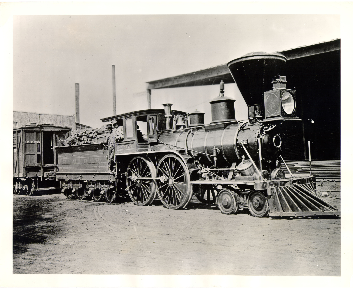
From here A photograph of the Pioneer, a steam locomotive, which was built in Boston and put into service in San Francisco, ca. 1868. | DPLA

A photograph of the Pioneer, a steam locomotive, which was built in Boston and put into service in San Francisco, ca. 1868.
loco.png
The note on back of image reads:
"Built in Boston and brought around Cape Horn to San Francisco in 1855, this locomotive was christened the ‘Elephant’ because of its size, and went to work grading San Francisco sand hills. In 1856 it was sold to the Sacramento Valley Railroad and rechristened the ‘C. K. Garrison.’ By a third christening in 1868, it became the "Pioneer" in recognition of its distinction of being the first locomotive used on a California railroad and probably the first on the Pacific coast.”


A slight aside.
From here What Did San Francisco Look Like in the Mid-1800s?

This 1859 map of San Francisco was extremely utilitarian. The map is a chart, used primarily by sailors and those looking to navigate their way to the city on the bay.. “How did you get to San Francisco in 1859? You got there by boat, so charts were incredibly important,” Rumsey explains. The US Coast Survey drew the chart, perhaps as one of their earliest projects. “The US Coast Survey was a very young organization in 1859, but they spent a lot of time making charts of San Francisco,” Rumsey says.

Why so much time in San Francisco?
Gold had only been 'discovered' a few years earlier and the United States had only stolen the land from Mexico around the same time.

End of aside.

A good compact source of images showing the type of terrain in the area (basically sand dunes 7 miles across) and once again making me wonder WHY San Francisco was settled, at all.
Amazing images of San Francisco before it was a city
 
Note: This post was recovered from the Sh.org archive.
Username: Red Bird
Date: 2019-04-14 14:55:01
Reaction Score: 3
One thing I caught from dianag’s post with this video


Was, while I don’t agree with all Pigeon says and believes, the statements about the Mystery schools/Catholic Church/Rothschilds etc. causing mayhem throughout the centuries to capture people/states/kings/nations in their economic trap and owning them could apply to the burning down of cities.
They leave hoodoo architectural marks, etc. (like the dogs they are), saying they own them (San Francisco) then proceed to entrap San Francisco by not letting a crisis go to waste, burning it down, and being charitable folk, they loan the local PTB the money to rebuild, plus pay for the architects of course. Then they own the town, the businesses, and most of all the gold.
You can accomplish a lot with unlimited money even with few actual citizens, plus the worse you make it look the better.
They may choose the cities by marks left by previous cultures knowing there is a reason for the city site...

Run on sentences, but seems to be a theme.
 
Note: This post was recovered from the Sh.org archive.
Username: KorbenDallas
Date: 2019-05-29 08:33:16
Reaction Score: 2
Wanted to add to our discussion, for I somehow forgot about the first SF fire of 1851.
  • 1850 population was 21,000
  • Fire damage: 2/3 of the city - 2,000 buildings
That would make 3,000 buildings per 21,000 people approximately. The ratio 1:7 is probably normal in todays single family house America. Not so much when we account for condos, and apartments. Then again I’m not an expert.

What’s important, they had to virtually build the entire city to have the OP megapolis by 1878.
 
Note: This post was recovered from the Sh.org archive.
Username: jd755
Date: 2019-05-29 10:39:10
Reaction Score: 7
Aah San Francisco the place that had to be settled, or so it seems.
The hills abound with mercury actually way more than gold. Maybe important maybe not. I'll add more when I remember the links but I do remember this one to the sixth 'general fire'.

An eye witness account supposedly, no way to establish veracity, is there ever?

Eyewitness to the Sixth Great Fire - 1851

Rev. Albert Williams (1809-1893) was founder of San Francisco’s First Presbyterian Church. He resigned his pastorship October 8, 1854. This account of the sixth Great Fire comes from his book "A Pioneer Pastorate and Times..." published in 1879.

On the anniversary of the fire of the 4th of May, 1850, came another on the 4th of May, 1851, the fifth general fire.


Whats the chances?

And more, it began to be a confirmed conviction that they were not accidental, but incendiary. On the 22d of June, 1851, the sixth, and, happily the last general fire, and severest of all, occurred. The fact that the point of the beginning of this fire was in a locality quite destitute of water facilities, with other attending circumstances, left hardly a remaining doubt of its incendiary character.

It's as if they were planned in advance hence the low casualty numbers, the people were moved out prior?

The fire began in a small frame house on Pacific street, between Stockton and Powell streets, in the rear of the church, on the same block on which it was situated. When first discovered, a bucket of water might have extinguished the fire, but the preventive was not at command, or timely efforts to apply it were neglected. The time was Sunday morning.

Interesting isn't it how good the fire 'investigators' of the day were at identifying the root of the fire. Especially skillful given the lack of a fire department.

The time was Sunday morning. At the first bell-ringing for the eleven o’clock service, looking out of my north study window, from my residence on California street, I saw a dark cloud of smoke rising from the region of the church. In anxious haste I left for the threatening scene. On Stockton street I met a friend, who reported the fire as already beyond control, and our church beyond the power of preservation.

Surely a Reverend would be 'at church' prior to the summoning of his congregation not sat at home eating toast and spotting smoke signals along with the verger, choir, organist, church wardens etc. And meeting an unnamed friend, not a verger or a member of the congregation just a friend, does that strike anyone as a bit odd, apart from me obviously?

Very many of the congregation were on the way to the church service at the beginning of the fire. The choir had made special preparation for the music of that day. I reached the church in time to assist members of the congregation in saving the books, organ, and other moveable articles, and last of all, helped to detach the pulpit and bear it to a place of safety.

Amazing isn't it what was deemed so valuable to risk life and limb to save from an out of control fire, a pulpit for crying out loud. So loads of people in the doomed church then, not fighting the fire but saving religious paraphernalia. It just gets dafter and dafter.

Meanwhile the fire had begun its destructive work upon the west pulpit end of the building, and from the burning masses around had gained such power that in a few minutes the entire structure was enveloped in the consuming flames. The eastern Stockton street front, supporting the belfry, last gave way, and the bell loosened from its lofty height fell into the street and was broken in the fall. In so brief a space of time, the church for which we had waited so long, and in the use of which so much gratification had been derived, was entirely destroyed.

So is that one pulpit saved whilst the other burned no way to tell which one was saved from the flames. Enveloped in a few minutes and a brief space of time who in their right mind would go anywhere near a building so completely engulfed or about to be engulfed in flame IF there were no lives to be saved?

Our friends, De Witt and Harrison, saved their large warehouse on Sansome street, with its valuable contents, protecting it with blankets saturated with many thousand gallons of vinegar. Others of our people lost their all. Late in the afternoon, I went outside of the burnt district, seeking such of my congregation as had been extreme sufferers.

So vinegar saves wooden buildings from flames, who knew?

I traced one family, consisting of a father, mother, and two daughters, to their place of retreat, a small room, in the middle of which was the small remnant of articles contained in a blanket, saved from a fully stocked store and a dwelling pleasantly furnished, together with much prized heirlooms from former generations. Only on the previous day, an additional supply of goods had been added to the stock of the store, all of which, according to wont, was fully paid for, but all in a moment was lost.

Why does the 'fully paid for' merit a mention in this tale? Had they not heard of vinegar fire protection devices aka blankets?

With the impression of risks from incendiaries, and the fear of repetitions of what was believed to be villainous incendiary work, hundreds of citizens were organized as a corps for patrolling the city, especially in May and June, 1852, as a precautionary and preventive measure against incendiarism.

See no fire corps, department or anything but fire investigation still established the root of the fire.

Mechanical labor, building materials, and many other articles of merchandise, rose to greatly enhanced values as a consequence, as had been the case in other preceding fires. Rents were greatly advanced, alike for stores and residences. In the case of the latter, dwellings in the vicinity of, and less commodious than my own residence, readily commanded $300 per month.

And is this the real reason for these fires?

These tales of yore really do beggar belief if one can suspend the silly idea, the one we are told or sold, that its a real historical document and look at what is actually written. Have to say a big thank you to this site as its only through being here I have come to realise this.

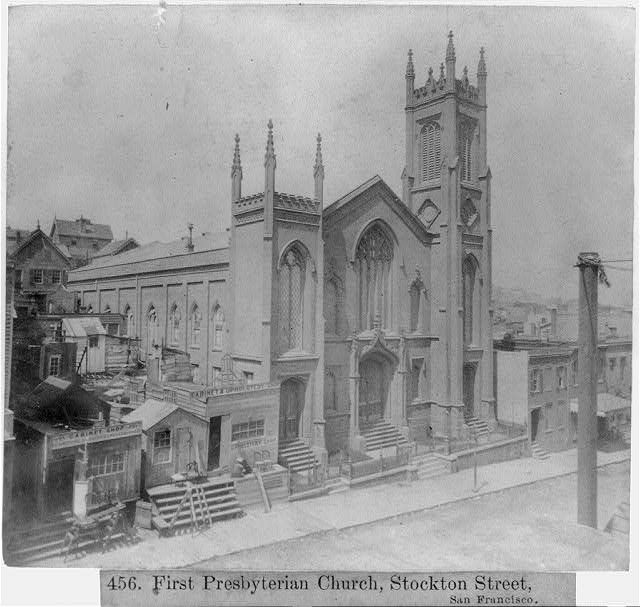
Found a picture of the church that burnt on pinterest through duckduckgo so no link.

4a6ef8472d10e1b7134980cb92a26918--william-waterhouse-picture-collection.jpg

A few things.
How did they manage to build it so close to those surrounding buildings without destroying them?
Was it actually an empty site then "squatters" moved in as the buildings on the left are little more than shacks or are they the builders buildings?
This doesn't explain the proximity of the building on the right nor the tall building at the rear left which completely blocks a window of the church.
Looks like stone but must be render over brick or wood, can't find a big enough picture to see more clearly.
What is that strange 'mini spire' on the roof of the small building to the right abutting the church?

Found just one other reference to this Albert Williams on a blog about Hawaii.
Seems Hawaiians were yet another 'nationality' knocking about in San Francisco and its hills.
The Reverend Albert WIlliams, founder of the First Presbyterian Church of San Francisco, and the Reverend Joseph Rowell discovered Kanui in 1861, living in San Francisco. The two ministers rescued him from a down-hill plunge his life was beginning to take after the $6,000 he had made in the mines was wiped out by a bank failure.

And thats it.
 
Note: This post was recovered from the Sh.org archive.
Username: KorbenDallas
Date: 2019-05-30 17:41:30
Reaction Score: 9
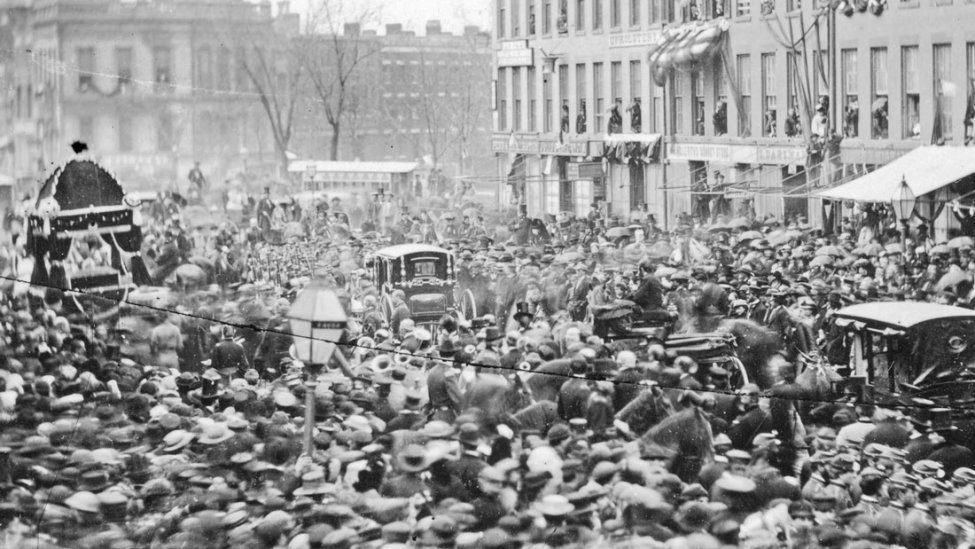
In reference to those "exposure" issues. Below is a photograph of the Lincoln's funeral activities. It was allegedly taken on April 27, 1865. This is approximately 13 years prior to the 1878 OP image of San Francisco.

While I have my doubts about the accuracy of the general time line, we have what we have. And in this case we have 1865. I'm pretty sure the crowd is not frozen still. In other words, when we have people, we can see them. When we don't have people we don't see them. Obviously with a lot of people, we see a lot, with jut a few individuals we see less.

Lincoln-Funeral-Cortege.jpg

I really start to like this guy.

 
Note: This post was recovered from the Sh.org archive.
Username: ISeenItFirst
Date: 2019-06-19 04:13:14
Reaction Score: 1
Never heard of vinegar as a fire protectant. I've heard of vinegar mixed with Alum as such, but I believe in this case it is the alum that works, the vinegar just acts as a vehicle for it. Vinegar and a base like baking soda will create CO2 that will put out a fire, but this doesn't seem like something that would work with blankets.

(I've owned a fire protection company, and still have a few antique fire protection devices around, so while I wouldn't call myself an expert, I do have some experience/research in this area)
 
Note: This post was recovered from the Sh.org archive.
Username: AnthroposRex
Date: 2019-07-09 13:39:21
Reaction Score: 0
That dome structure reminds me of the atrium in balboa Park in San Diego.
Botanical Building and Lily Pond | Balboa Park


It also could be a greenhouse or a covered walkway, I suppose.

"a photo" you say?

Looks to me like hand drawn art. Not unlike Gustav Dore but without the horizontal lines.
 
Note: This post was recovered from the Sh.org archive.
Username: JWW427
Date: 2019-08-23 22:41:25
Reaction Score: 1
Jon Levi's channel drilled down on SF.
It is rather odd the lack of people at high noon, which Levi was able to determine with pole shadows.
These photos, and many others of the period are so profoundly odd because of the lack of folks in the streets.
Could photography itself be much older than we are taught?
Could the TPTB be responsible for fake ones?
My mind is spinning....
JWW
 
Note: This post was recovered from the Sh.org archive.
Username: KorbenDallas
Date: 2019-09-21 08:01:48
Reaction Score: 1
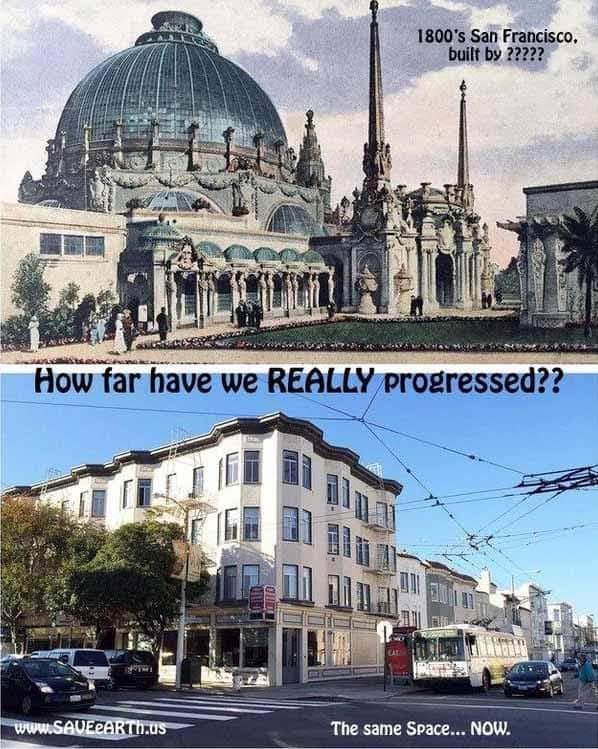
Just an image I stumbled upon...

SF_1800.jpg
 
Note: This post was recovered from the Sh.org archive.
Username: Dielectric
Date: 2019-09-21 10:23:12
Reaction Score: 1
Didn't they use dynamite also during these so called great fires to blow out fires and to create fire breaks? These so called fires have always been one of the most suspicious of all things in history in my opinion, and just think of the opportunities if you're controlling the militia and fire brigades. Boom~ oh so sorry we had to blow up the bank to try to save the city.

This thread and the sister thread...

Did anyone bring forward the Carrington event of September 1st 1859?
1878 San Francisco: abandoned and ready for re-population...

I read through the above thread as well.

Can this be a 30 year old city? One made without benefit of motorized machines? We are talking horse and mule power with wagons, picks, and shovels here. If we were very lucky there might have been two or three steam shovels in the whole county, maybe the whole State of California at the time. Cable operated steam shovels didn't even exist until the 1870's so that's out entirely. Only chain operated ones could be considered and as far as I know these were all operated from rail lines. Major dirt operations were more like massive slave operations than anything else. It's very hard to see a city of that size and level of development being accomplished in 30 years without a massive and skilled labor force.

Maybe there's more to CME's than we have been lead to believe? Maybe there was a disaster of mega proportions out west that had to be hidden. Maybe the Sun is capable of emiting some energies which could cause massive loss of life. It isn't that far out to consider.
 
Note: This post was recovered from the Sh.org archive.
Username: KorbenDallas
Date: 2019-10-12 23:34:05
Reaction Score: 1
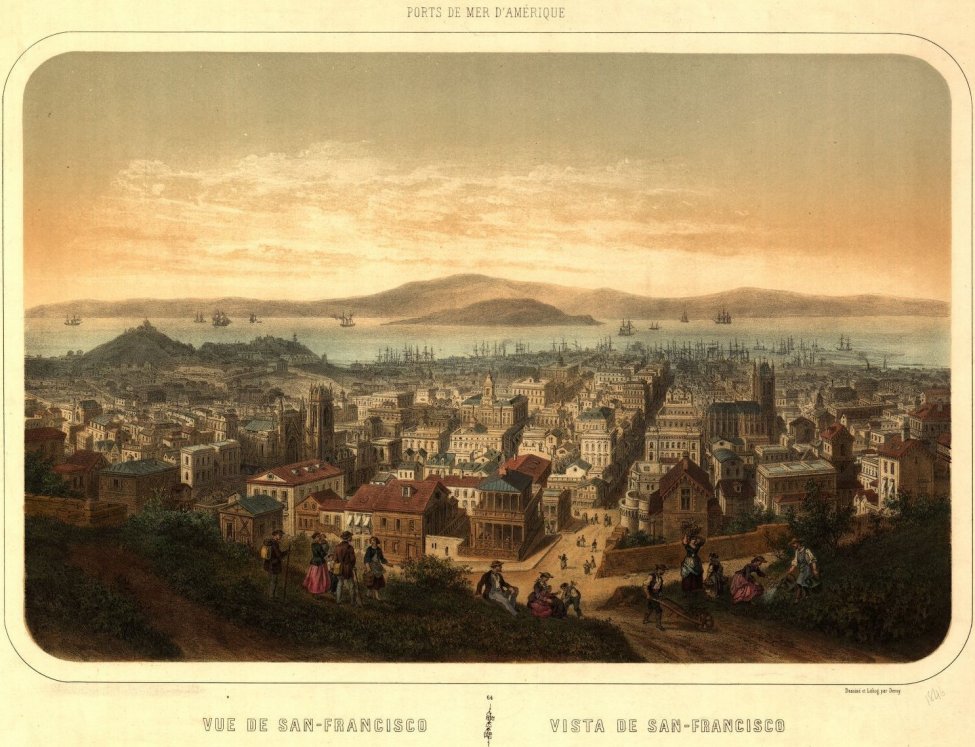
The below image was published in Paris : ca. 1860:
  • View of San Francisco, with people on hill in foreground.
  • KD: Nice buildings those "gold rushers" were able to erect.
SanFrancisco-1860s.jpg
 
Note: This post was recovered from the Sh.org archive.
Username: Starmonkey
Date: 2019-10-13 00:20:32
Reaction Score: 0
Nice!
I think Paris and other earlier FEEJ (fair exposition exhibition jubilee) sites are good places to dig. There were some old books from the fair with incredible drawings some abandoned mansion explorer found and I saw on eBay but can't remember what they're called.
Going back to old Europe for those albums would be best. They didn't have as much to hide. Already had a good story going for awhile. And they're a little older and closer to the beginning of the big push.
Post automatically merged:

I wondered how the few people that were around in these ghost cities survived whatever happened to everyone else. To take pictures.
"Oh! I just had my jasmine tea that day, as always!"
Seriously, what could the few poseurs and paparazzi think about these places? Are there no TESTIMONIES? No CONFESSIONS?
 
Note: This post was recovered from the Sh.org archive.
Username: Starmonkey
Date: 2019-10-13 15:23:18
Reaction Score: 0
Le Monde Illustre 1859.
Had to go back through several months of watch history on YT...
Sorry to jump rails and oceans to gay Paris, there.
Five minutes in.
 
DJ asked me to add a brief point form overview of the ideas in my video from a few months ago on these 2 San Francisco panoramas...

Video coming out of Jon Levi's where he looked at the 1878 panorama and saw some far off buildings.
I looked into what they might be and where they are located.
His buildings he pointed to were not the location of the 1915 Panama Exposition- which should have been much further to the right.
But it might be the site of the 1894 San Francisco Midwinter Fair, or part of the old fort area.

I found 2 different panoramas of San Francisco. The second is claimed to be from 1873 because it won a grand prize medal at that year's Vienna Exposition. Yet there are some, but not many, differences between the two panoramas, indicating they were taken within a year or two of each other. So why claim the second is from 1878?

Key points to consider between the two panoramas is differences such as the pile of rubble in the front of the early picture, cleaned up in the later one.

Parts of the panorama though appear as if they were painted in, especially the ships in the harbour.
Of course the strange Vanilla Sky appears in both, I will be coming to that in a future video.

In a few instances some laundry is laid out on a line close to the rubble, a pile of wood planks appear, and a horse and cart and a few people are there. Beyond that there is no other sign of life in the entire photo. that includes no horse poop on the streets, in fact, no hitching posts for horses, no chimney fires burning (which you would need to even boil potatoes).

I began to wonder if perhaps these are not really panorama photographs of a real city at all, but those of a model. And perhaps the closest to the viewer might be real photos which were later superimposed on the image of a model.

I ended by looking at a few of the odd labeled buildings in the older 1873 panorama


View: https://www.youtube.com/watch?v=lObD2CKQMdM
 
The second is claimed to be from 1873 because it won a grand prize medal at that year's Vienna Exposition.
That is not correct.
Edward Muybridges photographs did indeed win a Grand Prize Medal in Vienna but it wasn't a panorama that won.
From here Eadweard Muybridge : the Stanford years, 1872-1882 : Stanford University. Department of Art : Free Download, Borrow, and Streaming : Internet Archive

Page 8

Muybridge was equally thorough. After a successful career in San Francisco as a seller of imported books, he plunged into the profession of photography to become the most sought-after photographic artist on the West Coast. From his correspondence with such journals as The Philadelphia Photographer and Anthony's Bulletin, we learn that he followed closely advances in the technique of photography, and early contributed ideas that furthered progress in its practice. He was ambitious for preeminence: if the photographer Carleton E. Watkins could make 18 x 22 in. negatives of the Valley of the Yosemite in 1861, Muybridge would eventually go him better, in 1872, and take larger and more comprehensive views than had ever been made of it, or any other Western scenery, for that matter. For this work he won the gold medal for landscape at the Vienna Exposition of 1873, in a competition that included fifty photographers from all over the world.

And here Eadweard Muybridge Collections - Muybridge : Image & Context

Muybridge went on to make landscape photography within California a fundament of his early career. After Yosemite, Muybridge photographed the scenery of Geyser Springs, Alameda County and Menlo Park, as well as the rugged Farralon Islands. He then completed a second six month Yosemite project in 1872 - the resulting series of both large and small plates winning him the 'International Gold Medal for Landscape' at the Vienna Exhibition of 1873, and with it, fame overseas (Haas, p45).

As I said back up this thread there is an earlier panorama attributed to Edward Muybridge and that was taken in 1877.

Muybridge also created 2 large scale 360 degree panoramas of San Francisco in 1877-8 and spent several months documenting important military and governmental installations surrounding the city.
And here https://www.loc.gov/resource/ppmsca.23775/

As for signs of life in those panorama do read back over this thread. Lots of them are singled out for perusal.

The ships in the bay were painted in as they are out of scale with everything else.

As for the vanilla skies theory why then does the sea also become vanilla?
I have discovereed a probable reason why but am waiting on the opinion of someone more versed in glass plate photography to examine the evidence.
 
Last edited:
Tips
Tips
Please respect our Posting Rules.
Back
Top