Note: This post was recovered from the Sh.org archive.Username: jd755Date: 2019-03-04 22:04:38Reaction Score: 1
Then some things like this just leap off the screen and 'the Russian connection' gets reconfirmed.
New York Herald
New York City, New York
January 16, 1849
The city [Philadelphia] ice boat dragged nine vessels after her down the river this morning, including the brig Osceola, Captain Fairfowl, for California.
Kepheldt, Major General J., of Russian Army
So this chap is a lowest rank of general in the Imperial Russian army but still a general traveling seemingly alone on a United State brig, not steamship, heading to California in 1849 long after the Russian American Company sold Fort Ross to Sutter and everyone in it left in Russian American Company ships according to the articles I have read.
I suppose he could have been retired but given Popov sailed his clapped out little fleet to San Francisco during the civil war there appears to be somethng there that has a Russian connection.
A little more reading brings up these interesting little snippets.
From here
San Francisco History - 1853 Sketch
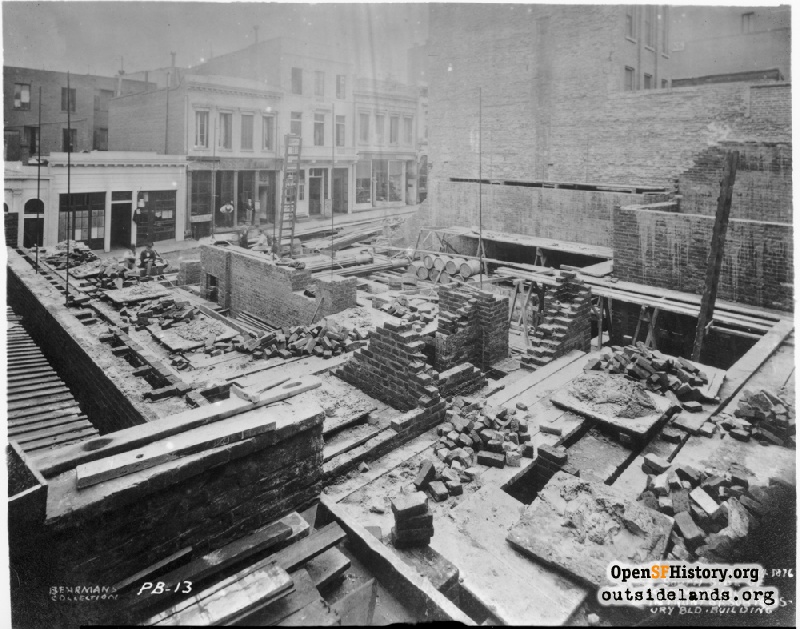
I had read a couple of weeks back that some ships sailed with bricks as ballast which is authenticated by these two buildings.
The first brick building was erected of Montgomery and Clay streets, by Mellus and Howard, in September, 1848.
This was the second brick building in upper California, one having been previously erected at Monterey.
At an election for Councilmen in October, 1848,
158 votes were polled; at an election in December, the number of votes was
347; and at an election held in August, the year following, the city was able to poll
1519 votes.
By February, 1849, the population had increased to two thousand. The duties collected at the Custom House for the four quarters of 1848, were as follows:—First Quarter, $11,931—Second Quarter, $8835—Third Quarter, $74,827—Fourth Quarter, $100,480.
It was computed that
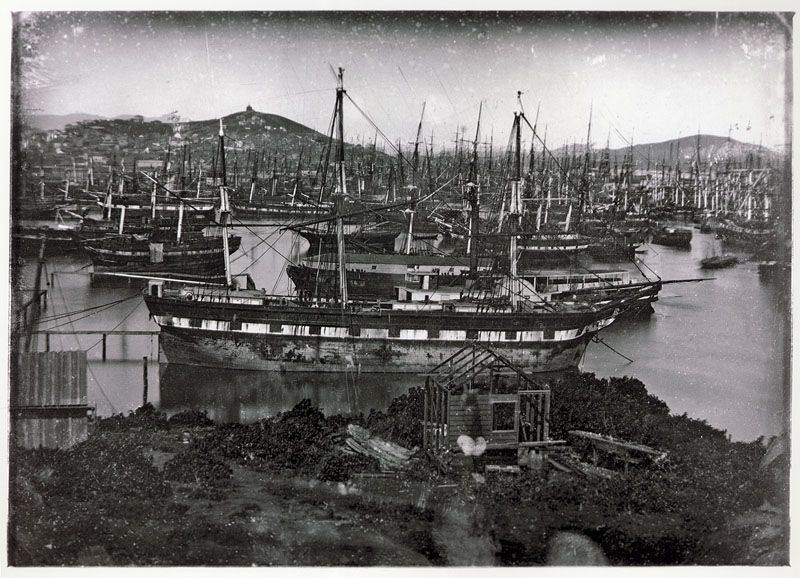
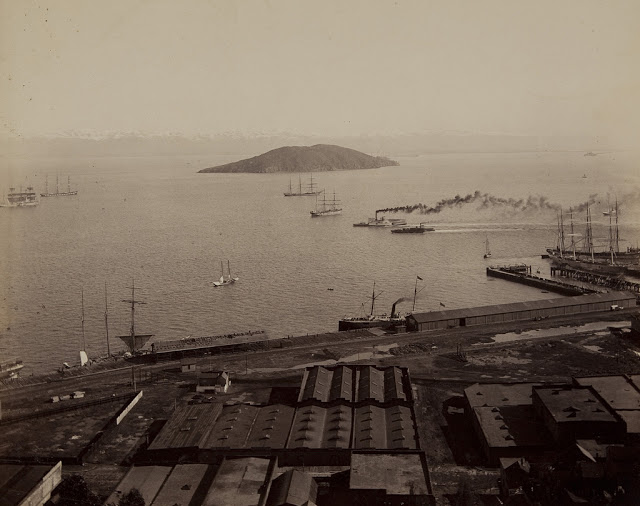
the number of immigrants in the country by the beginning of June of that year [1849] was fifteen thousand, of whom the larger portion had disembarked at this port. Sixty-four vessels were in the harbor.
In the month of July there arrived by sea 3614 souls. Some idea of this rapid march of the country in those times may be formed from the fact that
on a single day, the 1st of July, there arrived 17 vessels, with 889 passengers.
In August, 1849 The number of arrivals in the month was 3895, of whom 87 were females. In September the arrivals were 5802, including 122 females, and in October, 4000.
The Baptists built the first Protestant house of worship in California, and dedicated it on the 5th of August, 1849. It is the same building now used by them, standing in Washington street below Stockton.
In the year ending April 15, 1850, there arrived 62,000 passengers, 2000 of whom were females. The number of vessels conveying them was 695 American, and 418 foreign.
In the course of the year 1850, the principal streets were graded and laid with planks. Commercial street, from Montgomery to Kearny, was first completed. Anticipating another winter like the past, the preparation of the streets was hastened as the autumn advanced, and when the season for rain arrived, the chief thoroughfares were effectually covered with wood.
The winter, however, brought but little rain, and the fires of May and June following, destroyed a large portion of the costly expenditure, which had added largely to the debt of the city.
Hitherto nothing effectual had been accomplished to secure the city against the ravages of fire. But now the most vigorous efforts were set on foot,
consisting of the organization of fire companies, and the construction of wells and reservoirs. Many brick buildings were erected, and Montgomery street, from Washington to Sacramento, on the west side, was built up almost entirely with substantial brick structures, intended to be fire-proof.
In July, 1850, there were seven churches in the city, viz:
The First Baptist Church, Washington street, near Stockton; the First Congregational Church, corner of Jackson and Virginia streets; Trinity Episcopal Church, corner Jackson and Powell streets; Grace Church, corner Powell and Jackson streets; the Methodist Episcopal Church, Powell street near Washington; and the Catholic Church, Vallejo street, near Dupont.
Seems my hunch was right at least one temporary railway was used.
In the summer of 1851, the work of filling in the docks was carried on with great activity. The wharves had stretched out a great distance into the Bay, and hundreds of wooden buildings had been erected on piles in places lately occupied by shipping.
A steam excavator, better known as the "Steam Paddy," was set to work on the sand hills in Happy Valley, back of the Oriental Hotel, and the cars, laden with sand, ran on a railroad of descending grade along Battery street, depositing their freight from California to Clay street.
The first brick edifice constructed on the newly made soil was the American Theatre, in Sansome, south of Sacramento street. The sub-stratum on which the sand had been deposited, consisting of soft, yielding mud, many doubts were expressed as to the safety of the building. On the night of its opening, it was crowded with people, whose weight occasioned the walls to sink one or two inches. But as the building stood firm, encouragement was given to proceed, and
in a short time the foundations of many substantial brick storehouses were laid in the artificial soil. By the summer of 1852, the bay section of the city was studded over with storehouses of solid masonry, which would have done credit to any city in the world. At the same time, similar buildings were erected in other quarters, presenting effectual barriers against the recurrence of such conflagrations as those of May and June, 1851.
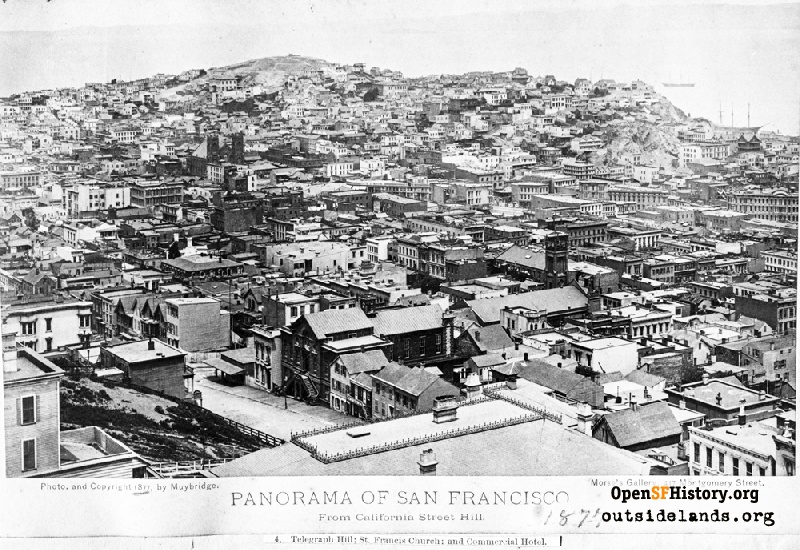
Meantime, Front and Davis streets had been laid out and partly built. California and Market streets were run out far beyond their intersections, the sand hills of Happy Valley were literally almost leveled and cast into the sea, and the rocky hills at Clark's point rent to pieces and subjected to the same fate. Foundries and workshops lined the bay shore to Rincon point,
the heights at the point began to exhibit spacious brick edifices, and the city was rapidly taking possession of other heights on the north and west. In fact, the year 1852 witnessed a greater progress in the substantial and permanent improvement of the city, than any other year
and the Irish connection I was on about above takes a suprising turn.
The Cable Car Home Page - When Steam Ran on the Streets of San Francisco II
Market Street, San Francisco’s main stem, was laid out in characteristic San Francisco fashion – without regard to topography.
Jasper O’Farrell, an Irish engineer who had migrated from Valparaiso, Chile, began surveying and mapping the city’s streets in 1846.
Underwater "paper blocks" were created, since some of O’Farrell’s streets went straight into San Francisco Bay! Others have grades of more than 20 per cent, and some grades too steep for any type of street vehicle.
Market Street of the late 1850s was far from being either broad (except on paper), magnificent or populated. Sand dunes obstructing the street towered as high as 60 feet above "street level." Stagnant pools of water occupied sites destined for commercial development.
The wind literally propelled real estate, consisting largely of sand, in all directions. On wet days Market Street was muddy. On dry days it was dusty.
The goal was to bring the land to market. The method would be a railway. Thomas Hayes, who owned a large tract in the Western Addition, now known as the "Hayes Valley" and the banking house of Pioche and Bayerque, who held Hayes’s mortgage, ultimately joined with several large property owners in the Mission, to form a business alliance to build a rail line connecting the main part of San Francisco with the old Mission settlement, a distance of three miles.
On May 3, 1859, grading began southwesterly along Market Street, beginning at 3rd Street. Grading was not as easy, as it would now appear. High sand hills often covered Market Street’s official grade. Scrub oak was laid as a thatch to help prevent sand engulfing the rails. A steam locomotive, built by Young and Stoddart, began moving, on December 28, 1859, cars loaded with sand from 3rd Street to lower Market Street. This date marked the beginning of the steam locomotive era for San Francisco.
During the construction period, the downtown streets next to Market Street were lowered, including the surrounding blocks. Once these projects were completed the "downtown" gained the level topography that it has today.
The roadbed was completed one month later, in late April, thanks largely to the use of a steam shovel (steam paddy). From 3rd and Market the line ran on Market to Valencia and then on Valencia to 16th Street.
A steam paddy
Steam-powered excavator, 19th century - Stock Image - C023/4029