SH Archive 1893: the destruction of the World's Columbian Exposition in Chicago

SH.org OP Username
CyborgNinja
SH.org OP Date
2018-04-28 05:09:39
SH.org Reaction Score
107
SH.org Reply Count
107

Archive

Old SH Archive
Joined
Sep 8, 2020
Messages
17,737
Reaction score
3,164
The World's Columbian Exposition was a world's fair held in Chicago in 1893 to celebrate the 400th anniversary of Christopher Columbus's arrival in the New World in 1492. Not to be confused with the "A Century of Progress International Exposition" 30 years later also known as the 1933 Chicago World's Fair. The 1893 Columbian exposition or Chicago World's Fair was a pivotal moment in the history of the United States. Chicago won the right to host the World's Fair over New York, Washington D.C., and St. Louis. During its six month run, nearly 27,000,000 people, roughly half the population of the United States at-that-time, attended the fair. Its numerous displays and exhibits established conventions for architecture, design, and decorative arts, in addition to initiating a new era of American industrial optimism.
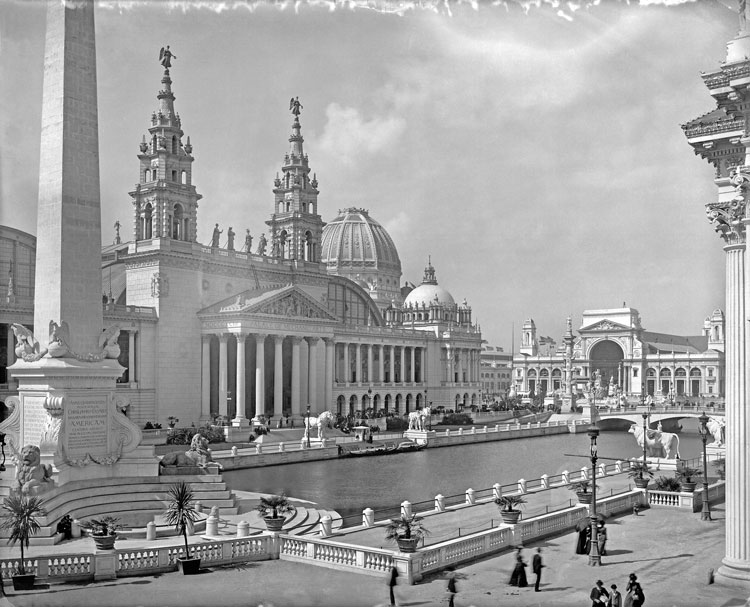
ChicagoExpo_10.jpg
Nicknamed "The White city".

Le architects
Daniel_Burnham_c1890.jpeg
Totally not a Freemason.
The layout and design of the fair, as seen here, is the work of Daniel Burnham (notable designs of his include the Masonic Temple Building. Burnham and his co-author Edward H. Bennett also prepared "The Plan of Chicago", which laid out plans for the future of the city and was an outgrowth of the City Beautiful movement. Intended to introduce beautification and monumental grandeur to cities.

Portrait_of_Frederick_Law_Olmsted.jpg
Also totally not a Freemason.
...And Frederick Law Olmsted, whose Olmstead Brothers firm was responsible for the landscaping of the George Washington Masonic National Memorial grounds among other American public parkland. Most of the fair was designed in the Beaux Arts tradition, a popular movement in Paris that was quickly gaining global momentum. In the years following the fair, this influential architectural style redefined the cityscape of Chicago, Boston, New York, and many other prominent American cities. Source.

Although many others came close, the World's Columbian Exposition of 1893 was the biggest Exposition to date (based on attendance, 25% of the US population at that time). This was sold as a show case of the world. Complete with cultural districts and human zoos. Visitor could marvel at the wonders of modern technology and during the evenings the buildings were rigged with brilliant light displays courtesy of Nikola Tesla himself.

ChicagoExpo_NightLights.jpg
"Chicago’s 1893 World’s Columbian Exposition was particularly successful — and famous — thanks in part to a staggering array of cultural and technological marvels which debuted there, including some of the first demonstrations of electrical power, the world’s first Ferris Wheel, and the first servings of the candied popcorn that would later be dubbed “Cracker Jacks.” Nearly all the halls and pavilions at the fair were temporary, but a handful of buildings still stand — although not all of them are still in Chicago." Atlasobscura.
  • Construction started: No Information. (Bidding ended 1890.)
  • Construction finished: No Information.
  • Total construction time: No Information. (3 years, Potentially)
  • Opening: May 1, 1893 (However Christopher Columbus' discovery of America anniversary was 1892.)
  • Closure: October 30, 1893
  • Total Expo operation time: 182 days (Days closed -No Information.)
  • Visitors: 27,300,000
  • Ticket Cost 1893\(2018): US$0.50\(US$13.18)
  • Cost of the project in 1893\(2018): US$28,000,000\(US$738,141,662.26 )
  • Profits 1893\(2018): US$29,000,000\($764,503,864.48)*
  • No. Buildings constructed: No Information.
  • Site of venue: Chicago, Jackson Park and Midway Plaisance. 690 acres (2.8 km2)
  • Demolished: No information
  • Remaining buildings: Four: 1) The Palace of Fine Arts is now the Museum of Science and Industry, 2) The World's Congress Auxiliary Building is now the Art Institute of Chicago, 3) The Norway pavilion is now in Blue Mound, Wisconsin and 4) The Maine Pavilion was moved to Poland Spring, Maine. In addition, one of the statues is in the center of a traffic circle in Chicago.
*(Conflicting reports confuse this issue. The fair paid all debts (US$28m) with an additional US$1m returned to subscribers, here. OR The fair paid all debts (not given) with US$1.5m returned to investors, here.)

ChicagoExpo_11.jpg
"Thank you for your visit, the city you are looking for is temporarily available."


ChicagoExpo_Map-1893.jpg

1893, Chicago, IL.

ChicagoExpo_Map_2018.png
2018.

Not so temporary after all.
ChicagoExpo_7.jpg

The above scene is of the Palace of fine arts. Below is an image of this building "under construction", Its crucial that we fully understand exactly what this construction was as there are images online of many of these fair buildings shrouded in scaffolding and clearly in some late stage of construction.

Palace of fine arts dome built.png
Seems legit.
I'll admit in the photo I've supplied clearly shows the building of the dome. You can find many photos of the roof being built. But that is it. Roofing renovations do not a complete scratch build make. The front of the facade is having some kind of overhaul but you can see those columns are already pre-existing. I believe this photo is some time after the Worlds Fair, after the demolition of the other lake side structures. The Palace of fine arts exists today, the official narrative of course is that they tore down the original before rebuilding it from stone at a later date. The face lift under way in this photo is perhaps the sanitizing of any cultural icons. Chiseling off priceless frescoes, that sort of thing.

Fineartsbuilding_Disrepair 2.jpg Fineartsbuilding_Disrepair.jpg
...Unlike the other "White City" buildings, it was constructed with a brick substructure under its plaster facade. Wikipedia. This one building was build from brick under the plaster facade? Why though? Aren't these pictures of it being built from the ground up?
These are photos of Washington D.C Capitol building, also a grecco-roman building being retro fitted with a dome. Note there are no existing photos of the ground floor being built.

Is it possible that this complex was a royal court and palace belonging to the true people of North America. The Tartars spoken of by Fomenko in his work 'how it was in reality.'?

ChicagoExpo_4.jpg
Exhibition hall seen in the background was largest building in North America at the time.

ChicagoExpo_5.jpg
Those are torches ablaze on that building. Open flame on a plaster structure hardly seems safe.

ChicagoExpo_2.jpeg
Why aren't there blueprints for this stuff?

ChicagoExpo_8.jpg
Plaster in water fountains? -And I thought the plaster and open flames was a bad idea.

It's too successful, smash it all to pieces!
After the event was over these sites were demolished. The temporary plaster 'staff' and wood explination created a plausible excuse for future generations to dismiss these buildings. Some things did survive, well sort of. The Statue of the Republic, aka the “Golden Lady,” is a one-third scale replica of a sculpture by Daniel Chester French that stood in front of the Court of Honor at the 1893 World’s Columbian Exposition. The 24-foot statue today stands in Jackson Park.

Statue_2.jpg
Muh lady. *tips tinfoil hat*.

The republic.png
Imagine if it was actually solid gold and they liquidated it.

We are supposed to believe this was built as a temporary attraction. The scene rivals anything you can find in Europe. But the idea of European cities in the new world doesn't fit the approved chronology.

This fountain piece was odd...

Facts-About-the-1893-Worlds-Fair.jpg

In Japan this is recognized as a dolphin and can be found at almost all historical castles. I can't help but see a similarity here. What do you think?

ChicagoExpo_Fountain_3.png Osaka_Castle_gargoyle.jpg
So many weird things are associated with this Fair, they had a serial killer on the loose, The White City was said to have inspired author L. Frank Baum to create the Emerald City in his book The Wizard of Oz even a few masonic numbers crop up.

the No.999..png
I can't imagine a project this large being so badly documented. I don't believe this but even if the entire fair ground was made in three years and it all happened exactly as were told it did, why has this never been repeated? Surely things get more efficient over time. If this was done in 3 years in 1893, I mean 25% of the country attended so Its definitely a good money maker! making something like this today should be common place. I just can't see how this was all done on a whim.
Note: This OP was recovered from the Sh.org archive.
 
Ever since I first read this archived post I’ve been curious about all of the retrofitting of domes onto these buildings. It makes me wonder if the original domes had some tech in them that needed to be hushed up...
 
I've searched this topic for a few months now. My questions about human logistics are absolutely unanswerable under the current official narratives. The "official" construction times are absurd, obviously, but the story about moving millions of humans through the exhibits in that amount of time is far beyond absurd.

27 million, 300 thousand people had to travel from somewhere in America. They needed to have someplace to sleep during the fair: hotels, or tents, rooms, the ground. A fair that size would not be a one day event you visit and leave before dark to go home. Disneyland can't even pull that off.

People would have needed to eat. Where did 27 million people have a meal while attending the fair? What about the logistics of bringing in and preparing food for that many people? (I've been an event planner, feeding 500 people one meal, which is a logistical feat in itself even with modern food delivery, freezers and refrigerators and with a full kitchen prep support staff).

Where did meat for 27 million people come from? Was there supposedly a slaughterhouse network near by where millions of animals were butchered to provide meat for fairgoers? What kind of septic system was in place to handle millions of gallons of animal blood, and where was it located? How was it possible for millions of pounds of meat to be transported via the unrefrigerated horse and buckboard technology of common trade in those days?

Also, if 27 million humans eat one meal, in one day, times the 180 day run of the fair, the excrement output alone for only one meal per day would require a sewage infrastructure of the magnitude of New York City, Los Angeles or Tokyo.

I don't find mention of either restaurants or any form of outhouses in any of the offical stories. Nor is there mention of where millions of travelers would park their horses while attending the fair, how the horses would be fed, and how excrement from millions of horses in the parking lot would be removed and treated.

For those fairgoers wealthy enough to actually own a vehicle and travel there in luxury from all over America (before there was a significant paved highway system), where did they park their cars?

Nowhere in any of the maps that I can see are parking lots for either horses or cars designated.

So many questions.
 
Last edited:
Amazing how often this happens!

But I just watched an episode of a new TV show which is researching whether American serial killer H.H. Holmes might also be Jack The Ripper since it seems he had a spell in London at same time. Anyway tonight's episode featured this 1893 Chicago World's Columbian Exposition as H.H. Holmes was supposedly living there during this time. They believe he could have been the serial killer during the event.
 
Why? I just read it. It reads like a story. A 500,000 foot overview of what it could possibly take to create a plan like this - not a plan itself.

To quote an old ad: "Where's the beef?"
 
Just found these quotes from the book interesting enough to post as a swan song.
There was first of all a strong and reliable corps of firemen, drilled up to the highest standard of efficiency, equipped with the best appliances, well distributed throughout the grounds, and with a force on duty by day and night. There were fire buckets by the thousand; there were Babcock extinguishers without number; chemical engines by the score, with hose lines reaching to the top of the tallest structure, and with a water supply of more than 64,000,000 gallons a day; there was a fire-boat in the grand canal, with powerful pumps and half a mile of hose, ready for instant service. Finally there was an excellent system of electric signals, with fire alarm boxes at all necessary points, and with menal ways ready and able to work them. With such precautions it is no wonder that the amount of insurance carried on the buildings during the construction period did not exceed two or three millions; but this was largely increased when the temples of industry were completed and filled with their precious contents
A feature of the Fair is the five acres of dining and refreshment rooms, for such is the floor space set apart for these important adjuncts. There are twenty-seven restaurants and cafes, with one hundred and fifteen dining-rooms, with tables set forth from kitchens as complete as those of a hotel, with seats for 8,000 persons, and with more than 1,000 waiters and cooks
There are in Chicago nearly 1,400 hotels of every size and grade, with spare room sufficient for at least 150,000 extra guests; this in addition to innumerable boarding and private houses where quarters may be had. Of restaurants and cafes there are also about 1,000, whose capabilities are almost unlimited. For a single hotel project nearly $200,000 was collected in small subscriptions paid in advance as room rent, before even ground had been broken
From the commencement of work on the grounds and buildings up to the middle of December 1892, John E. Owens, director of the medical bureau, reported 23 deaths, 2,092 cases requiring surgical treatment, and 1,703 needing medical treatment; but as to the surgical cases most of them were of slight injuries. Nevertheless the casualties were greater in proportion than those which have occurred on many an historic battle-field. The largest number of accidents occurred at the Manufactures building, where nine men lost their lives, most of them by falling from great heights. No spectators had been injured except at the dedication services, and that so many of the workmen suffered was due, as I have said to carelessness and inexperience, and not to any want of precaution.
By those who visited the grounds a few days before the opening could best be realized the magnitude of the now completed task. There was then at work an army of 40,000 or 50,000 men, under such discipline that all seemed to move with the precision of a military parade. Some were busied in cleaning the roads, in leveling roadways, and removing debris; others in gardening, and still others in finishing staff decorations or putting the final touches on buildings, with thousands of painters and carpenters at work and with many additional thousands passing to and fro, on errands, on business, or acting as escort to visitors. Most striking of all was the endless procession of wagons and drays, approaching the grounds from several directions in lines a quarter of a mile in length; then, under the direction of the Columbian guards, falling into other lines already within the park, and proceeding on their way with loads of materials and exhibits. In the opposite direction passed a similar line of empty vehicles, returning for new loads to the railroad depots. Inside the buildings a second army was at work, unpacking and installing exhibits, some by hand and some that must be lifted by derricks and wheeled on cars into place.
The Argentine republics were each represented by a single vessel, and in the entire fleet there were few bctter models of naval architecture than the German cruiser Kaiscrin Augusta, which, with her consort and the American ship Miantonoiuoh, formed the rear of the larboard division
In preparing the collection of mammalia skilled workmen were employed for nearly two years under the direction of William Palmer, taxidermist of the National museum, each specimen being mounted in its natural attitude, from sketches and photographs taken from life.
There is also a remarkably fine specimen of the manatee, a species rapidly becoming extinct, and a sea elephant, such as were formerly common along the California seaboard.
Of oils there is a remarkable collection, including those extracted from the nose of the pilot-whale and the forelegs of the crocodile, the latter valued as a leather dressing. Here one may compare with olive oil for table use that which, prepared from the fat of the guacharo, serves as a palatable substitute to the native of Equador. Here also are oils made from the entrails of the eel and the fat that underlies the upper shell of the turtle, the former recommended as a specific for deafness, the latter for rheumatism. Still another is the golden colored oil used for water-proof coverings and obtained from a Central American insect, which yields more than half its weight of the grease from which the oil is manufactured.
One of the most interesting exhibits is a mammoth terrestrial globe, probably the largest in existence, and yet with all the accuracy of delineation that science and mechanism can bestow. The globe is 63 feet in circumference, 20 in diameter, 1250 in superficial area, and mounted as it is on a star-shaped structure which serves as pedestal, 15 feet above the floor, over-tops the surrounding exhibits. On its face oceans and continents are reproduced on a scale of one and three-quarter inches to a degree, measured at the equator. The boundaries of all the countries of earth, their surfaces and subdivisions, the sites of the larger cities, the limits of ocean and of inland seas, and the courses of rivers and streams are portrayed in skilfully shaded colors and with singular fidelity. Parallels and meridians are also indicated, with zone and isothermal lines, with the principal steamship lines, and with the course of the great discoverer clearly traced, on the first of his New World voyages.
At the lower axis, within the antarctic zone, where there is nothing to be depicted save for the shadowy outlines of Graham's land, is the apparatus for turning the globe Concealed under a huge design representing the seal of the land office. Through an ingenious device the interior may be lighted by electricity, giving to the outer surface a novel and pleasing effect.
Finally should be mentioned in connection with the department of the Interior, its Alaskan exhibit housed in the northern gallery of the Government building, one fully illustrating the resources of that much abused territory, and more than justifying the well-known remark that Seward made, some few years after its purchase. "What, Mr Seward," asked one of his admirers, "do you consider the crowning act of your political career?" "The purchase of Alaska," he replied, "but it will take the people a generation to find it out." And now that a generation has well-nigh passed away, the people are beginning to realize her natural wealth, not only in land and pelagic peltry, but in fisheries, forests, and mines, the first making good the decreasing output of the Columbia river canneries, the second with timber of many varieties and in unlimited supply, the third containing, in addition to valuable placers, gold-bearing quartz-veins, which may yet go far to reestablish the equilibrium in the value of the precious metals.
The California redwood from which was cut the section in the central rotunda of the Government building was 300 feet high and 81 feet in circumference. To cut and forward this exhibit in a number of subdivisions, on eleven railroad cars, cost, with the work of putting it together, more than $10,000. It was named the General Noble, after the late secretary of the interior.
Says the manager of the State department, G. Hunt, to whom I am indebted for a valuable dictation thereon: "Among the purposes of its exhibits was to popularize itself, especially by laying stress on its possession of the earlier records of the formation of our government, comparatively few of which have ever been printed. That people may see for themselves they have never been printed was indeed one of the objects of their exposition."
Those who stop to admire the gigantic section of the tree which stands under the dome of the Government building may be interested in knowing that it once grew in the edge of Converse basin, beyond the General Grant National park, California. It once stood, says a witness to its destruction, among a goodly company of quaint red-woods, interspersed with firs and pines of every variety, six thousand feet above the sea. Among the crew of those who felled it were men from Missouri, Maine, Virginia, Iowa, and Scotland. It had been agreed between the government and the contractor that no nail should mar its bark, and a swinging platform was also erected around it. The tree was cut fifty feet from the ground, measuring at this height seventeen and a half feet. From this huge stump thirty feet were taken for the Fair, all the interior sections being removed except a small thickness and the bark. The falling of the tree, which was two hundred and eighty-five feet in height, was witnessed by over one hundred people from the mills and adjoining camps, the event being thus described:
"The saw was withdrawn, the last wedge driven. The immense tree quivered like one in agony, and with a crushing, raging, deafening sound it fell, the extreme top, with its branches, falling upon an opposite hill and breaking into a million pieces. The larger part split as it fell at the base of the fifty-foot stump, and lay like the hulk of a monster ship — the weight of that part being estimated at over 200 tons."

Chapter the Eighth. — Manufactories of the United States.

To say that this is the largest building ever erected for exposition purposes; that it is 1,687 feet in length and 787 in breadth; that from the floor to the ridge of the roof is 236 feet; that it has more than 40 acres of exhibiting space; that through it extend longitudinally and laterally two avenues 50 feet in width; that it has thirty main stairways, each 12 feet wide; that around it and within it is a gallery 50 feet wide, with smaller galleries innumerable, from which may be viewed almost at a glance its rich and varied display — all this would not enable the reader to form an adequate conception of the monumental edifice in which are housed many thousands of exhibits, representing the industrial and liberal arts of the civilized nations of earth.
With this huge palace of industry no point of comparison can be taken, for nothing of the kind exists. Nor does it help us to know that, in its construction there were used 1,260 carloads or 16,500,000 feet of lumber, nearly 200 tons of nails, several thousand tons of iron and steel, and 60 tons of paint; that the sky-lights alone cover a space of eleven acres, and consumed 65 carloads of glass, with eleven additional carloads for the 900 large windows which the building contains.
Perhaps of its dimensions no better idea can be given than to state that on its site could be erected about 500 residences, each with a lot of 25 by 100 feet, capable of accommodating in all at least 5,000 persons, and that with far less crowding than is felt in the more crowded portions of Chicago.
In the construction and placing of the arched steel trusses which uphold the vast semicircular roof of the main hall, unsupported by a single column, was accomplished one of the greatest engineering feats of the age. There are twenty in all, apart from those at the ends and corners, with a total weight of 6,500 tons, each fourteen feet wide at the floor, ten at the apex, and with a span from base to base of 732 feet.
To handle these huge girders a special appliance was contrived in the shape of an immense traveller or derrick, which was even more of a marvel than the girders themselves. This was probably the largest machine of the kind ever constructed, 300 feet long by 50 in width, with a central height identical with that of the roof, and with arms or extensions, 70 feet in length. Thus the workmen were enabled to place the girders in position, the derrick running the entire length of the building, on a track supported by piles, with six carriages, each with as many sets of wheels. No wonder that this feat called forth the admiration of European engineers, that it was the subject of universal comment among the scientists and scientific journals of the world, by most of whom failure had been predicted.
The central hall itself, with its clear story windows and its roof of iron and glass, is a structure nearly twelve acres in extent, compassed by a spacious system of naves and aisles and galleries, the first more than a hundred feet in width.
During the eighteen months or less that the building was in process of construction, beginning with August, 1891, from 500 to 700 men were employed; nor was there at any time the slightest difficulty in procuring either labor or material, notwithstanding the hazard and dimensions of the work.
The preparation of the site was of itself a labor of no ordinary magnitude. In some parts it was merely a swamp; in others a sand-dune. Into the marsh there were driven 3,500 piles to a depth of 35 feet, and in the sandy portion eight or ten feet of soil must be cleared away before a foundation was reached. Elsewhere was made what is termed in builders' phrase a spread foundation, formed by digging large square holes and filling them with heavy timbers laid cross-wise to the surface. Thus only could be secured the solid base on which is reared this temple of industry and art. In the construction of this edifice were presented new problems not only in mechanical engineering but in architectural treatment; and first of all how to extend along the lake shore the wall of a structure more than two furlongs and a half in length, without dwarfing the adjacent buildings and impairing the landscape effect of the grounds.
 
Just found these quotes from the book interesting enough to post as a swan song.

You're leaving without even watching the video I posted showing the two remaining Chicago world's fair buildings which are apparently made of stone?

After I spent dozens of hours of my time trawling through nonsense on the internet to find it?
 
You're leaving without even watching the video I posted showing the two remaining Chicago world's fair buildings which are apparently made of stone?

After I spent dozens of hours of my time trawling through nonsense on the internet to find it?

To add fuel to these flames, I have personally visited a standing stone and marble structure still standing from the Buffalo expo.

1901: Pan Am Buffalo and why these Pan Ams were as insane as they look

There is actually a surprising amount of permanent remnants from the world's fairs in America. I can speak to Buffalo, but there are also remnants in St Louis and as you mentioned Chicago. I'm sure there are more elsewhere but I have not had a chance to dive into that particular topic.
 
Seen as how wandering off topic is the fashion these days, within certain undefined limits, here is what anotherlayer a member who lives in Buffalo within the grounds of the Buffalo expo, if memory serves, has to say.

Oh, this old grimy thread :) We built the Pan Am with our hands and our horses. I will still get the same question "oh, are you sure those construction photos are not deconstruction photos?". The answer is, yes, I am sure. I did the simple work of hitting up the Buffalo Historical Society and I poured through a few boxes of meticulously labeled photos from construction day 1 to deconstruction day 365.

The Pan Am Buffalo was built by us. There are plenty of old world examples that still survive all throughout the city. If there was an effort to cover anything up, they would have taken down the old Post Office and the old City Hall.

There were no buried buildings. It was the last remaining chunk of farmland in the midst of a very burgeoning city. It was not located in a hidden area, it was surrounded by beautifully new built houses as the city extended itself. By 1901, Buffalo had the most millionaires per capita. I own a building where I have actual newspaper classified ads from the original owner (building was his old blacksmith/stable built behind his house, 1889). He was renting bedrooms and promised a pleasant 15 minute ride to the Expo in his personal carriages. I have a presentation (actually up on youtube, but it's horrible) that lays out his emigrating to the US in 1850. As a local house history researcher, I went very deep with it. All the years, all the stories, all the newspaper clippings, all the military records, all the business listings, all the cemetary plots, the meeting with the great grandson of this man who was in fact named after him... 1901 is 1901. Buffalo was the exact city it is today. We didn't have the money to tear down all the Tartarian buildings, so you can squint on a good day downtown and see a bit of the past. Shorpy Buffalo isn't too far off the mark.

Anyway, there was no magical Atlantis under the ground. There were no hidden canals that went no where but around and around and around. It's a fantasy world where we absolutely had the wherewithal to pull it off.

The only thought I can hang on to is that the dating is flat out skewed. Somehow this 1901 maybe was 1801 and we've smashed years in again. And something very unbelievable happened to shift our reality within the last 150 years.

1901: Pan Am Buffalo and why these Pan Ams were as insane as they look

But there's no plans so he might be making shit up.
 
Now might be a good time to share this story -
I believe I saw the remains of one of the Tartarian buildings in San Francisco 20-odd years ago. Obviously I had no idea at the time.

I was visiting my sister in SF with my parents and we decided to take a drive up the coast. We drove a long way. We stopped somewhere and there was a breakwater stretching out into the sea. Huge huge rocks just piled up in a line heading directly out from the shore.

As I looked at it, I realised that every block in it was cut to an accurate rectangular shape. I wondered why anyone would bother cutting stones like that to just chuck them in the sea.

I couldn't take my eyes off it. The stone was absolutely gorgeous, I couldn't decide if it was granite or marble. It seemed to have an opalescent sheen to it. I remember thinking 'Who in their right mind would make a breakwater out of such gorgeous stone?'

The rest of my family wanted to move on but I insisted on just standing and staring at it for a good half hour or more. There were L-shaped sections in it.

I have considered going onto google earth and searching for this, but that would take a lot of time.

In fact I have a lot to contribute to this discussion but in order to make posts that meet the standards you require takes a lot of time.

For example Jon Levi posted a video describing the demolition of a 'Tartarian' hotel somewhere in the USA. He went over all the newspaper reports and so on in detail. The key details I remember are that the entire thing was constructed of interlocking granite blocks which were as big as nine feet at the bottom, tapering to five feet at the top. It took months and months to knock it down.

I think he said there were L-shaped sections in it. I was intending to find this video, watch it again carefully, then post it as a rebuttal to your new thread about the stone splitting technique. I'm assuming the stone splitting technique only works for square blocks, not for L-shaped ones? However that would take time, and I have a lot of other things to do first. For example I am an experienced electrical engineer and I found a video talking about Maxwells missing equations which explains how Tesla's free energy technology worked. I intend to spend a few hours watching that again, making notes, then uploading it to its own thread with a summary and video bookmarks for all the most interesting sections.

And my wife's just entering a critical stage of a long running legal battle so that will be my main priority for the next few weeks.

If you find this forum is getting overwhelming, just take a break. What I do is ask my wife to hide the wifi router to help me limit the amount of time I spend online.

All best wishes :)
 
If you find this forum is getting overwhelming,
Not sure that advice is meant for me but assuming it is be assured I'm fine. Cannot say the same for the direction this forum is taking. Science, "real" and "fake" is to the fore and its not my bag.

Found this book today. The Century World's Fair Book for Boys and Girls, by Tudor Storrs Jenks—A Project Gutenberg eBook

And these images I hadn't seen before.
i_016.jpg
THE FOUNDATION OF THE MANUFACTURES

i_015.jpg
AND LIBERAL ARTS BUILDING

i_021.jpg
THE “COURT OF HONOR” AS IT LOOKED IN JUNE, 1892

i_017.jpg
A WILDERNESS OF IRON.—BUILDING MACHINERY HALL

i_195.jpg
THE BIG TREE: GOVERNMENT BUILDING.
Edit to add;
I was visiting my sister in SF with my parents and we decided to take a drive up the coast. We drove a long way. We stopped somewhere and there was a breakwater stretching out into the sea. Huge huge rocks just piled up in a line heading directly out from the shore.
Its in the archive somewhere if memory serves, the rubble from the earthquake was in part used to build breakwaters.
This PDF may be of use in that regard.
http://www.robertbardell.com/wp-content/uploads/2014/12/Where-the-Rubble-Went.pdf

All initial stone splitting produces regular shapes of rectangles or squares. Subsequent shaping is done as a secondary process be it by machine or by hand.

Neither of these replies is remotely related to the op but on balance its the only place I can put them, sorry 'bout that.
 
Last edited:
The reality we face is the uncertain authenticity of pictures. They say pictures are worth a thousand words, but they can easily be used to reinforce, distort, or bring about an entirely different perception.

We can all find many examples of how pictures can suddenly be contrived, manipulated, or deleted to back up any point. This is not referring to any sort of grand conspiracy. It is a simple fact of life that you can even dictate what people look for in a photo and what to ignore by framing their perceptions before they even see it.

That is the hardest part for all of us. What you see may not be reality or hardline truth. It may be an illusion of a representation designed to sway your mind a certain direction. I genuinely believed initially that two starships were really battling in the Mutara Nebula and could travel faster than light when I was kid.

The most important thing is to keep your mind fluid to all possibilities. Yes, we could be living in a bizarre nexus of many realities where two totally conflicting bases of reality can coexist. The focus always seems to be to compel us to stop searching and stop asking questions whatever the truth could be.
 
Not sure that advice is meant for me but assuming it is be assured I'm fine. Cannot say the same for the direction this forum is taking. Science, "real" and "fake" is to the fore and its not my bag.

Found this book today. The Century World's Fair Book for Boys and Girls, by Tudor Storrs Jenks—A Project Gutenberg eBook
So, a children's book. Ok, let's take a look.
And these images I hadn't seen before.
Why did they always use the worst possible cameras of the day?
THE FOUNDATION OF THE MANUFACTURES

AND LIBERAL ARTS BUILDING​

So, let me get this straight -- The Columbian Exposition went from this:

THE “COURT OF HONOR” AS IT LOOKED IN JUNE, 1892​

--- to this in 11 Months?

chicagoexpo_10.jpg


I think they called this book a children's book because you need the imagination of a child to believe this narrative. I do appreciate that that only take 'construction photos' when the entire crew is on a break. I wonder how often they took breaks? I mean, they only have 11 months to build a 680 acre fairground. This is *over 1 square mile* of building area.
 
Why did they always use the worst possible cameras of the day?
I do agree with you, many images in this book are in poor quality, many of them manipulated and made to look old with some grainy effects. Plenty of others are straight out cut offs or more wide photos and high quality photos that circulate the web, they took the worse photos they could get their hands on in order to make the fair look really something old. Many of the main buildings have not been shown and those who do, are converted into drawings from original photos.
And what's up with all those drawings of Chinese and other South China Sea people? Were they going for some kind of narrative there?

I can't say much about the construction photos. They look real but there's only a handful of them. It should have been more thinking of this logically. It's a book about how the Columbian Exposition was made. And of course, the author sneaked a drawing of Christophor Columbus among the pages, as a reminder of that story, just in case someone forgets it.

The suspicious thing to me is exactly the fact that this book is made for children, it's fun enough to be read by boys and girls and in the same time indoctrinates them on how the story of fair really went according to the author's view.

The most suspicions to me is the author himself Tudor Storrs Jenks. He made the book in New York, 1893 which is digitized in the Library of Congress from where it is republished and distributed for free by the Project Gutenberg Release Date: June 5, 2019. Alternative theories about World's Fairs started to proliferate around 2017/2018 If I remember correctly. So a year later or so this book gets republished as a reminder of what really went on more than a Century ago in Chicago.
How convenient.

But let's quote something from the CV of Mr. Tudor Jenks

TudorJenks_proc.jpg
Tudor Storrs Jenks (May 7, 1857 - February 11, 1922)[1] was an American poet, prose author, artist and editor, as well as a journalist and lawyer. He is chiefly remembered for the popular works of fiction and non-fiction he wrote for children and general readers.

Education​

Jenks graduated from Brooklyn Polytechnic Institute in 1874, Yale University in 1878, and Columbia Law School in 1880. He studied art in Paris in the winter of 1880-1881. Among his classmates at Yale were William Howard Taft, afterwards president of the United States, and Arthur Twining Hadley, later president of the university. During his attendance there he became a member of Skull and Bones and Delta Kappa Epsilon.[2]

I find the fact of him being a member of "Skull and Bones" really telling of his duty towards his brotherhood. But of course, anyone could discard this fact as "conspiracy theory" easily.

Either this book's photos were heavily at the time of first publishing in 1893, or when it was digitized at the Library of Congress, for which I couldn't find a date.

The moment someone starts digging a bit for the established narrative, odd things start to emerge into light.
Here's a link from the archive.org

The Century World's fair book for boys and girls : being the adventures of Harry and Philip with their tutor Mr. Douglass at the World's Columbian exposition
 
Last edited:
The book seems very strange to me. The photos (which in themselves don't seem right ) are of no relevance to the story. A kids story starts then page 2 , boom ,construction photo & similarly spaced right through
Screenshot_20230222_121337_Brave.jpg
Screenshot_20230222_121344_Brave.jpg
 
Last edited:
This PDF attached is fanbloodytastic especially for the anecdotal stuff about the times it was produced in and facts about the fair.

Here' a brief flavour.


Material and Methods In Exposition Sculpture.—As a rule, the figures and bas-reliefs were made from models one-fifth their present size. Sometimes the model was made of wood, and the plaster or staff was worked upon the figure until it was brought to the formation desired. Many of the heroic figures are done in actual staff. It is not too much to say that hundreds of thousands of people have availed themselves of the invaluable lessons which the building of this exposition, in all its parts, afforded, and have gained thereby liberal educations in art.

Interesting Machines.—Among the numerous carving and moulding machines, one carves from wood intricate designs and statuettes in groups. A machine exhibited by C. J. Goehring, of Alleghany City, Pa., turns out four or five groups of wood statuary in the space of a few minutes. In ancient times the labor was performed by hand and months were spent on a single group.

A great variety of machines for geometrical moldings, vised in the manufacture of furniture and house decoration, is seen. These ingenious devices have been on the market for only two or three years, and some have recently been sold in Europe for $25,000 each.

Immense exhibits of machine tools are made by the Pond Machine Tool Works, William Soellers & Co., Niles Tool Works and many others. Another machine for the manufacture of tags and labels takes the paper from the roll, cuts the tags, prints the labels, punches the eyelets, and then inserts the wire for fastening.

Another makes the different sizes of nails from wire. In 1876 the wire-nail industry was unknown in this country, though four or five crude machines were shown at the Centennial by French exhibitors. These were purchased by Americans, and since 1876 the manufacture of wire nails has become general all over the United States,

MANUFACTURES AND LIBERAL ARTS BUILDING. The greatest structure on the Exposition grounds and the largest building of the kind ever erected, its length being 1,687 i^et, and its width 787 feet. Its cost was $1,500,000.
It is as notable for the symmetry of its proportions as for its immense size. The floor alone consumed over 3,000,000 feet of lumber, and five carloads of nails.
To say that this giant structure contains forty-four acres of floor space gives but a faint idea of its immensity.
One thousand cottages, each 25 by 50 feet, could find room within its walls.
The height of the wall is 66 feet; of the four central pavilions, 132 feet; of . the four corner pavilions, 97 feet; of the roof over central hail, 245.6 feet; of the roof truss over central hall, 202.9 Height clear from the floor, 202.9 feet.
The span of truss is 382 feet. Span in the clear, 354 feet. The width of truss at base is 14 feet; at hip, 32 feet; at apex, 10 feet. The weight of truss is 300,000 pounds; with purlines, 400,000 pounds. There are 12,000,000 pounds of steel in the trusses of central hall, and 2,000,000 pounds of iron in the roof of the nave.

The exterior of the building is covered with staff treated to represent marble. The huge fluted columns and the immense arches are built of this beautiful material.

Construction of the Builing.—In the heaviest timber was required. There are 27 main trusses. To handle these, a "traveler" was constructed' on the matn floor of the building, 50 by 260 feet and 120 feet high, on top of which was raised a central tower 135 feet high, making the total height of this great lifting device 255 feet; it weighed 20,000 pounds, and over half a million feet of lumber were used in its construction. The floor of the building would not, of course, bear this great weight, and the "traveler" moved on a track specially prepared for it.

It cost the Exposition management $198,000 for the carpentry work necessary to make some changes from the first plans. As originally designed, the building had at either end an open court of four acres each. It was found advisable, in order to provide more room, to roof these courts over. Fift}' tons of paint and 30,000 panes of glass were consumed in the structure.

Considered from the standpoint of the amount of capital invested, it overshadows every other. The railroads of to-day are worth from $35,000,000,000 to $30,000,000,000. This probably represents one-tenth of the total wealth of civilized nations, and one-quarter, if not one-third, of their invested capital. The world's whole stock of money of every kind—gold, silver and paper—would purchase but a third of its railroads. If to the railroads be added transportation by water and all means of convej'ance on common roads, the magnitude of the interests represented in this department of the Exposition may be fairly estimated.

For the first time in the history of International Expositions, Great Biitain and all her colonies are generously represented.

The Vatican has taken much interest in the Exposition, and this is the first International Exposition in which it is represented
. Many of the treasures of the Vatican library and museum are here. One is a paper of 1448, containing a reference to the " Northern Land," or what half a century later proved to be the American continent. Another is a bull of Alexander VI, dated at Rome, 3rd of May, 1493, granting to King Don Fernando and Queen Donna Isabel, in regard to the West Indies discovered and to be discovered, the same privileges which had been granted the King of Portugal in respect to the western coast of Africa. Many other invaluable papers of a like character are shown.
 

Attachments

  • Official Guide to the Worlds Columbian Exposition, Full Information Respecting All Features of...pdf
    14.4 MB · Views: 215
Last edited:
Three more of the renovation. From the bldg.51 archive.
348940746_1295234544684557_1947189491263492397_n.jpg
347394706_3501133173505343_8577441841725061997_n-scaled.jpg
348631926_145580661843972_3749181245957185310_n.jpg
 
Tips
Tips
Please respect our Posting Rules.
Back
Top