Archive
Old SH Archive
- Joined
- Sep 8, 2020
- Messages
- 17,737
- Reaction score
- 3,168
All over the world the people began to rebuild, there was an understanding that there had once been a great civilization before this flood but what exactly had been lost was unknown and the people did the best they could, however in many places the people were confused and remembered nothing. In these places there was great suffering, cannibalism was commonly practiced and the people were profoundly desperate.
One such place was what is today modern day India, the people there remembered much and the practice of Buddhism was known by many. However the teachings were incomplete and the priesthood confused as to the original message. Then one day a man came from from the ocean. He landed on the southern coast of India. A lone traveler, he was said to be very old.
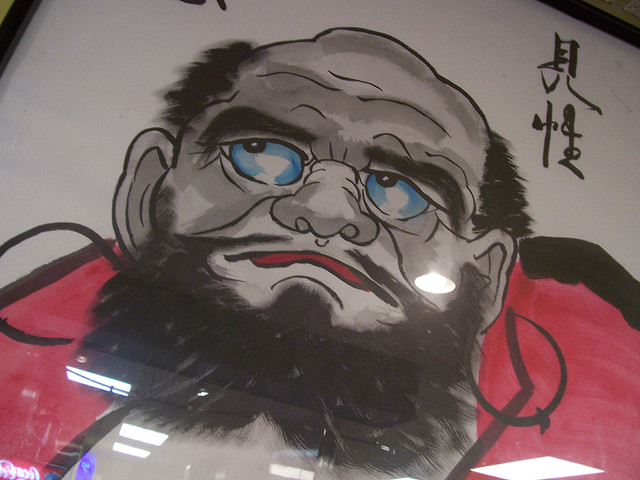
This man was described as being very strange in appearance, his features were unique to him alone and shared by no other person in this region. The man was bald with a long red beard and full mustache. His eyes were said to be as blue as the sky and his nose, quite pronounced. These traits were not shared by any of the local people and he spoke their language although crudely at first. This was truly evidence to the people that he was from else where. A stranger in a strange land who brought with him the teachings of what he called "the way" or "the knowing."


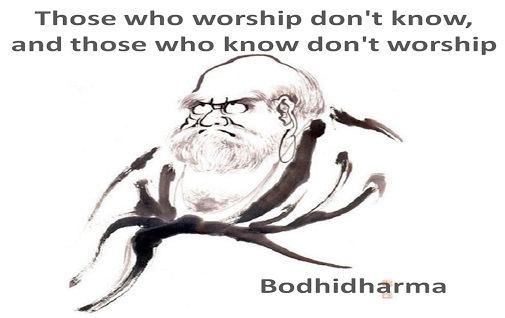
Depictions of Bhodidharma.
Although his true name is lost to the ages, he was known by the people of India as "Bodhidharma" and later in China and Japan as "Daruma". But who was Bodi-hi-Dhar-ma the "blue eyed devil" often depicted with a red beard, and what was his message to the people of these lands?
-Wikipedia.Bodhidharma was a Buddhist monk who lived during the 5th or 6th century. He is traditionally credited as the transmitter of Chan Buddhism to China, and regarded as its first Chinese patriarch. According to Chinese legend, he also began the physical training of the monks of Shaolin Monastery that led to the creation of Shaolin kungfu. In Japan, he is known as Daruma.
Little contemporary biographical information on Bodhidharma is extant, and subsequent accounts became layered with legend.
According to the principal Chinese sources, Bodhidharma came from the Western Regions, which refers to Central Asia but may also include the Indian subcontinent, and was either a "Persian Central Asian"or a "South Indian [...] the third son of a great Indian king." Throughout Buddhist art, Bodhidharma is depicted as an ill-tempered, profusely-bearded, wide-eyed non-Chinese person. He is referred as "The Blue-Eyed Barbarian" (Chinese: 碧眼胡; pinyin: Bìyǎnhú) in Chan texts.
Aside from the Chinese accounts, several popular traditions also exist regarding Bodhidharma's origins.
The accounts also differ on the date of his arrival, with one early account claiming that he arrived during the Liu Song dynasty (420–479) and later accounts dating his arrival to the Liang dynasty (502–557). Bodhidharma was primarily active in the territory of the Northern Wei (386-634). Modern scholarship dates him to about the early 5th century.
Bodhidharma's teachings and practice centered on meditation and the Laṅkāvatāra Sūtra. The Anthology of the Patriarchal Hall (952) identifies Bodhidharma as the 28th Patriarch of Buddhism in an uninterrupted line that extends all the way back to the Gautama Buddha himself.
Bodhidharma is a enigmatic figure in east Asian religion and his influence cannot be understated. Yes it is said he was blue eyed, so was he Caucasian perhaps? The term devil in Asian culture referred to a foreigner as their facial features were often found to be quite striking and garish compared with that of the more familiar locals. It was not uncommon for this phrase to be attributed to western sailors by the Japanese of the Edo period. Even today the term "Gaijin" or "Foreign devil is used". The Devil is better translated as "strikingly different" rather than some "demonic evil."
So a Caucasian teaching man comes to Asia with a message for the people, lets hear more of this mysterious person...
-Wikipedia.An Indian tradition regards Bodhidharma to be the third son of a Pallava king from Kanchipuram. This is consistent with the Southeast Asian traditions which also describe Bodhidharma as a former South Indian Tamil prince who had awakened his kundalini and renounced royal life to become a monk.
Firstly there is some confusion as to his initial origins. Some say he was a Prince from Tamil Nadu, the southern most region of India. Many others argue that he was form across the sea and that Tamil Nadu was simply where he first made land fall, the starting point of his journey. It could equally be argued that the Caste system of India was implemented by the Indo-European peoples who were of Caucasian appearance and had migrated southward from Ancient Persia into what is now India. The ancient Persians were a Blonde blue eyed people. There are many artifacts found in Modern day Iran with depictions of blonde men and the name Iran comes from the term Aryan, a term for blonde, blue eyed peoples.


(left)Persian artifact depicting blonde men.
(Right)Southern most state of India, Tamil Nadu. Originally known as Madras.
-www.zen-buddhism.netBodhidharma left his motherland of India and started his endeavor. Although the actual route of his journey to China is unknown, most scholars believe that he traveled from Madras to Guangzhou province of China through the sea, and then by land to Nanjing.
Some scholars also believe that he cross the Pamir Plateau walking, along the Yellow River to Luoyang. Luoyang was famous as an active center for Buddhism at that time. It is said that Bodhidharma’s journey to China is said to have taken three years.
Travels in Southeast Asia
-Wikipedia.According to Southeast Asian folklore, Bodhidharma travelled from Jambudvipa by sea to Palembang, Indonesia. Passing through Sumatra, Java, Bali, and Malaysia, he eventually entered China through Nanyue. In his travels through the region, Bodhidharma is said to have transmitted his knowledge of the Mahayana doctrine and the martial arts. Malay legend holds that he introduced forms to silat.
Vajrayana tradition links Bodhidharma with the 11th-century south Indian monk Dampa Sangye who travelled extensively to Tibet and China spreading tantric teachings.
The father of Kung fu.
He was said to be the father of Shaolin kung fu.
-Wikipedia.Some Chinese myths and legends describe Bodhidharma as being disturbed by the poor physical shape of the Shaolin monks, after which he instructed them in techniques to maintain their physical condition as well as teaching meditation. He is said to have taught a series of external exercises called the Eighteen Arhat Hands and an internal practice called the Sinew Metamorphosis Classic. In addition, after his departure from the temple, two manuscripts by Bodhidharma were said to be discovered inside the temple: the Yijin Jing and the Xisui Jing. Copies and translations of the Yijin Jing survive to the modern day. The Xisui Jing has been lost.
This idea of a Caucasian man coming from a far off land to spread lessons of knowledge and enlightenment to the common people is not unique to Asia. There are the legends of the Viracocha of south and central America who were described as white bearded men of European appearance that either taught or created civilization and fundamental rules for the native people to live by. Often remembered fondly for eradicating the practice of cannibalism among the primitive tribesmen. These great teachers were said to have come from across the sea then after a time left the back to whence they came. A sort of ancient humanitarian effort.

Moche ceramic vessels depicting bearded men.
-lds.org“All the Indians agree that they were created by this Viracocha, who they believe was a man of medium height, white and clothed in a white robe gathered around his body, and that he carried a staff and a book in his hands. After this, they tell a strange story; that is, that after this Viracocha created all the people, he came walking to a place where a large group had congregated … Viracocha continued his journey, doing the works of piety and instructing the people he had created … and wishing to leave the land of Peru, he gave a speech to those he had created, advising them of things which were to happen in the future. He warned them that people would come saying that they were the Viracocha, their creator, and that the people should not believe the impostors, but that in the coming ages he would send his messengers to teach and support them. And having said this, he and his two companions went into the ocean and walked away over the waters, without sinking, as if they had been walking on land.”
CN summary:
I can imagine a situation in which immediately proceeding the initial great flood, Noah's flood. A mission by the survivors, perhaps those who were able to escape with in a vault or aboard some ship returning and setting forth to re-educate the scattered survivors. There is a Wachowski brothers film Cloud atlas in which the later half of the film depicts an advanced space faring civilization of humans returning to Earth hundreds of years in the future to find the population living a primitive tribal lifestyle and these advanced people rescue the tribal people from this primitive state. Its the exact same concept. I'd bet my bottom dollar, that some European group set out to do rescue the earth from their own ignorance and we have only these scattered myths to remember them by. Why I think these great civilizers were European is simply based on the reports of their appearance. The blue eyes and red beard were a distinguishing factor in these myths that set Bhodi apart from his Chinese and Indian followers. The long white beards of the Viracocha of central America for instance, full beards are not a genetic trait of the native people found in that region. Its also significant to mention that descriptions of Buddah mention he had blue eyes and gold coloured skin, its does also say he had forty teeth and that the palms of the hands could touch the knees without bending so take it with a grain of salt I guess, but the point still stands.
Related links..
www.onmarkproductions.com
Redice radio:
Radio 3Fourteen - Ali Aliabadi - Bodhidharma: The Blue-Eyed, Red-Bearded Barbarian
Note: This OP was recovered from the Wayback Archive.
Note: Archived Sh.org replies to this OP are included in this thread.