SH Archive Clueless Historians in Castor, UK: Roman this, Roman that...

SH.org OP Username
KorbenDallas
SH.org OP Date
2019-11-27 06:44:37
SH.org Reaction Score
38
SH.org Reply Count
38
Note: This post was recovered from the Sh.org archive.
Username: KorbenDallas
Date: 2019-11-28 22:28:23
Reaction Score: 0
As far as I’ve heard “peter” means something like a rock.

There are plenty of other towns in the vicinity. I picked Peterborough, because it was close enough to be buried as well.
 
Note: This post was recovered from the Sh.org archive.
Username: usselo
Date: 2019-11-29 11:30:56
Reaction Score: 3
Local tourism websites say 'in the fourth century'. Ie in the 300s.
Castor | Benefice of Castor

Church guide (leaflet)

Its founder is presented to us as having been St Kyneburga, whose history - or narrative - is outlined at Catholic Online's profiles of St Kyneburga, Kyneswide, & Tibba.

The dating of transfers of their remains to Peterborough Cathedral may be a clue to dates of catastrophes - or post-catastrophe recovery efforts.

She (St Kyneburga) is oddly reminiscent of St Pega who also was a prime mover in the affairs of nearby Crowland church/abbey/monastery. Ie founding or extending abbeys associated with the prior or subsequent involvement of a sibling.

Crowland (previously called Croyland) and its abbey are very interesting locationally and historically. It's about seven miles to the north east of Peterborough. Ie further into the once-flooded fens. It has a fire-damaged abbey, it has St Pega's brother saving his own life by convincing an attacking general he will become king (this meme comes up in astro-theology and, I believe, middle eastern history), a still-standing three-arched 'trinity bridge', and appears in the clue-ridden Lincolnshire legend of a 'St Hugh destroying a terrible dragon that had a distinctive weak-spot - a wart or boil protected by armour - part of which destroyed dragon then landed near Crowland'. That legend has echos all over the world. Possibly linked to star and crescent symbolism. St Hugh may be what the Celts called 'Lugh', which Patrick McCafferty and Mike Baillie suspect was a returning - and death-dealing - comet. That's a whole other story I'm working on.

The fens are taught to us as being sea-marsh that was drained by dutch engineers. Local history says the A15 road north out of Peterborough was, in 'Roman' times, the coastal road. I've previously posted a link to a Steve Mitchell paper on evidence of inundation of Britain, in which he speculates that the A15's engimatic neighbouring Car Dyke remnant canal structure was possibly a 'Roman' sea flood management engineering work. This dyke ran/runs north out of Peterborough.

A few miles north of Castor, one of the northward-heading 'Roman' roads continues as 'King Street'. It crosses the river Welland and nine other brooks (usually on cute stone bridges) in a one-mile or so stretch starting at Helpston and ending at West Deeping. We call it 'Ten-Bridge Road'. That drive feels as though you are crossing a dried-out estuary. Hard to get that feeling from a map but it is there. Note the cluster of 'Deepings' villages immediately to the west. The town of Stamford (home of the 'Stamford News' newspaper referred to in the video clip) four miles to the east was a wool port. Most of it built on higher ground above the river Welland. It also has one of Britain's few 'Egyptian revival' buildings. And note in that wiki page the image of the Boston masonic lodge, which is about 20 miles to the east-north-east on the present coast.

20 or 30 miles to the north we have Branston Booths, Potterhanworth Booths and I think Metheringham Booths, a name associated with informal coastal ports. Not smuggling as such but sea-land trading points without infrastructure as such. They are about 25-30 miles inland today, overlooking the River Witham.

Louis Figuier's The World Before the Deluge often points out evidence around Britain of higher sea levels.

There is a lot of evidence that the sea came much further inland in earlier times. That the fens were not marsh but sea and that Castor and Water Newton - along with Stamford-Deepings to the north - look like former estuarine littorals.

Some thoughts have been milling around in my head for a while and they came to mind while I wrote this so I will post them here:

Time Team's Series 19, Episode 12 - Time Team Guide to Burials - is also fascinating *especially* if you discard Time Team's counsel and prefer to consider that caves, barrows, passage graves and dolmens were actually being used as bunkers. That perspective throws Time Team's burials episode into a completely different, desperate, light. I would link to it but can't find a version that is universally visible so perhaps folks can search for their own region.

Other clues and hints to 'Roman' water engineering in a Britain experiencing higher sea levels. Raymond Selkirk's controversial 'The Pearcebridge Formula'. There is also a Car Dyke-like coastal canal running along the north shore of the Solent. Also, it's been speculated that there was once a waterway linking the upper reaches of the Thames to the UK's southern coast. Certainly, there was a later canal proposal.

One idly wonders if many cathedrals are assemblages of stones recovered from catastrophes. I suspect the dates of cathedrals' steeples being added and/or removed may also be markers for catastrophe dates.

In England, the prefixes 'Cast' and 'Chest' to a vilage or town name are usually thought to be hints that there are 'Roman' settlement remains beneath.

I've long wondered if Philip Pullman's 'His Dark Materials' series is possibly allegory for historical fact; because it has a back-story along the lines of:
- Mankind's practical application of science provoked catastrophe attributed to divine retribution.
- That the 'Church' was established to squash similar experimentation, liquidate people capable of it or remembering it, and to monitor for signs of it reappearing.
- That supervised science - including real history - was carefully carried out in privileged monasteries (ie, universities).
- That eventually, privileged understanding grows to a point where the now more-or-less scientific elite feel the restraints can be loosened safely.
- That the various power-holders and sub-heirarchies of power fear their loss of easy-living and easy-status and so the fight for control continues, with newly-added motives.

That's just me tumbling in my mind things that fit well with odd things discussed here and odd things that appear in many places; offline and online. If you read the intelligence and think-tank history associated with various Oxford and Cambridge colleges, or even the woefully inaccurate teaching of 'electricity' in our time, Pullman's plot elements become more understandable.

I mention this because the latest BBC version of His Dark Materials starts with a flooded Oxford and a 'Magisterium' that is even more clearly the - cough - theological elite than even Pullman suggested. Even down to a dramatic reference at one point to a theological academic's 'filthy predilictions' that can be mapped straight to current controversies.

A flooded Oxford would take a significant rise in sea level but thinking of that possible Roman canal link from the Thames to the south coast, I wonder...

Regardless, to me, the series looks like a 'new narrative' for older children in the process of being released, one which includes the possibility of a flood. A flood that is much, much more recent than mainstream narrative proposes.

Now, look at the evidence for vitrification, soil-loss, vegetation-loss, woolsack rock formations, and even cometary impacts/air-bursts such as the Younger Dryas Impact Hypothesis look more and more like a 'modified limited hangout'. Ie there is evidence they have also occurred much more recently than 12,000 years ago.

Linking Peterborough with St Petersburg is inspired. I wish I had thought of it!
 
Note: This post was recovered from the Sh.org archive.
Username: Grumpy Owl
Date: 2019-12-01 18:06:55
Reaction Score: 1
Ironically I can't view the video in the OP because I am in the UK (damn you BBC!)

Time Team presenter Tony Robinson is himself no stranger to 'falsified history', being best known as an actor for his role as "Baldrick" in the numerous Blackadder TV series.


I agree, while I could understand items from hundreds of thousands of years ago being deeply buried, it does not make sense for 'Roman buildings' (from about 2000 years ago) to be so deeply buried.

Not wanting to sideline this thread too much, but it is worth mentioning the Staffordshire Hoard initially discovered in 2009 using a metal detector. Its not clear how deeply buried this was, but it was discovered with a metal detector, so couldn't have been too deep, and this was Anglo-Saxon so much later than the Romans.
 
Note: This post was recovered from the Sh.org archive.
Username: usselo
Date: 2019-12-01 20:06:39
Reaction Score: 7
The narrative is all over the place on this church. Starting with the founding date. Some sources say St Kyneburgha founded a convent there in 650AD, others say she founded it around 660AD. The fourth century reference I mentioned in my earlier post seems rooted in a 4th century Christian communion plate having been found in nearby Water Newton. It seems to be the only reason the church guidebook (originally written by the Reverend Canon William Burke in 2006) speculates it was a Roman christian temple/church for 300 years or so before St Kyneburgha showed up.

Officially, the church has been damaged by various sackings and damages:
  • at the end of the 'Roman' occupation (450AD),
  • then by 'Vikings' in about 870 and 1012,
  • and during the 1642-1651 English Civil War.
It's a striking church. 'Romanesque' tower. Ie the tower is officially Norman but who knows what's Norman, what's Roman, and what's something else? The tower is more or less central along the long axis of the church rather than the usual position closer to the eastern end. The steeple's style looks out of place on the tower. Imagine the steeple gone and the tower's arches as open windows and then the tower is reminiscent of natural-convection architecture found in warmer climates.

Above the main porch is a stone carving the guidebook alleges is a Celtic-Saxon Christ surrounded by the sun and the moon. As the sun and moon cannot be distinguished from each other, it is just as likely to remind followers of comet catastrophe theory that close-approach comets are often described as 'a second sun'.

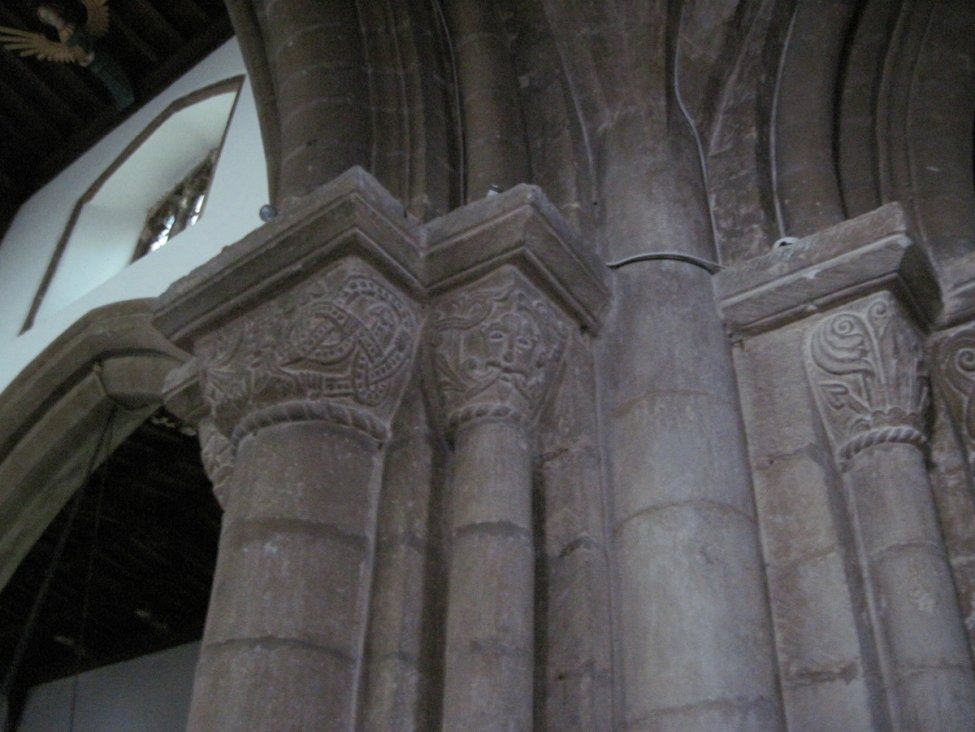
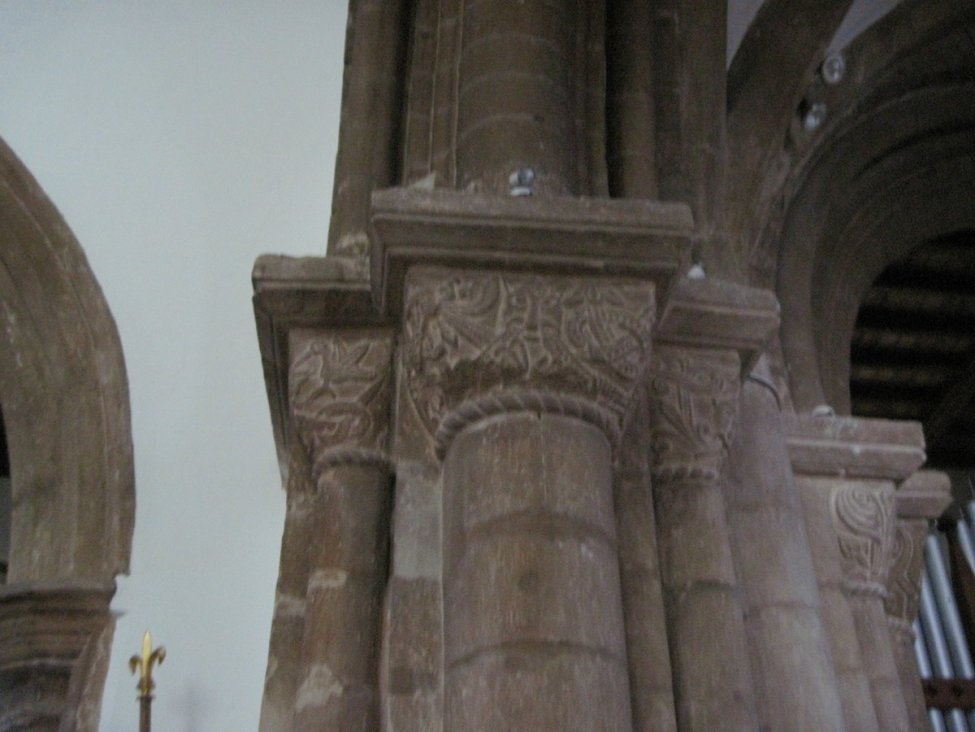
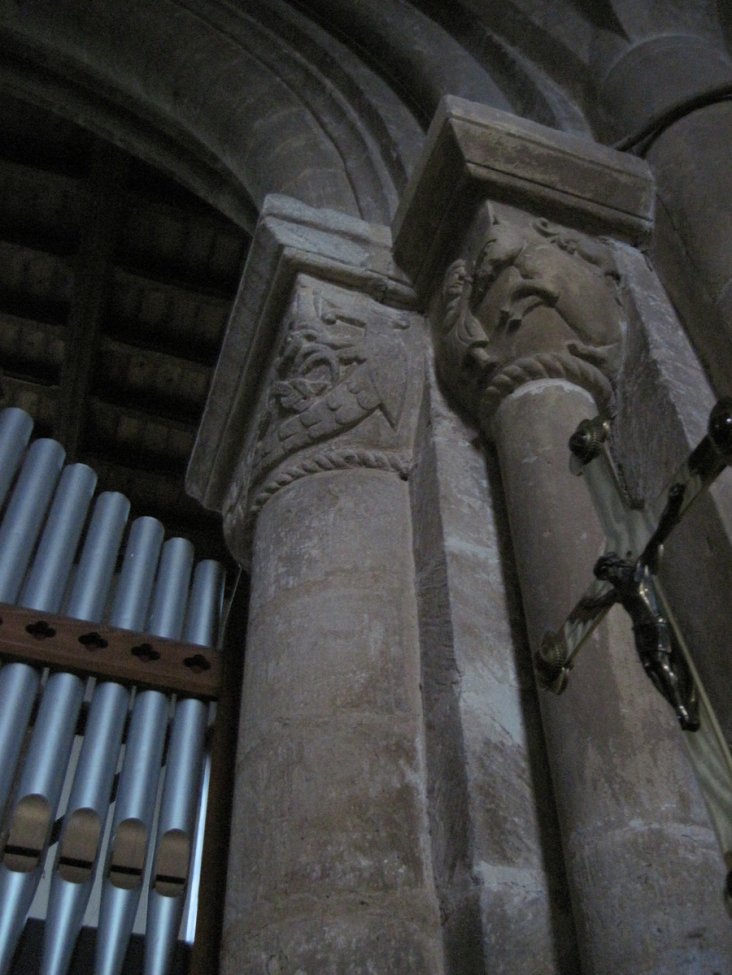
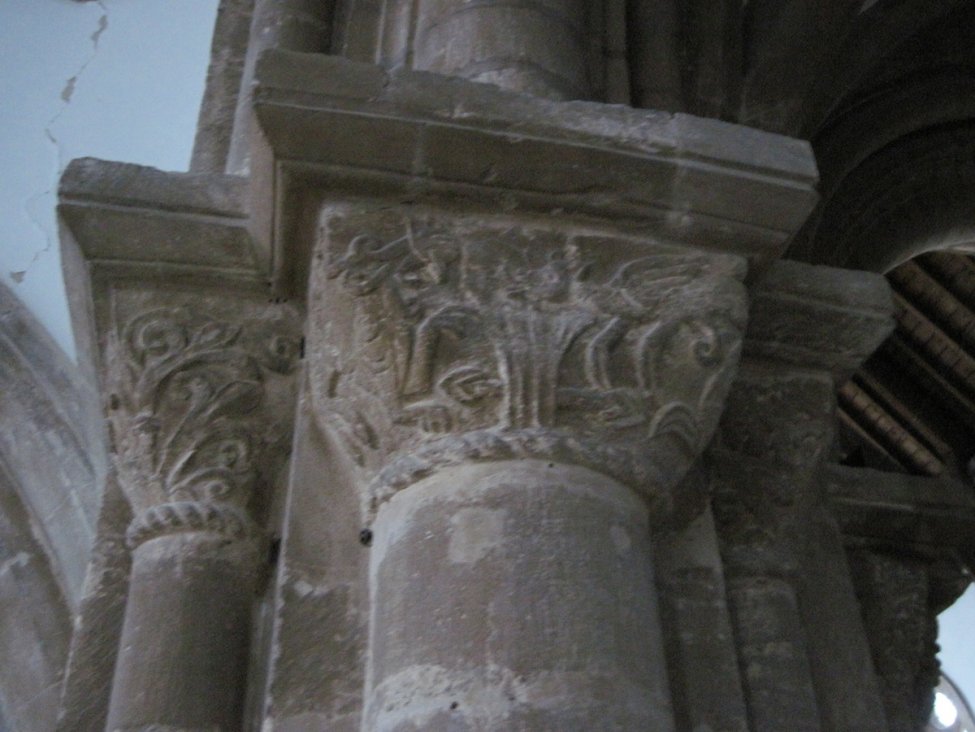
On the inside, at the top (corbels) of the columns supporting the interior corners of the tower, are carvings described in the church guide as 'strange'.

Two appear to be 'green men'.

small_both_green_men.JPG
small_big_green_man.JPG

Two, and possibly three, appear to show dragons. The church guide contains an image of one green man but generally showcases the more mundane carvings. Ie, those carvings that are not green men and not dragons. Eg column on the left:

small_one_dragon_carving.JPG

And:

small_two_dragons_not_sure.JPG

The guidebook does mention 'Saxon' carvings of dragons at the bottom of a cross moved into the church from outside in 1934. Similarly it mentions two green men carvings on the 'Norman' south doorway.

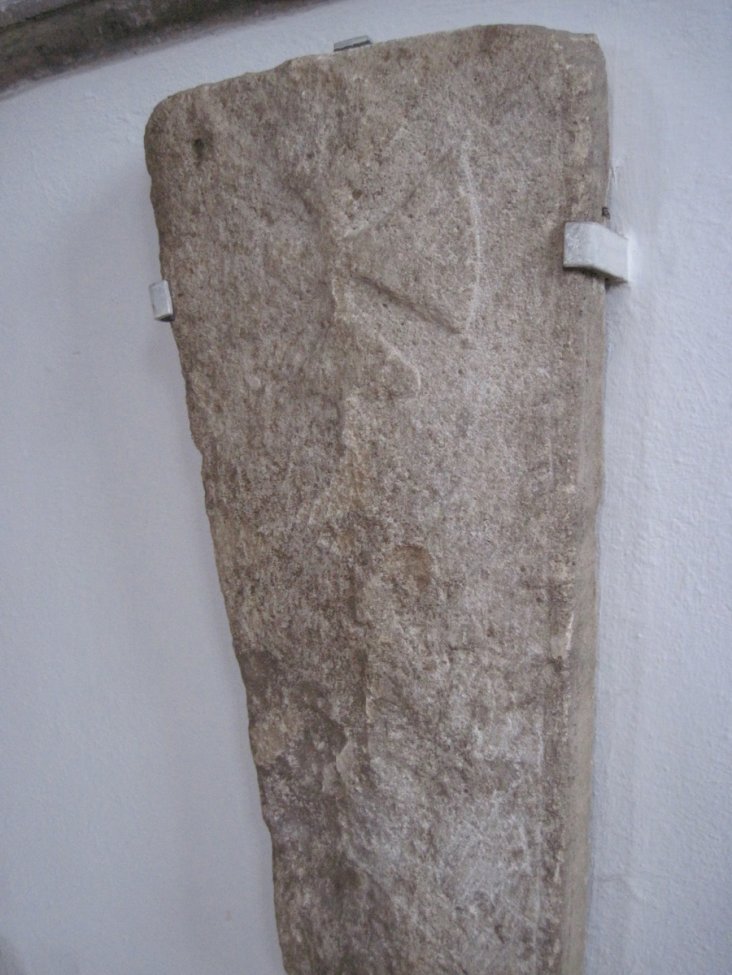
Among several interesting carvings inside the church is a 'body-stone' - which presumably means tomb-cover - carved with a Maltese cross:

small_maltese_cross_body_stone.JPG

A nearby notice says of this allegedly 13th or 14th Century cross:
Ie, it's a Templar cross. Poor light makes the left half shadow relief difficult to see in the above photograph. Scotland has Rosslyn Chapel, Bosham has Templar sword sharpening marks on the doorway, London has various too. Outside the conventional Templar histories, Maltese crosses have a symbolic meaning in terms of precession and, for example, Randall Carlson's Cycle of Catastrophe.

Leaking out from the combined array of information about this church is the confused messaging about where the 'Roman' ruins are relative to the church and how much is known about the original 'villa' and its ruins based on apparently very little excavation.

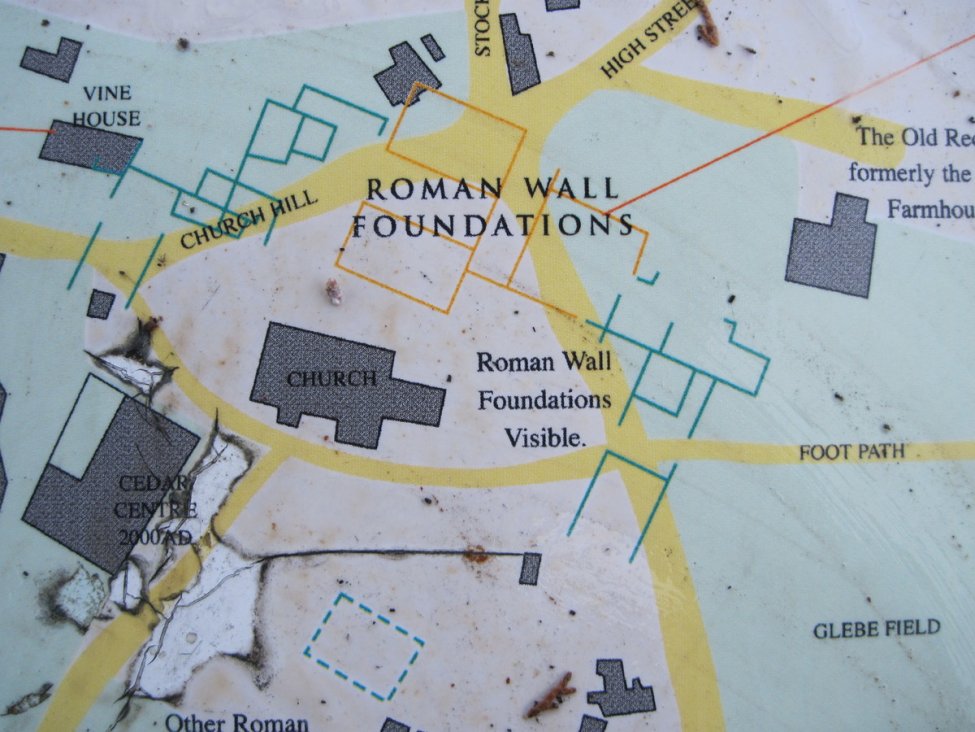
The plan of the church and 'Roman' villa on the information board in the churchyard shows the underground ruin pictured in the Artis dig in the first post above. It is a smaller building that seems to be about 30m to the south west of the main church. So the ruin you see as having been dug out by Artis is now under the path and graveyard to the south of the church.

Interesting that Artis dug up that particular part of the foundation because - according to this noticeboard - the larger part of the 'Roman' ruin seems to be on the other side (more or less) of the church. This noticeboard shows this plan:

small_less_complete_villa_plan.JPG

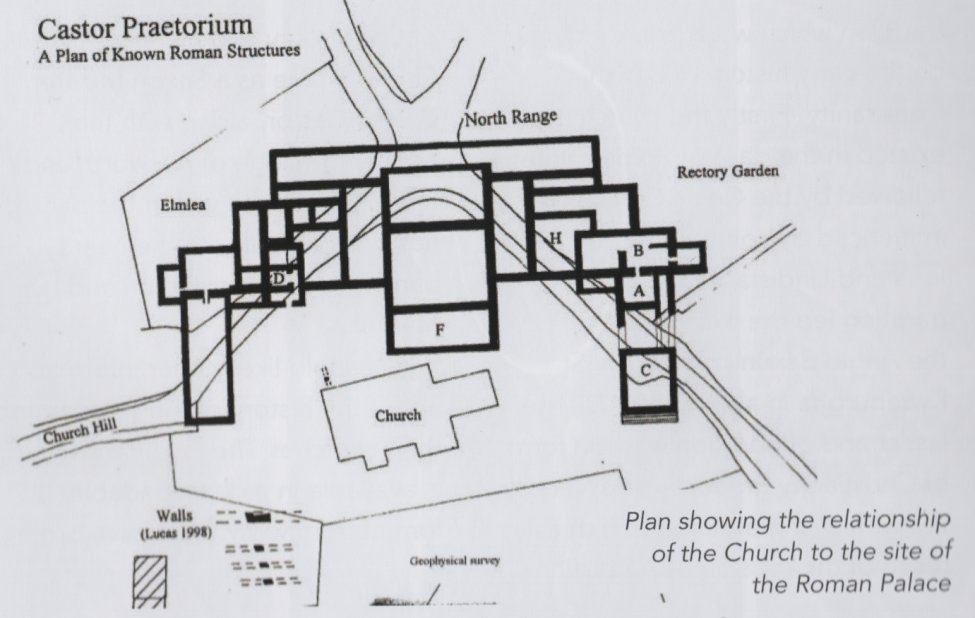
The church guidebook says the church stands in the upper courtyard that was in front of the building and presents this plan:

small_more_complete_villa_plan.jpg

The relative orientation of church to ruin is the same but the plan is more complete. Perhaps it is based on more recent geophysical data. But the whole enchilada seems to be based on a nibble of excavation shown in the plan's lower right corner (as we look at it). It shows allegedly excavated walls in white-outline, differentiated from the presumably unexcavated thick black walls that make up the rest of the structure.

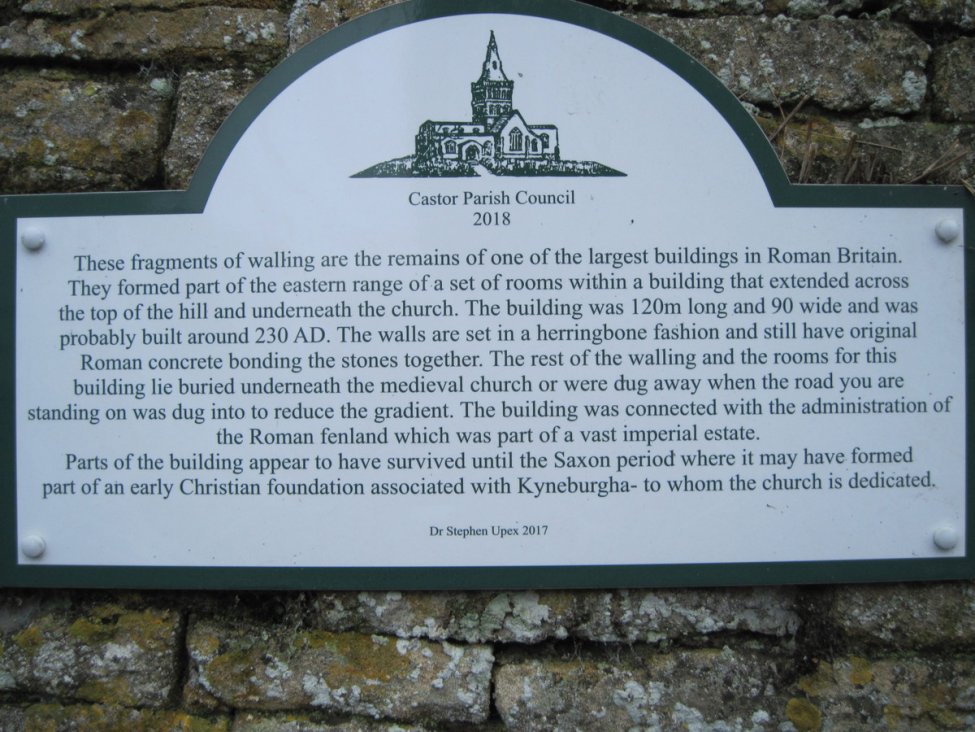
No wonder so many sentences in the guidebook start with the phrase: But the relationship between church and ruin is more complex yet. Per a couple of enigmatic noticeboards in and around the churchyard: one says the church's alignment is not quite the usual 'due east-west' alignment because it sits on top of - ie follows the walls of - the old villa. Another explicitly says there are ruins beneath the church:

small_ruins_beneath_church.JPG

So what exactly was the church aligned on that forced its unconventional orientation?

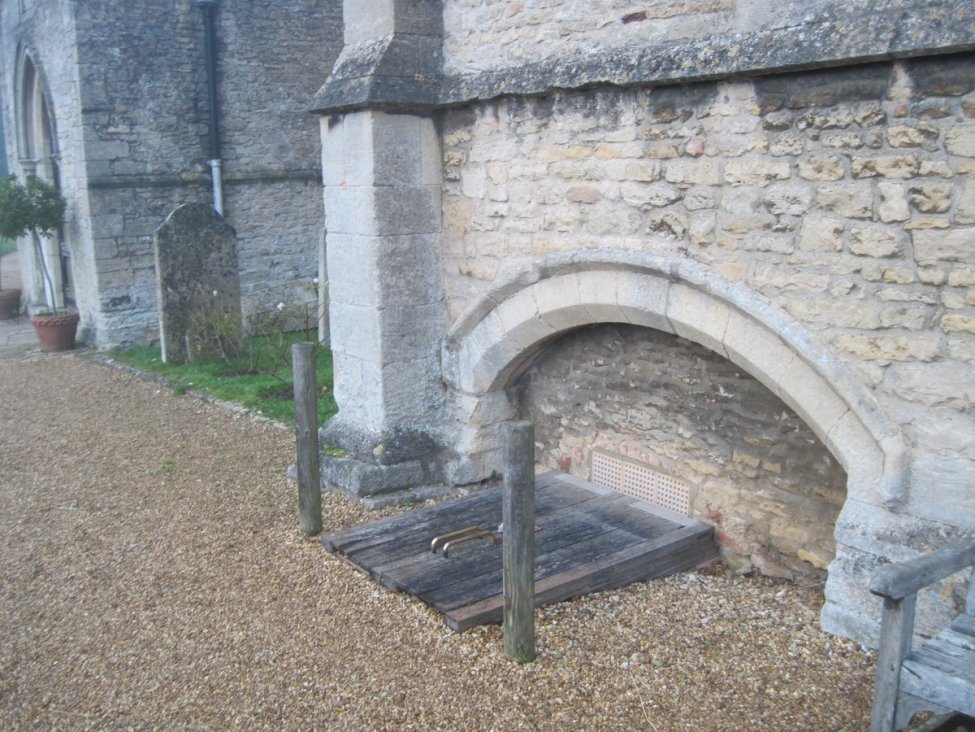
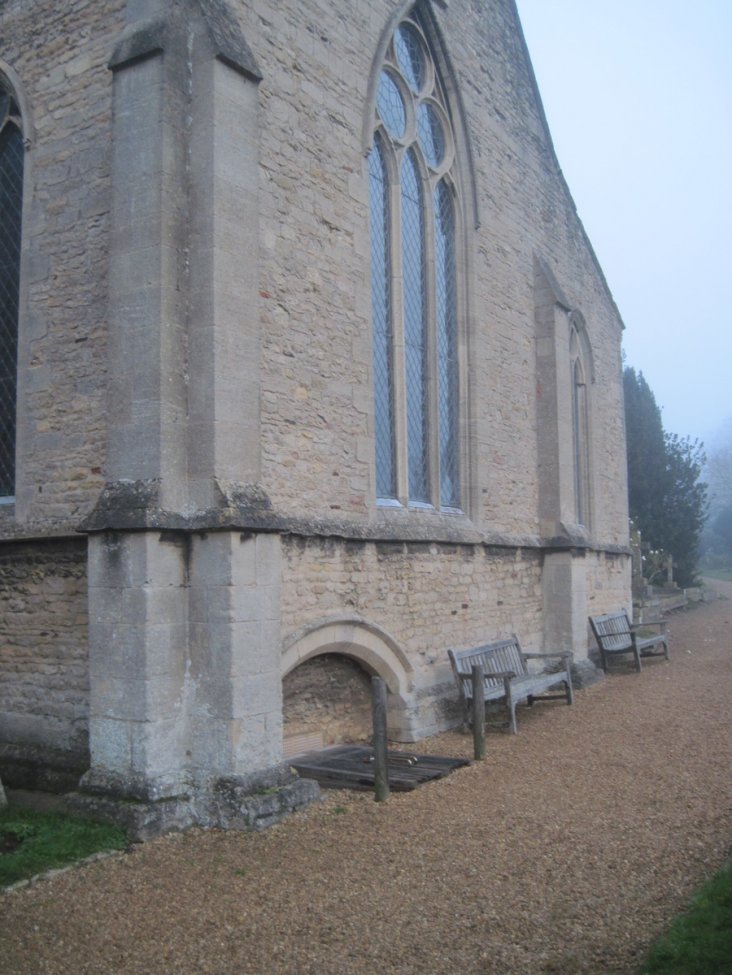
The guidebook says But, you hardly need to fiddle with the east window to work out that there is - or was - something below. Note this arch in the south wall, the ventilation holes, and the wooden trapdoor in front of it. For scale, the top of the arch is about four feet above soil level:

small_arch_and_trapdoor.JPG
small_arch_trapdoor.JPG

That's Artis's alleged headstone on the left as you look at it. Note, the headstone has been 'refurbished'.

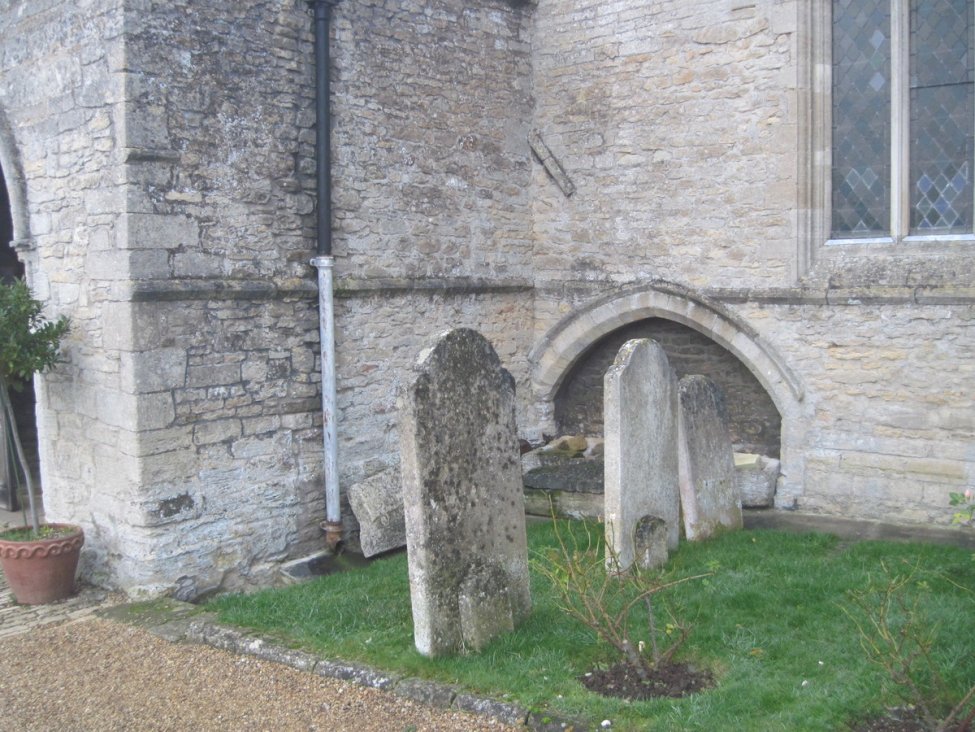
There's a second low arch in the south wall a few feet to the west (ie to the left). Top of its arch is about five feet above soil level:

small_second_arch_artis_grave.JPG

Artis's headstone now the righthand border of the pic.

So what really lies beneath?

This issue of what was left above ground, what was left below is also interesting because many of the village houses seem to have been built from old stones. Ie, available stones.

The guidebook also has a picture of an Artis excavation of solid-looking undergound ruins apparently 400 or 500 metres to the west-south-west of the church.

Where did Artis dig during his 20+ years and why? (And why does he have a name that is so close to 'Artist'?)

Other notes:

The guide admits that a lot of it was built from 'Roman' ruins but is perplexed in places about old-looking elements being where they are within the church structure. it says at one point. I would like to hear what Gunnar Heinsohn would make of that, but I suspect I already know.

The guidebook says it was struck by lightning in 1795, nearly killing bell-ringers. Because that's what you do when lightning threatens - head to the nearest high building on a hill and hang on to the ropes attached to its highest-mounted metal objects.

Also, we find:
That's a feat of forensic civil engineering speculation about a structure whose foundations are theoretically more or less un-excavated.

We do also have a local historian pointing out the similarities with St Pega from nearby Crowland.

Two more quotes from the guidebook:
There is so much more but if you have read Clube and Napier's The Cosmic Winter and/or Baillie/McCafferty's The Celtic Gods (which proposes that Celtic god and witch myths describe close-pass encounters with at least three comets and their multiple fragments) you will appreciate this from the end of the guidebook:
(Michaelmas: 29 September).
Some more finds on archaeologists' attempts to explain the end of the 'Roman' east of England.

40 miles or so north of Castor we have Norton Disney 'Roman' villa. It's underground, of course.

Norton Disney is interesting in itself as well as for what it exposes about archaeologists; attempts to rationalise evidence.

Let's take a look at the findings about what destroyed it, starting with Anthony Lee's Destruction of Norton Disney Roman villa. Note the causes: violence and fire. Usually "intense fire".

The cause of which Anthony easily attributes: It's Funnily enough, you find similar in the Castor church guidebook, where destruction is attributed to One wonders if there is an emoticon for "singing from the same hymn-sheet"?

Antony Lee's Norton Disney link shows that Norton Disney boasts one of the features of England's 'Roman' villas: the in-building 'burials'. Copying Antony, I'm turning on the sarcasm here, only in the other direction, so . For background, you have to understand that post-Romans didn't like to live in villas; they only liked to bury their dead in them. After all, why live in a substantial stone building when you can live in a thatched hut and use the local masonry for burying your dead instead?

For example, excavations at Norton Disney uncovered three crushed corpses beneath a collapsed wall. This, it turns out, confused a naive archaeologist of the last century (that is: the 20th Century) into thinking the walls had collapsed on these people, killing them. According to Richard Parker:
However, modern archaeologists are keen to eradicate such silly notions.

Anthony Lee dismisses this as And at Beadlam Roman Villa - Unpicking An Archaeological Site - ELEANOR SCOTT ARCHAEOLOGY, Eleanor Scott - who has specialised in child sacrifice burials as well as Middle Eastern archaeology - suggests although some people did bury their dead in holes dug in 'Roman' floors, the fact that some also put their dead children and relatives on top of 'Roman' floors - along with roof slates and bits of building material For her, the idea that Norton Disney occupants were killed by collapsing building is simply "picture story' archaeology".

I guess when your only tool is human history, every problem looks like human agency.

To his credit, Richard Parker wants to find the now-disappeared skeletons and forensically analyse them. This because the condition of skeletons in collapse buildings can be an important indicator. For example, in Bob Kobres' description of what is possibly Comet Phaethon's destructive outcomes in the second millennium Palestinian city Lachish, Kobres cites David Ussishkin's paper: Palestine in the Bronze and Iron Ages (1985 p. 223):
So good luck Richard. But, as you say, they appear to have been shipped to Oxford, home of the Ashmolean - Britain's equivalent of the Smithsonian.
 
Note: This post was recovered from the Sh.org archive.
Username: 0harris0
Date: 2019-12-02 15:23:04
Reaction Score: 1
exactly the same over here on the Somerset levels!

how many Dutchmen does it take to drain a marsh? :ROFLMAO:
(oh, and create 100s of km of dykes, ditches and sea defences?!)
 
Note: This post was recovered from the Sh.org archive.
Username: usselo
Date: 2019-12-02 22:55:48
Reaction Score: 3
Yes, exactly!

Part 2: I looked further into the Artis dig image that I thought was 400-500 metres to the west-south-west of the church.

That image - found in various Castor-related documents - is this one:

Room B.jpg

and turns out to be about 100 metres to the north-east, ie 180 degrees opposite to my interpretation and much closer.

This image is important because it is one of the few parts of the alleged large building that Artis excavated. Or claims to have excavated, given that Castor was being dug up for at least a century before Artis, according to earlier visitor William Stukeley.

But back to the image... It's room B on this plan presented by Stephen Upex in The Praetorium of Edmund Artis - SG Upex (from the publications index page at Publications | NVAT)

Upex plan A.jpg

For orientation, the north east corner of the church is in the lower left. Note how Upex distinguishes between rooms Artis dug and rooms Artis 'indicated', ie inferred?

This matters because there are some signs that the claim: 'Castor hosts the second largest Roman villa in Britain' may itself sit on foundations more 'inferred' than 'dug'.

To be clear, there is a lot of 'Roman' under the church and under Castor. What is less clear is the evidence for a single enormous Praetorium.

To precis what would otherwise be a very long post, I will focus on a couple of documents. First, the retail understanding of Castor, which is captured in this image:

A possible reconstruction of the great Roman Building on top of Church Hill and Stocks Hill in...jpg

and which is apparently based on this plan:

Plan C.jpg
That plan can be found in Figure 1h in Five Parishes - Chapter 1: the Nene Valley in Prehistoric and Roman Times

Its caption there says:
But note that the structure that allegedly bridges from the two excavated sections appears not to have been excavated in modern times. You may remember that I posted a plan image in an earlier post that also shows the 'excavated' central section in solid black.

It was Artis who proposed that the various rooms he excavated - or in some cases may even have encountered above ground - were once a single building.

Let's have a look at how his notion has withstood the rigours of achaeological investigation. 'Mackreth 1995' above refers to Donald Mackreth's review of the evidence published as 'Durobrivae: A Review of Nene Valley Archaeology, Volume 9, Page 22. It's only a four-page read, but for those short of time, let's highlight the language and the deductive process used. Mackreth steps in to review a problem: apparently some people thought Artis was blowing it out of his ass:
Just to help people read Mackreth with lawyer-like care, Mackreth is saying the idea was re-established. He is not saying the fact was re-established. When he talks about facts, he is explicit about facts. For example:
or he makes clear that he is limiting the discussion:
At least to start with...
The north-eastern end is that room B above. You'll notice that an excavated north-western end has snuck into other presenters' narratives, just like it snuck into Plan C.jpg above. That's JP Wilds' digs. It's got its own issues in my opinion but I'll leave those for the super-keen to research for themselves.

Mackreth then explains that Artis' plan: which
He then goes on to substitute Artis' room J for Artis' room F (not a trick you should try in a court, by the way), and adds:
Yep, just move it.

Adding an "if..." and a couple of "would have beens..." to JP Wild's discovery that room K had a big heating system enables Mackreth to fill the fact-gap with reasonable-sounding conjecture.

So, a sentence that starts with:
leads us to dimensions which:
and also to:
Noting the words "suggest" and "interpretation" here, and remembering that Upex's plan shows rooms J and F's existence as 'indicated', not as 'excavated', we realise that the reader's imagination is now doing all the heavy lifting instead of archaeologists. That being so, the reader's imagination is ready to take on even greater imaginative burdens:
whose length:
Which is followed by Plan C.jpg above. And eventually the further extension of the 'excavated' ruins shown in this image from my earlier post:

small_more_complete_villa_plan.jpg

So legally-treacly is Mackreth's phrasing that I genuinely wonder if he took legal advice before writing. After 1995, the phrase "highly interpretive" seems to have been abandoned somewhere along the Castor narrative, leaving us with, well, with TV programming and a glorious line-drawing.

It's probably superfluous to add here that in the early 20th Century, one of the diggers and popularisers of 'the Castor story' (my quotes) was William Le Queux. Le Queux was a journalist, novelist and "agent" whose pre-WWI stories of German espionage helped prepare British minds for the necessity of WWI.

For anyone that wants to go further, particularly into how the north-west foundations were 'revealed', Upex's review of the Castor evidence is more detailed and more nuanced than Mackreth's.


Part 3: More Lincolnshire 'Roman' archaeology oddness that might help make some connections:

Roman archaeology tutor and museum curator Antony Lee has posted examples of Lincolnshire finds that indicate an enigmatic Rider God 'cult':
Rider gods of Roman Lincolnshire

One example from his page:

threekingham.jpg

He speculates that these may not be from a Roman-only cult; that they may be relics of a pre-Roman belief that was carried into Roman times. While noting that Lee uses the perjorative term 'cult', it is good to see an expert acknowledge the possibility of blurry boundaries between what is attributed to 'Romans' and what is attributed to 'pre-Romans'.

The heads of the images sometimes wear 'Phrygian' caps (possibly a symbol for a comet with a red umbra) but sometimes have radiant 'manes', along with their horses (although, obviously, horses usually have manes).

Lee's page has a map showing the locations of these finds in Lincolnshire:

small_horse-and-rider-distribution-map.jpg

You can see the distinct cluster around the old 'Roman' town of Sleaford.

Compare the cluster of 'Roman Rider God' finds with this map:

Wikipedia_Byards_Leap_Location_Map.png

which was grabbed from Wikipedia's page about the Lincolnshire folktale of Byard's Leap.

Byard's Leap is about seven miles west-north-west of Sleaford on Ermine Street 'Roman' road. Wikipedia's modern version of the Byard's Leap tale goes:

The tale shares common elements with the 'Sir Hugh and the Dragon' tale I mentioned earlier (I could paste the full Sir Hugh tale here but would need to get the copyright-holder's permission first). Swap the witch for a dragon, swap the witch's heart for a wart-like weak spot on the dragon, swap 'Byard' for 'Barde' - the last name adopted by Sir Hugh after defeating the dragon - and you effectively have the same tale.

The witch sinking her nails into the horse is reminiscent of Baillie/McCafferty's Celtic myths (in 'The Celtic Gods') that have comet-gods stripping their opponent's flesh even as they lose in battle.

Note also the stone being dropped in a pond and the witch falling into a pond.

At: Bayard (legend) - Wikipedia, Wikipedia says this story is very similar to the 'Bayard tale told in medieval Europe' and that various Belgian towns still ostentiously celebrate it.

That's interesting because Lincolnshire and Belgium are separated by the North Sea, which has the unique 'Silverpit' sea-bed crater not far north east of the Lincolnshire coast:

Silverpitlocatormapresized.png

Image from: The Geological Society of London - Silverpit, which reports that, while first thought to be an impact crater, Silverpit was recently voted 'not an impact' crater. You might not want to apply the 'looks like a duck, walks like a duck, quacks like a duck' model to author Kevin Smith's description of Silverpit's physical features at:
The North Sea Silverpit Crater: impact structure or pull-apart basin? | Journal of the Geological Society | GeoScienceWorld

But at least Lincolnshire's ancient residents would agree with Smith's proposition that Silverpit wasn't a random impact crater. :)

More imagery of Silverpit can be found in: Link

Funnily enough, in Geography we were taught that the origins of the uplands of Lincolnshire - the creamy-brown patches in Antony Lee's map above - were not known but were possibly 'ripples' caused by Italy's Alps-creating tectonic collision with northern Europe.

Given that D. S. Allan and J. B. Delair highlight evidence that the Alps - along with many other 'toothy' mountain ranges - are just a few thousand years old in their book 'Cataclysm! Compelling Evidence of a Cosmic Catastrophe in 9500 B.C.', it's possible to conceive that even upland Lincolnshire is, well, new.

Who knows? But the notion might explain another oddity pointed out by Antony Lee, in his examination of a 1912 postcard image of Roman Lincoln which
20180320_141935.jpg

Lee faults the postcard for showing Roman walls that do not comply with today's timeline. Some are at least 50 years too early and some two centuries too early. But what's worse is the depiction of the topography on which the walls are built.

Says Lee: For folks who've never been to Lincoln, imagine the river at the top of the postcard above and the gate nearest to it. Today, the ground to this side of that gate is about 200 feet higher than the river.

Arguably the card shows a hollow lane leading down to the river, but it still doesn't look anything like today's 200 foot drop - much of which is rightly called 'Steep Hill'.

How interesting. Lincoln Cathedral was damaged by an earthquake in 1185, along with much else in Lincolnshire. But Lincolnshire is not on a faultline. Of the source of the earthquake, Wikipedia says:

Presumably, its reference is RMW Musson's 'The seismicity of the British Isles to 1600' (2008), where several North Sea events are found:
  • 3.15: 22 April 1076
  • 3.32: 25 January 1165
  • 3.35: 15 April 1185
  • 3.76: 23 April 1449
22 April is the peak of the Lyrids meteor shower.

Entry '3.22 1117 England' is interesting for its puzzlement over what might cause multiple earthquakes over a large part of Europe at the same time.

Returning to Lee's 'Rider Gods'... He points out that the metal figurines are similar to the 'Stragglethorpe Rider' - a 'Roman' stone engraving found a few miles west of Byard's Leap.

stragglethorpe.jpg

We see the monster being speared has a coiled tail (coiled tails are also visible in the column-top dragon carvings of Castor church). It's also similar to Paulo Uccello's St George and the Dragon paintings.

800px-Paolo_Uccello_047.jpg

Note the Rider God-like prancing front legs of the horse, the dragon's spiralling tail and the strange spiral in the odd sky. I've read that spirals are associated with events in the sky. Look at the rider's armour. It seems too thin on the thigh and possibly also on the arm. As if it might represent sinews rather than muscle. That would bring us close to tales of Lugh, the Celtic god whose limbs were stripped to sinew as he fought his opponent.

Also, cryptically, see the patterning in the patches of grass. Why?

This was painted in the cloister of Santa Maria Novella in Florence in 1470 as part of a pair, together called 'The Flood'.

Which reminds us that Stragglethorpe's St Michael's church page in the Romanesque Corpus records:

Once you associate the Rider God finds' imagery with the image on the Stragglethorpe Rider stone, then one wonders how the meaning of the Rider Gods could remain a mystery. Because this imagery is found all over Europe to such an extent that it resembles - switching to modern commercial terminology - imagery licensed from a single brand-owner:

Just look:
Thracian horseman - Wikipedia

Avoiding any comment on the dating of the Thracien horseman imagery - given the problems associated with dating - the riders are called hunters but are associated with saviours, specifically St George and St Demetrius. They also seem to come in two major variants: those where the rider is killing a dragon and those where the rider is killing a human.

What to make of that?

Sir Hugh Barde - the saviour in the Sir Hugh and Byard's Leap tale - was rewarded by being allowed to extract taxes, as, of course, were the 'Romans', the 'Normans', and the Knights Templar - who took ownership of the highlands around Lincolnshire.

It's almost as though a story was created to explain havoc, rescue from havoc, and justify an apparently perpetual reward for those who carried out the rescue.

A final thought. Note how Uccello's dragon wings each have three roundels. We can conceive of his dragon as a central evil, flanked by six 'circles', three to each side.

That reminds of Castor Church guidebook and its strangely dismissive comment of William Stukeley for merely recording what the vulgar folk of Castor claimed they had seen:

A lot of trouble sure has come travelled along 'Roman' Ermine Street.

A coach and six is a carriage drawn by six horses harnessed in two lines of three. This was an arrangement that could travel long distances very quickly. But understanding passage along Ermine Street as a metaphor for speed and straightness, it's perhaps not odd that thousands of miles to the east - in Siberia - scapulas have been found with arrangements of spirals carved in one side and zig-zagging patterns of serpents in the other. Here is one held by The Hermitage museum in St Petersburgh:

spiralholeplaque.jpg
Front

maltahermitageplateback.jpg
Back

mammothspiralsserpents.jpg
Rendering of a different example.
A coach and six horses?

This journey started in the east of England and has reached the east of Asia, leaving me with the sense that I live in Westworld.

Thanks to Heather Hobden's Mammoth Hunters of the last Ice-Age, their legacy, and "World Surveyor Man" for providing some of the connections here that I wouldn't have seen on my own.
 
Note: This post was recovered from the Sh.org archive.
Username: MagnusOpus
Date: 2019-12-06 14:53:37
Reaction Score: 1
I happen to know the secretary of the detectorist club that the guy who found the staffordshire hoard is a member of.....it was found about 3 miles from where I live!......I have been thinking of starting a thread about it here as it is a fascinating subject

To answer your question, it was found at about the same depth as it was originally buried....just off the "Roman" road Watling Street....and very close to a place called Wall which has "Roman" remains pretty much on the surface

I'm currently trying to get my head around the Anglo Saxon and Roman thing, it seems a popular idea here that the ancient Romans and Normans were one and the same thing....and the idea has a lot to commend it.....the thing it makes me wonder is were the Anglo Saxons before or after?....certainly the Staffordshire hoard has objects that have a kind of medieval look about them, the aesthetic somewhere between gothic and celtic.....proper Northern European!
 
Note: This post was recovered from the Sh.org archive.
Username: jd755
Date: 2019-12-06 16:10:39
Reaction Score: 1
Here's a brief wander through the history I was told at skool.
Neanderthal.
Ancient Britons. Stone Age. Bronze Age. Iron Age
The Romans.
Celts, Jutes, Angles, Saxons, Vikings.
Anglo-Saxons.
Normans.
Then came bloody great long line of Kings and Queens and the English, the Scots, the Welsh, the Irish
Then the British.
Throughout it all is constant killing and Christianity.
Utter cobblers, all of it.
 
Note: This post was recovered from the Sh.org archive.
Username: usselo
Date: 2019-12-06 21:27:59
Reaction Score: 1
Yes, I'm no longer a believer in the Romans or the Normans as separate entities from each other, nor as described in any way.

And the Anglo-Saxon invasion is being taken down. From the first few minutes of archaeologist Frances Pryor's TV series on the Dark Ages:
I struggle with dismantling my previously-held notions and am shocked when I see how old as this TV series seems to be. Ndevertheless, the Anglo-Saxons do also seem to be 'a misinterpretation'.
 
Note: This post was recovered from the Sh.org archive.
Username: Feralimal
Date: 2019-12-06 22:52:48
Reaction Score: 1
Absolutely. This is the struggle. How much to let go of. And then how to build it back up again. And when you think it's not just history but science, politics, religion, how we view ourselves, philosophy, etc, etc - basically all the domains we took for granted.... Well, it's a hard task! All the best to you!
 
Note: This post was recovered from the Sh.org archive.
Username: usselo
Date: 2019-12-08 15:34:52
Reaction Score: 1
And to you Feralimal!

There are many odd things about the process one's mind goes through. If we take just yesterday (Saturday) morning - ie the morning after my previous post above - early on I started reading Stukeley's Itinerarium Curiosum, which turned out to be filled with material that evidences the comet catastrophe theory (and eventually led to my post in the Northern Barbarians thread today.) I had some chores to do and then - unusually - found myself watching this 'The Rules' episode of the kid's TV series Strange Hill High. I think that video link is just a clip, unfortunately. Early on, I notice its Murdoch character looks like a specific Celtic comet reference due to his his domed/bowl-shaped head, white beard and single eye with eye-patch fastened vertically down his cheek and mostly missing arm (it has a metallic prosthetic). If you've read The Celtic Gods, you'll know that the one-eyed comet (which loses an eye down its cheek), that also loses most of an arm is a memorable feature of Celtic legend. But that episode then turns into a story of a re-entering satellite which becomes a meteorite coming at the school. The cast have to save the school from it using the school's ancient defence system - a green jelly shield.

Now, I don't usually watch TV so that's quite a catch. Naturally, I pondered this coincidence - specifically: "to what extent do my thoughts about comet catastrophes affect how I interpret what I encounter?" Obviously, readers can make up their own mind about this, erm, coincidence.

A few minutes later I get a chance to look for more Stukeley material and find myself at 12 Plots — MIAC :: The Mind is a Collection, which is about how your physical reality = 'place' - affects how your mind perceives and expresses.

Last thing at night I watch a little of 'Dark City' - as recommended elsewhere in this forum. And notice a green jelly being placed in a food dispenser in front of the protaganist as he tries to find his wallet and make sense of things. I'll watch the rest when I get a minute.

This morning - Sunday - just after posting the Stukeley link to the Northern Barbarians thread above, I'm - again unusually - at a Christmas charity event, during which I encounter a booklet wherein a 1950s vicar is describing his efforts to repair his church's door. He thinks its made from a 'bog oak' recovered from the Lincolnshire fens because parts of it are black, brittle and cut like coal, rather than wood. If you've read my link to Stukeley above, you will understand why that is quite a coincidence. I also see pictures of a stained glass memorial window showing St Michael with flaming sword, wings, horns from his head, and St George with his red cross on on his sun-like shield. This not long after reading a monk's reference to seeing a red crucifix in the sky just after sunset in AD 774 (now attributed to a nova, which I didn't know until I just looked it up).

The above is an example of a particularly dense set of coincidences. I find these happening quite often, though not usually this densely.

So, there is the crypto (hidden) nature of these seemingly, long-hidden discoveries. But there is also a cryptic, and seemingly 'pushed', quality about the process of uncovering them. Unless my mind simply finds what it wants to find.

Regardless of how it happens, I would like it to happen to me around the science side of things: ie for moving on the 'Missing Link to Ancient Power' thread at The missing link to ancient power. It looks like life on Earth could do with that push.
 
Note: This post was recovered from the Sh.org archive.
Username: Feralimal
Date: 2019-12-08 17:25:03
Reaction Score: 1
:)

Those are a bunch of coincidences! And what interesting research you are undertaking along with great observations.

Personally I'm not minded to call them coincidences. I think of them as syncs (from synchro-mysticism or synchronicities). I distinguish between the personal and cultural ones. Personal ones I value. Cultural ones such as '911 was predicted in film' I'm not so interested in.

Fwiw, when it comes to what they mean I try not to read too much into them. I'm working off the thesis that other than being taken as some sort 'pat on the back' - a sort of positive affirmation from creation, they are best ignored and not worth getting too excited about. I tend to think that these providential events are there continuously but we are mostly 'un- tuned' to them.
 
Note: This post was recovered from the Sh.org archive.
Username: Starman
Date: 2019-12-09 00:08:18
Reaction Score: 0
This is my dilemma as well. I've been doing so much deconstruction, that I can't find any touchstones to believe in (yet). The conspiratorial lies, the confabulation, the abject amnesia keeps everything in a dark fog. I'm much better at detecting BS and purposeful obfuscation than I am at discovering any historical truths that I feel I can rely on. I don't know if the world is flat or we live on a ball. The same goes for just about everything else.

My only consolation these days is accepting my peeling back of the onion as some sort of success in deconstructing the matrix. I have the sense that when you die, your main limitation going forward are the beliefs you brought in with you. Beliefs are chains that bind. The fewer the better. If you stay 'open to outcome', you will be better primed for receiving potential truths in another realm.

Somewhere there must be truth?
 
Note: This post was recovered from the Sh.org archive.
Username: Feralimal
Date: 2019-12-09 06:55:50
Reaction Score: 0
I tend to think not, or at least I don't think it's discoverable in the same way as a lie is. Maybe it's what remains.
 
Note: This post was recovered from the Sh.org archive.
Username: usselo
Date: 2019-12-09 16:45:31
Reaction Score: 0
That's what I think too.

Most of the time...

Meaning: I do also think it is technically possible for Internet-connected and media-connected software AI to put certain clues in front of us, and even to work out which pre-existing clues we might respond to and then put appropriate clues in front of us.

But I can't even evidence that either of those is happening. All I can evidence is that my mind can consider 'meta-evidence' about the circumstances of each new finding . I'll let you know if I figure out what's really going on! :)
 
Note: This post was recovered from the Sh.org archive.
Username: Feralimal
Date: 2019-12-09 17:04:32
Reaction Score: 0
Yes. Those are what I call cultural syncs, and would dismiss them. Whether it's AI, the demiurge or something else, I don't know, but it seems like some sort of programming and I'm suspicious of it.

If you're putting it together personally, I'd say it's meaningful. And please do let me know what you figure out!
 
Note: This post was recovered from the Sh.org archive.
Username: usselo
Date: 2019-12-27 16:50:27
Reaction Score: 3
Some of the loose ends in my posts in this thread may be tied off, or at least plaited, to see if we can expose some patterns.

Regarding the '15 April 1135 East Midlands earthquake', which damaged - among much else - Lincoln Cathedral:
Britain claims St George as its patron saint and treats 23 April as St George's Day. Nominally, because it is not a holiday, individuals barely register it, and it is moved if it clashes with Easter. Around Europe, St George's Day is celebrated - or acknowledged - on 23 April or on 6 May. I haven't tallied which countries do and which don't acknowledge it, and on what dates, but the fact that one country with a history of apparent earthquakes close to 22 April allows us to speculate.

Given there is already speculation that St George - and his spear or sword-carrying analogues (St Michael, Arthur) - have a cometary or celestial origin, we can speculate that the event might be tied to 23 April.

In England today, St George is not particularly associated with green men and fertility (read: 'new soil'). However, apparently he used to be associated with fertility and still is in other European countries.

The linked text mentions green men carvings being common in English churches; we found several in Castor church. Also in Castor church we saw two column carvings showing figures fighting dragons or monsters. Imagery of St George is also common in English churches. Here's an example from Baston church, Lincolnshire. Righthand window: dragon in shades of purple underfoot and around his legs, red crescent on a sun-like golden shield.

cropped St Michael and St George.jpg

The saint in the window on the left is St Michael. Note the red, flaming sword.

On a second look at Paulo Uccello's St George and the Dragon painting from 'The Flood' sequence, we see three roundels, circles, on each wing. Why did Uccello add roundels to the wings of a dragon?

We can look again at the images carved on bones and stones in Siberia:

mammothspiralsserpents.jpg

Which brought to mind William Stukeley's comment about Castor's people commemorating an event:
We see 'deities' carved by the Moche people - a pre-Columbian people living on the north coast of Peru near what is now the town of Trujillo. Their culture is thought to have disappeared around the year 800 AD. The following two figures are associated with fertility, specifically with maize and are sometimes associated with serpents. They are thought to have descended from earlier stave-carrying 'sky deities' observed by the earlier Chavin culture. I noted the pattern of central 'beast' surrounded by cones; a relative noted the similar speckling on the cones to the speckling of the spirals on the Siberian carving pictured above. Obviously, you make your own calls when you compare these things.

_017.jpg

_018.jpg

Here's a stave carrier:
_020.jpg

Note the semi-circular head-aura and the angle of the stave. The stave is very similar to the spear carried by Lincolnshire's iron horse gods, to Thracian horsemen and to images of St George. I think it was David Mathisen who pointed out that a stave carried at this angle is a common element in world mythology. Baillie/McCafferty proposed it is the secondary ion tail sometimes seen with comets.

The Moche also had explicit stories of deities fighting dragons. Here is an image of one:

-012.jpg
Note the two serpents appearing to spring from the waist. Here's another one, this time with the snake-bedecked deity carrying a dragon:

_010.jpg
Stories of deities with two snakes springing from their waist - sometimes shown instead of legs - are found worldwide. They are anguipeds; the nagas of Indian and Iranian legend, the abraxus of Greek/Roman/Gnostic coins and amulets. They crop up as carvings on a carved stone marker in Tondela, Portugal, as well as - arguably - a figure flanked by monsters on Tondela's nearby mermaid water fountain. It's worth searching for details of the legend associated with that carving and considering what it might be based on.

Returning to Castor, to St George and to his red cross, the very possibly forged Anglo Saxon Chronicle (forged because there is so little evidence that a separate culture of Anglo Saxons existed) has the following entry for AD 774:

A red cross in the sky, wonderful serpents, all about the time Moche culture are thought to have disappeared.

Given the amount of fakery in history, who knows what is real, what isn't, and what occupies an orthogonal position as deliberately created as part of a narrative.

Moche notes and images from: Tarmo Kulmar's The Deity of Sky: One Way to Interpret the Moche Iconography
 
Note: This post was recovered from the Sh.org archive.
Username: jd755
Date: 2019-12-27 21:22:45
Reaction Score: 0
England not Britain. He was apparently French anyway.
St Patrick is Ireland's, There appears to have been two of thenm both Welsh or Khumry.
St David is Wales.
St Andrew is Scotlands.
Britain has no patron saint because it isn't a country.
The United Kingdom is a country with a German monarchy but no patron Saint.
 
Note: This post was recovered from the Sh.org archive.
Username: usselo
Date: 2019-12-28 08:43:16
Reaction Score: 1
You are absolutely correct - thanks for the catch.

Adding to my loose-ends post above:

Note the prancing mustang in Plissken's Denver Airport symbolism thread. Specifically, KorbenDallas' post about Denver Airport's blue mustang. And in this Roman Castor mudflood thread, we have prancing horse figurines, leaping horses, and knights, saints and deities riding them into fights against malign 'forces'.

We have material evidence and a mass of folklore and myth ranging from St George in English folklore to Valhalla in Nordic folklore (Valhalla being the place warriors practice fighting in order to tackle a greater evil - a dragon if I recall correctly).

I previously wondered if Denver Airport's Quetzalcoatl symbolism is a reference to a comet being boxed up. Specifically: I meant the 'glass box' may represent 'boxing up' in the style of reticles used for 'target acquisition'.

With so many symbolic links, we could speculate that there is a:

  • Plan A: to try to knock out comets and comet debris that is heading our way.
  • Plan B: to protect against the possible:
    • electrical/ionic nature of cometary material
    • atmospheric contamination by gas and/or acids
    • destructive heat and blast effects created by very fast-moving debris in the atmosphere
    • failure of Plan A
  • by placing selected resources into protection underground.
A lot of the weirdness around modern wars may be visible evidence that the elites see themselves as living in a variant of Valhalla.

And a lot of the weirdness around modern economics and politics may be visible evidence that we non-elite people are funding that variant of Valhalla. That we may have been bred or 'allowed to live' because our creativity and productivity is required to develop and support Plan A and Plan B.

I mentioned Westworld earlier because I can't tell if we are seen merely as resources for enabling these plans, or if we are Westworld-style 'hosts' who live for different re-tellings of this narrative. That is: perhaps it is an amusing show or developmental game put on for the benefit of Westworld-style 'guests'.
Just adding another link to the horse symbolism found in Britain.

In a post on PN Oak's theory that a Hindu-like, Sanskrit culture once lived in Britain, Tim Cullen (MalagaBay) traipses through some of the horse symbolism found in Britain. It brings to mind some of the imagery and legends referred to in the earlier post.
 
Tips
Tips
Please respect our Posting Rules.
Back
Top