Hi everyone. Recently Dielectric kindly asked me to participate in the discussion about this curious battery, so I did my own research based on what’s been presented here and have compiled a theoretical explanation. A lot of what I am about to tell comes from my own research, which you may have read in «The Lost Key» article (particularly part 3). But even if you haven’t read it, I will try to briefly describe my general theory about fields and energy first.
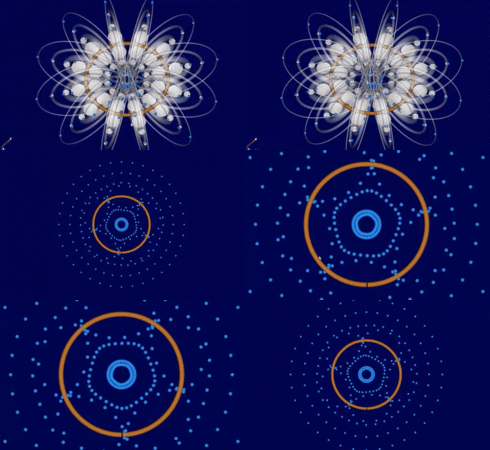
According to my personal research and to data gathered by many other researchers around the world, almost everything in our universe consists of fields/energy, which tend to form a shape that is known to us as torus. Either in its full shape, or just partially (as a vortex), you can it almost everywhere: blood cells, plants/fruits, galaxies, and of course – energy fields that we call magnetic:
At this stage it is very important to understand that torus shape is inherent in everything. To many people it seems that there is no direct connection between the shape of magnetic field and some fruits like apple (for example). But as far I as I’m concerned (or at least, according to what I tend to believe) – the connection between those is direct. If we see this shape both in energy fields and in shape of fruits/plants/galaxies it most probably MEANS SOMETHING.
Another important thing to note is that torus shape is actually not the most accurate description of the field. Firstly, we have (what I call) external geometry, which consists of a torus AND a hyperboloid. The hyperboloid goes through the hole of the torus (it strongly resembles an hourglass).
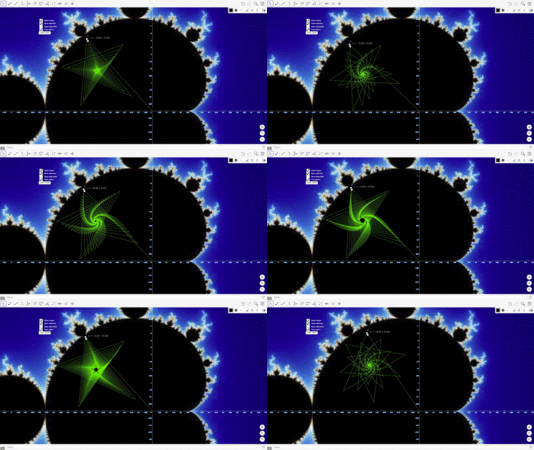
Secondly, we have internal geometry, which (from geometric point of view) is formed by two oppositely-directed vortices. The number of arms of the vortex defines the number of points of the geometric figure that we see in the middle of torus (the very internal geometry I referred to previously).
Based on the research conducted by YT channel «
Fractal Woman» and my personal observations, I can confidently say that the internal geometry of a field represents its frequency. Many people are used to thinking that frequency is something that should be represented by a digital value or some math formula, but in reality the most accurate and simplest representation of it
is a geometric shape.
Especially when it comes to identifying and classifying energy fields of different types of matter (particularly at microlevel, which is very hard to observe). That’s where things become tricky. Assuming that each energy field (be it the so-called magnetic field, or a certain force that forms the body of an apple) has a geometric image that represents its frequency,
how can we accurately classify and identify them? This is particularly crucial when it comes to understanding frequency/geometry of magnetic field and other fields (or rather states of field, if we strive to be more precise).
In the 3rd part of «The Lost Key» I assumed that superconductivity is strongly associated with hexagonal shape, while magnetism may be connected to pentagon (the latter is purely my speculation based on logic, and conclusions reached by Ken Wheeler in his book about magnets).
OK, so you are probably asking yourself – why should I care about it, even if it’s true? The answer is the following: knowledge of the system/logic behind field geometry of different types of matter can give us a universal key to almost everything. Having this key, we could compile a new systematic table of matter (similar to the Mendeleev’s one, but much more profound), that would explain all the inconsistencies in the existing physical model of our universe.
Now let’s get closer to Nigel’s Battery issue. To understand the reason why it works, you need to start thinking in terms of field geometry. Even though we don’t know the exact field geometry of magnetic field, we know that, most probably, it is uniform across all existing magnets. If we stack several magnets together, the main properties of the field do not change, it just becomes bigger/stronger (which means that the field geometry also stays the same).
View attachment 21931
*(the amount of magnets (3) was chosen randomly, there can be any amount you like)
*(the presented geometric shapes were chosen randomly, just to give you a general idea)
But in Nigel’s battery we have some additional components that are added to the chain of magnets, which make it perform differently. In the video posted by 3D Printing Bear we add copper, zinc and magnesium. If it performs differently, it most probably means that the resulting field and its geometry have changed (frequency and properties are always interconnected). And since we know that we aren’t adding anything else except for those components, it means that they somehow manage to influence the field of magnets.
What can influence a field? Obviously – another field. But some would object that those materials are not magnets or radioactive! Indeed. But what if our understanding of existing fields is very incomplete? What if those elements ALSO create fields of certain frequency? Yes, we don’t see them with our eyes or any other available tools. Yes, we do not see them interact with each other (at least visually). Yes, they do not attract or repel anything. BUT, it doesn’t mean that they can’t exist. We are just not used to thinking about their existence, while some bad guys who pull the strings and control science would obviously do everything to suppress such knowledge if it existed. So I see no reason why they shouldn’t exist. So let’s assume that it’s true. Keeping that in mind, let’s draw a new image with magnets and those elements, but this time depicting them all with fields.
Now we see that all those fields should somehow interact with each other. But how can we find out any details about the nature of their interaction, given that we know NOTHING about the given phenomenon? The easiest way to solve this question is to address the field geometry aspect. What we have here can be imagined as mathematic/geometric task, where several geometric shapes are being stacked together.
View attachment 21934
*(once again reminding you that these shapes are just examples to give you a general idea)
The only problem is that we don’t know the exact shapes of given fields. BUT, if we somehow manage to discover a way to identify the exact field geometry of magnets, this task would become MUCH easier to solve. By knowing the initial field geometry of magnet, and the one that appears when we add those additional elements, we can compare it and make out some rules and patterns of how different fields interact with each other in terms of their geometry. Simply saying, going for geometry is the easiest way because we (as humans) can at least see the difference between geometric shapes. It can also become a stable anchor point for anyone capable of doing research.
But how can we find out the field geometry of a magnet? I think that the easiest way is to look for crystal structure of different magnetic materials. At least that’s where we could start. The only problem is that we cannot rely on the data provided by official science here. I tried doing my research in this direction and discovered that all information there is extremely vague and intricate, as if someone deliberately made it like this.
In case someone wonders why we can’t see the exact field geometry of a magnet using Ferocell – the answer is probably because it is not capable of detecting it. I guess you need to have a more sensitive device/scanner to reveal its field geometry.
Ok, let’s sum it all up in simple words. Those additional components of Nigel’s battery (copper, zinc and magnesium) also create fields. On their own they are useless, but in combination with magnetic fields, they can result in something more productive. Using the right combination of fields creates a new field with unique features. To understand the logic behind their interaction, you need to address the aspect of field geometry, which is a visual representation of frequency. Every field has its own frequency (geometric shape), including the magnetic one.