Exploring the technology of Prof. Nigel Cheese: Quantum Battery

Hey guys, I have been catching up with this thread and the work of Nigel but there's a lot to get through still.
Does anyone have a contact for Nigel, himself? Is the Gmail address he published still valid?

I'd really like to help him take stuff into production and distribution.
 
If you have a gander at this it should help you with a greater understanding of how Nigel Cheese's quantum battery works and a few other important things as well. I would recommend watching Santos' presentation too, of which the video presentation is a bit patchy, but the content is very worthy and is built upon at 48:40 in explaining and cross referencing with Walter Russell's great body of work.

If you have any questions FPV Angel holds a live feed on his channel, APM Research 24/7 - Live, on which you can ask away. Njoi ...


View: https://www.youtube.com/watch?v=iGvleVAqaRk
 
At the 12.00 mark he mentions "protons" and "electrons". He's an IDIOT... the translator is illiterate.
His "proton becomes and electron" is totally inconsistent with Russellian Science.
He then goes on to count these MARBLES as a construct of an 'atom'. Again, this is Inconsistent with Russellian Science.
I may watch more later just to see if there's anything actually true about this presentation but Im not holding my breath.
This guy In My Opinion, is trying to look smart by joining Russellian Science with Particle Theories.
I want to vomit
 
Better question is,
Has anyone made a working “battery” that does not loose its charge as it dries out and corrodes the metal’s used?
Second question,
Is Nigel another controlled opposition opportunist?

I recently attempted his magnetic propulsion turning bar magnets at a 45%(approx) to the ones on the train. Found in one of his videos. It failed all attempts to get it to work.
 
Better question is,
Has anyone made a working “battery” that does not loose its charge as it dries out and corrodes the metal’s used?
Second question,
Is Nigel another controlled opposition opportunist?

I recently attempted his magnetic propulsion turning bar magnets at a 45%(approx) to the ones on the train. Found in one of his videos. It failed all attempts to get it to work.
Short answer, yes, at least possibly. I haven't had time to record a new video covering the new design & prototype I made but I'll attach photos. I built it late night on Aug. 27th and after day one it was putting out 4-5V. As of today it still happily lights an LED, and when given time to sit or put on a multi-meter will work back up from the ~2.4V of the LED to ~4-5V.
IMG20220905082506.jpg

The new design uses the exact same graphite and zinc foils I've used from the beginning of my experiments, but instead of wet paper or o-rings I used slices cut of an acrylic tube I ordered. I also used the same jug of distilled water and dropper bottle for filling each cell, however I used alcohol to clean everything to avoid contaminants.

As to your 2nd question, no I do not believe Nigel is controlled opposition. If he was, I'd say he's some of the "worst" controlled opposition I've seen and would've been "fired" by now. He refuses money & donations, he's spoken out against all number of worldly evils on LinkedIn and had his posts deleted, he has no website or method to even collect or give money, which is almost a cornerstone of controlled opposition. Beyond that I am one of at least 3 engineers I know who are regularly proving out his technologies and theories, and developing them further with his help. FWIW
 
Beyond that I am one of at least 3 engineers I know who are regularly proving out his technologies and theories, and developing them further with his help
So as that is the case have any of you asked Nigel precisely what the paper is in his vide and why he builds and demonstrates a dry cell yet you are building and demonstrating a wet cell?
 
So as that is the case have any of you asked Nigel precisely what the paper is in his vide and why he builds and demonstrates a dry cell yet you are building and demonstrating a wet cell?
I have not asked about the paper in that particular video no. I had always assumed as mentioned in either the description or comments of that video that it was either black carbon or construction paper soaked in water magnesium solution of about 3-5%. I agree he does just call it 'a bit of paper' but I never got the impression it was anything particularly exotic. I think he was just doing a short "proof" video by building a basic form of the battery. I do know one of his original goals was creating an emergency power source that could be "activated" by any kind water source. In another QB video he describes a version of the battery as "so to say, dry." but I have not asked it that one uses rubber seals to hold in the water or not.

It's been a very slow and somewhat meandering process getting connected with Nigel and all along the way I have done my best to be polite and respectful without asking for "all the answers" right away. I care a great deal more about understanding his theories and technologies in order to develop them to a useful point. I also don't know how much he is allowed to put out publicly given his military background and history which I won't get into here. The man has had a very complicated life and suffered much for trying to do what was right within multiple organizations.

All that being said, if I get an opportunity I will ask about the black paper from his QB build video.

Also FWIW the QB from my last post continues to put out regular voltage and lights an LED. Despite the fact that it uses water, if one was hermetically sealed and the water & container free of contaminants it could last a very very long time. Embed the thing in epoxy with contacts exposed and it would be a non-toxic sealed battery that for all intent and purpose is dry. If someone broke or cut into it they would just get a wet mess, no acids or alkalines.
 
I have not asked about the paper in that particular video no. I had always assumed as mentioned in either the description or comments of that video that it was either black carbon or construction paper soaked in water magnesium solution of about 3-5%. I agree he does just call it 'a bit of paper' but I never got the impression it was anything particularly exotic. I think he was just doing a short "proof" video by building a basic form of the battery. I do know one of his original goals was creating an emergency power source that could be "activated" by any kind water source. In another QB video he describes a version of the battery as "so to say, dry." but I have not asked it that one uses rubber seals to hold in the water or not.

It's been a very slow and somewhat meandering process getting connected with Nigel and all along the way I have done my best to be polite and respectful without asking for "all the answers" right away. I care a great deal more about understanding his theories and technologies in order to develop them to a useful point. I also don't know how much he is allowed to put out publicly given his military background and history which I won't get into here. The man has had a very complicated life and suffered much for trying to do what was right within multiple organizations.

All that being said, if I get an opportunity I will ask about the black paper from his QB build video.

Also FWIW the QB from my last post continues to put out regular voltage and lights an LED. Despite the fact that it uses water, if one was hermetically sealed and the water & container free of contaminants it could last a very very long time. Embed the thing in epoxy with contacts exposed and it would be a non-toxic sealed battery that for all intent and purpose is dry. If someone broke or cut into it they would just get a wet mess, no acids or alkalines.
Thank you.
 
I’m frustrated by people, Nigel included, that claim to have something, but never fully disclose any build plans that are precise enough to make it.
I’m all for experimenting and have put a tremendous amount of time and money into various types of devices yet in the end don’t work. Or some important part is left out. Like what kind of paper is being used??
However thank you for sharing your results. I will be interested to know what the zinc looks like after a few weeks. I suspect it will be quite corroded.
 
I’m frustrated by people, Nigel included, that claim to have something, but never fully disclose any build plans that are precise enough to make it.
I’m all for experimenting and have put a tremendous amount of time and money into various types of devices yet in the end don’t work. Or some important part is left out. Like what kind of paper is being used??
However thank you for sharing your results. I will be interested to know what the zinc looks like after a few weeks. I suspect it will be quite corroded.
I understand your frustration and sympathize. I have spent well over 10 years trying to research, investigate, and test (if possible) several different alternative/over-unity claims. Even though Nigel does not necessarily come out and say exactly what he's doing in every video, he's put out FAR more than anyone else I've come across. I got as far as I did (including my current longest lasting design) just from content he put out online and before having any direct communication. There are 3-5 other technologies described in PDF's he's released that I would quit my job to pursue and put out open-source designs for if I financially could. So while he didn't say the exact kind of paper, if you watch his videos describing generating power from LED's and earth circuits people can (and have) replicate most of it. That's exactly how Michael T. became Nigel's PCAM engineer and he built the first prototype (which I've seen the videos of working). I guess it comes down to the differences I see between Nigel and others (for me), mostly coming down to money. He has no way of giving him money, no site, no page, no social media page, and outright refuses donations. Every other person in the world of alt energy I've seen has something they are selling, and some way to give them money.

My goal through this thread and my videos has been to do that opposite of what you're frustrated with, by being transparent as I can with everything I'm building and testing. I aim to continue until I've got something practical that I can build, even if just for myself to use, and will show others how they can as well. If I can put out the materials, plans and instructions to build a QB that allows charging of small devices for weeks to months (maybe years) I'll be pretty happy. That would be a necessary proof of the concept, and open up more minds to possibilities and new design ideas going forward. Then instead of people just saying "that's impossible because of such-and-such law" they might just build and test to see for themselves. I'd love to see more average folk do REAL science at home and prove things out for themselves.

I'll post an update here on the status of the zinc and graphite foils with the new design. Considering I have air trapped in most of the cells I agree there will be some corrosion. The cells in this version are siliconed close. Properly doped epoxies could solve this issue however, and would allow for the right ionic-diode effect while maintaining corrosion resistance, and providing a hermetic seal. I hope to film a new video soon with an update on the new design and how it's worked after several weeks to a month. So far I use it as a nightlight on my night stand and randomly remove the LED during the day to re-check voltage, which keeps going back up to 4-5V from the ~2.4V that the LED runs at.
 
Last edited:
So as that is the case have any of you asked Nigel precisely what the paper is in his vide and why he builds and demonstrates a dry cell yet you are building and demonstrating a wet cell?
Ok I have an official answer about the paper which I'll quote: "It was a standard A2 piece of black craft paper purchased from any commercial artist outlet, in this case the second floor of a shop called muller. It is just "thick absorbent paper"... That is the mystical material." That's what I had thought, which is why I used cardstock paper for most of my early builds.

I have not yet asked about the 'so to say, dry.' QB from his other video, but I'm pretty sure that one uses rubber seals to hold in a drop of water and the magnets help hold the seal to prevent evaporation.

At this point I am not totally sure how possible, or rather long lasting, a QB of fully dry materials would be? I assume someone could create a dry middle "electrolyte" layer that would act as the ion source, and with the right materials layered on either side you could induce the same ion flow that can light an LED or be captured in a capacitor or standard battery. At that point it comes down to whether there is a strong molecular chemical reaction happening at the interface layers between materials that could cause corrosion or creation of new compounds that reduce performance. I'm hardly a chemist though so all of that is outside my skillset.
 
Better question is,
Has anyone made a working “battery” that does not loose its charge as it dries out and corrodes the metal’s used?
Second question,
Is Nigel another controlled opposition opportunist?

I recently attempted his magnetic propulsion turning bar magnets at a 45%(approx) to the ones on the train. Found in one of his videos. It failed all attempts to get it to work.
I have to agree with 3D Printing Bear.
It does work when you use the right materials. In my version I used magnets, pyrolytic graphite , magnesium strips and an diy electrolyte. It depends on the electrolyte you use.

My recent built had the led lightened 18 days and there was no degradation or rust on the magnets. Water was not part of this version as water reacts with magnesium and create rust. I'll post image od my QB that lasted 18 days.

I'm on another project way more interesting which is regarding the light bridge and the RPP using 2 earths. I was able to get 30 volts from it. I can't reach the voltage Nigel gets but I'm still learning how to get there.

Anyone replicated the light bridge successfully ? Heres my try but I think it's not working as Nigel's

Please share if you were able to successfully replicate.
Screenshot_20220924-081606_Gallery.jpg
Screenshot_20220924-081511_Gallery.jpg
Screenshot_20220924-081824_Gallery.jpg
 
Is anyone here working on Nigel light bridge and RPP?

I've tried to replicate after several attempts and the best I can do is 30v DC but the capacitor don't fully charge. For example a 450v 100uF capacitor only recharges around 29 volts. From Nigel videos he's capable of filling a 400v capacitor.

I'll leave some pictures of what I accomplished.

First picture have a 50v 1uF capacitor just for demonstration purposes , the second doesn't have the capacitor.

Why doesn't it fully charge like Nigel demonstrated , any ideas?

I had to arrange the diodes like that because the way Nigel has doesn't work in my circuit
20220925_091242.jpg
20220925_091228.jpg
 
Is anyone here working on Nigel light bridge and RPP?

I've tried to replicate after several attempts and the best I can do is 30v DC but the capacitor don't fully charge. For example a 450v 100uF capacitor only recharges around 29 volts. From Nigel videos he's capable of filling a 400v capacitor.

I'll leave some pictures of what I accomplished.

First picture have a 50v 1uF capacitor just for demonstration purposes , the second doesn't have the capacitor.

Why doesn't it fully charge like Nigel demonstrated , any ideas?

I had to arrange the diodes like that because the way Nigel has doesn't work in my circuit
Nice try but you are missing the earth connections. I have replicated some of Nigel's light bridge. Before you do anything you will need 2 earths connected to both ends of the LEDs. Iron is best, steel or galvanized steel is also good. Connect some black annealed wire to the ground and connect it to a ring of LEDs in a serial connection and keep the wire insulated or avoid the wire touching anything in between. Use 5mm clear cold white LEDs. Avoid using copper. When it's dark you should see the ring of LEDs glow white/light blue very dim and flicker. This is a Cherenkov effect. The arrangement described above will not produce power but demonstrates that LEDs really do not need much current to operate.
I understand your frustration and sympathize. I have spent well over 10 years trying to research, investigate, and test (if possible) several different alternative/over-unity claims. Even though Nigel does not necessarily come out and say exactly what he's doing in every video, he's put out FAR more than anyone else I've come across. I got as far as I did (including my current longest lasting design) just from content he put out online and before having any direct communication. There are 3-5 other technologies described in PDF's he's released that I would quit my job to pursue and put out open-source designs for if I financially could. So while he didn't say the exact kind of paper, if you watch his videos describing generating power from LED's and earth circuits people can (and have) replicate most of it. That's exactly how Michael T. became Nigel's PCAM engineer and he built the first prototype (which I've seen the videos of working). I guess it comes down to the differences I see between Nigel and others (for me), mostly coming down to money. He has no way of giving him money, no site, no page, no social media page, and outright refuses donations. Every other person in the world of alt energy I've seen has something they are selling, and some way to give them money.

My goal through this thread and my videos has been to do that opposite of what you're frustrated with, by being transparent as I can with everything I'm building and testing. I aim to continue until I've got something practical that I can build, even if just for myself to use, and will show others how they can as well. If I can put out the materials, plans and instructions to build a QB that allows charging of small devices for weeks to months (maybe years) I'll be pretty happy. That would be a necessary proof of the concept, and open up more minds to possibilities and new design ideas going forward. Then instead of people just saying "that's impossible because of such-and-such law" they might just build and test to see for themselves. I'd love to see more average folk do REAL science at home and prove things out for themselves.

I'll post an update here on the status of the zinc and graphite foils with the new design. Considering I have air trapped in most of the cells I agree there will be some corrosion. The cells in this version are siliconed close. Properly doped epoxies could solve this issue however, and would allow for the right ionic-diode effect while maintaining corrosion resistance, and providing a hermetic seal. I hope to film a new video soon with an update on the new design and how it's worked after several weeks to a month. So far I use it as a nightlight on my night stand and randomly remove the LED during the day to re-check voltage, which keeps going back up to 4-5V from the ~2.4V that the LED runs at.
Short answer, yes, at least possibly. I haven't had time to record a new video covering the new design & prototype I made but I'll attach photos. I built it late night on Aug. 27th and after day one it was putting out 4-5V. As of today it still happily lights an LED, and when given time to sit or put on a multi-meter will work back up from the ~2.4V of the LED to ~4-5V.

The new design uses the exact same graphite and zinc foils I've used from the beginning of my experiments, but instead of wet paper or o-rings I used slices cut of an acrylic tube I ordered. I also used the same jug of distilled water and dropper bottle for filling each cell, however I used alcohol to clean everything to avoid contaminants.

As to your 2nd question, no I do not believe Nigel is controlled opposition. If he was, I'd say he's some of the "worst" controlled opposition I've seen and would've been "fired" by now. He refuses money & donations, he's spoken out against all number of worldly evils on LinkedIn and had his posts deleted, he has no website or method to even collect or give money, which is almost a cornerstone of controlled opposition. Beyond that I am one of at least 3 engineers I know who are regularly proving out his technologies and theories, and developing them further with his help. FWIW
Well done mate. Guess who?
Is anyone here working on Nigel light bridge and RPP?

I've tried to replicate after several attempts and the best I can do is 30v DC but the capacitor don't fully charge. For example a 450v 100uF capacitor only recharges around 29 volts. From Nigel videos he's capable of filling a 400v capacitor.

I'll leave some pictures of what I accomplished.

First picture have a 50v 1uF capacitor just for demonstration purposes , the second doesn't have the capacitor.

Why doesn't it fully charge like Nigel demonstrated , any ideas?

I had to arrange the diodes like that because the way Nigel has doesn't work in my circuit
BravosSix apologies for the assumption that you hadn't used two earths, I couldn't see these in the picture with the Light Bridge and the oscilloscope. The voltage issue you have is with just working with a DC earth the LEDs are limiting the voltage output. For example you have sixteen 10mm LEDs and only getting 29V. So on average it is generating 29 V / 16 LEDs or approx. 1.8V per LED. Well done. To get the higher voltage across the capacitor a high frequency signal and a serial LED load is needed. Nigel mentions in other videos that a DC to AC inverter is used on the capacitor output. The frequency is returned to one earth to create harmonic frequencies across the light bridge.
The 1st image is my breadboard R&D version of the photonic harvester's light bridge. On the bottom left are two magnetic compound SIPs and a twin earthed Cherenkov LED ring. All LEDs are warm white piranha / super flux LEDs. Above that is a magnetic convergence circuit. In the center and bottom right are the LED load panels and capacitors for storage. At the top right is the frequency management unit microprocessor. Note that the setup below was just for temporary testing and does not reflect the current design.
The 2nd image shows Nigel's LED load panels from the videos found on Greg Ottenmeyer's Gaea ZPE youtube channel. I contacted Nigel and asked about these and he suggested that these panels are just 48 LEDs in series. In the video Nigel says they are connected by 1 wire, but its 1 multicore wire. It's two wires; a serial connector and an RF signal that goes to ground and is connected at the center of each row of LEDs. These panels are not intended to go to full brightness they are used to bring up the voltage potential. These panels are similarly replicated in the top image using 8 rows of 16 LEDs in parallel which gives a voltage of 48V. The parallel connections increases the current.
LED2.jpeg
LED.jpeg
Has anyone tried connecting multiple QB stacks in parallel? I've read that many of you are getting great voltage potentials whilst increasing the length of the stacks, but just like the LED load panels I described previously that are used in Nigel's light bridge, adding QB stacks in parallel would increase the current output. I would like to hear if anyone can increase the brightness of their LEDs or even store the harvested energy into capacitors. For QB technology to be viable it would need to store the harvested energy into supercapacitors at 5V or 12V or more.
 
Last edited:
Nice try but you are missing the earth connections. I have replicated some of Nigel's light bridge. Before you do anything you will need 2 earths connected to both ends of the LEDs. Iron is best, steel or galvanized steel is also good. Connect some black annealed wire to the ground and connect it to a ring of LEDs in a serial connection and keep the wire insulated or avoid the wire touching anything in between. Use 5mm clear cold white LEDs. Avoid using copper. When it's dark you should see the ring of LEDs glow white/light blue very dim and flicker. This is a Cherenkov effect. The arrangement described above will not produce power but demonstrates that LEDs really do not need much current to operate.


Well done mate. Guess who?

BravosSix apologies for the assumption that you hadn't used two earths, I couldn't see these in the picture with the Light Bridge and the oscilloscope. The voltage issue you have is with just working with a DC earth the LEDs are limiting the voltage output. For example you have sixteen 10mm LEDs and only getting 29V. So on average it is generating 29 V / 16 LEDs or approx. 1.8V per LED. Well done. To get the higher voltage across the capacitor a high frequency signal and a serial LED load is needed. Nigel mentions in other videos that a DC to AC inverter is used on the capacitor output. The frequency is returned to one earth to create harmonic frequencies across the light bridge.
The 1st image is my breadboard R&D version of the photonic harvester's light bridge. On the bottom left are two magnetic compound SIPs and a twin earthed Cherenkov LED ring. All LEDs are warm white piranha / super flux LEDs. Above that is a magnetic convergence circuit. In the center and bottom right are the LED load panels and capacitors for storage. At the top right is the frequency management unit microprocessor. Note that the setup below was just for temporary testing and does not reflect the current design.
The 2nd image shows Nigel's LED load panels from the videos found on Greg Ottenmeyer's Gaea ZPE youtube channel. I contacted Nigel and asked about these and he suggested that these panels are just 48 LEDs in series. In the video Nigel says they are connected by 1 wire, but its 1 multicore wire. It's two wires; a serial connector and an RF signal that goes to ground and is connected at the center of each row of LEDs. These panels are not intended to go to full brightness they are used to bring up the voltage potential. These panels are similarly replicated in the top image using 8 rows of 16 LEDs in parallel which gives a voltage of 48V. The parallel connections increases the current. Has anyone tried connecting multiple QB stacks in parallel? I've read that many of you are getting great voltage potentials whilst increasing the length of the stacks, but just like the LED load panels I described previously that are used in Nigel's light bridge, adding QB stacks in parallel would increase the current output. I would like to hear if anyone can increase the brightness of their LEDs or even store the harvested energy into capacitors. For QB technology to be viable it would need to store the harvested energy into supercapacitors at 5V or 12V or more.
Really appreciate your inputs . Thank you. I'm learning and trying what I can do to make it work. Also waiting to receive my DC inverter to add and test it out.

I've come across with something that is confusing me which is about the light bridge.. The built I've made works without the LEDs, I mean when I remove the LEDs the voltage is the same as if the diodes are the only ones pulling that voltage . Pics to demonstrate.

Meanwhile I'm testing a recharge on a 2.7v 500Farad capacitor. It's charging around 0.01per hour from 2 earths. Added 1 purple LED to the build to get around 2.7 volts, and seems to be working. The 0.019v pic was taken yesterday at 00:30am and 0.028v was at 06h30 am
20220928_002253.jpg
20220928_064516.jpg
 

Attachments

  • 20220926_120516.jpg
    20220926_120516.jpg
    1.3 MB · Views: 102
  • 20220926_120551.jpg
    20220926_120551.jpg
    1.1 MB · Views: 102
Next thing to do is whilst measuring the DC voltage across the LEDs also measure the AC voltage from the anode to a ground. Then also measure the AC voltage across the LEDs. You will need to disconnect the ground from the circuit and connect it in series like measuring current. Ask yourself where is the AC is coming from? Take it back to basics using just one LED and build from there.
1664351844277.png

You mentioned that you're trying to charge a large supercapacitor. The image above shows six 2.7V volt 500F supercaps in series fully charged to about 15 to 16V across a supercap management board ALD SABMB6. It's ungrounded and there are no LED loads. It's the raw energy harvesting from my synthetic photon generator. So it is possible to harvest a lot of energy from LEDs. I originally built this to store the energy harvested from a 20W solar panel. This is being used for mass energy storage. Unlike the energy harvested from a solar panel, to use this energy with silicon based electronics it must be passed through a large bank of capacitors otherwise the voltage will be reduced to the safe input of the device's input. That device at the top right is a DFRobot solar management board that was previously connected directly to the 20W solar panel. Unfortunately the required 15 to 30V input range drops to only 3.6V when connected directly to the raw output of the photon harvester. Also try charging a 25V 1000uF electrolytic capacitor and discharging it with the stored energy. You will get a very impressive white spark not an arc like an electron discharge. See below. This energy is not electrons and will not destroy the capacitor and can be repeated many times without degradation of the capacitor.
1664353969450.png
The energy generated via PCAMs can be stored indefinitely and if built large enough could be used either as a hyper power pulse discharge of many 1000's of ion volts, or slow release, where the slow release offers an intelligent on demand supply that never degrades a circuit.
In addition, when used in the hyper pulsed mode the energy released will melt iron (which normally has a melting point in excess of 3000K), but as shown, the energy release does not effect any organic matter and is, for want of a phrase cold to the touch. Could a controlled kinetic energy release of this energy be the basis for an "ion drive" propulsion system?
There is also a video of this same demonstration where a plasma ball is generated and another shot where the spark has entered the into the skin of the arm holding the discharge capacitor and the steel bar used in the demonstration was fused onto the capacitor leaving carbon scoring.
 
Last edited:
Next thing to do is whilst measuring the DC voltage across the LEDs also measure the AC voltage from the anode to a ground. Then also measure the AC voltage across the LEDs. You will need to disconnect the ground from the circuit and connect it in series like measuring current. Ask yourself where is the AC is coming from? Take it back to basics using just one LED and build from there.

You mentioned that you're trying to charge a large supercapacitor. The image above shows six 2.7V volt 500F supercaps in series fully charged to about 15 to 16V across a supercap management board ALD SABMB6. It's ungrounded and there are no LED loads. It's the raw energy harvesting from my synthetic photon generator. So it is possible to harvest a lot of energy from LEDs. I originally built this to store the energy harvested from a 20W solar panel. This is being used for mass energy storage. Unlike the energy harvested from a solar panel, to use this energy with silicon based electronics it must be passed through a large bank of capacitors otherwise the voltage will be reduced to the safe input of the device's input. That device at the top right is a DFRobot solar management board that was previously connected directly to the 20W solar panel. Unfortunately the required 15 to 30V input range drops to only 3.6V when connected directly to the raw output of the photon harvester. Also try charging a 25V 1000uF electrolytic capacitor and discharging it with the stored energy. You will get a very impressive white spark not an arc like an electron discharge. See below. This energy is not electrons and will not destroy the capacitor and can be repeated many times without degradation of the capacitor.
The energy generated via PCAMs can be stored indefinitely and if built large enough could be used either as a hyper power pulse discharge of many 1000's of ion volts, or slow release, where the slow release offers an intelligent on demand supply that never degrades a circuit.
In addition, when used in the hyper pulsed mode the energy released will melt iron (which normally has a melting point in excess of 3000K), but as shown, the energy release does not effect any organic matter and is, for want of a phrase cold to the touch. Could a controlled kinetic energy release of this energy be the basis for an "ion drive" propulsion system?
There is also a video of this same demonstration where a plasma ball is generated and another shot where the spark has entered the into the skin of the arm holding the discharge capacitor and the steel bar used in the demonstration was fused onto the capacitor leaving carbon scoring.
Your built is impressive, that's another level for sure comparing to what I was trying to do, and thank you for sharing your experience.

Sorry for my lack of knowledge but I'm still learning. All this is new to me, I have no concrete basic eletronics experience nor electricity real education, I think I'm aware it can be dangerous. I'll try to learn fast to avoid dangerous mistakes. By the way, Nigel if you are reading this thank you for your kind warning, I'll do my best to avoid it.

I don't know which one is the anode or catode on my built..
20220928_135435.jpg
20220928_141956.jpg
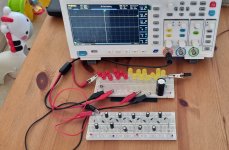
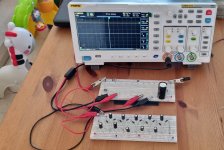
But I think the light bridge works. Just took this pic to demonstrate while using just 1 ground connected and the oscilloscope in the end (making the AC ground?) whilst the purple leds light up . I'm not using an AC inverter yet to grou d it to earth, still waiting to arrive.

Can you please provide more details in your project, looks very interesting .

Kind Regards
 
Your built is impressive, that's another level for sure comparing to what I was trying to do, and thank you for sharing your experience.

Sorry for my lack of knowledge but I'm still learning. All this is new to me, I have no concrete basic eletronics experience nor electricity real education, I think I'm aware it can be dangerous. I'll try to learn fast to avoid dangerous mistakes. By the way, Nigel if you are reading this thank you for your kind warning, I'll do my best to avoid it.

I don't know which one is the anode or catode on my built.. But I think the light bridge works. Just took this pic to demonstrate while using just 1 ground connected and the oscilloscope in the end (making the AC ground?) whilst the purple leds light up . I'm not using an AC inverter yet to grou d it to earth, still waiting to arrive.

Can you please provide more details in your project, looks very interesting .

Kind Regards
BravoSix thank you for the compliment on my build, but that's not the half of it. Currently I am designing a brand new type of Photonic Harvesting Array that uses LEDs as opposed to photovoltaic cells used in solar panels. It's the next evolution of NCs RPP, but there is still a long way to go. I've also worked on other aspects of NC's tech; QB's, magnetic compound SIPs, SCU and PCAMs since 2018 and have a slight advantage as I have a Dip. in electrical engineering, an AdvDip. in mechanical engineering and a B.Tech in Mechatronics as well as over 20 years experience as an automation control systems engineer and currently work in as a senior engineer / project lead in automation projects for a global mining and metals company that has no idea that I work on research on the side. If they did they would try to to claim any registered IP for themselves. As company engineers our employment contracts include granting any registered IP to them, so I'm careful to remain anonymous for the time being. That's enough about me and I'm starting to bore myself so lets get back to talking tech.

First thing, don't worry about electronics experience, you have an oscilloscope and it looks like you know how to use it so that's a good start, it suggests that you have some physics lab knowledge. I strongly suggest getting 1 or 2 or more digital multimeters that can measure DC and AC voltages as well as DC and AC currents. Look up LED on Google and work out which legs are the anode and cathode of a diode. The anode leg is usually longer but will depend on what type of LED you're using. There is a gap inside the LED between the anode and cathode and this is where the magic happens as charged particles are jumping between that gap. Normally the anode is connected to positive and the cathode is connected to ground or 0V, this is called a forward bias connection. When the two grounds are connected there may be an inversion of the voltage polarity across the LED making the connection reverse bias. Next measure to see if there is an AC voltage across the LED bridge, if there is then you have created frequency harmonics which we want and it means that there is a reciprocating current travelling in both directions through the LED bridge. You mentioned that a voltage remains even when the LEDs are disconnected, this is expected as there is a voltage difference between the two ground connections and this is called a ground potential difference, however what you're seeing when the LEDs are connected is called the scalar wave that travels along the surface of the earth from north to south which when connected to LEDs gets amplified and measurable. The LEDs act as an antenna and an amplifier.

When connecting the inverter be extremely careful as things can go bang and burn very quickly, including you. I haven't tried integrating an inverter but I have lots of electrical experience in industry, so I think that the neutral on the ac side will be tapped off to return to one side of the LED bridge. Check NC's videos for which side, I can't remember, probably the cathode. NC also states that this system needs an external generator to get started, meaning that the light bridge unaided will generate more than 12V DC, but will not have the power to operate the inverter initially so you will need a way for it to switch over from a 12V lead acid rechargeable battery once the harmonic feedback is operational. I can't stress this much more, please be very careful.

Shout out to 3D Printing Bear. Thank you for starting this post and I'm very impressed with the collaboration as discussed and shared here on the QB. You guys have far exceeded any efforts that I made in that area. If you don't mind me suggesting I think you guys need to work on making arrays of QB that can sustain power outputs of 5 and 12 volts at 1 or 2 amperes or more to power conventional electronic devices via small supercapacitors. Perhaps also finding ways of containing the QB stacks in tight fitting polycarbonate enclosures and drip feeding distilled water to keep the QBs moisture levels up and maintain optimum energy outputs.
 
Last edited:
BravoSix thank you for the compliment on my build, but that's not the half of it. Currently I am designing a brand new type of Photonic Harvesting Array that uses LEDs as opposed to photovoltaic cells used in solar panels. It's the next evolution of NCs RPP, but there is still a long way to go. I've also worked on other aspects of NC's tech; QB's, magnetic compound SIPs, SCU and PCAMs since 2018 and have a slight advantage as I have a Dip. in electrical engineering, an AdvDip. in mechanical engineering and a B.Tech in Mechatronics as well as over 20 years experience as an automation control systems engineer and currently work in as a senior engineer / project lead in automation projects for a global mining and metals company that has no idea that I work on research on the side. If they did they would try to to claim any registered IP for themselves. As company engineers our employment contracts include granting any registered IP to them, so I'm careful to remain anonymous for the time being. That's enough about me and I'm starting to bore myself so lets get back to talking tech.

First thing, don't worry about electronics experience, you have an oscilloscope and it looks like you know how to use it so that's a good start, it suggests that you have some physics lab knowledge. I strongly suggest getting 1 or 2 or more digital multimeters that can measure DC and AC voltages as well as DC and AC currents. Look up LED on Google and work out which legs are the anode and cathode of a diode. The anode leg is usually longer but will depend on what type of LED you're using. There is a gap inside the LED between the anode and cathode and this is where the magic happens as charged particles are jumping between that gap. Normally the anode is connected to positive and the cathode is connected to ground or 0V, this is called a forward bias connection. When the two grounds are connected there may be an inversion of the voltage polarity across the LED making the connection reverse bias. Next measure to see if there is an AC voltage across the LED bridge, if there is then you have created frequency harmonics which we want and it means that there is a reciprocating current travelling in both directions through the LED bridge. You mentioned that a voltage remains even when the LEDs are disconnected, this is expected as there is a voltage difference between the two ground connections and this is called a ground potential difference, however what you're seeing when the LEDs are connected is called the scalar wave that travels along the surface of the earth from north to south which when connected to LEDs gets amplified and measurable. The LEDs act as an antenna and an amplifier.

When connecting the inverter be extremely careful as things can go bang and burn very quickly, including you. I haven't tried integrating an inverter but I have lots of electrical experience in industry, so I think that the neutral on the ac side will be tapped off to return to one side of the LED bridge. Check NC's videos for which side, I can't remember, probably the cathode. NC also states that this system needs an external generator to get started, meaning that the light bridge unaided will generate more than 12V DC, but will not have the power to operate the inverter initially so you will need a way for it to switch over from a 12V lead acid rechargeable battery once the harmonic feedback is operational. I can't stress this much more, please be very careful.

Shout out to 3D Printing Bear. Thank you for starting this post and I'm very impressed with the collaboration as discussed and shared here on the QB. You guys have far exceeded any efforts that I made in that area. If you don't mind me suggesting I think you guys need to work on making arrays of QB that can sustain power outputs of 5 and 12 volts at 1 or 2 amperes or more to power conventional electronic devices via small supercapacitors. Perhaps also finding ways of containing the QB stacks in tight fitting polycarbonate enclosures and drip feeding distilled water to keep the QBs moisture levels up and maintain optimum energy outputs.
Again, thank you very much for your inputs and feedback, really appreciated. I respect your anonymous position, like I do in what I expose and fight for.

I've learnt how to basically use a oscilloscope about 2 or 3 months ago, so you know where I'm now 🤣

I'm really green on this topic but want to learn more about it, it's fascinating me. Just found the need to have a multimeter and an oscilloscope to measure the QB that started to create from NC's videos.

I was able to create one that lasted around 18 days without adding liquids and kept 4v after those 18 days. I stopped using water, copper and zinc on my magnets when they started to rust and degrade with oxidation.

After watching 3D Printed Bear videos I started to research and building QB with pyrolytic graphite and magnesium as he mentioned in the videos. Therefore I'm not using water anymore . Send some pictures of my QB try outs

After 18 days the light on the LED
20220827_061916.jpg
20220817_173246.jpg
20220905_163741.jpg
Started to research how electrolytes were made and glycerine, Epsom salt and Sodium free salt are an option I need to try.

I believe some kind of electrolyte is needed for these QB to work.
20220817_175814.jpg

Now you know this is the multimeter I use with combination with the oscilloscope to measure the light bridge. When I said I didn't know where was the anode and catode is because the polarity changes if a LED or Diode are used from two earths.

Sometimes I use the multimeter to confirm the polarity on the ends and I try to keep the correct colours just to prevent mistakes.

Question: when using the AC inverter van it be connected to a 31v output like the result of my light bridge built ? Or do I need to step down the voltage to 12 volts? (Sorry for my ignorance and lack of knowledge/experience on this matter)
 
Tips
Tips
Please respect our Posting Rules.
Back
Top