Exploring the technology of Prof. Nigel Cheese: Quantum Battery

Well done mate. Guess who?
Thank you Sir, it's great to see you on here and contributing your vast wealth of knowledge and experience! If you happen to feel inspired to start a PCAM or LED-based thread here I'm cure plenty of folks would be excited to read what you have to type up and show. =]

Has anyone tried connecting multiple QB stacks in parallel? I've read that many of you are getting great voltage potentials whilst increasing the length of the stacks, but just like the LED load panels I described previously that are used in Nigel's light bridge, adding QB stacks in parallel would increase the current output. I would like to hear if anyone can increase the brightness of their LEDs or even store the harvested energy into capacitors. For QB technology to be viable it would need to store the harvested energy into supercapacitors at 5V or 12V or more.
I actually did this way at the beginning of my QB experimenting before getting connected with Nigel and I did see an increase in amp reading when connecting up five 10-cell QBs all in parallel, I just wish I was filming or recording all the details back then. As I get more materials in and am able to built up more QBs I can perform the same experiment again but film it this time. When connecting those five QBs up in series or parallel they would light up LEDs the same amount though. What I would like to start working on are experimental stats to being graphing out "ion-volt/ion-amp" outputs based on material types, weights, and properties. For instance how fast would a single 20V QB charge a 10V 500uF capacitor vs. four 20V QBs in parallel, or one that has 30g of magnets and material vs. 300g. I'm excited to get some real numbers behind these and begin to develop useful formulas for future designs, especially if I can integrate them with Nigel's ME/I = E equation.

Shout out to 3D Printing Bear. Thank you for starting this post and I'm very impressed with the collaboration as discussed and shared here on the QB. You guys have far exceeded any efforts that I made in that area. If you don't mind me suggesting I think you guys need to work on making arrays of QB that can sustain power outputs of 5 and 12 volts at 1 or 2 amperes or more to power conventional electronic devices via small supercapacitors. Perhaps also finding ways of containing the QB stacks in tight fitting polycarbonate enclosures and drip feeding distilled water to keep the QBs moisture levels up and maintain optimum energy outputs.
Thank you for joining the thread and offering your expertise! I like your suggestion and that's one of many items on my 'future experiments' list, specifically getting arrays built up in the right series & parallel arrangements to charge the supercapacitors I do have. I have some new materials coming in the mail to try and replicate my latest design with the sealed in distilled water that should let me build smaller versions that should be good for this kind of testing. I'm also slowly starting up notes on the various QB build methods and potential applications & tests. =]
 
Last edited:
20221002_140126.jpg
This is the best I can do without the AC inverter. 35.7 volts DC and AC is similar.
Screenshot_20221003-235158_Gallery.jpg
As I never worked with an AC inverter I don't know if I can add it to this 35.7v output or do I need to use a voltage regulator to step down to 12v for the AC inverter usage.

On my firsts tries on the light bridge I added a QB and I was impressed because the voltage got higher than I was getting . I had no idea what I was doing and why the voltage was getting higher. My first thought was can it be recharged? That's why I tried it. Soon I'll try it again and see what happens, at that time I was getting 3, 4 volts max and it went to 12v. It was exciting ..
It may soud silly ... but I'm new to these kinda experiments.

Soon I'll be receiving the AC inverter and I'm not sure how to properly use it in this light bridge system and I'm aware of NC schematics.

Screenshot_20220905-152010_Gallery.jpg
 
This is the best I can do without the AC inverter. 35.7 volts DC and AC is similar.
As I never worked with an AC inverter I don't know if I can add it to this 35.7v output or do I need to use a voltage regulator to step down to 12v for the AC inverter usage.

On my firsts tries on the light bridge I added a QB and I was impressed because the voltage got higher than I was getting . I had no idea what I was doing and why the voltage was getting higher. My first thought was can it be recharged? That's why I tried it. Soon I'll try it again and see what happens, at that time I was getting 3, 4 volts max and it went to 12v. It was exciting ..
It may soud silly ... but I'm new to these kinda experiments.

Soon I'll be receiving the AC inverter and I'm not sure how to properly use it in this light bridge system and I'm aware of NC schematics.

Sorry if I missed while reading the thread, but where is the resource for creating the light bridge?
 
Sorry if I missed while reading the thread, but where is the resource for creating the light bridge?
Not sure what you mean but the light bridge is the 3volt leds it self amplifying the signal.

From what I understood the LEDS can be connected to several sources, such as:

1. Two earths in the house: the copper water pipe and the earth from the 220v earth supply in the house.

2. Directly from A Radiant Power Panel

3. I use what I could find, an earth from the 220v supply in the house and an earth from my sound box that is distributed to all divisions in my house. Previously used the old TV plugs installation that exists in my house but got better results using the Earth from the sound system.
 
Hello, Can anyone please help me understand why the leds glow sometimes but most of the time are not glowing ?
Screenshot_20221031-151708_Gallery.jpg
 

Attachments

  • Screenshot_20221031-151715_Gallery.jpg
    Screenshot_20221031-151715_Gallery.jpg
    122.2 KB · Views: 130
Maybe they are over heat in some way, i trayed to soldering some LED SMD and sometime they glow because the heat
I'm quite sure it has to do with the right frequencies that oscillate. Not sure though.
 
Does anyone know what configuration Nigel uses on his light bridge demonstrations for the Scalar wave digital sequence ? Is there any special configuration for the positive and negative legs in the LEDs ?

I'm asking this because I'm not able to fill a capacitor such as 400v 470uf.

Can anyone give some inputs , please?
 
Nice try but you are missing the earth connections. I have replicated some of Nigel's light bridge. Before you do anything you will need 2 earths connected to both ends of the LEDs. Iron is best, steel or galvanized steel is also good. Connect some black annealed wire to the ground and connect it to a ring of LEDs in a serial connection and keep the wire insulated or avoid the wire touching anything in between. Use 5mm clear cold white LEDs. Avoid using copper. When it's dark you should see the ring of LEDs glow white/light blue very dim and flicker. This is a Cherenkov effect. The arrangement described above will not produce power but demonstrates that LEDs really do not need much current to operate.


Well done mate. Guess who?

BravosSix apologies for the assumption that you hadn't used two earths, I couldn't see these in the picture with the Light Bridge and the oscilloscope. The voltage issue you have is with just working with a DC earth the LEDs are limiting the voltage output. For example you have sixteen 10mm LEDs and only getting 29V. So on average it is generating 29 V / 16 LEDs or approx. 1.8V per LED. Well done. To get the higher voltage across the capacitor a high frequency signal and a serial LED load is needed. Nigel mentions in other videos that a DC to AC inverter is used on the capacitor output. The frequency is returned to one earth to create harmonic frequencies across the light bridge.
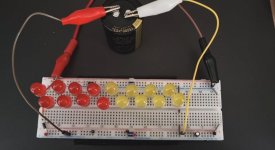
The 1st image is my breadboard R&D version of the photonic harvester's light bridge. On the bottom left are two magnetic compound SIPs and a twin earthed Cherenkov LED ring. All LEDs are warm white piranha / super flux LEDs. Above that is a magnetic convergence circuit. In the center and bottom right are the LED load panels and capacitors for storage. At the top right is the frequency management unit microprocessor. Note that the setup below was just for temporary testing and does not reflect the current design.
The 2nd image shows Nigel's LED load panels from the videos found on Greg Ottenmeyer's Gaea ZPE youtube channel. I contacted Nigel and asked about these and he suggested that these panels are just 48 LEDs in series. In the video Nigel says they are connected by 1 wire, but its 1 multicore wire. It's two wires; a serial connector and an RF signal that goes to ground and is connected at the center of each row of LEDs. These panels are not intended to go to full brightness they are used to bring up the voltage potential. These panels are similarly replicated in the top image using 8 rows of 16 LEDs in parallel which gives a voltage of 48V. The parallel connections increases the current. Has anyone tried connecting multiple QB stacks in parallel? I've read that many of you are getting great voltage potentials whilst increasing the length of the stacks, but just like the LED load panels I described previously that are used in Nigel's light bridge, adding QB stacks in parallel would increase the current output. I would like to hear if anyone can increase the brightness of their LEDs or even store the harvested energy into capacitors. For QB technology to be viable it would need to store the harvested energy into supercapacitors at 5V or 12V or more.
Hello 3D could y share the wiring diagram y followed , and what is frequency value did you put in earth input, the cap value etc..and the .(frequency unit management) device
for info i didn't wire as y did, i followed a digital state order which is +-+- +--+ -+-+ -++- ...................................... the 16 leds
i got 14 volts from 0.7 v coming from to earth supply, but the load doesn't increase much, and its drop slowly when i connect multimeter
thanks in advance
 
Hi,
I have a question about earth connections.
Is it clear when to use iron pins and wires or copper for connecting the earth(s) as mentioned by Nigel in his experiments?
I thought to have read somewhere that using iron wires instead of copper makes a difference if you want to use the earth magnetic flux field in a setup. Also I when using dual ground connections, where do you people connect them to and has the north /south orientation has something of importance?
 
Hi,
I have a question about earth connections.
Is it clear when to use iron pins and wires or copper for connecting the earth(s) as mentioned by Nigel in his experiments?
I thought to have read somewhere that using iron wires instead of copper makes a difference if you want to use the earth magnetic flux field in a setup. Also I when using dual ground connections, where do you people connect them to and has the north /south orientation has something of importance?
Hello Mike, Indeed iron wire drive better EMF, these two wire can be connected to the two sides right and left of the Leds complexe, orientation has its importance but don't know how to orientate south n north, ...
 
Hello Mike, Indeed iron wire drive better EMF, these two wire can be connected to the two sides right and left of the Leds complexe, orientation has its importance but don't know how to orientate south n north, ...
Thanks for the reply, so the grounds need to go into the ground with iron pipes and wires then for this stuff to work?
The grounds from the wall sockets will obviously don't work for this purpose. I've seen a video of someone who experimented with 2 iron grounds outside with wires around a ringmagnet creating voltage, also placing both poles in a north/south lineup, a few meter apart seemed to make difference as far as I understood.
 
Thanks for the reply, so the grounds need to go into the ground with iron pipes and wires then for this stuff to work?
The grounds from the wall sockets will obviously don't work for this purpose. I've seen a video of someone who experimented with 2 iron grounds outside with wires around a ringmagnet creating voltage, also placing both poles in a north/south lineup, a few meter apart seemed to make difference as far as I understood.
That s what i did too, but as i v experienced the two concepts either from rod outiside or using earth home supply, don't think it make much difference, but i agree didn't test with magne (which indeed can make a difference )
Also the correct wiring of Leds is the key+ circuit to feed cap using for exp a LCR circuit
i m still searching too, so once i have made something working, i ll let y know
Hello 3D could y share the wiring diagram y followed , and what is frequency value did you put in earth input, the cap value etc..and the .(frequency unit management) device
for info i didn't wire as y did, i followed a digital state order which is +-+- +--+ -+-+ -++- ...................................... the 16 leds
i got 14 volts from 0.7 v coming from to earth supply, but the load doesn't increase much, and its drop slowly when i connect multimeter
thanks in advance
Sorry Proton i I made a mistake on your username goty confused with 3d
 
Last edited:
Currently I'm testing out my QB's with glycerine.
I have about 600-750 mV per cell with copper and zinc and in between a piece of white paper with a drop of glycerine on it.
Another cell contains of a rubber O ring in between the copper and zinc with a few drops of glycerine in it.
It's kind of stable around @697mV.
As far as I know glycerine isn't electrically conductive.
There is voltage but no measurable Amps in a single cell and I'm still trying to figure outy what is happening since I have no science background.
On my 13 cell glycerine battery I have a white LED lit up since yesterday without voltage any drop yet.
I'm curious to see what the amount of oxidation is on the copper and zinc plates in the cells after a few days.
Will report back on that.
 
Last edited:
Currently I'm testing out my QB's with glycerine.
I have about 600-750 mV per cell with copper and zinc and in between a piece of white paper with a drop of glycerine on it.
Another cell contains of a rubber O ring in between the copper and zinc with a few drops of glycerine in it.
It's kind of stable around @697mV.
As far as I know glycerine isn't electrically conductive.
There is voltage but no measurable Amps in a single cell and I'm still trying to figure outy what is happening since I have no science background.
On my 13 cell glycerine battery I have a white LED lit up since yesterday without voltage any drop yet.
I'm curious to see what the amount of oxidation is on the copper and zinc plates in the cells after a few days.
Will report back on that.
Hello, mix Epson salt in the glycerine to increase voltage. I suggest you to read my previous comments on my built regarding QB , around 1.4 per cell.

Only pyrolytic graphite , magnesium strips and electrolyte without water to prevent destroying the magnets nor the magnesium itself.
 
Hello, mix Epson salt in the glycerine to increase voltage. I suggest you to read my previous comments on my built regarding QB , around 1.4 per cell.

Only pyrolytic graphite , magnesium strips and electrolyte without water to prevent destroying the magnets nor the magnesium itself.
cool, tnx. didn't see that post of yours before. I had a bottle of glycerine in the closet and decided to test it.
Anyway, thanks for the heads up. will obtain some epsom salt along with pyrolytic graphite for upcoming tests.
 
I feel more than a little lame that I haven't posted any updates in a while, but I suppose late is better than not at all. That being said I managed to finally upload the follow-up video to the longest running QB I've built so far, which kept putting out enough ionic voltage flow to light a 2.4V LED for a little over 2 months straight: Dissecting 1400+ hour QB and test filling new cells

My main takeaways at this point are:
  • Even distilled water is corrosive to Zinc (and many elements/compounds), and will eventually corrode through the zinc foil to open air holes allowing water to evaporate out of the cells, apart from turning zinc into zinc oxide.
  • Research an alternative to zinc foil that does not corrode in the presence of distilled water at all, to a much less degree, or at a much slower rate.
  • Research an alternative fluid to water that is not corrosive to the foils and will operate outside of at 0-100C temp range, such as various oils and ideally non-acidic/non-alkaline.
  • Design a case that allows a dry built QB to be "wetted/filled/activated" at the desired time.
  • Design a case that allow for the an air-tight seal once batter is activated.
I have a laundry list of experiments I want to do, and film, but circumstance and personal stuff keeps getting in the way. So I'll keep going about this as fast as life allows. Hopefully I or someone else hits the right material combination to make a truly long lasting battery.

I can say that for the non-toxic materials involved in my last QB, water as a "fuel", and the small amount of foil surface area, it did put out a pretty impressive amount of functional light, all built in my office/lab with basic tools. Maybe not ground-breaking work but not fruitless. :)
 
I feel more than a little lame that I haven't posted any updates in a while, but I suppose late is better than not at all. That being said I managed to finally upload the follow-up video to the longest running QB I've built so far, which kept putting out enough ionic voltage flow to light a 2.4V LED for a little over 2 months straight: Dissecting 1400+ hour QB and test filling new cells

My main takeaways at this point are:
  • Even distilled water is corrosive to Zinc (and many elements/compounds), and will eventually corrode through the zinc foil to open air holes allowing water to evaporate out of the cells, apart from turning zinc into zinc oxide.
  • Research an alternative to zinc foil that does not corrode in the presence of distilled water at all, to a much less degree, or at a much slower rate.
  • Research an alternative fluid to water that is not corrosive to the foils and will operate outside of at 0-100C temp range, such as various oils and ideally non-acidic/non-alkaline.
  • Design a case that allows a dry built QB to be "wetted/filled/activated" at the desired time.
  • Design a case that allow for the an air-tight seal once batter is activated.
I have a laundry list of experiments I want to do, and film, but circumstance and personal stuff keeps getting in the way. So I'll keep going about this as fast as life allows. Hopefully I or someone else hits the right material combination to make a truly long lasting battery.

I can say that for the non-toxic materials involved in my last QB, water as a "fuel", and the small amount of foil surface area, it did put out a pretty impressive amount of functional light, all built in my office/lab with basic tools. Maybe not ground-breaking work but not fruitless. :)
@3D Printing Bear: thank you so much for sharing the update. I'm working through is thread now and will start with the rumble-video.

One thought came when reading the takeaways provided.

Concerning to the corrosion of Zinc, I wonder if nanocoating it would create the protective layer sought. I found a solution with NaOH + KOH sprayed on in a closed container, preferably some negative pressure, also getting ample of sunlight in the process, does help in create strong nano layers.
 
Tips
Tips
Please respect our Posting Rules.
Back
Top